

AEO Strategy: A Practical Plan to Get Your Brand Cited in AI Answers
A practical AEO strategy for getting cited in ChatGPT, Perplexity, and Google AI Overviews, including a typical 90-day plan, KPIs, and when to get help.
Written by Alexander Toth Originally published: November 24, 2026 Last updated: November 24, 2026
An AEO strategy is a written plan for getting your brand selected, summarized, and cited when people ask ChatGPT, Perplexity, Gemini, Claude, or Google AI Overviews a question you can answer. It decides which questions you go after, which pages answer them, who does the work, and how you measure it in leads, not only in mentions.
If you’re new to answer engine optimization (AEO), what AEO is comes first. This guide is the next step: how we plan the work, what a typical first 90 days looks like, and how we tell whether it’s paying off.
Buyers now get a short answer instead of ten links. In a Pew Research Center analysis of March 2025 browsing data, Google users clicked a traditional result on 8% of visits when an AI summary appeared, compared with 15% when none appeared. Buyers tend to shortlist the brands named inside that answer.
Key takeaways
- An AEO strategy turns tactics into a plan: chosen questions, assigned pages, owners, a sequence, and KPIs.
- Start with the questions buyers ask right before they choose a vendor, not with the whole content library.
- AEO rests on the same foundations as SEO: helpful content, technical health, E-E-A-T, and authority from links, mentions, and citations.
- A typical first 90 days covers the baseline, priority pages, technical access, and off-site mentions. Every site moves at its own pace.
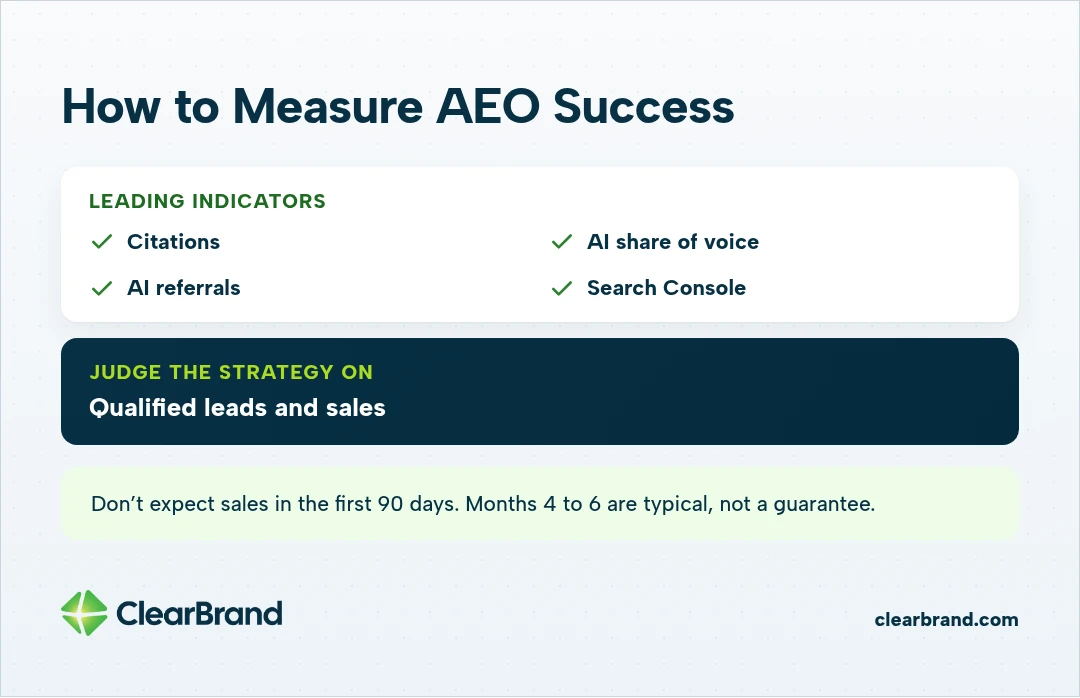
- Measure citations and AI referrals as leading indicators, and judge the strategy on leads and sales.
What should an AEO strategy include?
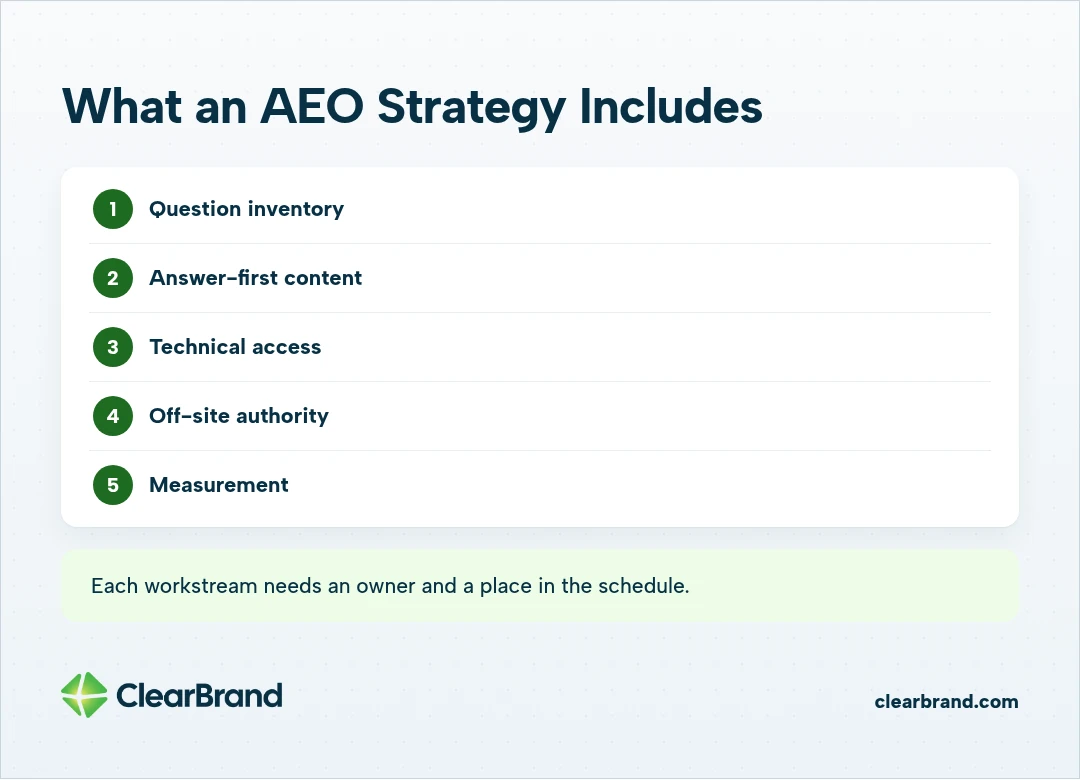
An AEO strategy is a framework with five workstreams: a question inventory, answer-first content on the pages that matter, technical access for search and AI crawlers, off-site mentions that AI tools trust, and measurement tied to pipeline. Each one needs an owner and a place in the schedule.
| Workstream | What it covers | Usual owner |
|---|---|---|
| Question inventory | The prompts and questions buyers ask, grouped by buying stage | SEO or content lead, with sales |
| Answer-first content | New and updated pages that answer each priority question in the first lines | Content team or agency |
| Technical access | Crawlable, fast, server-rendered pages; robots.txt that lets search and AI crawlers in; structured data that matches the page | Developer or site owner |
| Off-site authority | Best-of lists, reviews, digital PR, and accurate profiles | Marketing or PR |
| Measurement | Tracked prompts, citations, AI referrals, leads, and sales | Marketing ops or SEO lead |
AEO, GEO, and LLM SEO describe overlapping work. The differences between SEO, AEO, and GEO are smaller than the labels suggest, and generative engine optimization runs on the same five workstreams.
Things haven’t changed as much as people think. We keep doing what has worked for years in SEO: E-E-A-T, good content, technical SEO, and authority. The bigger change is where the citations come from.
How do you choose the questions and pages to start with?
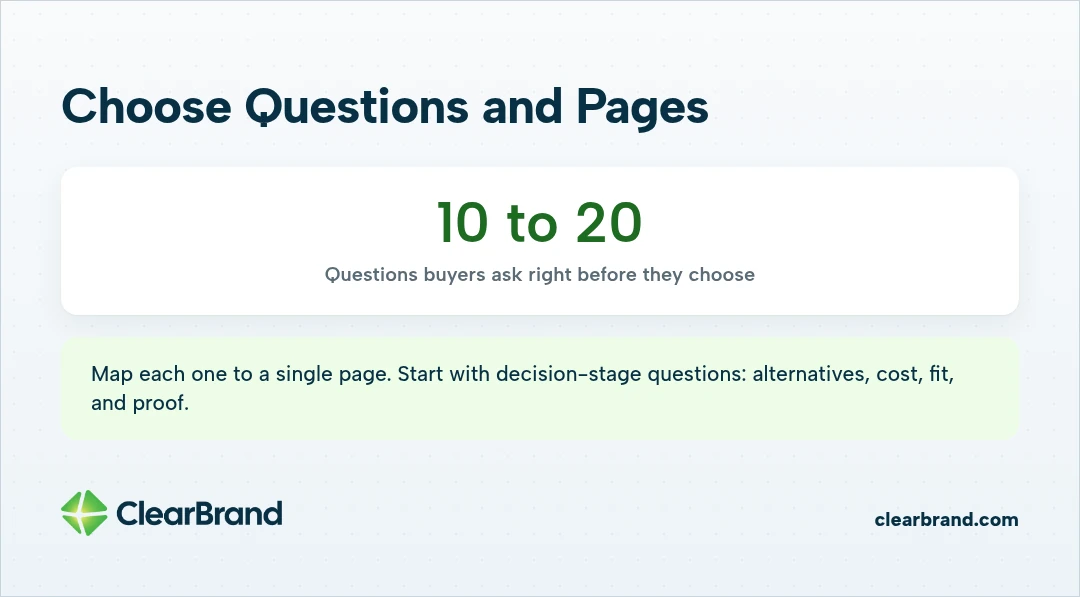
Start with 10 to 20 questions your buyers ask right before they choose, map each one to a single page on your site, and work on those pages first. Starting with a short list keeps the effort on the pages that matter, instead of spreading it across the whole site at once.
Build a question inventory
Pull questions from the places your buyers already talk. Sales and support calls are the most useful, because they’re the actual words people use when they’re close to a decision. Add question queries from Google Search Console, People Also Ask, and the prompts a buyer would type into ChatGPT or Perplexity.
Group those questions by stage: definition, how-to, comparison, cost, fit, and proof. With the stages labeled, you can see at a glance whether you have only definitional questions and almost nothing that sits next to a sale.
The wording changes by industry, even when the stage is the same:
- A SaaS team might track the best software in their category for a specific use case.
- A fintech brand might track a product for nonprofits.
- A health practice might track a treatment near a city, or what it costs.
- A home builder might track how long it takes to build a house in their state.
Prioritize by how close the question sits to a sale
Decision-stage questions come first: alternatives, cost, fit, and proof. Those are the prompts that lead to demos, calls, and consultations. If you only have time for a handful of pages this quarter, start there.
Definitional questions still matter for authority. They help AI tools and Google understand what you do. But AI Overviews now answer many of them without a click, so on their own they tend to drive fewer leads.
Keep them in the inventory, and don’t let them crowd out the questions that actually produce a conversation.
Cover the fan-out with topic clusters
AI search tools can look past the first prompt and run related searches behind the scenes. Google Search Central says AI Overviews and AI Mode may use this query fan-out technique, issuing multiple related searches across subtopics, when they build an answer.
We build topic clusters around each priority question so our clients have a strong page for the follow-up questions too. That helps with Google and with AI at the same time, because the same cluster can earn a Google ranking and get the brand cited in AI Overviews.
A typical 90-day AEO roadmap
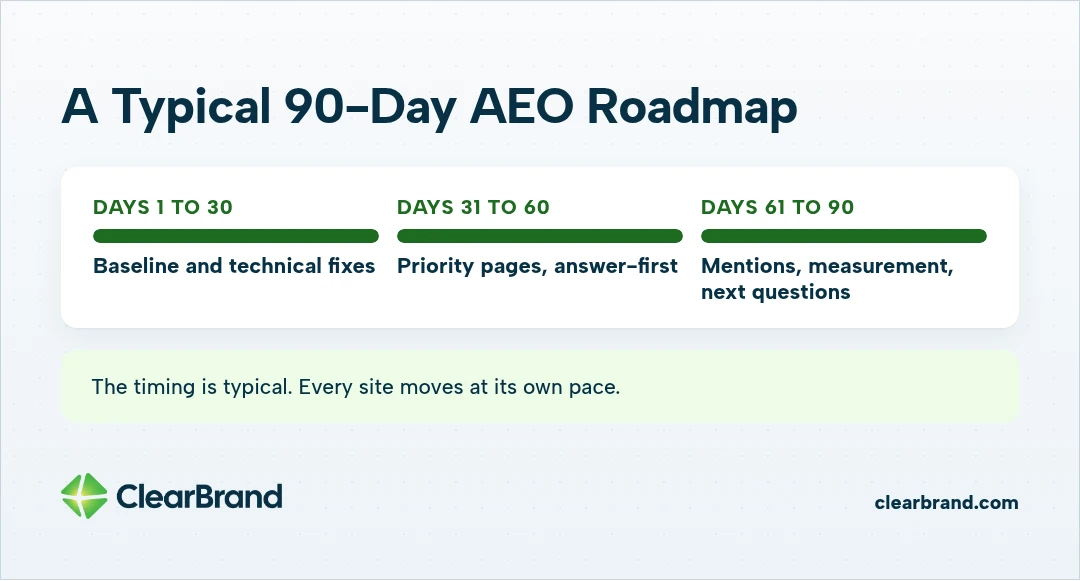
A typical 90-day AEO roadmap spends the first month on a baseline and technical fixes, the second on rewriting and publishing priority pages, and the third on off-site mentions, measurement, and the next round of questions. The timing is typical, and every site moves at its own pace.
| Phase | Focus | What you have at the end |
|---|---|---|
| Days 1 to 30 | Baseline: run the priority prompts in ChatGPT, Perplexity, Gemini, and Google; note who gets cited and how your brand is described. Fix crawl access, indexing, and page speed issues. | A tracked prompt list, a baseline, and a fixed technical foundation |
| Days 31 to 60 | Content: rewrite priority pages answer-first, add FAQs and tables where they help, and publish the missing pages for top questions. | Priority pages live and indexed |
| Days 61 to 90 | Authority and measurement: pursue best-of lists, reviews, and mentions; compare citations against the baseline; pick the next set of questions. | A first read on citations and AI referrals, plus the next 90-day plan |
This is also the shape of a practical 90-day GEO roadmap, because the workstreams overlap.
What to expect in the first 90 days
In the first three months, we look for movement in leading indicators: impressions, traffic, and citations on tracked prompts. We don’t expect sales to rise in that window for most companies. Months 4 to 6 are where we typically see leads and revenue start to show, and even that is not a guarantee.
If traffic arrives but leads don’t, the next step is conversion work. Make it easier for a visitor to book a demo, schedule a call, or sign up. Being cited helps most when the visitor can take that next step without friction.
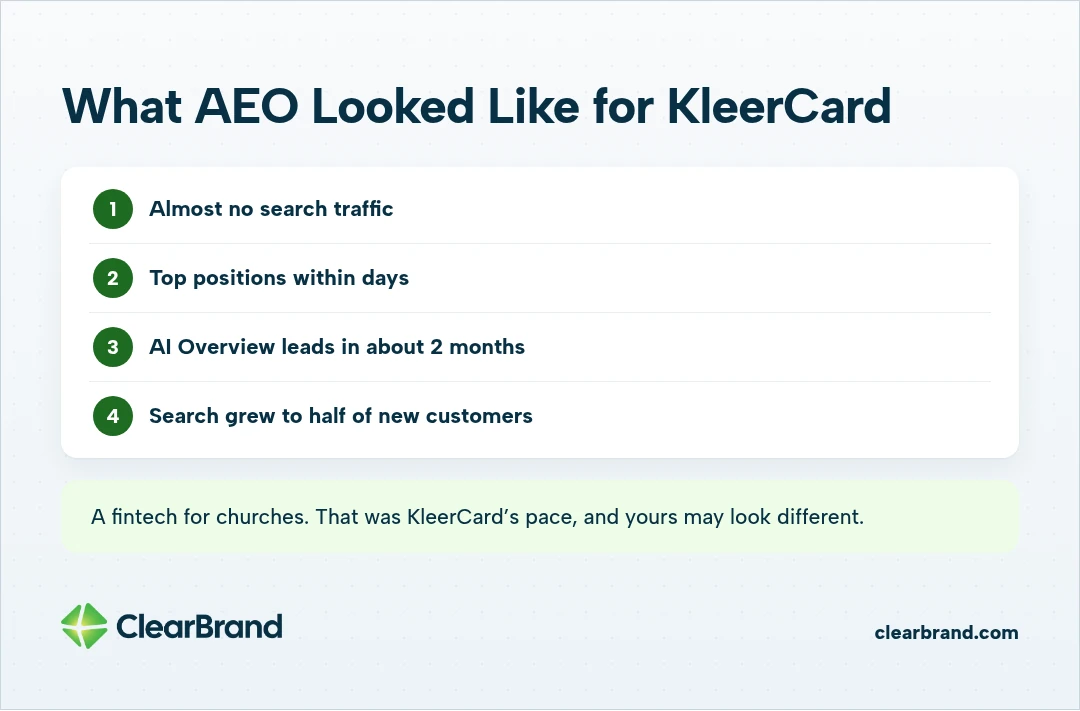
For KleerCard, blogs started landing in top positions within days of the first new article, and leads from AI Overviews started in about 2 months. That was KleerCard’s pace, and yours may look different.
Adjust the order for your business
You can change the order in the table to fit your business. For health practices, we often start with conversion pages, such as services and locations, before we put energy into traffic pages, because traffic that can’t convert doesn’t help the practice. Then blogs build traffic on top of those pages.
A SaaS or fintech team with solid product pages might flip that order a little, and spend more of month two tightening comparison and cost pages. Either way, the pages closest to a decision go first, and the supporting topic pages come after.
How to optimize content for AEO without losing Google traffic
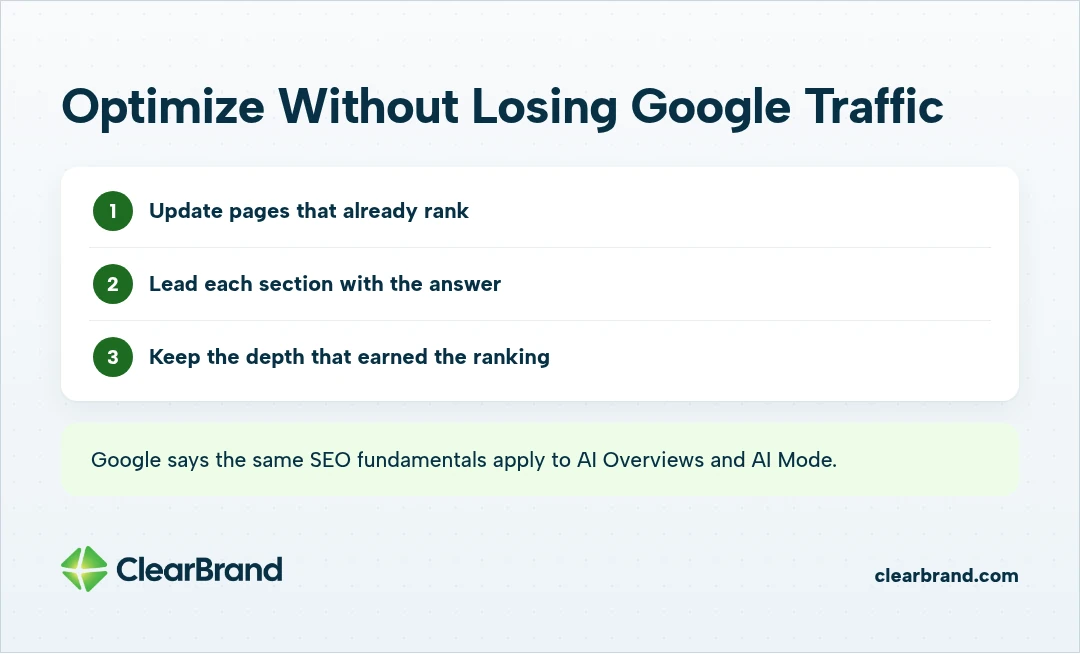
Update the pages that already rank before you write new ones. Lead each section with a one or two sentence answer, use headings that match how buyers ask, and keep the depth that earned the ranking. Google says the same SEO fundamentals apply to AI Overviews and AI Mode.
How to optimize for AEO, on a page that already works, is mostly an editing job. You keep the article and make the answer easier for AI tools to lift and quote, without flattening the proof, examples, and nuance that made the page useful in the first place.
Lead every section with the answer
Open each section with one or two sentences that still make sense when an AI tool lifts them out alone. Then add the detail, examples, and proof. If someone only reads those first lines, they should still walk away with a complete thought.
The heading should sound like the question a buyer would ask. When the heading and the first sentences agree, both people and models have an easier time matching the page to the prompt.
Use formats AI tools can lift
Short lists work well for steps, and tables work well for comparisons. FAQ H3s, which are questions set as small subheadings, handle the follow-up questions people ask after the main answer. Those formats are easier to extract cleanly than a long, winding paragraph that buries the point.
We see best-of lists show up often in AI answers for vendor queries. It’s worth knowing which lists already exist in your category, and whether you belong on them. That is off-site work, but it starts with a clear view of who already gets cited.
Keep it accurate and current
Name real authors, cite primary sources, and refresh the facts that change. In fintech, that means linking rules to the agency that publishes them, not to a summary that can drift. For health practices, a clinician reviews the page before it goes live.
Stale pages lose citations the same way they lose rankings. When a number, a product name, or a policy changes, update the page and the structured data together so they still match.
How AI models pick sources is the focus of LLM SEO.
The technical and off-site work behind AEO
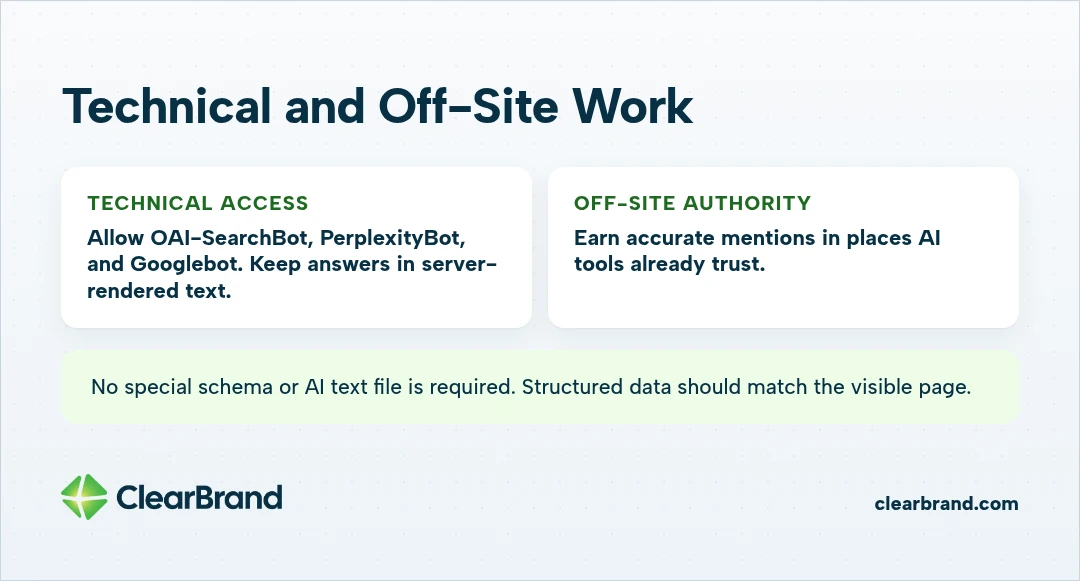
AI tools can only cite pages they can read. The technical side of an AEO strategy makes sure search and AI crawlers can access and understand your site, and the off-site side earns mentions in the places those tools already trust.
Both sides matter. A strong article that crawlers can’t fetch is hard for AI tools to cite. A crawlable site with no mentions outside itself gives those tools less to check it against.
Let search and AI crawlers read your site
Allow OAI-SearchBot if you want to appear in ChatGPT search answers, as OpenAI’s crawler documentation explains. Allow PerplexityBot if you want to appear in Perplexity search results, per Perplexity’s crawler documentation. Googlebot access in robots.txt covers AI Overviews and AI Mode.
Then check that a CDN or firewall isn’t quietly blocking those crawlers. A robots.txt allow rule doesn’t help if the request never reaches the page.
Keep important content in text, rendered on the server, with clean internal links. If the answer only appears after a script runs, some crawlers will miss it.
Google says there’s no special schema, AI text file, or markup required to appear in its AI features. Structured data still helps machines read the page, as long as it matches the visible text. On Webflow, this setup is part of Webflow AEO.
Earn mentions where AI looks
Third-party mentions help build the signals AI tools draw on when they decide who to recommend. They come from industry press, review sites, professional profiles, and community threads, along with best-of lists and digital PR. What matters most is that they’re accurate and appear in places AI models already treat as reliable.
Keep your About, product, and proof pages the clearest source on what you do. When AI describes you, you want that description to match the business, not a leftover tagline from an old directory listing.
How to measure whether your AEO strategy is working
Track your brand’s presence, often called AI share of voice, and its citations on a fixed set of prompts, plus AI referral traffic and Search Console performance. Treat those as leading indicators, the early signs worth watching, then judge the strategy on qualified leads and sales.
ChatGPT has no Search Console, so we use a prompt-tracking tool that runs our tracked prompts across AI platforms on a regular schedule and records what shows up. That gives us a repeatable read on presence and citations, instead of a one-off paste into a chat window.
Clicks and impressions from Google AI Overviews and AI Mode are counted inside Search Console’s Performance report under the Web search type, as Google Search Central describes. In GA4, watch AI referral traffic from sources such as chatgpt.com and perplexity.ai.
Then look at leads and sales: demos, signups, calls, and consultations, tied back to source where you can. The leading indicators show that the work is landing, and leads and sales show whether it’s paying off.
And ask buyers how they found you. Dunn & Stone, a home builder we work with, has closed deals that started in AI answers. They ask every consultation how they found them, and mentions of ChatGPT, Claude, and Gemini are rising.
SaaS teams that want more detail can track a longer list of AI visibility metrics.
What an AEO strategy looked like for KleerCard
KleerCard, a fintech company that provides credit cards with built-in expense management for churches, went from almost no search traffic to half of its new customers coming from search, with leads from AI Overviews starting in about 2 months.
When they came to us, the blogs weren’t ranking. Organic traffic was nearly nonexistent, and KleerCard showed up mainly for branded searches. Large competitors such as Bankrate, Divvy, and Ramp dominated the first page of Google, and KleerCard needed a way to reach churches.
The work was an SEO strategy built to get KleerCard discovered in search results and AI Overviews. We targeted high-intent keywords for those decision-makers, found gaps in competitor content, wrote pages built to be the most useful resource on each topic, and tightened on-page SEO.
Within days of publishing the first new article, KleerCard’s blogs started landing in the top positions for high-intent searches related to credit cards for churches and nonprofits. Soon after, they received their first qualified lead from an AI search recommendation.
Leads from AI Overviews started in about 2 months. Search grew to half of all new customers, and KleerCard now outranks multiple billion-dollar competitors.
AEO checklist
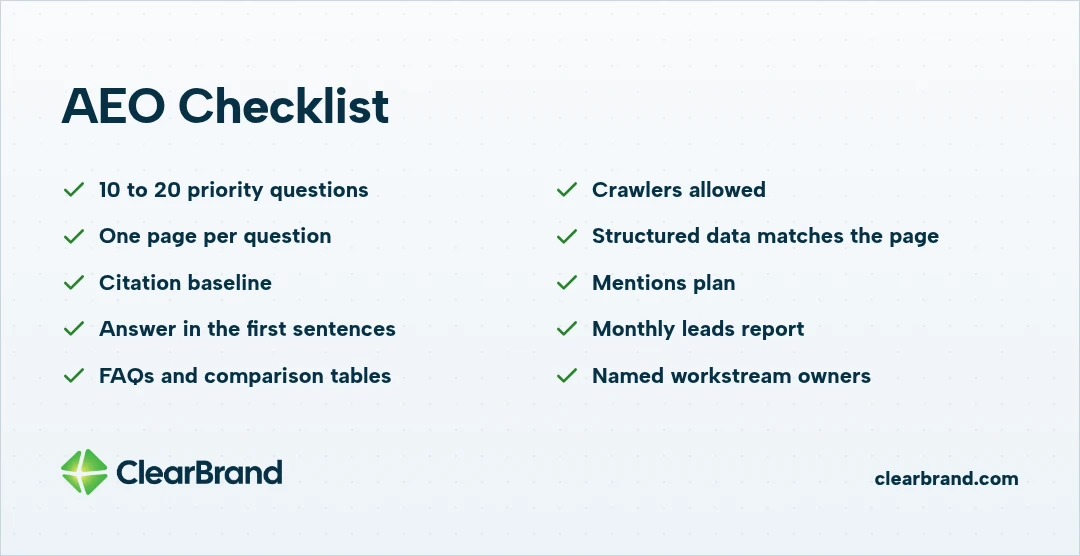
Use this checklist to confirm each part of the plan is in place before you scale it. If a line is missing, that’s usually the next piece of work, not a reason to start over.
- A list of 10 to 20 priority questions, grouped by buying stage
- One page assigned to each question
- A baseline of who AI tools cite for those questions today
- An answer in the first one or two sentences of each priority section
- FAQs as H3s and tables where buyers compare options
- OAI-SearchBot, PerplexityBot, and Googlebot allowed in robots.txt and at the CDN
- Structured data that matches the visible page
- A plan for best-of lists, reviews, and mentions
- Tracked prompts, AI referrals, and leads reported monthly
- A named owner for each workstream
Should you run AEO in-house or get help?
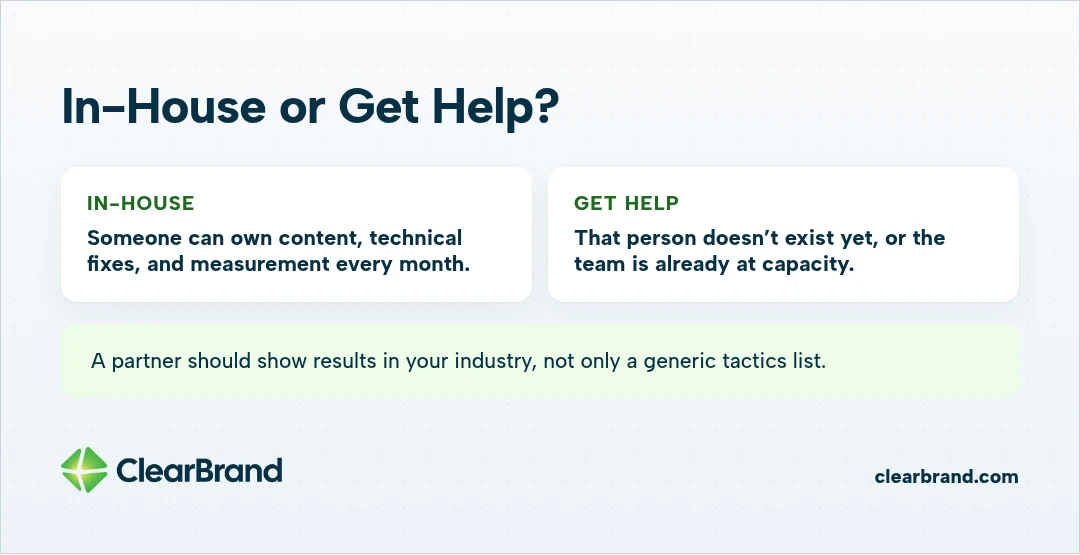
Run AEO in-house if you have someone who can own content, technical fixes, and measurement every month. Get help when that person doesn’t exist yet, or when AI search needs to produce leads soon and the current team is already at capacity.
In-house works when one person owns the plan and has a developer and subject experts to call on. The workstreams above do best with a standing place on the calendar, rather than whatever hours are left over.
Get help when the team is stretched, the site has technical debt, or nobody has time to track prompts and earn mentions. A partner should be able to show results in your industry, not only a generic tactics list.
We work with SaaS, fintech, health practice, and home builder brands, and we do GEO and AEO on top of SEO.
Frequently asked questions
How long does an AEO strategy take to show results?
Leading indicators such as impressions, traffic, and citations often move within the first three months, with leads and sales following later, typically around months 4 to 6. There’s no guaranteed timeline, and every site moves at its own pace. For KleerCard, leads from AI Overviews started in about 2 months.
Who should own AEO inside a company?
The SEO or content lead usually owns the plan, with help from a developer for technical access, sales for real buyer questions, and PR or marketing for mentions. One named owner keeps the five workstreams from drifting into whoever has a free afternoon.
What are AEO best practices?
AEO best practices are answer-first sections, question-based headings, crawlable server-rendered pages, structured data that matches the page, accurate off-site mentions, and tracking citations alongside leads. How to optimize content for AEO follows the same list: lead with the answer, keep the page current, and measure more than rankings.
Do we need special schema or an AI text file for AEO?
Google says you don’t need new machine-readable files, AI text files, or special schema to appear in AI Overviews or AI Mode. Structured data that matches your visible content still helps machines read the page, and it is worth doing for that reason.
Will AEO reduce our website traffic?
AEO adds to SEO rather than replacing it. Some definitional searches now get answered without a click, which is why we put decision-stage pages first and measure leads, not only traffic. Pew Research Center found that Google users clicked a traditional result less often when an AI summary appeared, so the citation itself has to work harder.
Is an AEO strategy different from an SEO strategy?
An AEO strategy builds on an SEO strategy and adds goals for being cited inside AI answers. The foundations are shared: helpful content, technical health, and authority.
Get a 90-day plan for your site
If you’d like a second set of eyes on your AEO strategy, we’d love to help. Your free SEO audit is a full review of your site and an initial 90-day strategy, and you keep it whether you work with us or not. Send us a note, and we’ll reply within two business days.