

YMYL SEO is the work of proving to Google and AI engines that pages about money, health, or safety are accurate, reviewed, and accountable. For fintech, that means named authors, a compliance review step, required disclosures, and claims sourced to primary regulators.
A fintech page can be well written, fast, and keyword-perfect and still sit on page 3. When the topic is someone’s money, Google looks for signs that the page is accurate and that someone accountable checked it.
I’ve found fintech is easier than healthcare on this front. It mostly comes down to the accuracy of your claims and sourcing them to the primary authority. When we explain an IRS rule, for example, we link to the IRS.
If you want the full fintech SEO strategy, start with our guide to fintech SEO.
What is YMYL SEO for fintech?
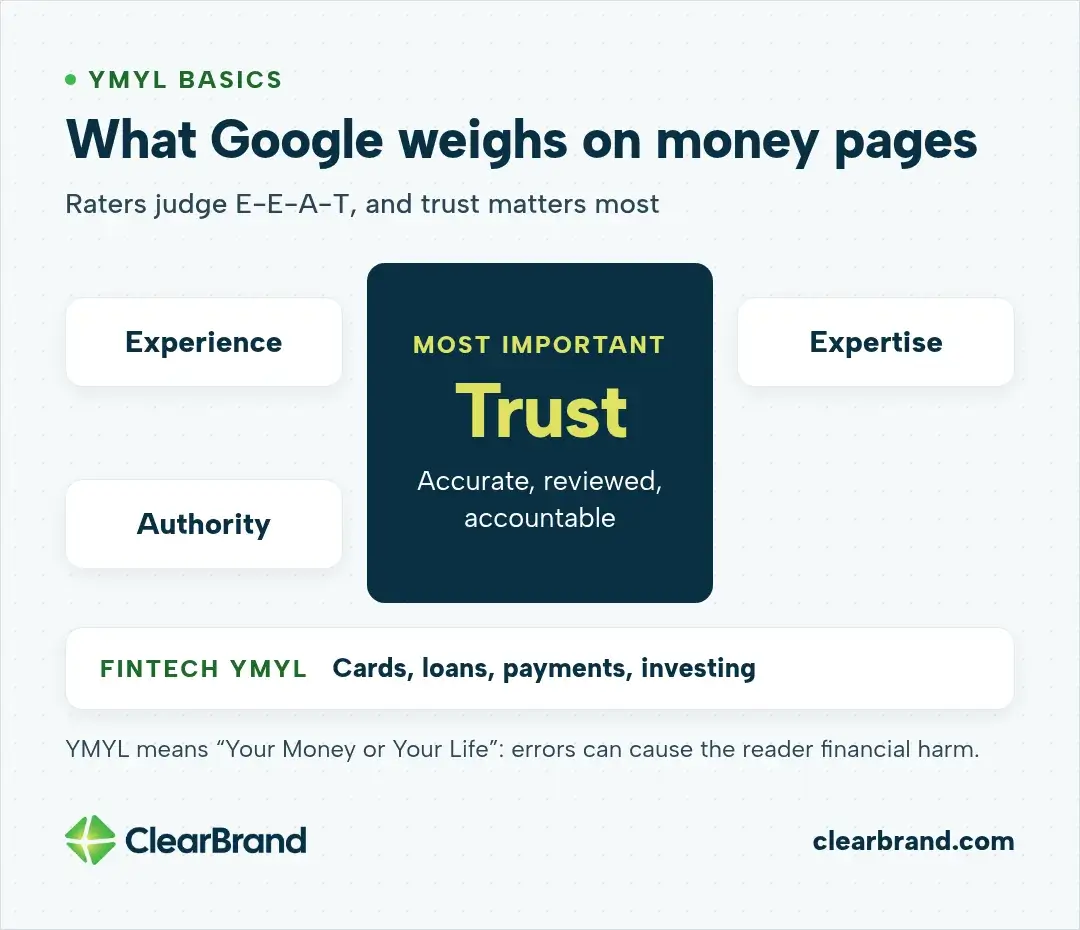
YMYL SEO for fintech applies that standard to pages about cards, loans, payments, and investing, where an error can cause the reader financial harm.
YMYL stands for “Your Money or Your Life.” Google uses it for topics that could significantly affect a person’s health, financial stability, or safety, as its guide to creating helpful, reliable, people-first content explains. The Search Quality Rater Guidelines go into more detail.
Raters judge those pages on E-E-A-T: experience, expertise, authoritativeness, and trust. Google’s rater guidelines call trust the most important of the four.
In my experience, AI Overviews, ChatGPT, and Perplexity tend to favor similar signals when they pick sources to cite.
Which fintech pages count as YMYL?
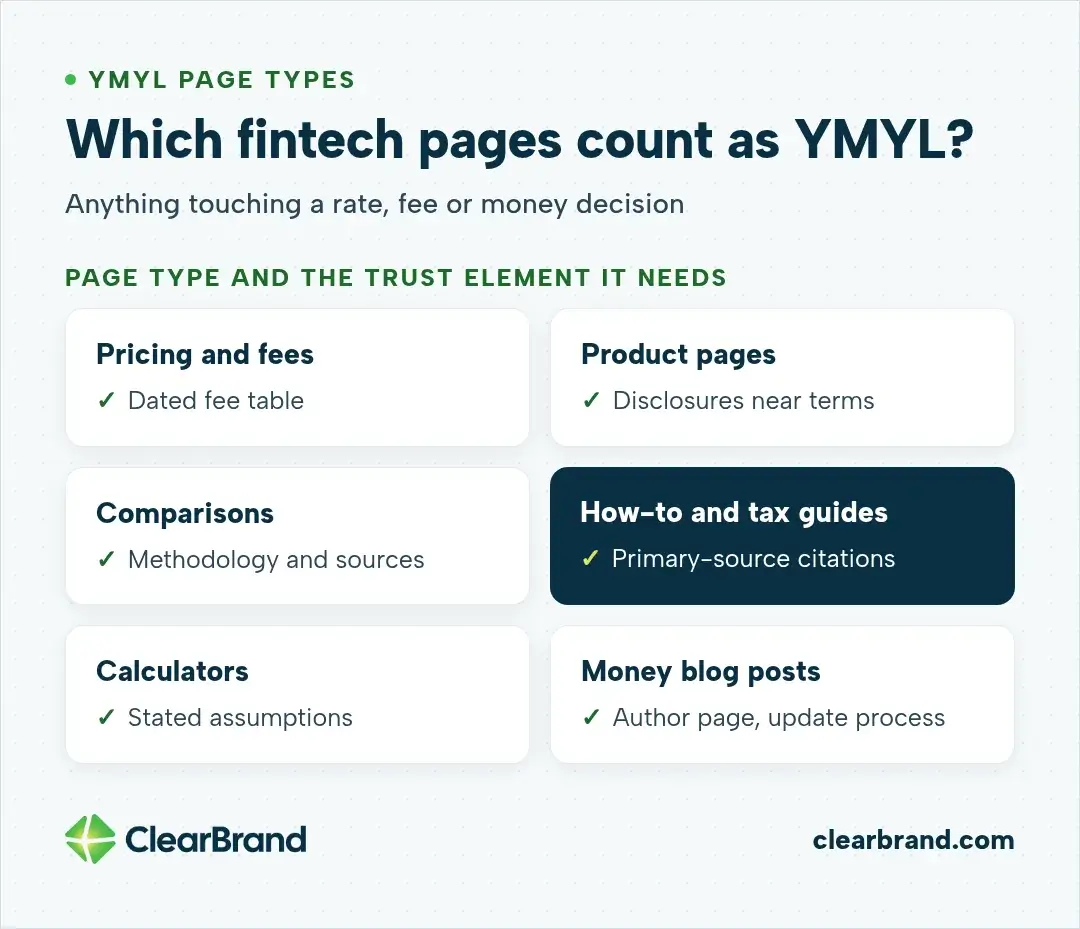
On a fintech site, most pages that touch a rate, a fee, or a decision about money are worth treating as YMYL.
| Page type | What can go wrong for the reader | Trust element it needs |
|---|---|---|
| Pricing and fees pages | Hidden or outdated fees | Dated fee table, disclosures next to the claim |
| Product pages (cards, loans, accounts) | Misstated APR, rewards, or terms | Disclosures near terms, issuing-bank language where it applies |
| Comparison pages | Unfair or unsubstantiated “best” claims | Methodology, sources, review date |
| How-to and tax guides | Wrong rule, wrong deadline | Primary-source citations, named author, re-review schedule |
| Calculators | Hidden assumptions | Stated inputs and assumptions |
| Blog posts on money topics | Stale numbers | Author page, sources, update process |
Google’s YMYL bar vs. what regulators expect
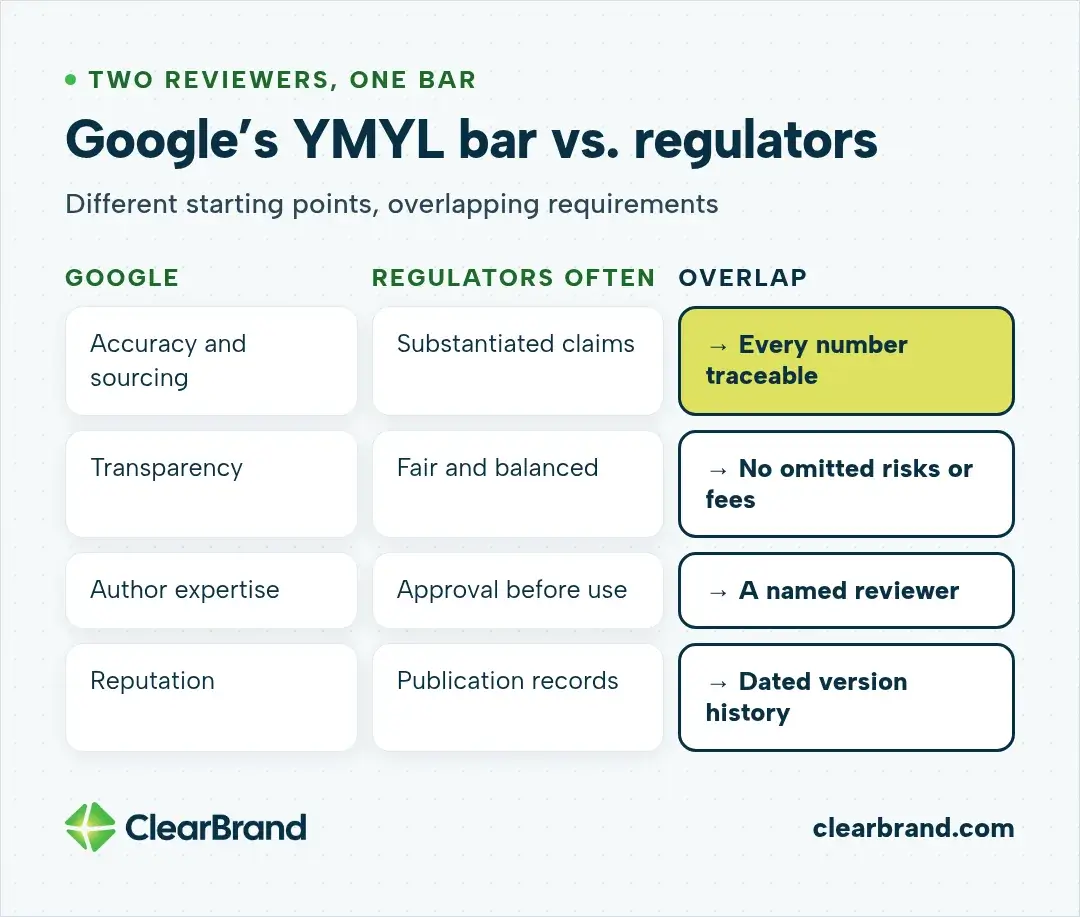
Google and financial regulators ask for many of the same things, even though they come at it from different directions.
| Google evaluates | Regulators often require | Where they overlap |
|---|---|---|
| Accuracy and sourcing | Claims that can be substantiated | Every number traceable to a source |
| Trust and transparency about who is behind the page | Fair and balanced communications | No omitted risks or fees |
| Expertise of the author | Review and approval before use (for some firms) | A named reviewer who signs off |
| Reputation | Records of what was published | A dated version history |
FINRA Rule 2210 (broker-dealers)
FINRA Rule 2210 applies to FINRA member firms, which are broker-dealers. It requires member communications to be fair and balanced and bars false, exaggerated, unwarranted, promissory, or misleading statements. It also requires an appropriately qualified registered principal to approve each retail communication before it is used or filed with FINRA.
The SEC Marketing Rule (investment advisers)
The SEC’s marketing rule, 17 CFR 275.206(4)-1, applies to registered investment advisers. It prohibits untrue statements of material fact and material statements an adviser doesn’t have a reasonable basis to believe it can substantiate on demand by the SEC. It also calls for fair and balanced treatment of material risks when an ad discusses potential benefits, and it sets conditions on testimonials and endorsements. The SEC’s final rule page has the full release.
CFPB rules for consumer credit and deposits
Regulation Z has an advertising section, 12 CFR 1026.16, that covers how credit terms appear in ads. In general terms, an ad that states specific credit terms may state only terms that actually are or will be offered, and mentioning certain terms can trigger more disclosures alongside them.
Regulation DD, 12 CFR 1030.8, covers deposit account advertising by depository institutions. It bars misleading ads and describing an account as “free” or “no cost” if any maintenance or activity fee may be imposed.
The Dodd-Frank Act also makes unfair, deceptive, or abusive acts or practices, known as UDAAP, unlawful for covered persons and service providers, and the CFPB examines for them. Its UDAAP examination procedures show what examiners look for.
This is general information, not legal advice. Which rules apply depends on your licenses, products, and partners, so work through these points with your compliance team or legal counsel.
A compliance review workflow for fintech content
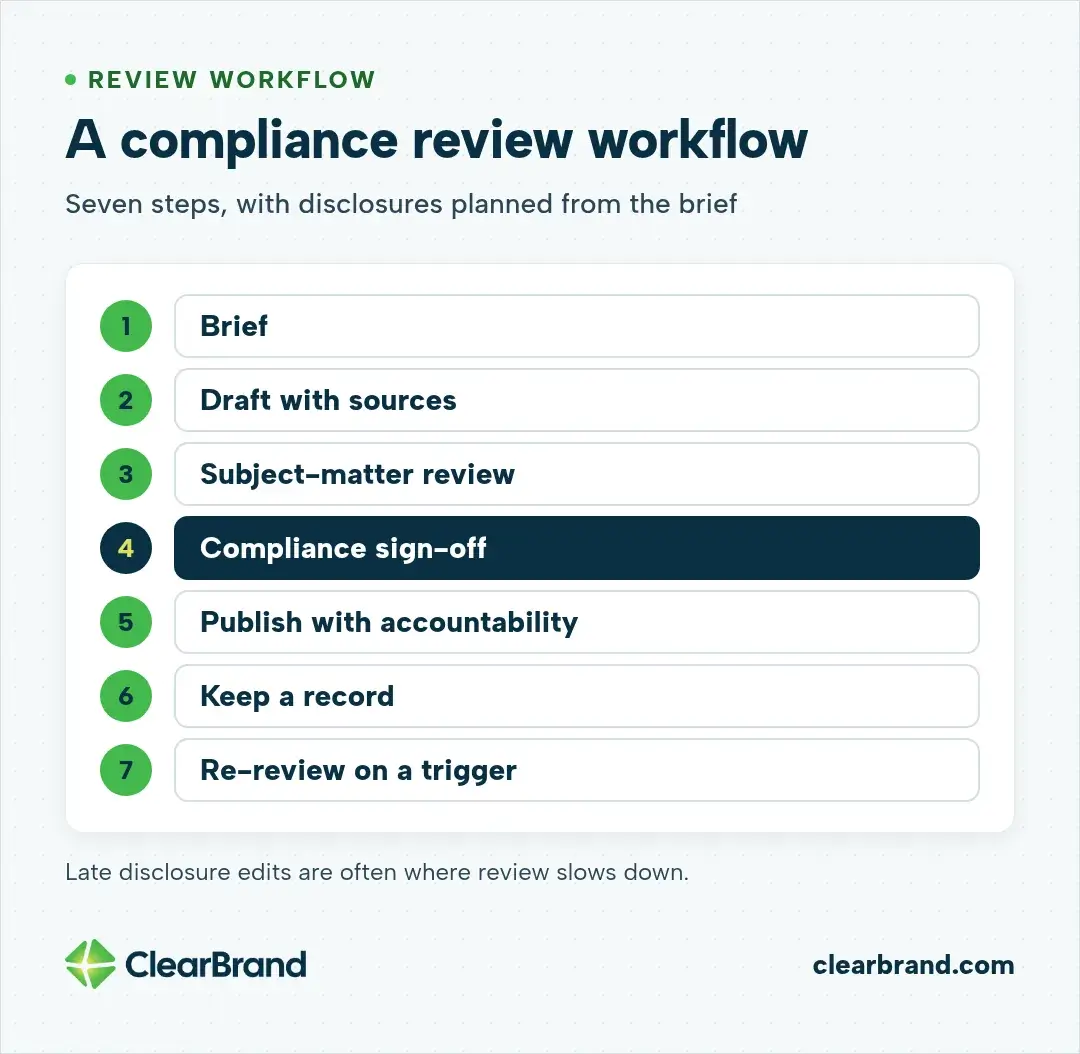
Fintech publishers that handle this well tend to follow a similar sequence:
- Brief. List every claim, number, and required disclosure before anyone drafts, and name who approves claims.
- Draft with sources. Link each number to its primary source: the IRS, CFPB, SEC, FINRA, FDIC, or your own terms.
- Subject-matter review. Someone who knows the product checks accuracy.
- Compliance or legal sign-off. The person your firm designates approves the final copy.
- Publish with accountability. Show a named author, the reviewer on the page and in Person schema, and a visible date.
- Keep a record. Save the approved version and the approval date.
- Re-review on a trigger. Rate changes, fee changes, rule changes, or a set calendar interval.
Put disclosures in the brief instead of bolting them on at the end. Late disclosure edits are often where review slows down.
A disclosure and claims checklist
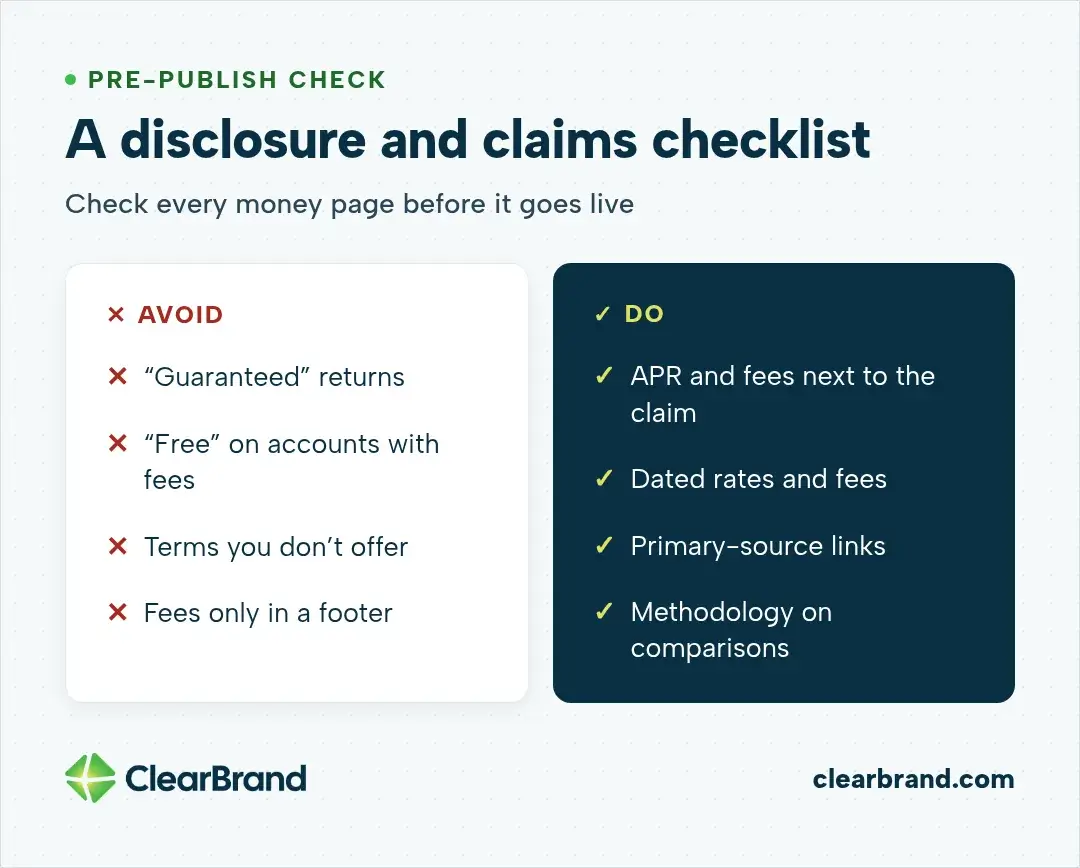
Before a money page goes live, check it against this list:
- No “guaranteed” returns or promissory language.
- APR, fees, and key terms sit next to the claim, not only in a footer.
- Terms stated are ones you actually offer.
- Issuing-bank or “not a bank” language appears where your product depends on a partner bank.
- No “free” on accounts that can carry fees.
- Rates and fees carry a date.
- Numbers link to a primary source.
- Comparison claims include a methodology.
- Testimonials and reviews are cleared with compliance before use.
What fintech author and reviewer pages need
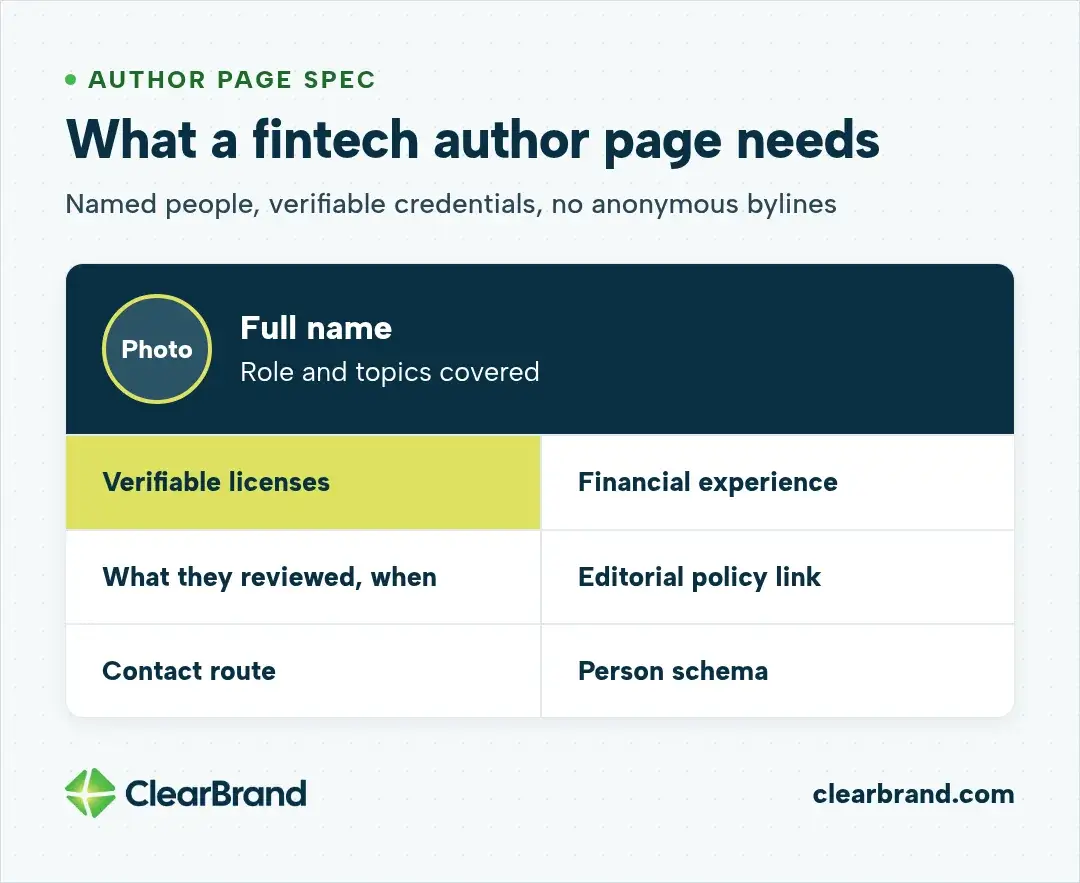
It helps for each author or reviewer on a money page to have a profile that covers:
- Full name and photo
- Role and the topics they cover
- Relevant licenses, registrations, or certifications, with a way to verify them
- Years and type of financial experience
- What they reviewed and when
- A link to the editorial policy and corrections process
- A contact route
- Person schema linked to the Organization
I’d avoid anonymous “editorial team” bylines on money pages. A reader, a rater, and an AI engine all want to know who stands behind the numbers.
The editorial policy page
A good editorial policy explains how you source claims, who reviews them, how often pages are re-checked, and how readers can report errors.
Sourcing that holds up in Google and AI answers
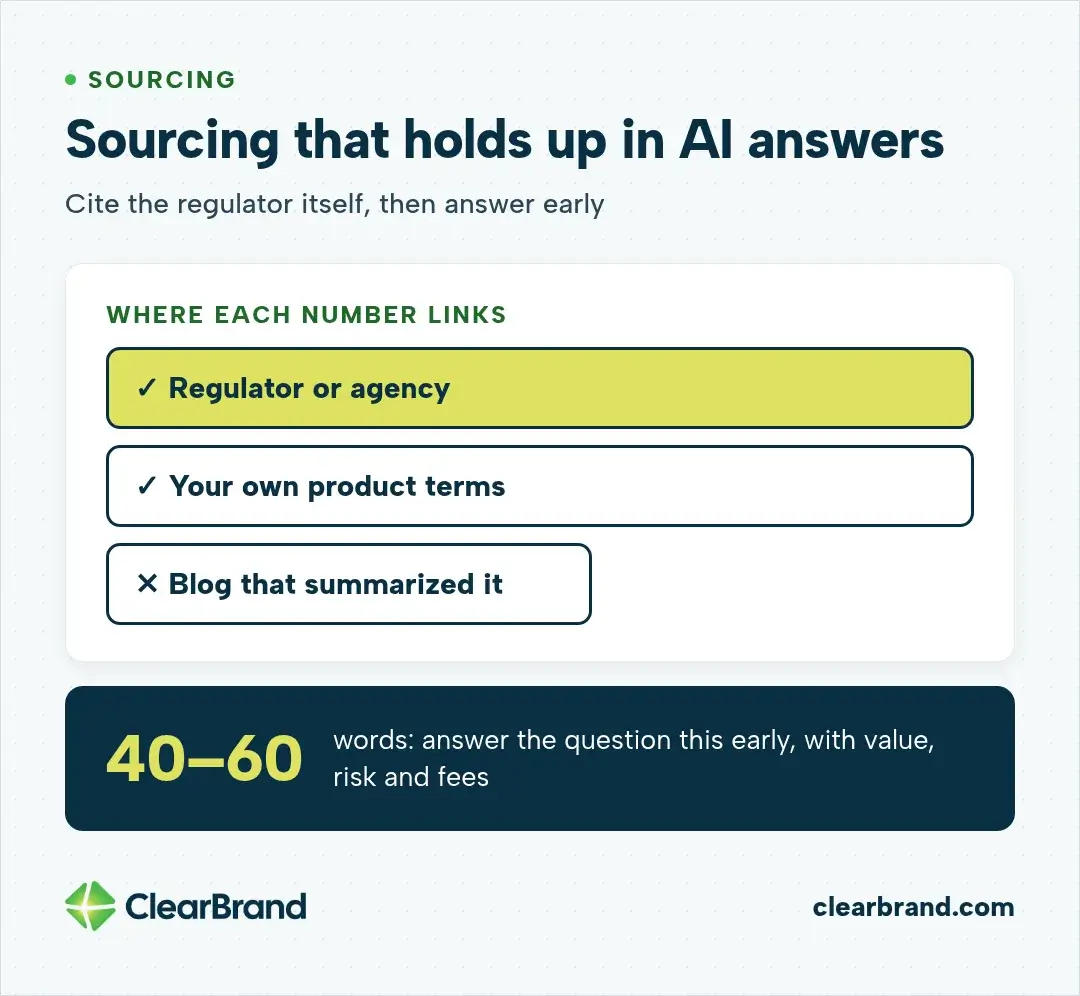
Where you can, cite the regulator or agency itself, not a blog that summarized it.
Try to answer the question in the first 40 to 60 words, and state value, risk, and fees in plain terms.
In my experience, AI search rests on the same foundations as Google: E-E-A-T, good content, technical health, and authority. Most fintech teams don’t need a separate playbook for AI answers, just the YMYL basics done well.
What this looked like for KleerCard
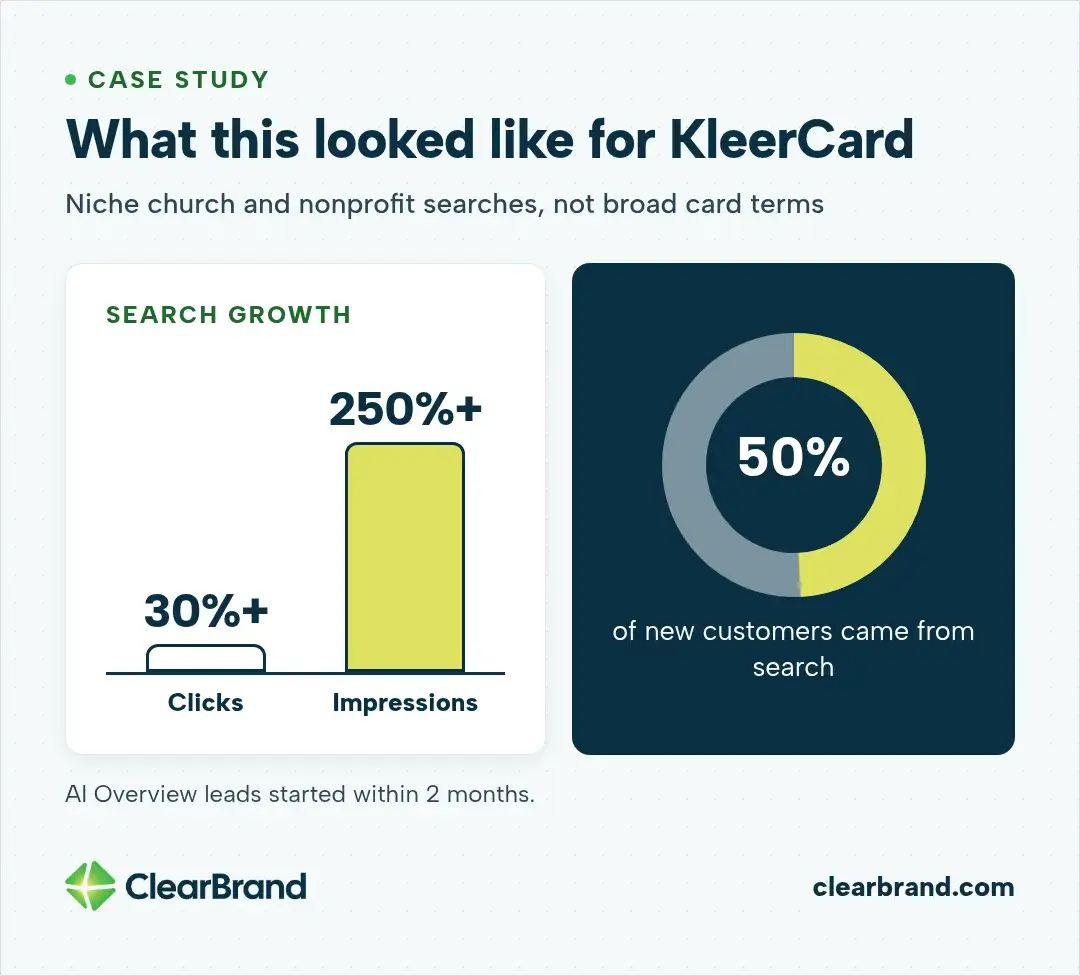
KleerCard provides credit cards with built-in expense management for churches. In fintech, big, VC-funded competitors like Bankrate, Divvy, and Ramp dominate the first page of Google for broad small-business card terms. Instead of fighting them there, we focused on a smaller audience: the searches churches, nonprofits, and educators make.
Within days of publishing the first new article, KleerCard’s blogs started landing in top positions for high-intent searches related to credit cards for churches and nonprofits. Our SEO work increased clicks on KleerCard’s website by more than 30% and impressions by more than 250%, and started bringing in leads from AI Overviews in just 2 months.
KleerCard went from almost zero search traffic to search bringing in 50% of all new customers, and the case study reports a 24:1 LTV:CAC. You can read the KleerCard case study for the full story.
Frequently asked questions
What does YMYL mean in SEO?
YMYL means “Your Money or Your Life,” Google’s term for topics that can affect a person’s finances, health, or safety.
Is fintech content YMYL?
Most fintech content is YMYL. Pages on rates, fees, credit, payments, or investing generally qualify, because errors can cause financial harm.
Is E-E-A-T a ranking factor for YMYL pages?
E-E-A-T is a framework Google’s raters use, not a single ranking factor. Google’s guidelines say trust matters most, especially for YMYL topics.
Do fintech blog posts need a compliance review?
Many fintech blog posts need a compliance review, depending on the firm’s licenses and products. FINRA member firms, for example, need a registered principal to approve retail communications before use. Your compliance team or counsel can tell you what applies to you.
What should a fintech author page include?
A fintech author page should include the author’s name, role, relevant credentials, financial experience, a link to the editorial policy, and a contact route.
Bringing it together
Classify your YMYL pages, run every claim through review, put disclosures next to claims, and show who wrote and checked each page. That combination helps earn trust from readers, raters, and AI engines alike.
If you’d like a second set of eyes on your money pages, we can look at where your site stands and what to fix first. Here’s more on how we approach fintech SEO.