
Fintech Content Marketing That Survives Compliance
A fintech content marketing system for teams that publish every week: what to write, how to use your experts, and how to clear compliance on time.
Originally published: November 10, 2026 Last updated: November 10, 2026
Fintech content marketing is publishing articles, guides, comparisons, and tools that teach buyers about your financial product until they trust you enough to sign up. In fintech, almost every post carries a claim someone has to approve, so the publishing schedule is usually the first thing to break.
This guide is the weekly system we use to keep fintech content shipping with compliance in the loop: what to publish, how to sort it by review risk, how a claims library speeds approvals, and how to measure the work in customers.
What fintech content marketing is, and why it’s harder
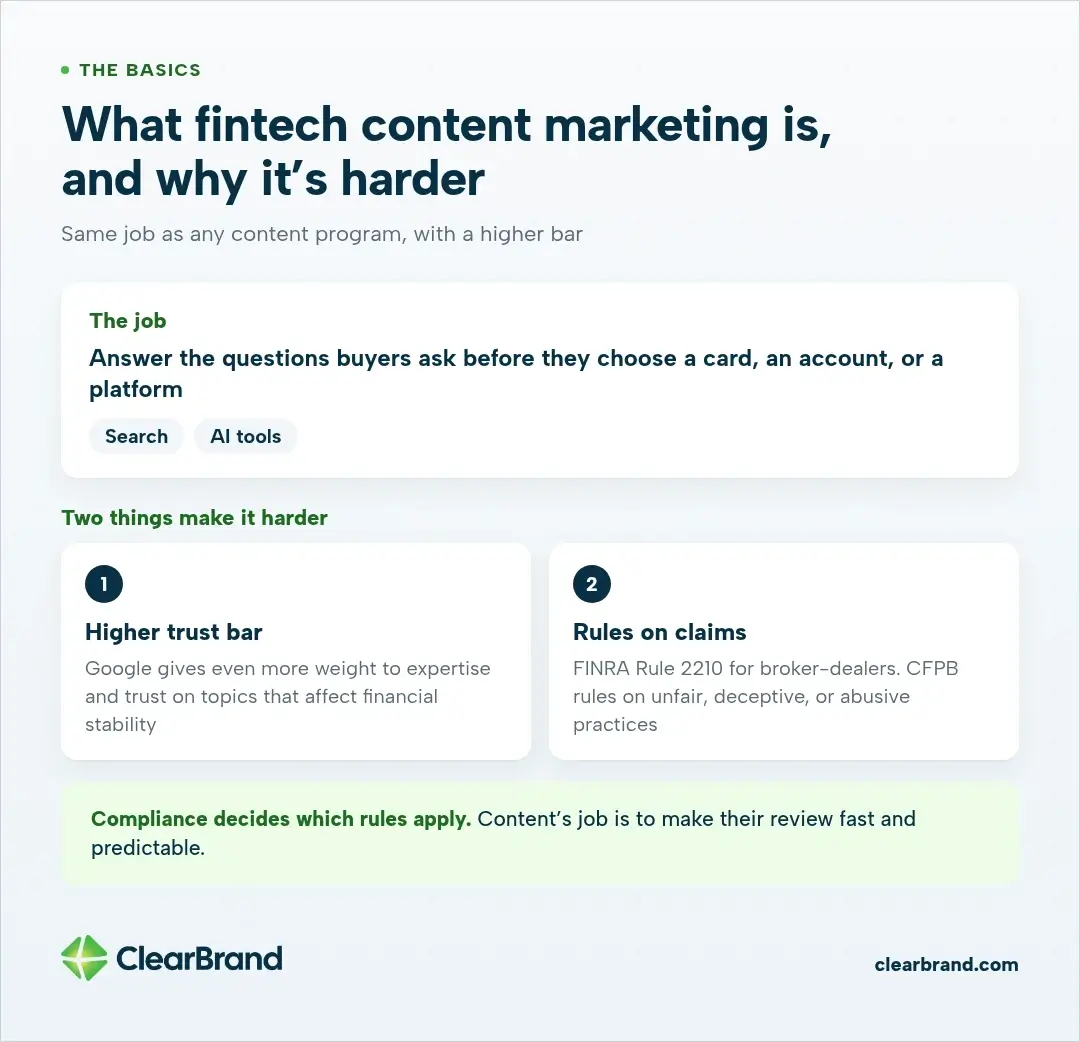
Fintech content does the same job as any B2B or consumer content program, and it’s one part of a wider fintech marketing plan. It answers the questions buyers ask before they choose a card, an account, or a platform, and it shows up when they search or ask an AI tool.
Two things make it harder. First, Google says its systems give even more weight to strong experience, expertise, authoritativeness, and trust on topics that could affect someone’s financial stability (Google Search Central). We cover that side, including author pages and sourcing, in our guide to YMYL SEO for fintech. Second, your claims may fall under financial marketing rules. Broker-dealers, for example, need a registered principal to approve each retail communication before it’s used under FINRA Rule 2210. Consumer financial products sit under the CFPB’s rules on unfair, deceptive, or abusive acts or practices.
Which rules apply depends on your license and your products. Your compliance team decides that. Your content program’s job is to make their review fast and predictable.
Build a fintech content marketing strategy in 4 steps
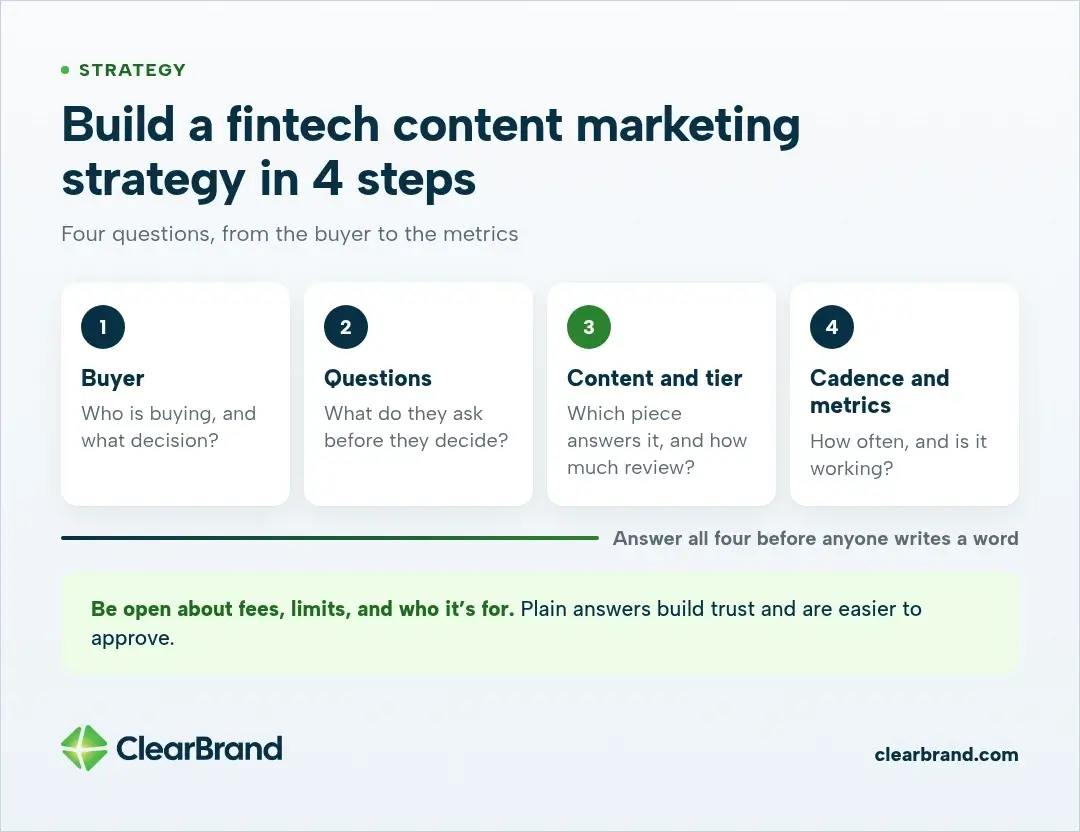
A fintech content marketing strategy answers four questions before anyone writes a word:
- Who is the buyer, and what decision are they making? A finance director choosing a spend tool reads differently from a consumer opening a savings account.
- What do they ask before they decide? Pull questions from sales calls, support tickets, and onboarding. Then check how Google and AI tools answer them today.
- Which content answers each question, and how much review will it need? Map each question to a content type and a review tier.
- How often will you publish, and how will you know it’s working? Set a cadence your reviewers can support and pick the metrics that tie to customers.
Be open about fees, limits, and who your product is for. Plain answers to the questions buyers worry about build trust, and they’re easier to approve.
What to publish: the content that wins fintech customers
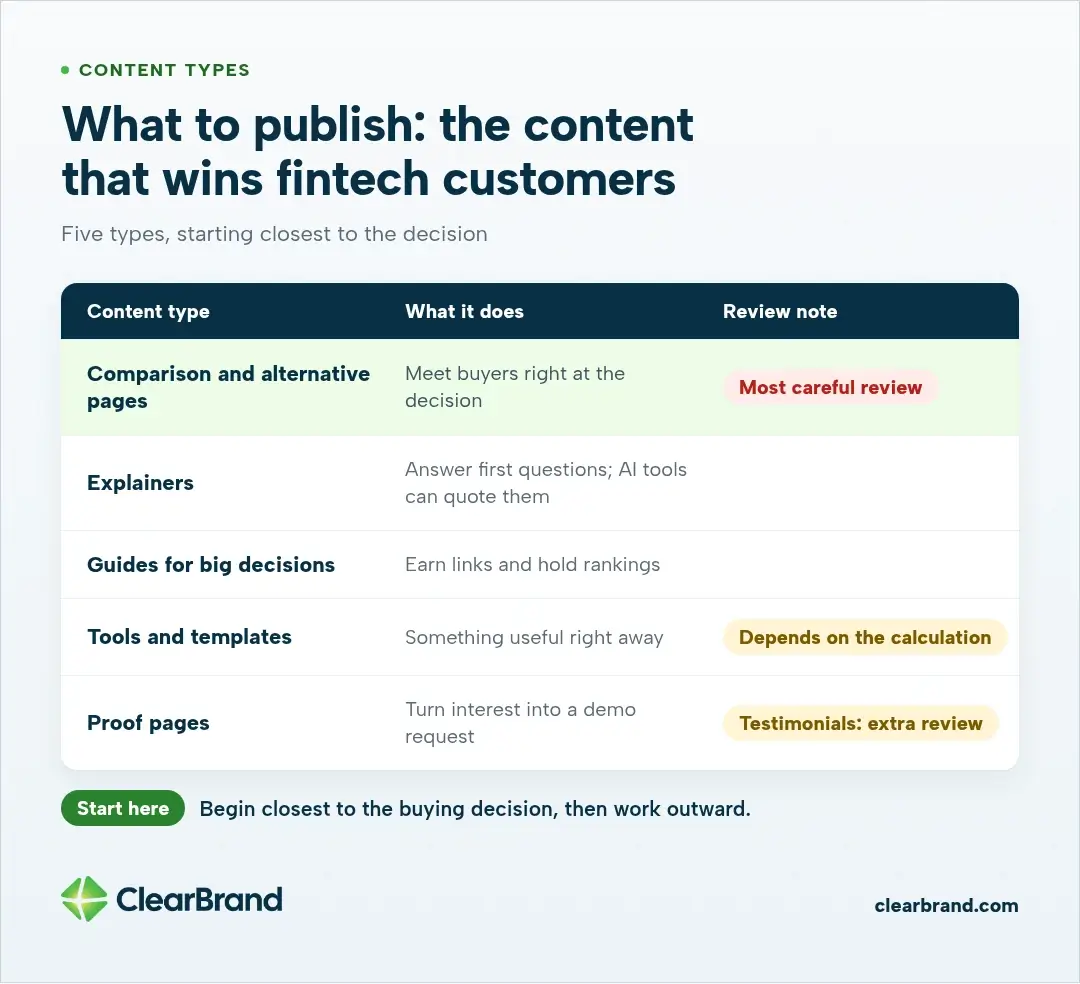
Start with the content closest to a buying decision, then work outward.
Comparison and alternative pages
Buyers compare before they switch. Pages like “your product vs a competitor” or “alternatives to a competitor” meet them right at the decision. These pages also carry the most claims about pricing and features, so they need the most careful review.
Explainers for the questions buyers ask first
How does a corporate card limit work? What’s the difference between a debit card and a charge card? Clear answers to first questions build trust early, and they give AI tools a clean answer to quote.
Guides for high-stakes decisions
Choosing a lender, moving payroll, or picking a spend management tool takes research. A thorough guide with sources can earn links and hold rankings over time. Our fintech SEO guide covers how those pages rank in Google and AI search.
Tools and templates
Calculators, budget templates, and checklists give a reader something useful right away. Review depends on what they calculate. A budget template usually needs less review than a rate or savings calculator.
Proof pages
Case studies and customer stories turn interest into a demo request. Testimonials often need extra review, so plan them early.
Sort every piece by review risk before you write
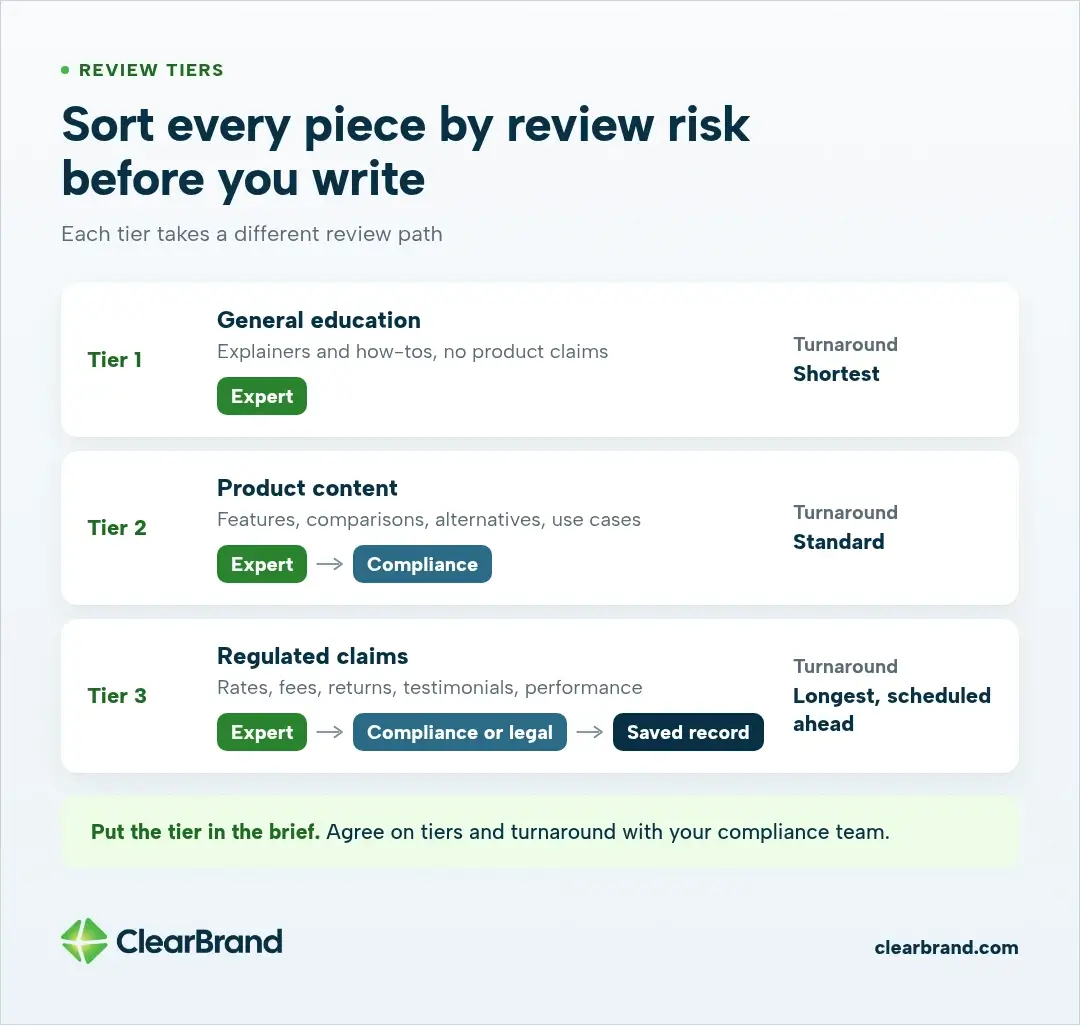
Review slows down when every post takes the same path. A short explainer on how ACH works doesn’t need the same path as a page about rates. Sort each piece into a tier when you plan it, and agree on the tiers with your compliance team.
| Tier | What it includes | Who reviews | Turnaround to agree with compliance |
|---|---|---|---|
| 1. General education | Explainers and how-tos with no product claims | Subject-matter expert | Shortest |
| 2. Product content | Features, comparisons, alternatives, use cases | Expert, then compliance | Standard |
| 3. Regulated claims | Rates, fees, returns, testimonials, performance, anything promotional | Expert, then full compliance or legal sign-off, with a saved record | Longest, scheduled in advance |
Put the tier in the brief. Then nobody’s surprised on Thursday when a Tier 3 page isn’t ready to go live.
Build a claims library so review gets faster every week
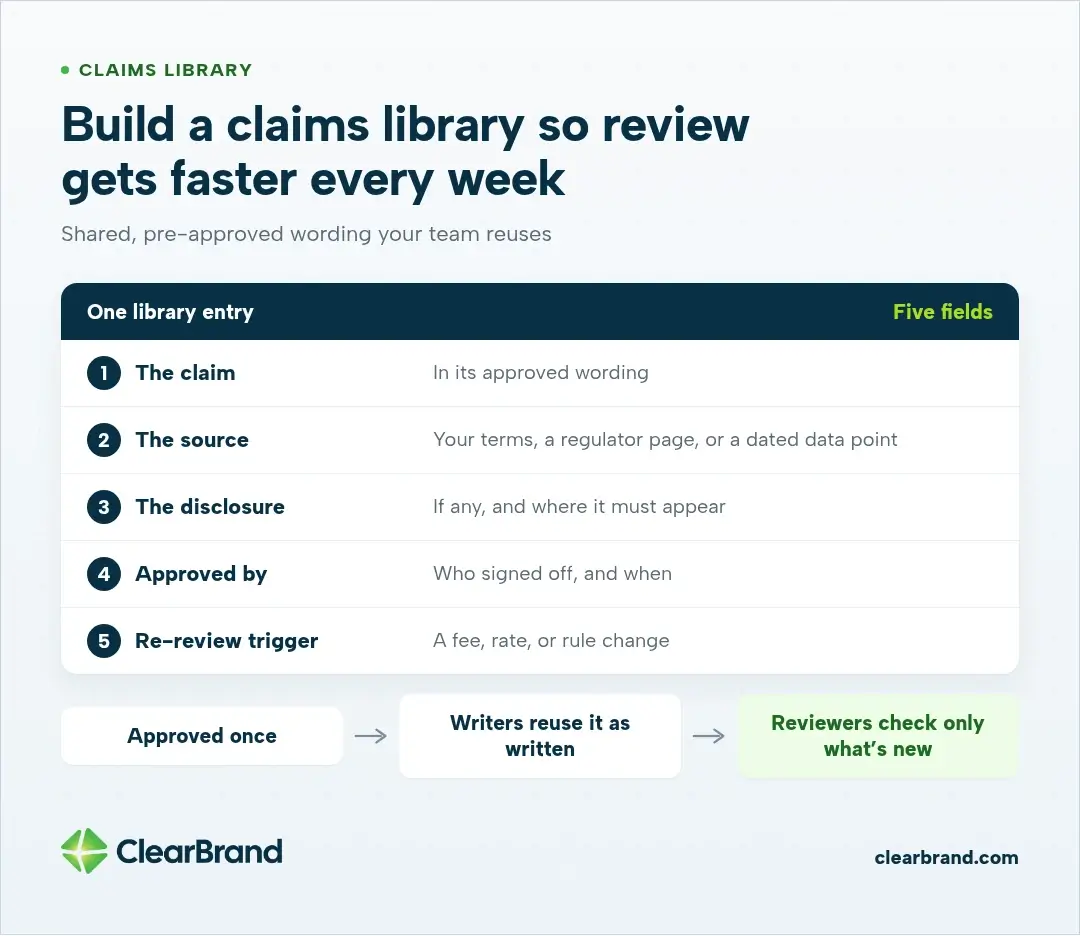
A claims library is a shared list of statements your compliance team has already approved, with the wording and disclosure that go with each one. Once a claim is in the library, writers reuse it as written, and reviewers only check what’s new.
Each entry holds:
- The claim, in its approved wording
- The source that backs it (your terms, a regulator page, a dated data point)
- The required disclosure, if any, and where it must appear
- Who approved it and when
- What triggers a re-review, such as a fee change, a rate change, or a rule change
Keep it in whatever your team already uses, a spreadsheet or a wiki page. What matters is that the team uses it every week.
Get the expertise from your own people
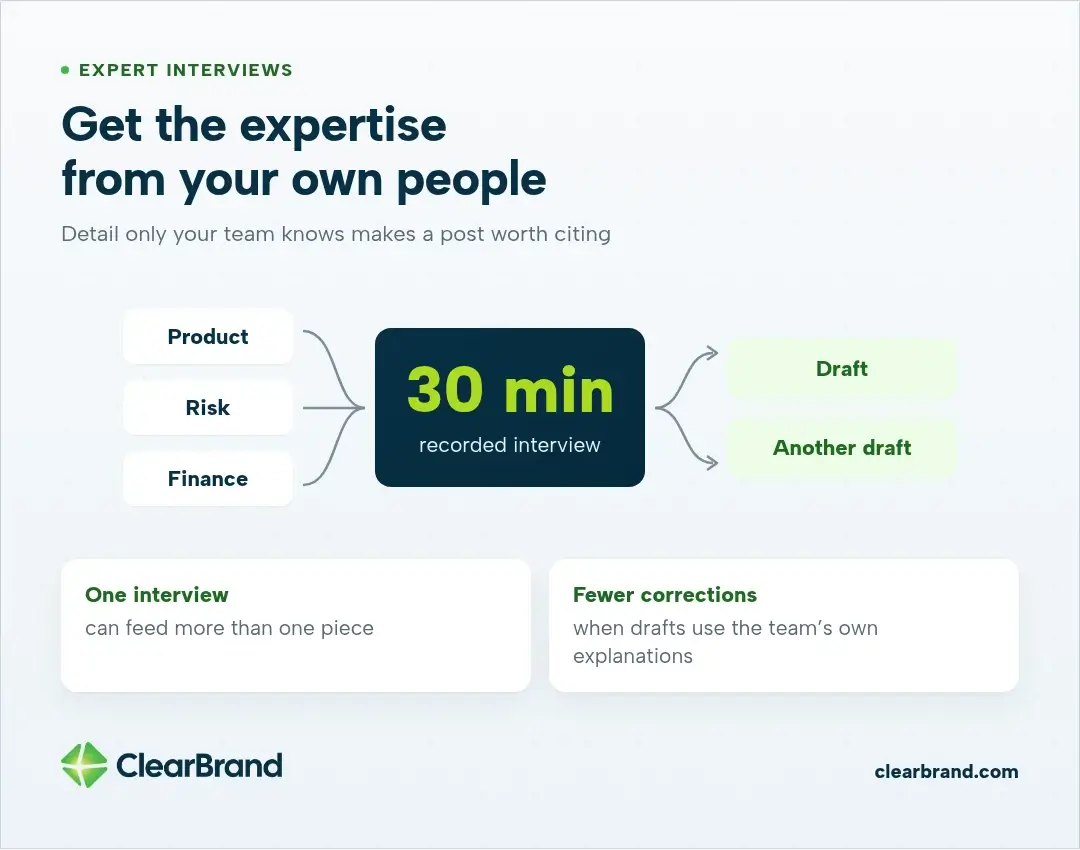
Generic finance content reads the same on every site. What makes a fintech post worth citing is detail only your team knows: how underwriting actually works, why a limit is set the way it is, what customers ask on onboarding calls.
The fastest way to get that detail is a 30-minute recorded interview. We interview product, risk, and finance people and turn what they say into drafts. One good interview can feed more than one piece. And reviewers have less to correct when a draft is built from their own team’s explanations.
A weekly cadence that leaves room for review
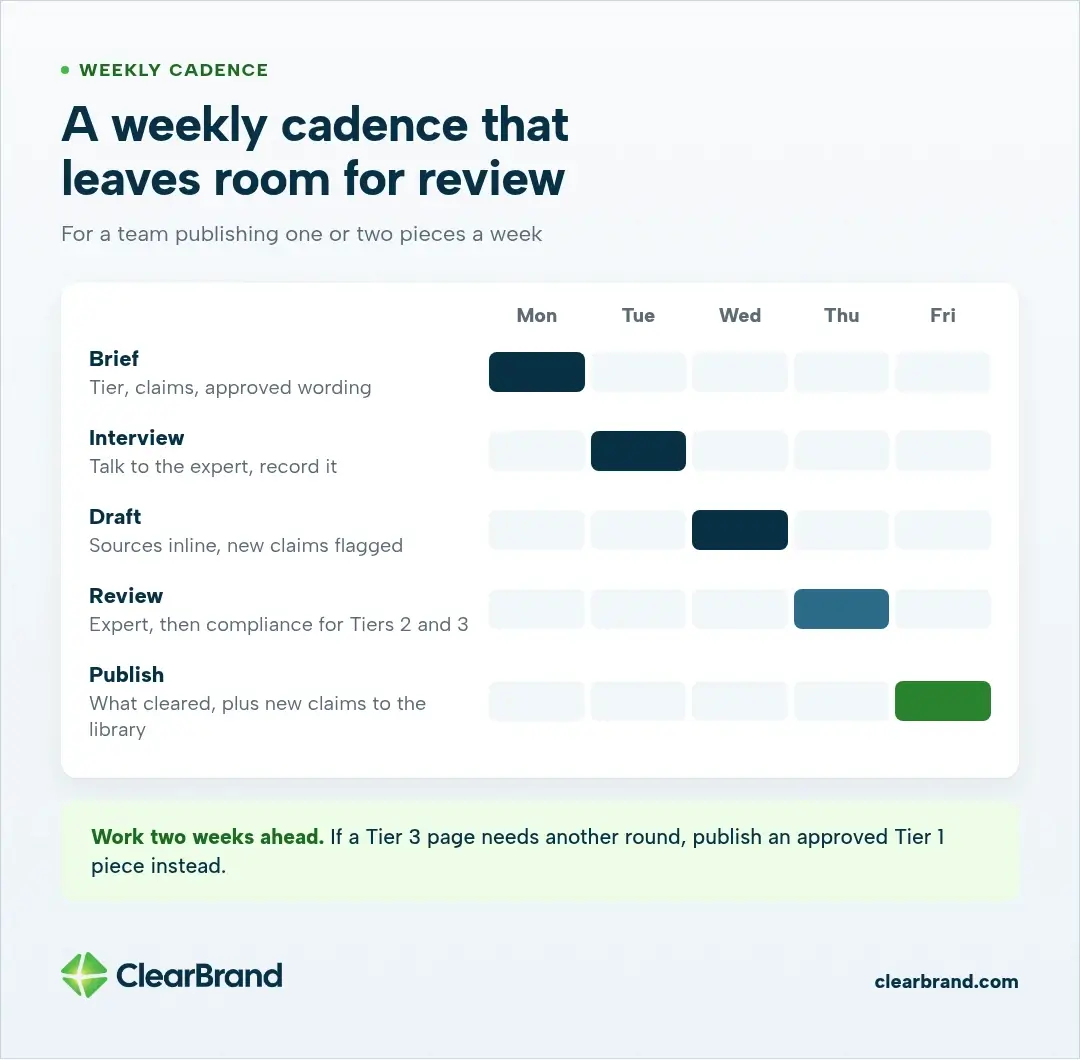
Here’s a simple rhythm for a team publishing one or two pieces a week:
- Monday: brief. Pick the topic, assign the tier, list every claim and number, and pull approved wording from the claims library.
- Tuesday: interview. Talk to the expert. Record it.
- Wednesday: draft. Write with sources linked inline and new claims flagged.
- Thursday: review. Expert check first, then compliance for Tier 2 and Tier 3.
- Friday: publish what cleared, and add newly approved claims to the library.
Try to work two weeks ahead. Then if a Tier 3 page needs another round, you can publish a Tier 1 piece that’s already approved and keep the calendar full.
Write drafts compliance can approve quickly
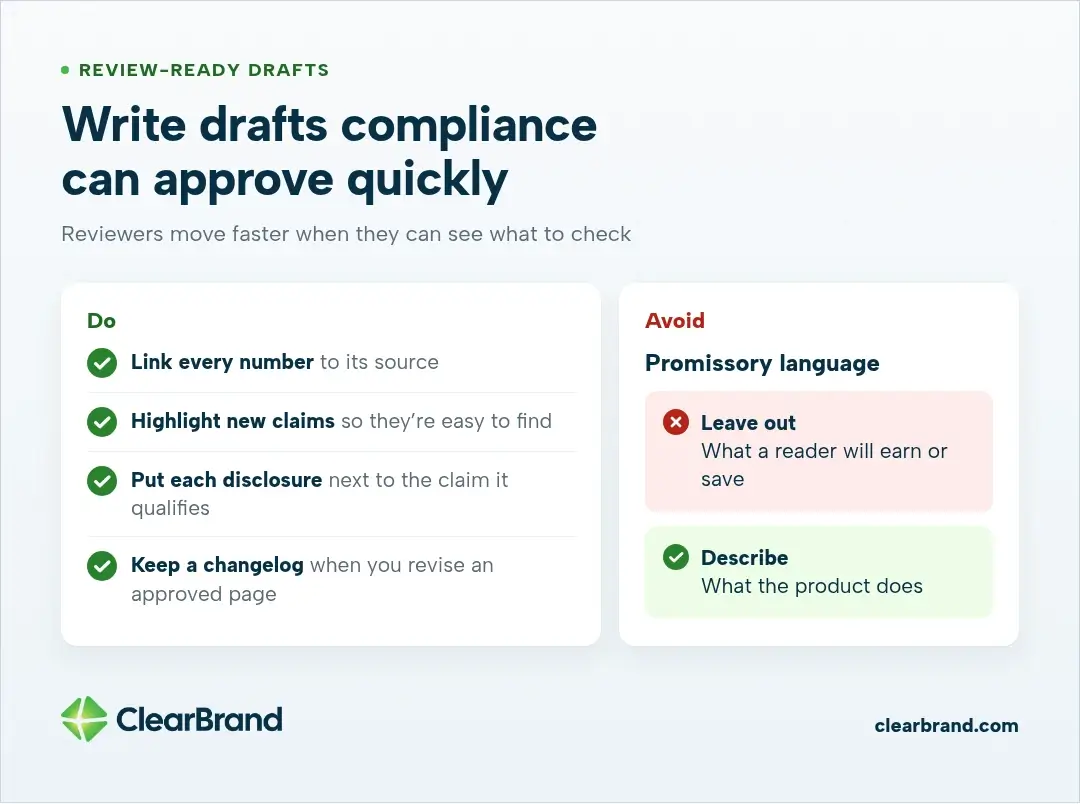
Reviewers move faster when they can see what to check. A few habits help:
- Link every number to its source in the draft.
- Highlight every new product claim so it’s easy to find.
- Avoid promissory language. Describe what the product does and leave out what a reader will earn or save.
- Put each disclosure right next to the claim it qualifies.
- Keep a short changelog when you revise an approved page.
For the full pre-publish list, use our disclosure and claims checklist.
Get more from each approved piece
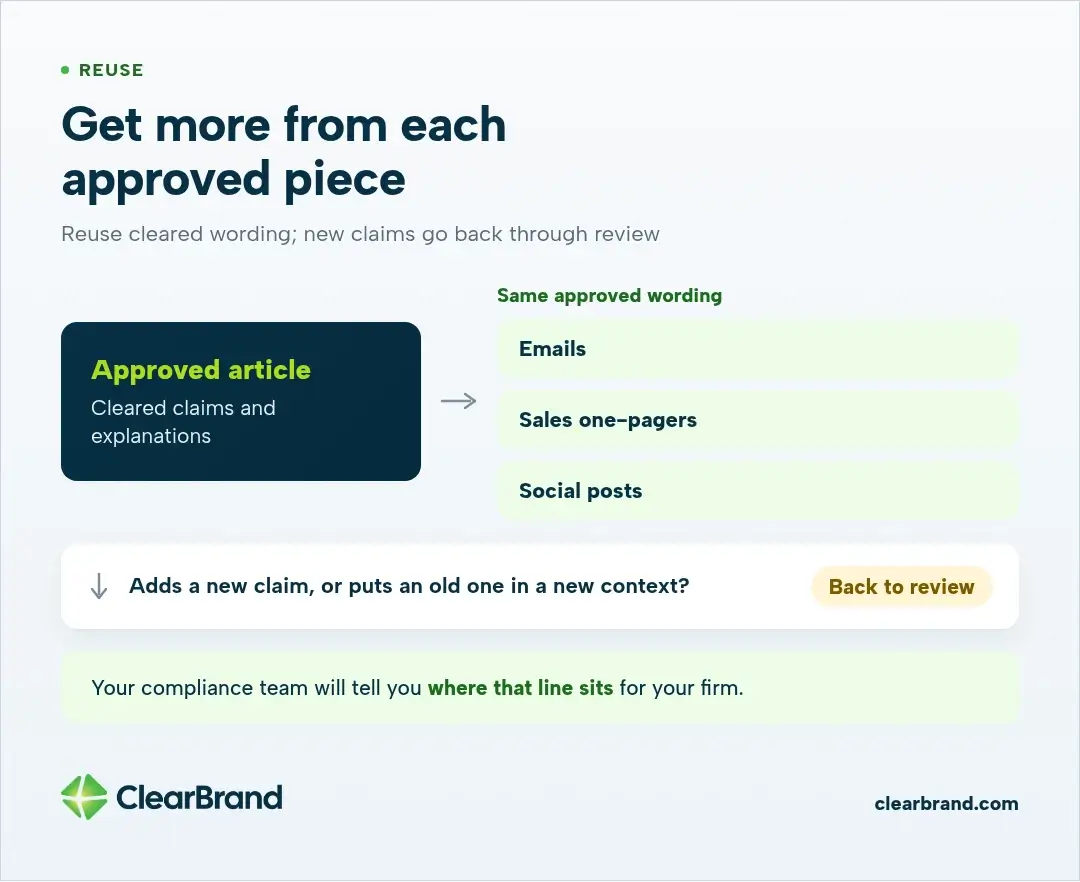
An approved article holds a set of cleared claims and explanations you can reuse. Turn sections into emails, sales one-pagers, and social posts, using the same approved wording. If a reuse adds a new claim or puts an old one in a new context, send it back through review. Your compliance team will tell you where that line sits for your firm.
Measure content by funded customers
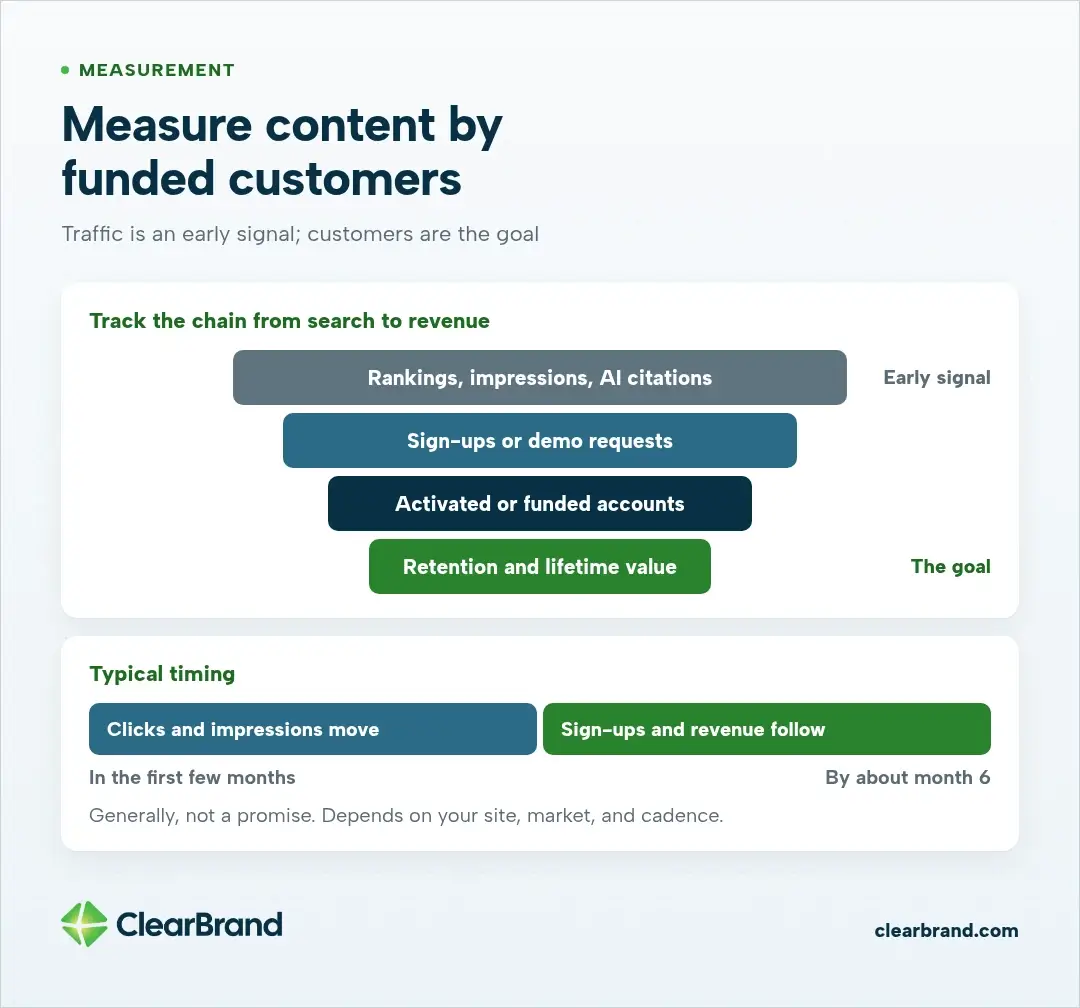
Traffic is an early signal. Customers are the goal, so track the chain from search to revenue:
- Rankings, impressions, and AI citations for the pages you published
- Sign-ups or demo requests from those pages
- Activated or funded accounts
- Retention and lifetime value
Clicks and impressions generally move in the first few months. Sign-ups and revenue generally follow by about month 6. That isn’t a promise for any company, and it depends on your site, your market, and how often you publish. If clicks fall because AI answers a question on the results page, here’s how we measure SEO when clicks drop.
What this looked like for KleerCard
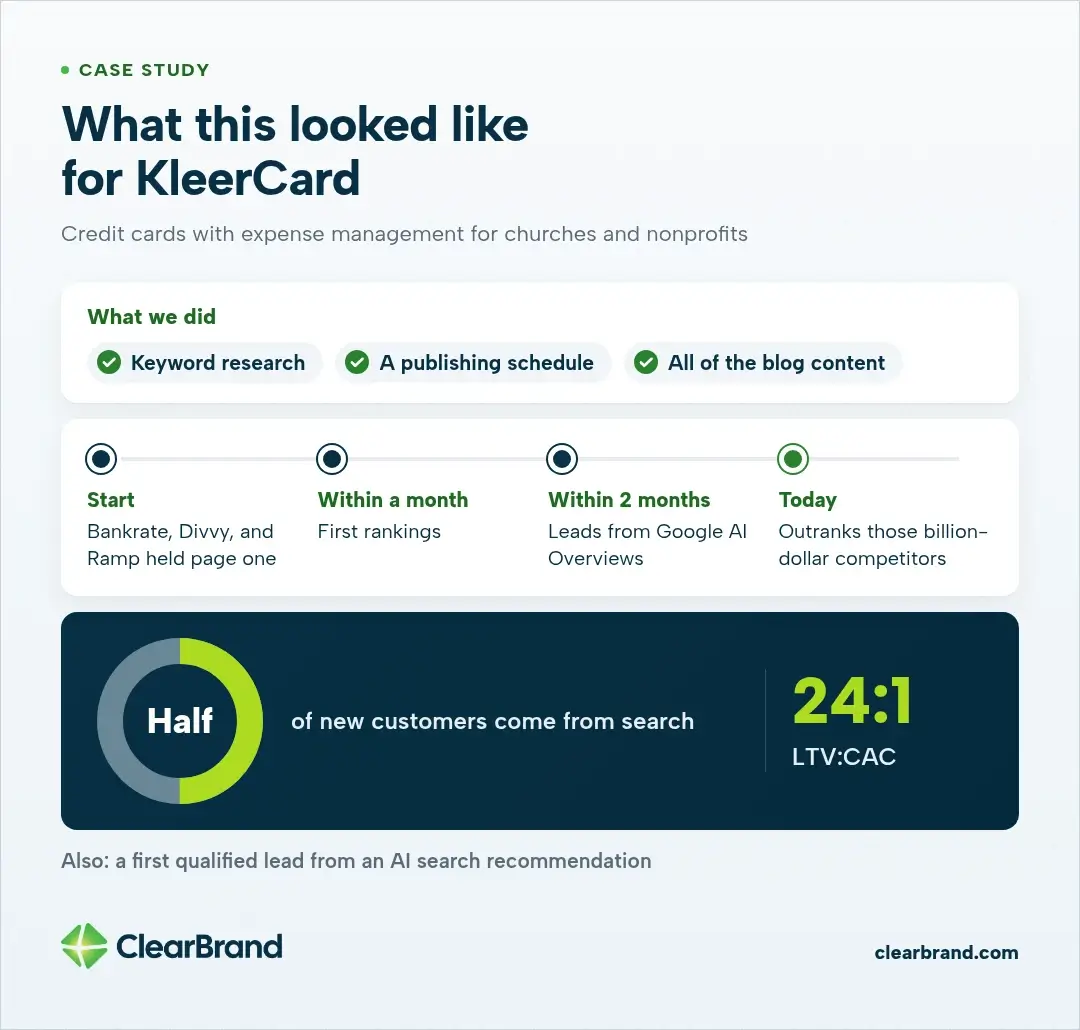
KleerCard issues credit cards with built-in expense management for churches and nonprofits. When we started, Bankrate, Divvy, and Ramp held the first page for the searches KleerCard’s buyers made.
We did the keyword research, set a publishing schedule, and wrote all of the blog content. KleerCard’s first rankings came within a month. It started getting leads from Google AI Overviews within 2 months, and it got its first qualified lead from an AI search recommendation. Today half of KleerCard’s new customers come from search, at a 24:1 LTV:CAC, and it outranks those billion-dollar competitors. Read the KleerCard case study.
Frequently asked questions
What is fintech content marketing?
Fintech content marketing is creating and publishing content, such as guides, comparisons, explainers, and tools, that helps buyers understand a financial product and trust the company behind it. In fintech, it also means building compliance review into the publishing process.
What content works best for fintech companies?
Comparison and alternative pages, clear explainers, in-depth guides for big decisions, practical tools, and proof pages tend to work best. Start with the content closest to a buying decision.
How do you get fintech content through compliance faster?
Sort each piece by review risk, keep a claims library of approved wording, interview experts so drafts start accurate, and agree on turnaround times with your compliance team. Reviewers then only check what’s new.
Should compliance review every blog post?
Your compliance team decides that based on your license and products. A common setup sends product claims, rates, fees, and testimonials through full review and routes general education through an expert check.
How long does fintech content marketing take to work?
Clicks and impressions generally start moving in the first few months, and sign-ups and revenue generally follow by about month 6. Timing varies by company and isn’t guaranteed.
Can you use AI to write fintech content?
AI can help with research and editing, but the substance should come from your experts and every claim should be checked against a source. We use AI-assisted editing to polish drafts built from human interviews.
Start with a plan your compliance team can live with
If your content keeps stalling in review, the fix is usually the system around it. We help fintech teams plan content by review risk, interview their experts, and publish on schedule. Learn about our fintech SEO agency work, or get a free SEO audit with a 90-day plan you keep either way.