
Home Builder Marketing: Where Buyers Actually Research Before They Call
Home builder marketing that follows buyers from Google and AI answers to the consultation, plus the channel mix and how one builder built a $25M pipeline.
Originally published: October 22, 2026 Last updated: October 22, 2026
Home builder marketing is how a builder gets in front of buyers during a research process that can run for months, across Google, AI answers like ChatGPT, social media and realtor referrals. The goal is signed builds. In my experience, the builders who do best show up with clear, accurate answers at each step, so buyers call ready to talk about their build.
Most marketing for home builders gets planned channel by channel. I find it more useful to start with the buyer and follow the path they take before they ever pick up the phone.
Key takeaways
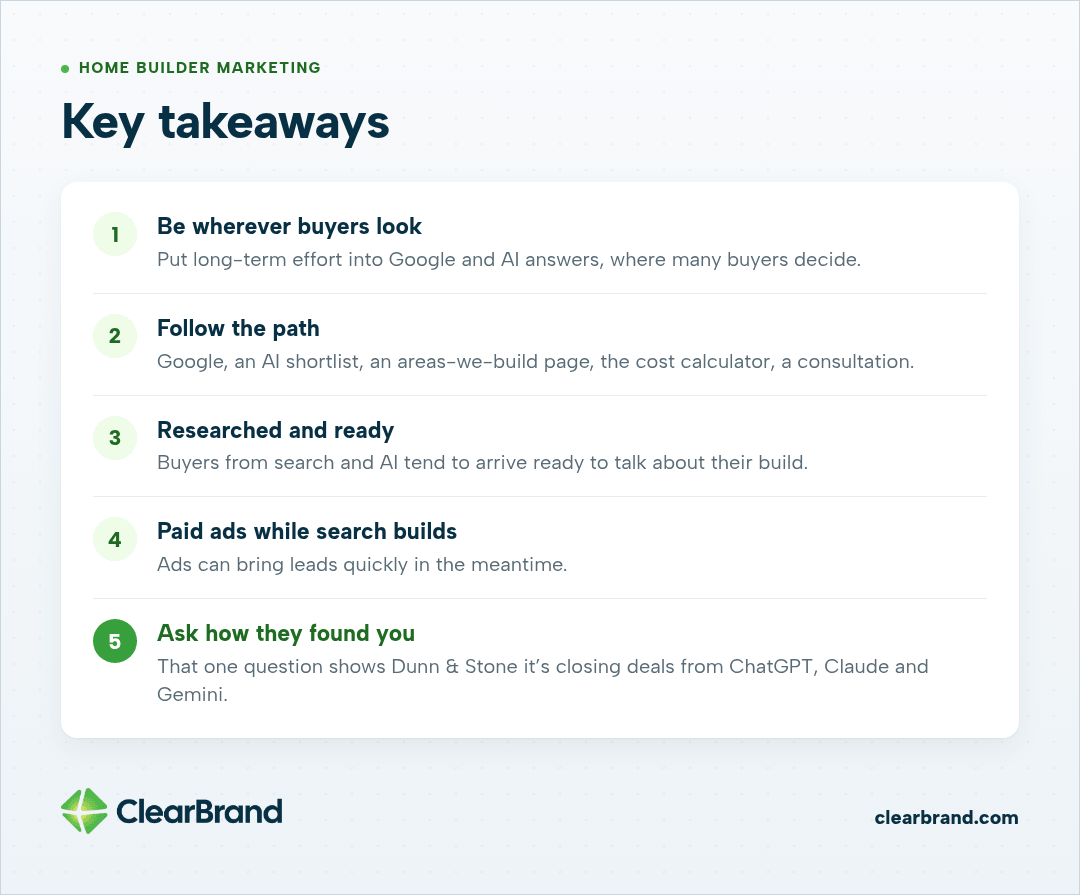
- Be wherever buyers look. Then put your long-term effort where many buyers do their deciding: Google and AI answers.
- The path often runs from Google to an AI shortlist, then to an areas-we-build page, the cost calculator and a consultation.
- Buyers who find a builder through search and AI tend to arrive researched and ready to talk about their build.
- Paid ads can bring leads quickly while search builds.
- Ask every consultation how they found you. That one question is how Dunn & Stone knows it’s closing deals from ChatGPT, Claude and Gemini.
Where home buyers research before they call a builder
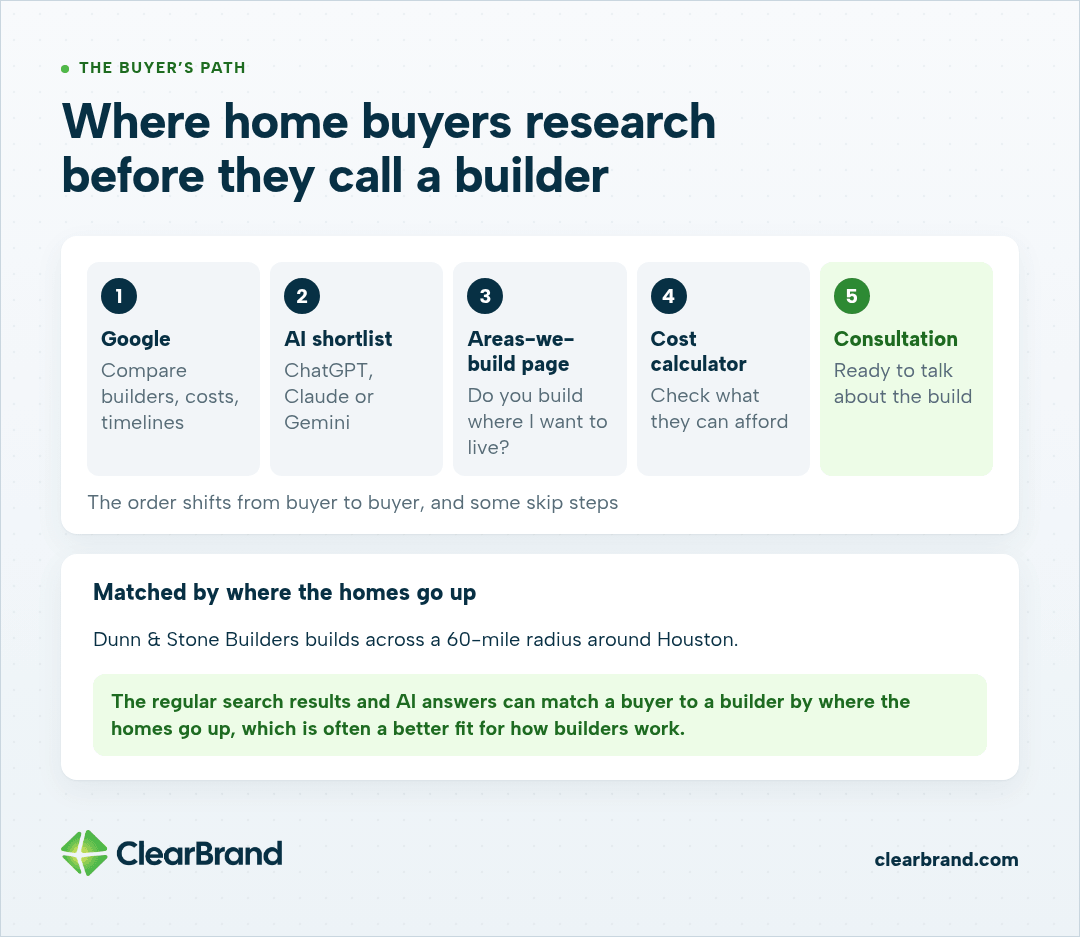
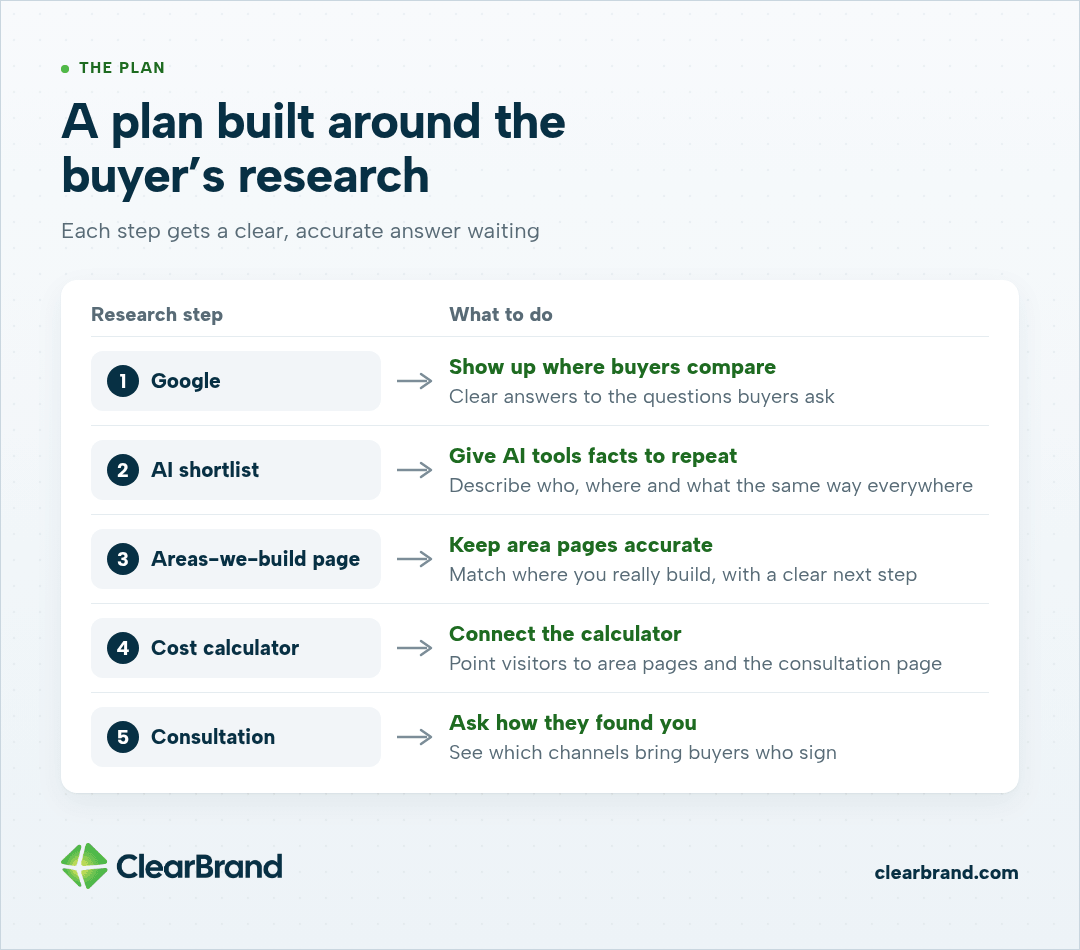
Many home buyers research a builder in roughly five steps before they call:
- They search Google to compare builders, costs and timelines.
- They ask an AI tool like ChatGPT, Claude or Gemini to help build a shortlist.
- They read the builder’s page for the area where they want to build.
- They use a cost calculator to check what they can afford.
- They book a consultation, often after visiting several pages.
The order shifts from buyer to buyer, and some people skip steps. But it’s the pattern I see in Dunn & Stone’s leads, and it’s the clearest way I know to plan home builder marketing.
Step 1: Google, where the comparison starts
Buyers go to Google to compare builders, read about the build process and get a feel for costs and timelines.
Google ranks its map results partly on how far a business is from the person searching. Dunn & Stone Builders builds across a 60-mile radius around Houston, so the map tends to show them for only a small slice of where they actually build.
The regular search results and AI answers can match a buyer to a builder by where the homes go up, which is often a better fit for how builders work.
Step 2: An AI shortlist
More buyers now ask ChatGPT, Claude or Gemini to help them decide. They describe the home, the area and the budget, and ask who to talk to.
AI tools can be specific about who builds in an area, which suits builders whose work spreads across many communities.
The buyers Dunn & Stone hears from through these answers have usually done the research already. They’ve let AI help with the decision, and many arrive basically ready to go.
Step 3: The areas-we-build page
Next, buyers often land on a builder’s page for the area they care about. These are accurate service-area pages that show where you build and what building there looks like.
In my experience, these are the pages that turn research into consultations, because they answer the first question a buyer has: do you build where I want to live?
For how to build these pages so each one is useful, read my guide to SEO for home builders.
Step 4: The cost calculator
Then buyers check whether they can afford the home. A cost-to-build calculator gives them a first answer on the spot, before they’ve talked to anyone.
Dunn & Stone’s cost-to-build calculator is the number one traffic page on its site. It draws researchers from across the country, and buyers inside the build area often open it right after reading an areas-we-build page.
Step 5: The consultation
By the time a buyer books, they’ve often visited several pages and done their homework.
That makes for a different first meeting. The conversation can start with their build instead of who you are.
Why buyers from search and AI often arrive ready to build
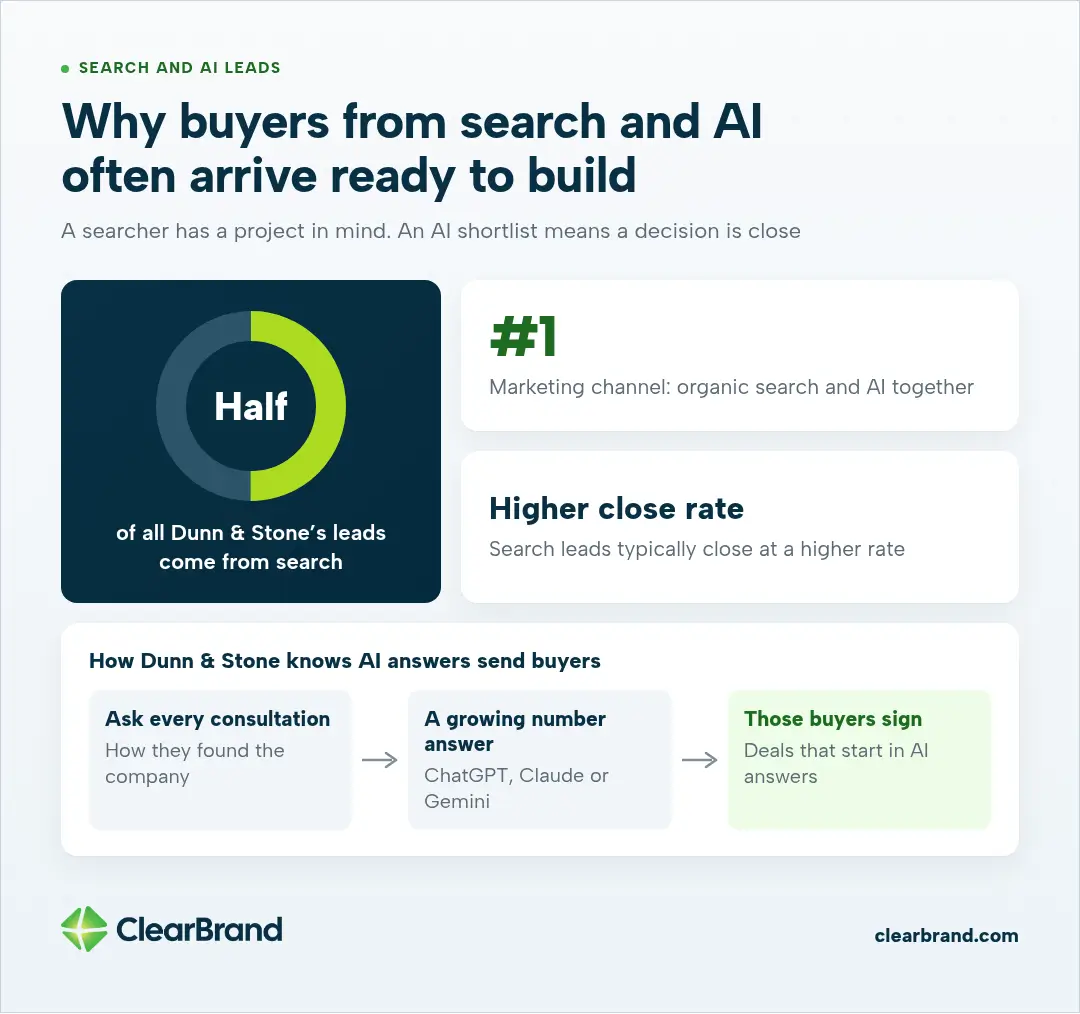
A buyer who searches usually has a project in mind. A buyer who asks an AI tool for a shortlist is often close to a decision.
Half of all Dunn & Stone’s leads come from search, and search leads typically close at a higher rate. They come in as phone calls, emails, form fills and booked consultations.
Organic search and AI together are now Dunn & Stone’s number one marketing channel.
How Dunn & Stone knows AI answers send buyers
Dunn & Stone asks every consultation how they found the company. Over the last six months, a growing number have answered ChatGPT, Claude or Gemini.
And those buyers are signing. Dunn & Stone Builders now closes deals that start in AI answers.
Curious where buyers find you today, in Google and in AI answers? Get your free SEO audit.
The home builder marketing channel mix
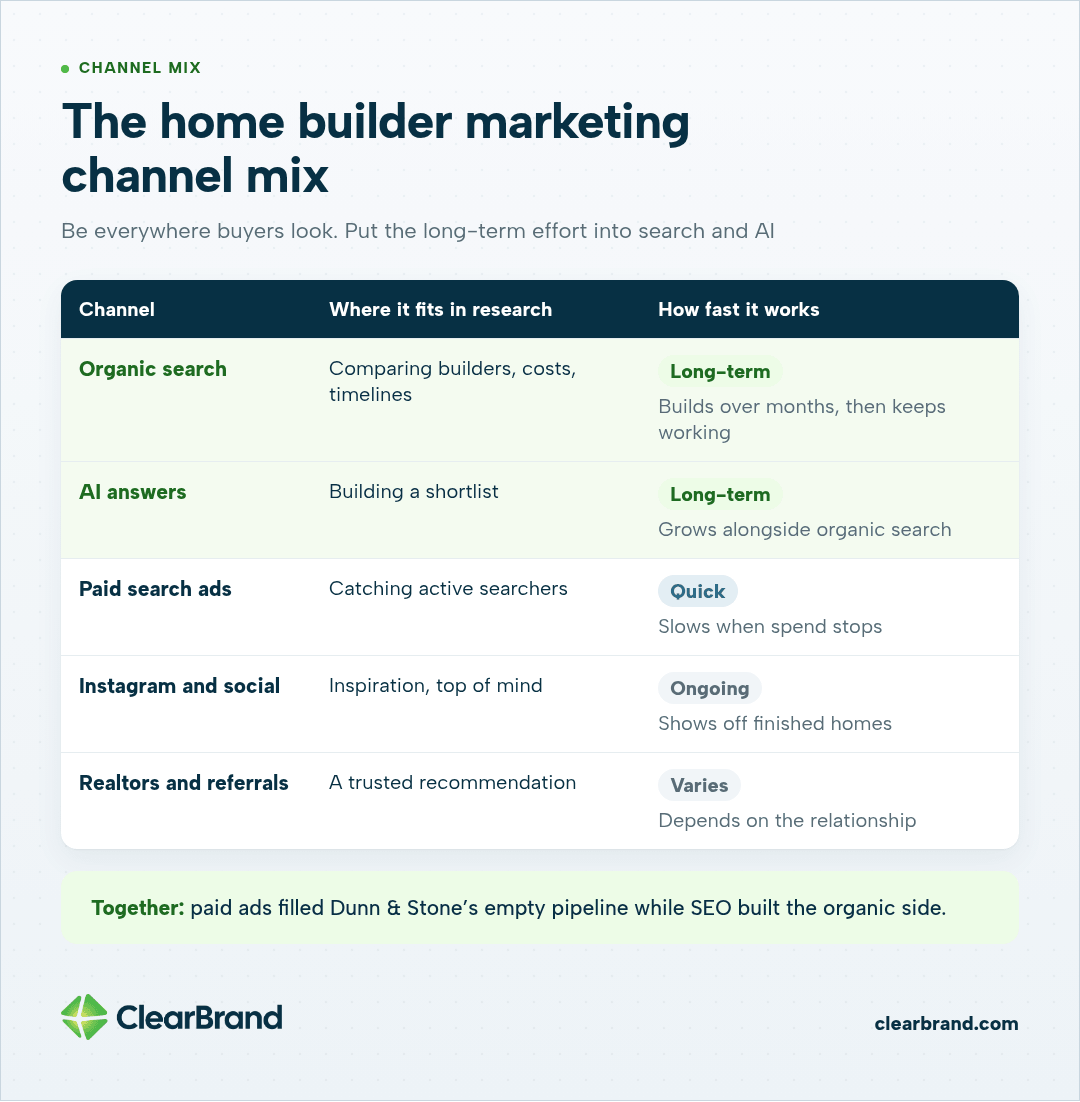
My general advice to builders is to be everywhere buyers are looking.
The difference is where the long-term effort goes. Every channel below can start a buyer’s research, and each one has real strengths. Many buyers still check what they find in a search or an AI answer before they call.
| Channel | Where it fits in the buyer’s research | How fast it works | How it connects to search and AI |
|---|---|---|---|
| Organic search (Google) | Comparing builders, costs and timelines | Builds over months, then keeps working as long as the pages stay current | Buyers who find you here have often researched and are ready to talk |
| AI answers (ChatGPT, Claude, Gemini, Google AI Overviews) | Building a shortlist and narrowing the choice | Usually grows alongside organic search | Often draws on pages that already rank, plus what other sites say about you; buyers often arrive close to a decision |
| Paid search ads | Catching active searchers right away | Quick, and you control the budget, areas and timing | Fills the pipeline while organic search builds, though leads slow when spend stops |
| Instagram and social | Inspiration, a feel for your homes and staying top of mind before buyers search | Ongoing | Shows off finished homes in a way a search result rarely can; when buyers compare builders, many move to Google and AI answers |
| Realtors and referrals | A trusted recommendation, often among the warmest leads you’ll get | Depends on the relationship | A referred buyer may still look you up, so what search and AI say about you matters |
How the channels work together
When Dunn & Stone came to us, their pipeline was empty. We ran paid ads for quick, qualified leads while SEO on landing pages and blogs built the organic side.
Instagram, realtors and referrals start plenty of conversations, and the trust they create is hard to get any other way. Search and AI are often where those conversations get checked, compared and turned into a booked consultation.
A home builder marketing plan built around the buyer’s research
A strong home builder marketing strategy follows those five steps and makes sure each one has a clear, accurate answer waiting.
- Show up where buyers compare builders. Publish clear answers to the questions buyers ask about building with you, so Google and AI tools can find them.
- Give AI tools facts they can repeat. Describe your company, where you build and what you build the same way everywhere.
- Keep your areas-we-build pages accurate. Each page should match where you really build and give buyers a clear next step.
- Connect the calculator to the rest of the site. Point calculator visitors to your area pages and your consultation page.
- Ask every consultation how they found you. It’s one of the simplest ways to see which channels bring buyers who sign.
Many builders also follow up with leads by email and keep track of them in a CRM, and that can help, since a custom build decision often takes months. I’d treat it as support for the research path above rather than a replacement for it.
My SEO guide for home builders, linked in Step 3, covers page types, area pages and measurement step by step.
Project pages and spec sheets for custom home builders
For custom builders, that plan needs one more piece. You sell a home that doesn’t exist yet, so the strongest evidence you can offer is the homes you’ve already built. A project page turns one finished build into that evidence, in words a buyer can read and an AI tool can quote.
The raw material usually already exists in the photos, plans and spec notes from each build. I’d rather see it working on your site than sitting in a shared drive.
What a custom home project page should include
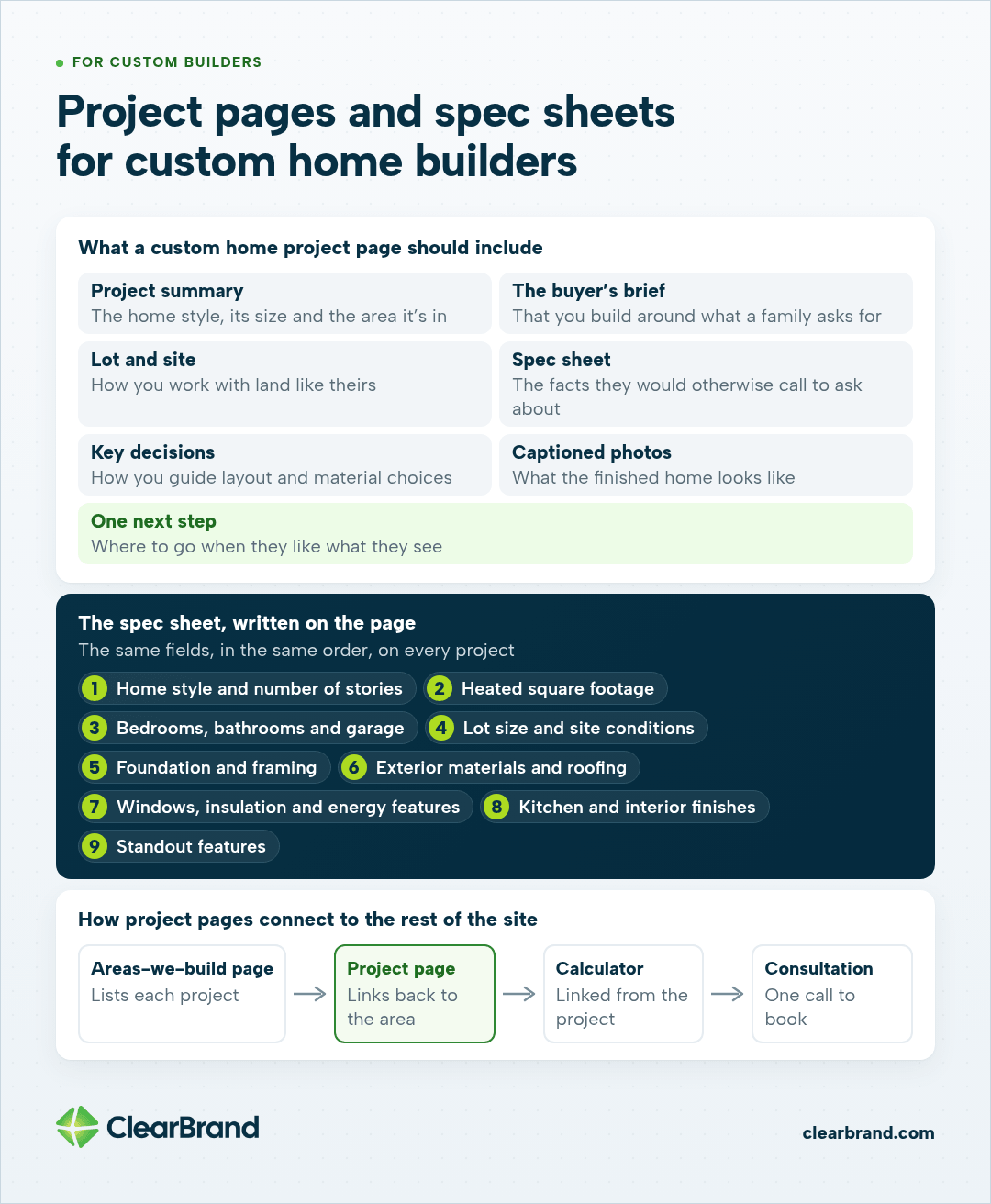
A custom home project page should include the buyer’s brief, the lot and site conditions, a spec sheet written on the page as text, the key decisions made during the build, captioned photos and one clear next step.
| Element | What it tells the buyer |
|---|---|
| Project summary | The home style, its size and the area it’s in |
| The buyer’s brief | That you build around what a family asks for |
| Lot and site | How you work with land like theirs, from a slope to a tree line or a view |
| Spec sheet | The facts they would otherwise call to ask about |
| Key decisions | How you guide layout and material choices during design and the build |
| Captioned photos | What the finished home looks like, room by room |
| One next step | Where to go when they like what they see |
Ask the homeowners before you publish details about their home, and keep the address and anything personal off the page. When families know their privacy comes first, the page stays something they’re proud to share.
The spec sheet, written on the page
Put the specs on the page as text, in a short table. Google can index PDFs, but buyers have to open a separate file, and search engines and AI tools may have a harder time reading specs from a PDF or a photo than from text on the page.
We recommend the same fields, in the same order, on every project:
- Home style and number of stories
- Heated square footage
- Bedrooms, bathrooms and garage
- Lot size and site conditions
- Foundation and framing
- Exterior materials and roofing
- Windows, insulation and energy features
- Kitchen and interior finishes
- Standout features
Write each value the way a buyer would say it, in plain words rather than internal codes. Leave cost questions to the calculator and the consultation, where you can speak to the buyer’s own plans.
Keep the homes you’ve built in one structured content type, with a field for each line of the spec sheet, so every new project page comes out complete. Our guide to CMS collections that rank walks through one setup.
How project pages connect to the rest of the site
Project pages work best as the proof between your areas-we-build pages, the calculator and the consultation. List each project on the area page where it was built, link the project back to that area and over to the calculator, and end it with one call to book a consultation.
You don’t need a big library to start. A few complete pages in the areas where you most want work will do more than a long gallery, and a new page each time a build wraps up keeps the set growing.
To see what they bring in, check which project pages buyers viewed before they booked, and when you ask how they found you, ask which homes caught their eye too.
How Dunn & Stone Builders went from an empty pipeline to $25M
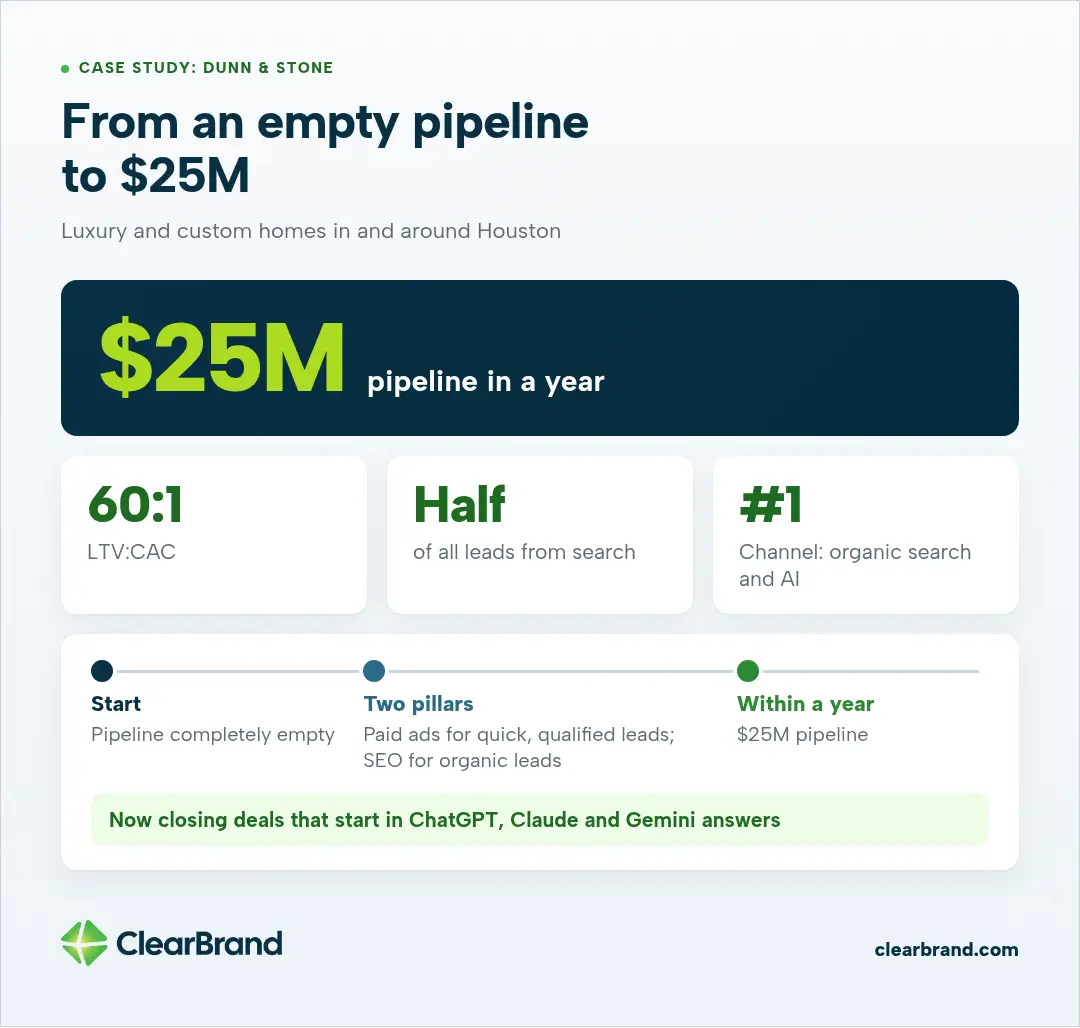
Dunn & Stone Builders builds luxury and custom homes in and around Houston. When they called us, their pipeline was completely empty.
The plan had two pillars: paid ads for quick, qualified leads and SEO to bring in organic leads.
The results:
- A $25M pipeline in a year, at a 60:1 LTV:CAC
- Organic search and AI as their number one marketing channel
- Half of all leads from search, typically closing at a higher rate
- Deals that start in ChatGPT, Claude and Gemini answers
Read the full Dunn & Stone case study.
Home builder marketing FAQ
What is home builder marketing?
Home builder marketing is how a builder reaches buyers during the months they can spend researching, across Google, AI answers, social media and realtor referrals. The aim is signed builds, so the best plans follow the buyer’s research path from first search to consultation.
Where do home buyers research before they call a builder?
Many home buyers start in Google and increasingly ask AI tools like ChatGPT, Claude and Gemini for a shortlist. From there they often read a builder’s areas-we-build page, check affordability with a cost calculator and book a consultation once they feel ready.
Do AI answers actually send buyers to home builders?
AI answers can send buyers to home builders, and I’ve watched it happen with one builder in particular. Dunn & Stone Builders asks every consultation how they found the company, a growing number say ChatGPT, Claude or Gemini, and Dunn & Stone now closes deals that start in AI answers.
What is the best marketing for a home builder?
The best marketing for a home builder puts you wherever buyers look, with long-term effort in organic search and AI answers, because those buyers often arrive researched and ready. Paid ads can bring leads quickly while search builds.
How do home builders get more leads?
Home builders get more leads by meeting buyers at each step of their research: clear answers in Google and AI tools, accurate areas-we-build pages, a cost calculator and an easy way to book a consultation.
How long does home builder marketing take to fill a pipeline?
Paid ads can bring leads right away, and organic search builds over months. Results depend on your market and where your site starts.
What should a custom home project page include?
A custom home project page should include the buyer’s brief, the lot and site conditions, a spec sheet written on the page, the key decisions, captioned photos and one clear next step. Writing the specs as text makes them easier for buyers and AI tools to read.
How should a custom home builder measure marketing?
A custom home builder should measure consultations booked, pipeline value and the source each buyer names when asked how they found you. Because a custom build has a long sales cycle, it also helps to note which project pages each buyer viewed before booking.
Getting help with your home builder marketing
Some builders run this in-house. Others want a team to handle the strategy, the pages, AI search and the reporting. If you’re comparing a home builder marketing agency, you can see how we run SEO for home builders.
A free SEO audit is a full review of your site and an initial 90-day strategy, and you keep it whether you work with us or not.
We’d love to look at where your buyers are researching and show you how to meet them there. Get your free SEO audit.