

SEO for home builders is the work of making your site the source Google and AI tools draw on when buyers research who should build their home. Judge it by consultations and signed contracts from buyers inside your build radius, not by sessions.
Custom home buyers spend months researching before they ever call a builder. More of that research now happens inside ChatGPT, Google AI Overviews and other AI tools, where a buyer can ask a long, specific question and get one answer back.
Most home builder SEO advice still stops at rankings and traffic. I care more about whether your site fills the pipeline with buyers who live inside your build radius and are ready to talk.
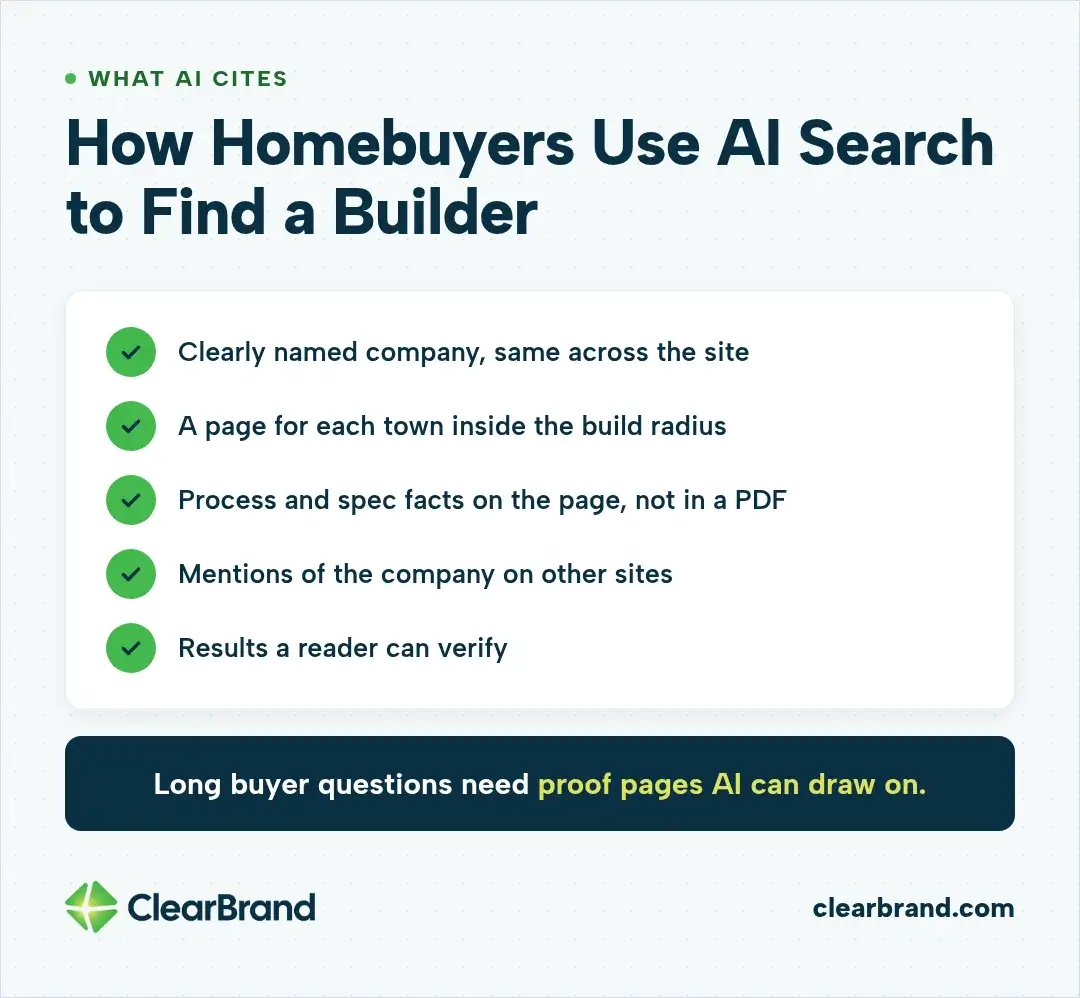
How Homebuyers Use AI Search to Find a Custom Home Builder
Buyers ask AI tools long, specific questions about builders, costs, timelines and towns. The tools tend to draw on pages that answer those questions with proof: a unique page for each town you build in, real process and spec detail, and published results. Builders without those pages are less likely to be part of the answer.
The questions buyers ask before they call
These are examples of the kind of prompts a buyer might type, not a record of real searches:
- “Who builds custom homes near [town]?”
- “How long does a custom home build usually take?”
- “What drives the cost per square foot on a custom home?”
Each one is specific, and the builder whose site already answers it in plain words has the better shot at being named.
What AI tools need before they cite a builder
When I look at whether a builder can show up in those answers, I check for five things:
- A clearly named company, described the same way across the site
- A page for each town inside the build radius
- Process and spec facts written on the page, not buried in a PDF or a photo
- Mentions of the company on other sites
- Results a reader can verify
In Google’s AI features, one buyer question can also fan out. Google says AI Overviews and AI Mode may run several related searches across subtopics, such as cost, timing and location, and each of those is another chance for a page to be cited.
AI is a new layer on the same foundations
None of this replaces the basics. Pages still need to be crawlable, the company still needs to be clearly defined, and the content still has to answer what buyers actually ask. AI search just makes skipping them more expensive.
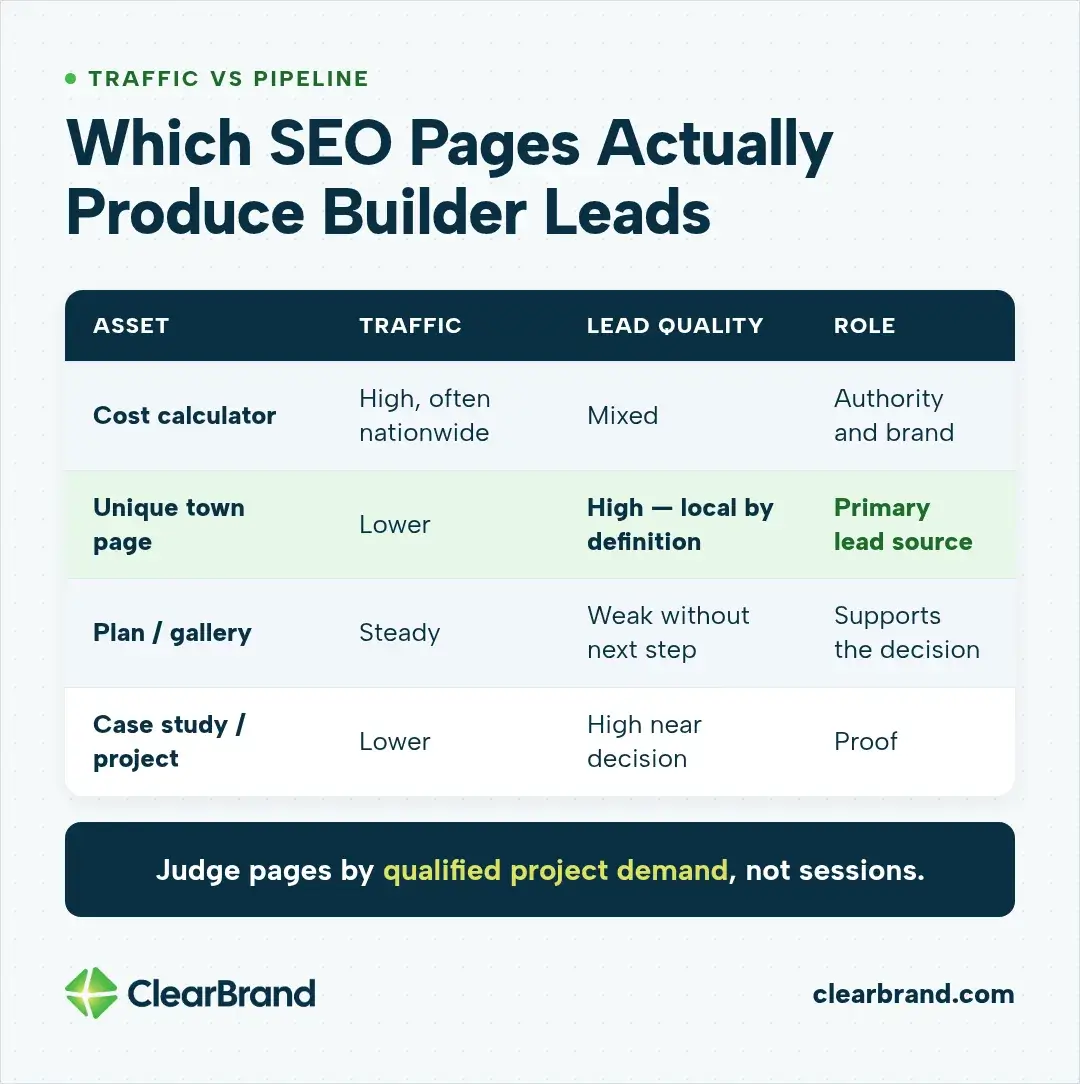
Traffic vs Pipeline: Which SEO Pages Actually Produce Builder Leads
Qualified project demand is an inquiry from a buyer inside your build radius who is ready to start a project. That’s the number SEO should move.
| Asset | Traffic | Lead quality | Role |
|---|---|---|---|
| Cost-to-build calculator | High, often nationwide | Mixed, many visitors outside the radius | Authority and brand |
| Unique town page | Lower | High, buyers are local by definition | Primary lead source |
| Plan and gallery page | Steady | Weak without context or a next step | Supports the decision |
| Case study or project page | Lower | High for buyers close to deciding | Proof |
One of our builder sites gets more traffic from its cost-to-build calculator than from any other page. But it shows up for searchers nationwide, so a lot of those visitors could never hire that builder. We keep it anyway, because it builds authority that helps the pages closer to a sale.
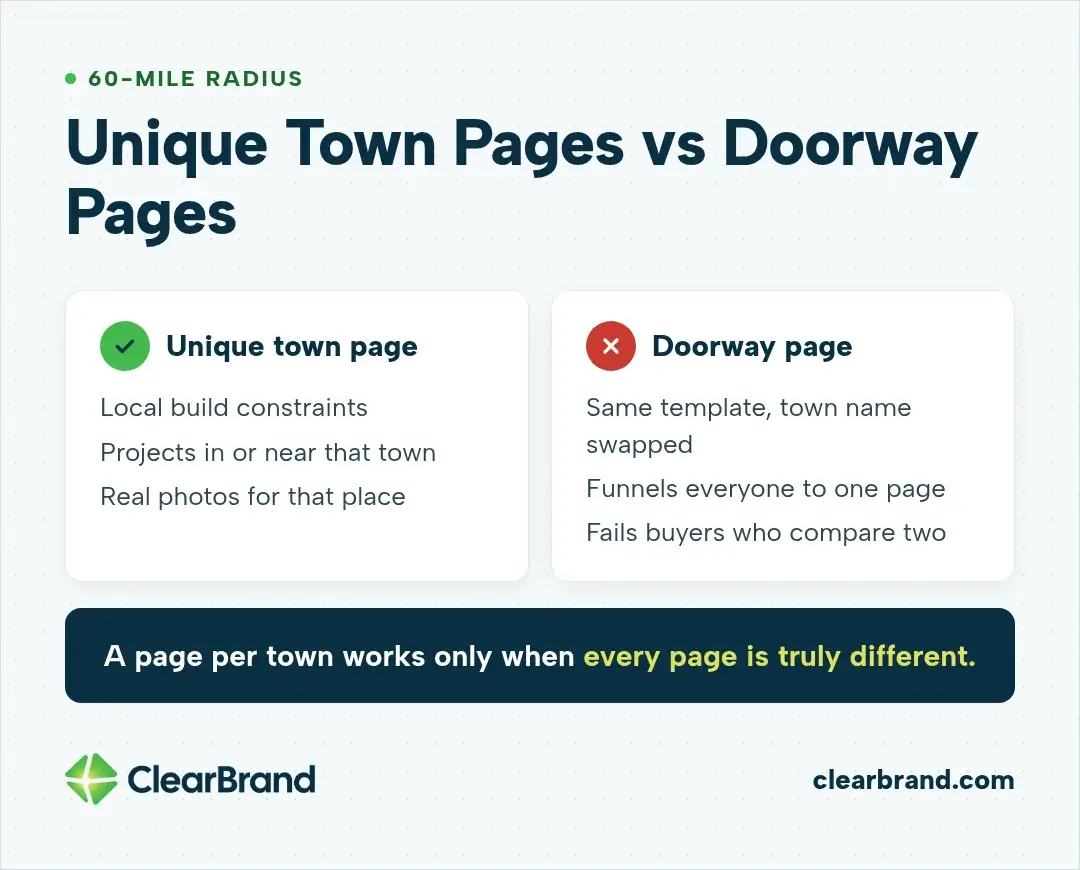
Unique Town Pages vs Doorway Pages
A builder with a 60-mile radius covers a lot of towns. A page for each one works, but only when every page is truly different from the others.
Pages that swap a town name into the same template risk looking like doorway pages, which Google’s spam policies describe as pages targeted at specific regions or cities that funnel users to one page. They also fail the buyer who clicks two of them and sees the same paragraph. A useful town page carries things only that town has: local build constraints, projects you built in or near it, and real photos.
I wrote more about why templated location pages fail, including how to tell a scaled page that helps from one that hurts.
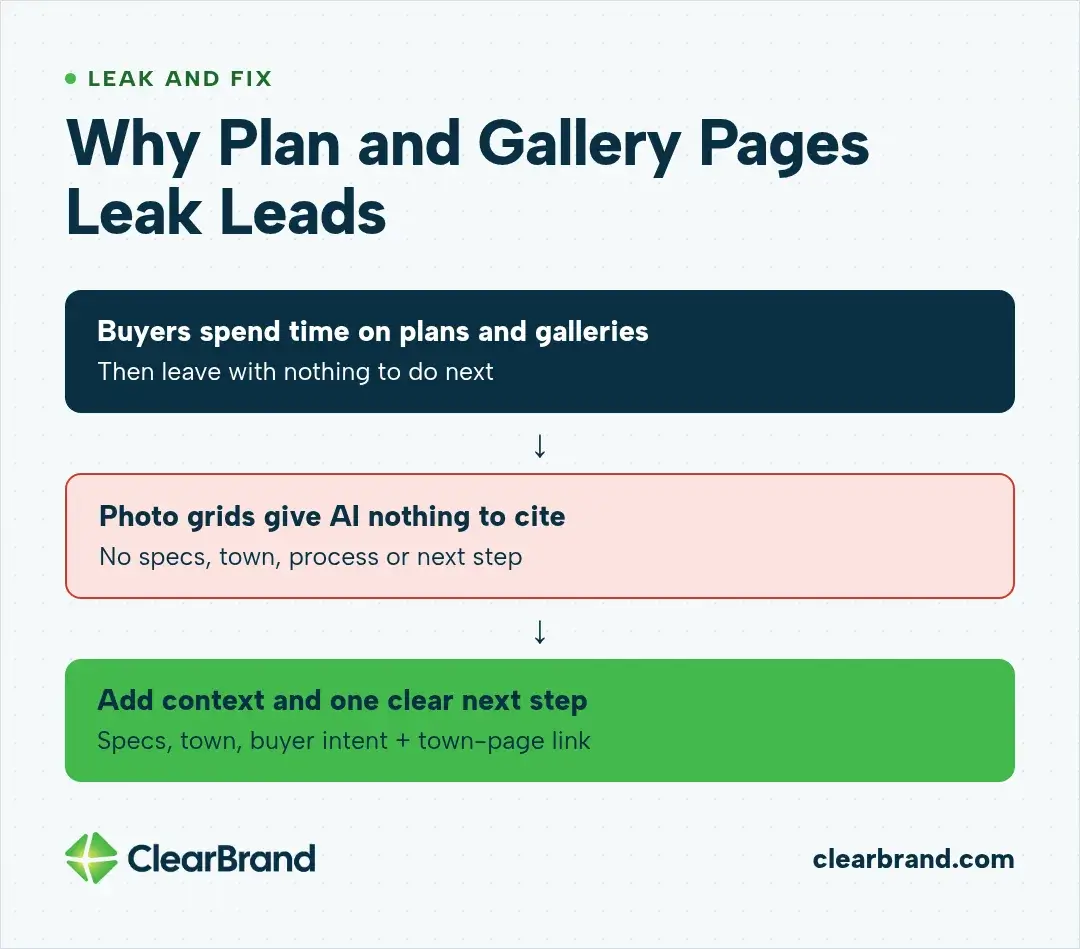
Why Plan and Gallery Pages Leak Leads
Buyers spend real time on floor plans and project galleries. Then they leave, because the page gave them nothing to do next.
A photo grid also gives AI tools nothing to cite. There are no specs, no square footage context, no process and no town, so the page can be beautiful and still rarely show up in an answer.
The fix is mostly writing. Add context to each plan or project: the specs, the town, and what the buyer wanted. Connect each one to the relevant town page, and give every page one clear next step.
SEO vs Paid Ads for Home Builders
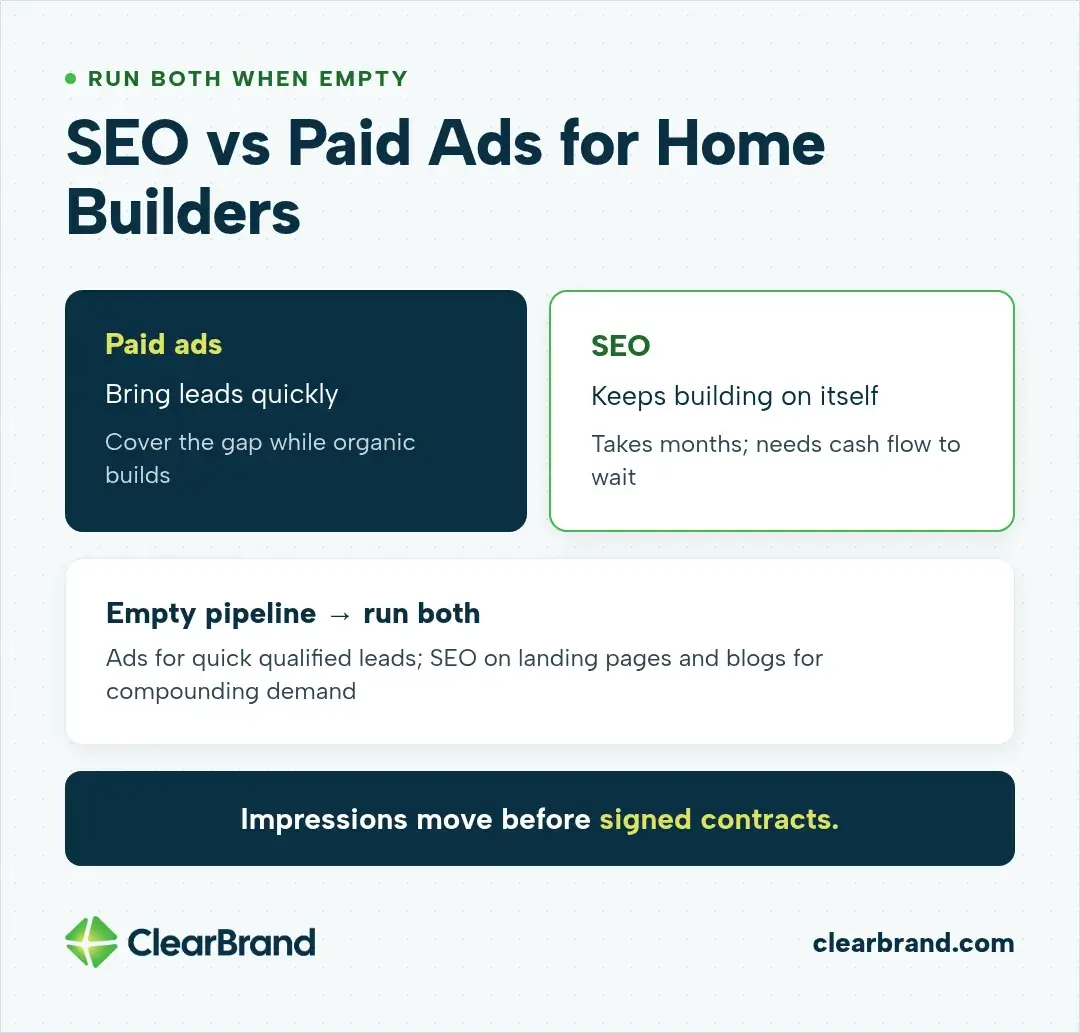
Paid ads bring leads quickly. SEO keeps building on itself, but it takes months, and you need the cash flow to wait for it.
So when the pipeline is empty, it often makes sense to run both. Ads cover the gap with quick, qualified leads while SEO on landing pages and blogs builds the organic side that keeps paying off later.
On timing, I’d rather not promise exact dates. Early signals like impressions and rankings usually move before signed contracts do, and how long contracts take depends on your market, your sales cycle and where the site starts.
How to Measure SEO for a Home Builder
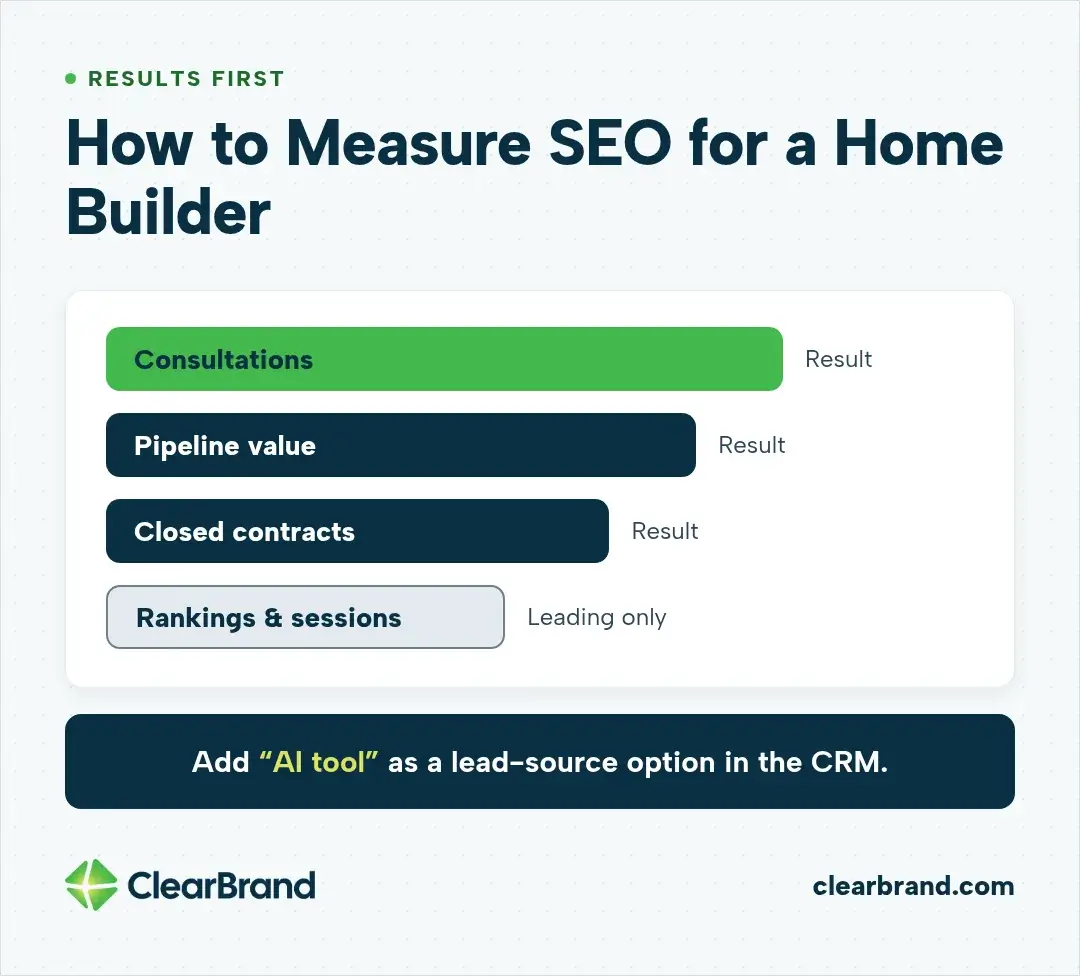
Track consultations, pipeline value and closed contracts. Rankings and sessions are leading indicators, useful for seeing whether things are moving, but they aren’t the result.
Ask every new lead where they found you, and add “AI tool” as one of the answer options. Otherwise AI-referred demand blends into “Google” or “a friend” and never shows up in your CRM.
If you want the tracking side in more depth, I covered it in a post on tracking AI search visibility. It was written for SaaS, but the method carries over.
What This Looks Like in Practice: Dunn & Stone Builders
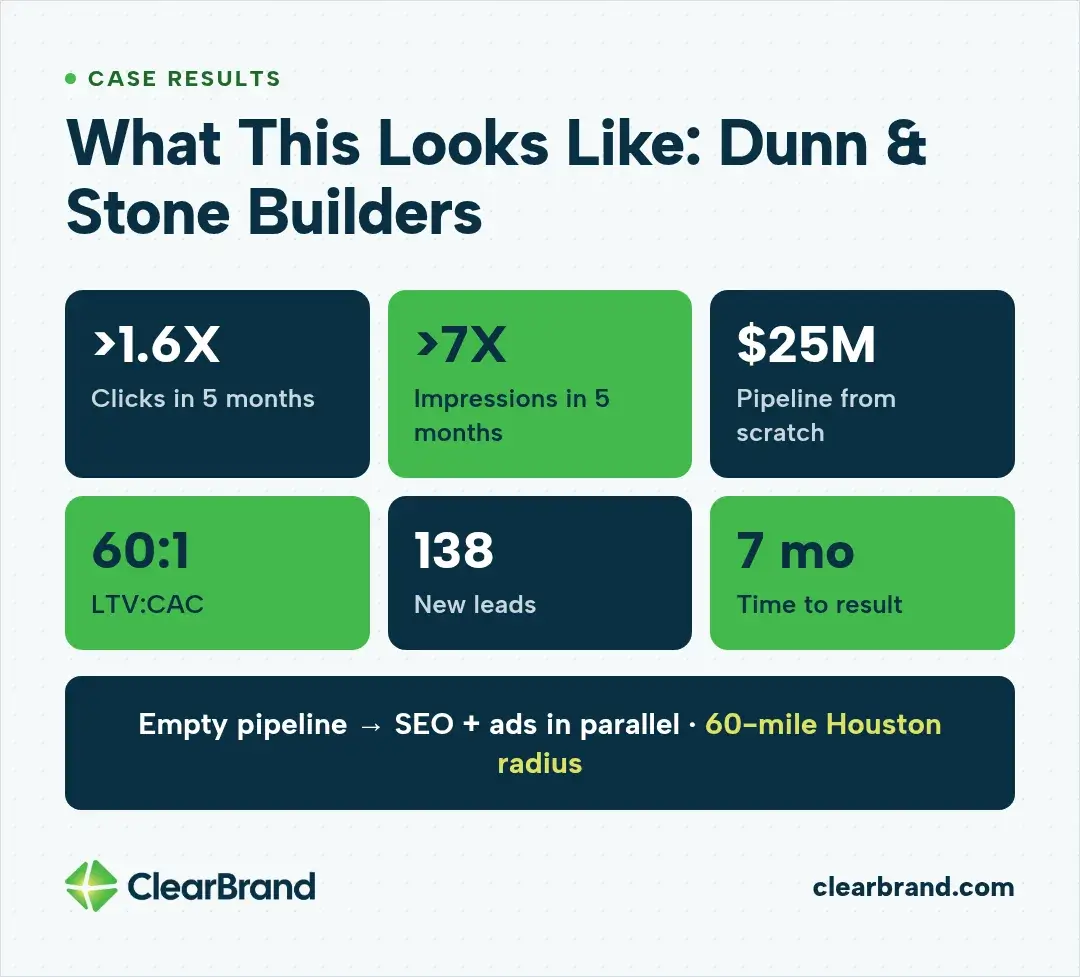
Dunn & Stone Builders builds luxury and custom homes within a 60-mile build radius around Houston. When they called us, they had a completely empty pipeline.
We ran SEO and digital ads in parallel. Paid ads provided quick, qualified leads, and highly targeted SEO on landing pages and blogs was built to bring in organic leads.
Through SEO, clicks on their site went up by more than 1.6X and impressions by more than 7X in 5 months. In the end, Dunn & Stone Builders built a $25M pipeline from scratch, at a 60:1 LTV:CAC. The case study also lists 138 new leads and a 7-month time to result.
You can read the full Dunn & Stone case study for how the work came together.
FAQ
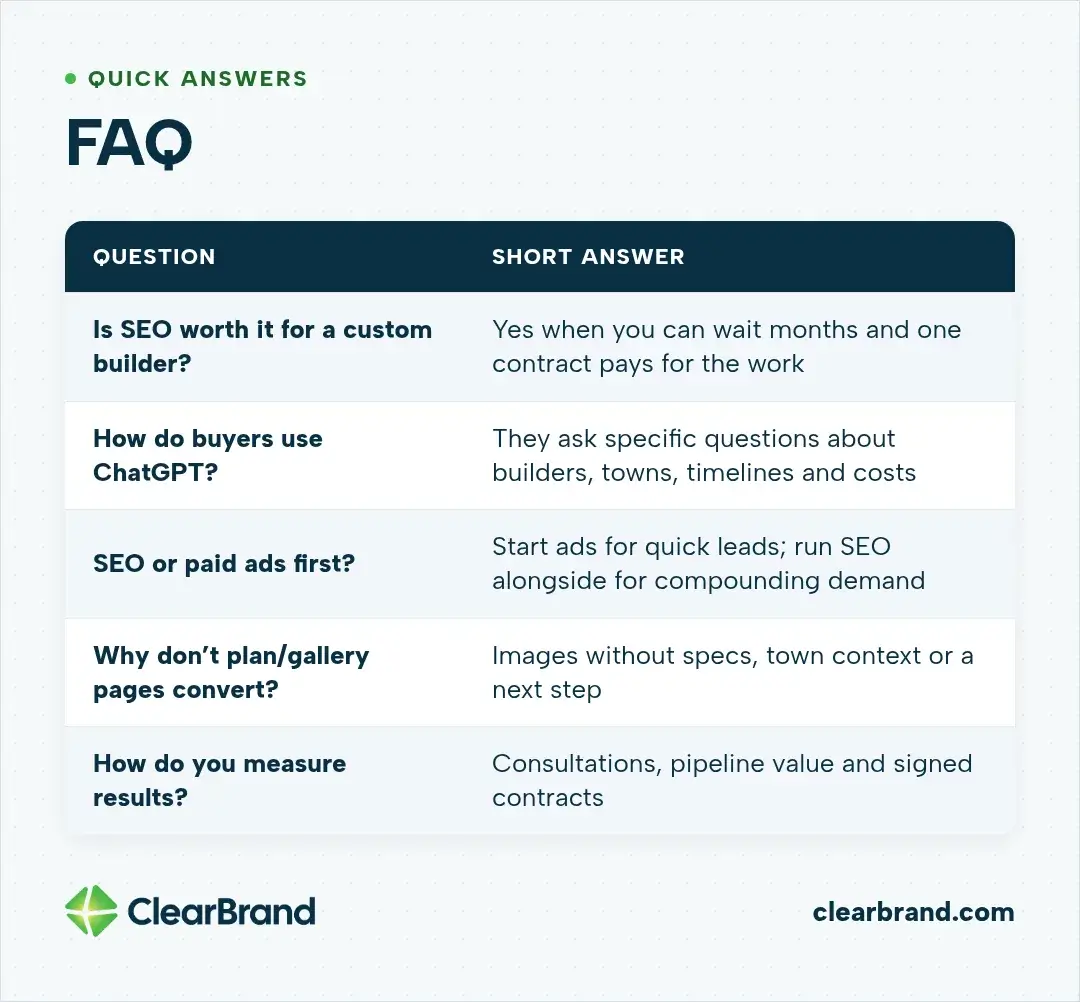
Is SEO worth it for a custom home builder?
SEO is worth it for a custom home builder when you can wait months for results and one signed contract justifies the effort. If you need leads this month, start with paid ads and build SEO alongside them.
How do homebuyers use ChatGPT to find a builder?
Homebuyers ask ChatGPT specific questions about builders, towns, timelines and costs. Sites that publish clear proof on those topics give the tool more to draw on.
Should a home builder run SEO or paid ads first?
Most builders should start paid ads for quick leads and run SEO alongside them for compounding demand. An empty pipeline usually needs both.
Why don’t my floor plan and gallery pages produce leads?
Most plan and gallery pages show images without the specs, town context or next step a buyer needs to act.
How do you measure SEO results for a home builder?
Measure consultations, pipeline value and signed contracts. Treat rankings and traffic as early signals only.
Conclusion
Buyers are already asking AI tools who should build their home. The builders most likely to get named are the ones whose sites publish the proof those tools can use: real town pages, real specs and real results.
Get your free SEO audit. It is a full review of your site and an initial 90-day strategy, and you keep it whether you work with us or not.
For how we work with builders and contractors, see our SEO for construction companies page. If you also build commercial projects, our construction SEO playbook covers both sides.