

When you choose a SaaS SEO agency or an in-house hire, you are deciding who does the work, who manages it, and how much money and time the choice takes.
Use an agency when you need people who can start this month and you do not yet have someone who can manage SEO quality as a full-time job. Hire in-house when you can fund a senior person who will do the work, you already have someone who can manage them, and product and engineering will give that person time in the sprint.
If you already lean one way, look at salary plus benefits and tools, at the workload one person can cover, and who’s going to manage them before you post a job or sign a retainer.
Key Takeaways
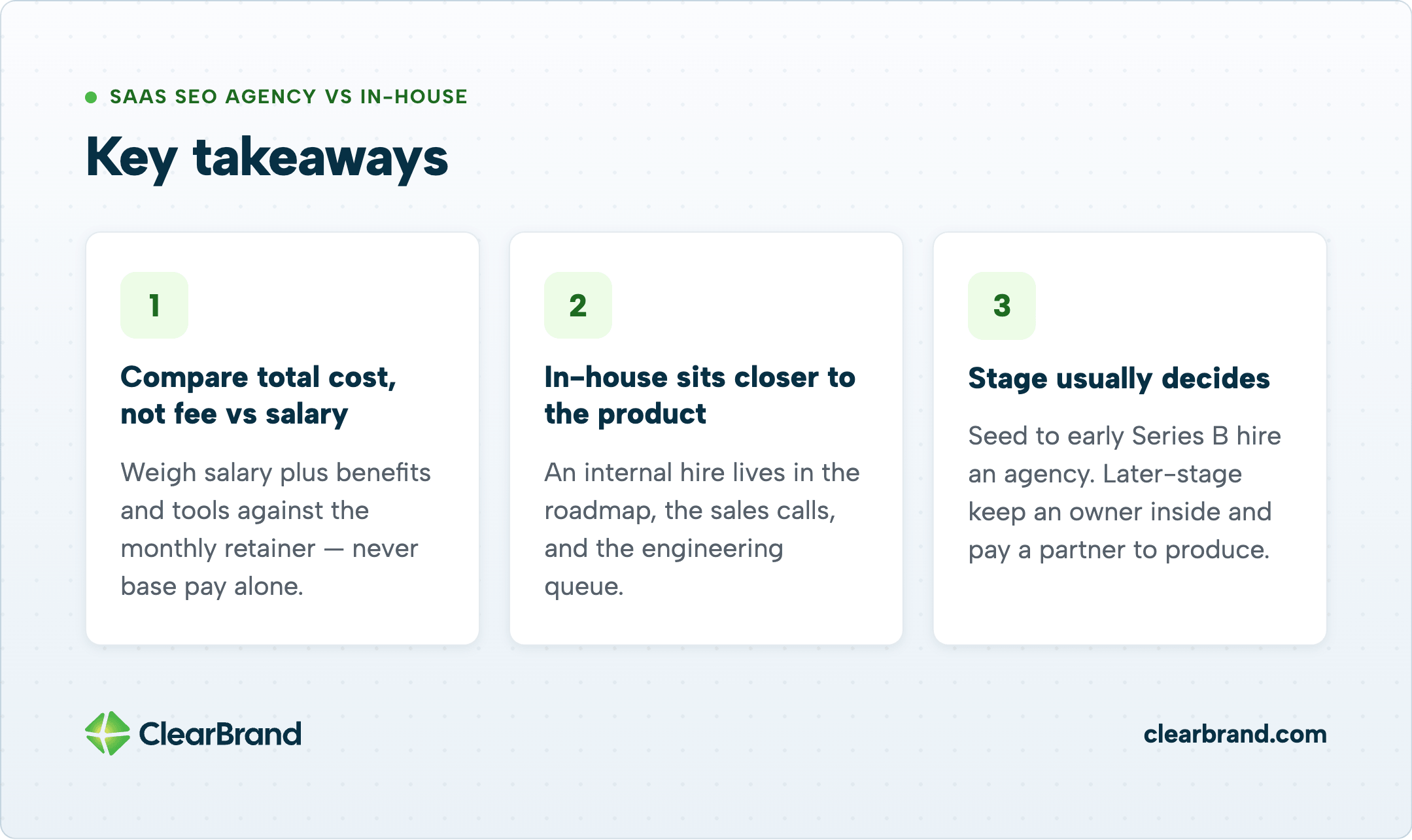
- Compare salary plus benefits and tools, not salary versus the monthly agency fee.
- An in-house hire is closer to the product and the engineering queue.
- Seed through early Series B teams usually hire an agency. Later-stage teams usually keep someone inside to set priorities and pay a partner to produce the pages.
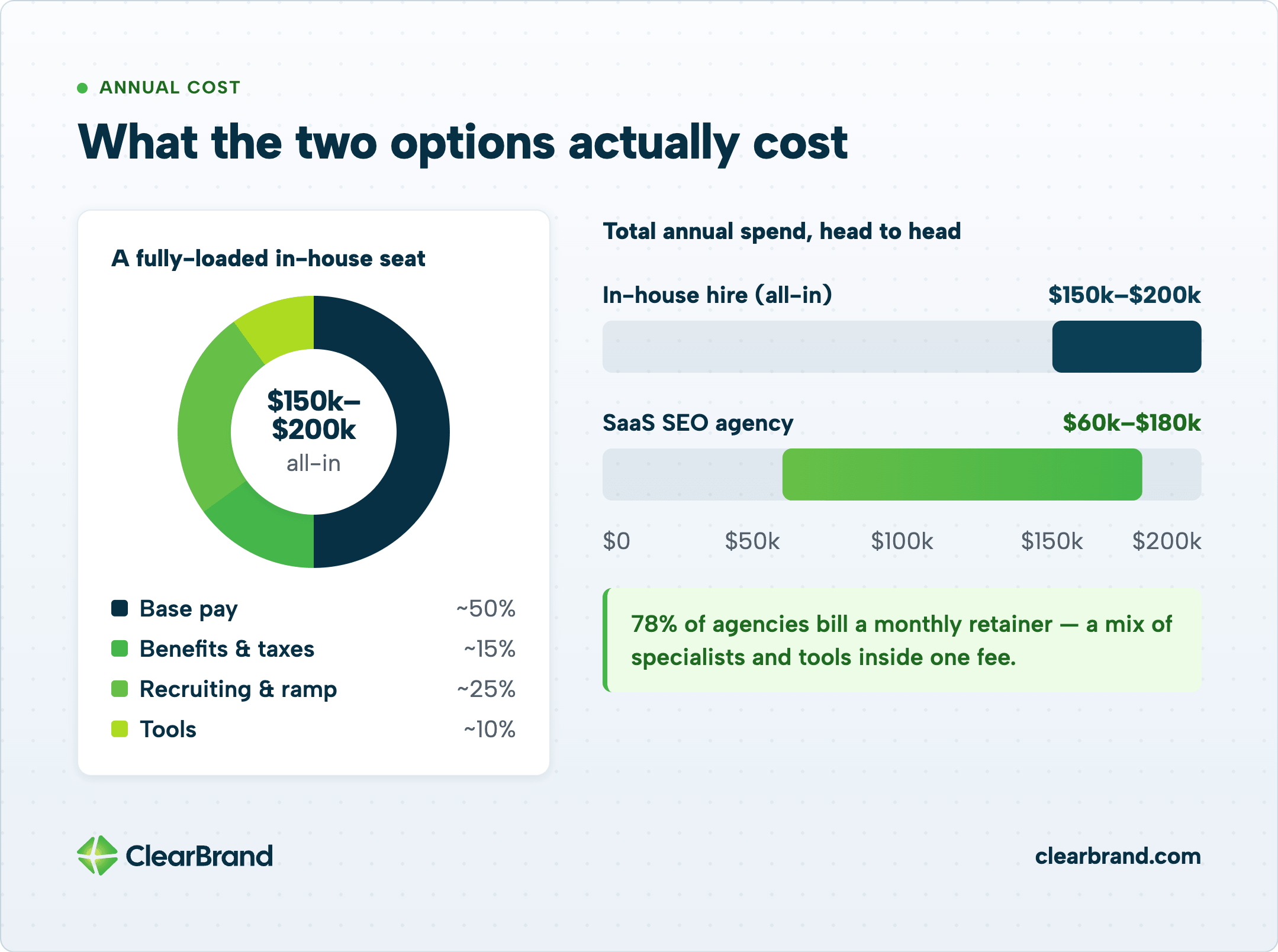
SaaS SEO agency vs in-house at a glance
A specialized SaaS SEO agency is usually cheaper and faster to start than a fully loaded in-house hire. An in-house person wins on product knowledge and day-to-day control.
| Factor | SaaS SEO agency | In-house SEO |
|---|---|---|
| Typical cash out | Growth-tier retainers commonly land around $5,000–$15,000 a month. Industry surveys put the average agency retainer near $3,200. | One specialist often costs $81,000–$115,000 in pay, then benefits, tools, and hiring lag. A manager-plus-writers team is a different budget. |
| Time to start | Weeks to onboard. | Months to hire, then months to ramp. |
| Skill coverage | Strategist, writer, technical, and reporting under one contract. | One person’s stack. Extra work goes to a freelancer or a second hire. |
| Product knowledge | Has to be taught. | Sits in Slack, sales calls, and roadmap reviews. |
| Tools | Usually bundled. | Extra. Ahrefs plans run $129–$1,499 a month. |
| Control | You manage a partner. | You manage an employee. |
| Risk | Vendor quality and divided attention. | Vacancy, severance, and a single point of failure. |
| Pipeline ownership | You still own demos, trials, and CRM. The partner owns the work plan. | Easier to sit with product and sales. Still needs a way to count trials and demos. |
If you already have writers and a developer, a consultant can write the plan. You still need someone to publish and implement it.
What a SaaS SEO agency vs an in-house hire actually costs
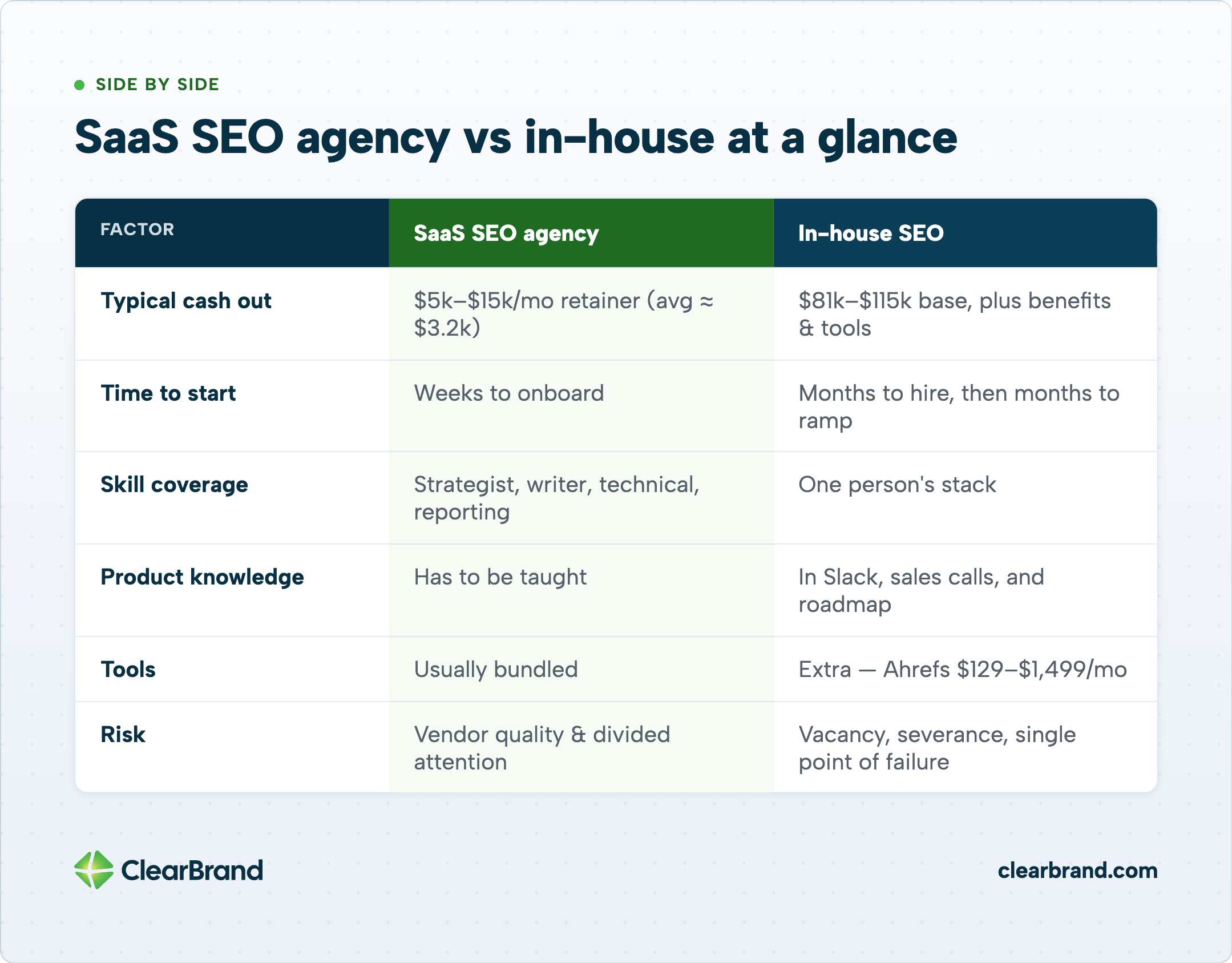
Let’s start with the in-house SEO hire. Indeed’s U.S. SEO specialist average is about $81,211 a year as of September 2026. Glassdoor’s specialist total-pay band runs roughly $66,000–$115,000. Senior manager titles sit higher. The BLS marketing specialist series sits below what most SaaS SEO managers earn.
Benefits and payroll taxes commonly add about 25 to 30 percent on top of base pay when you model a fully loaded seat. Tools sit outside salary. Ahrefs starts at $129 a month for Lite and runs through $249, $449, and $1,499. Content and crawl tools stack on top.
Recruiting and ramp-up happen first. You pay for the search, the interviews, the offer, and the first months while that person learns the product, the tools, and the buyers. Then the new hire can get into sales calls, the backlog, and Search Console before they start publishing articles or pages.
Ad that all up (recruitment time, training, base pay, benefits, time off, tools, etc.), and you’re looking at $150k-$200k minimum for an in-house hire.
Now let’s look at an agency’s cost.
Most SaaS SEO agencies bill a monthly retainer. Ahrefs’ survey of 439 providers found 78.2 percent use that model and cited an average agency retainer near $3,209 a month. Articles that compare SaaS SEO programs usually quote $5,000–$15,000. Tools and a mix of specialists are usually inside the fee.
The output is generally lower than what a full-time person can do. But for $60k-$180k that’s a fine trade.
When a SaaS team asks me whether they should hire instead of keeping an agency, the answer usually comes down to cost and management.
The default is an agency. In-house starts to make sense when you can fund a senior marketing director or SEO manager who will actually write, ship, and report, not only run meetings. One person who can set strategy and publish at a useful pace is rare. If paying that seat would strain cash, do not hire it to save money on a retainer.
If you need the monthly scope spelled out, read what an SEO retainer covers.
What one in-house SEO can cover versus a SaaS SEO workload
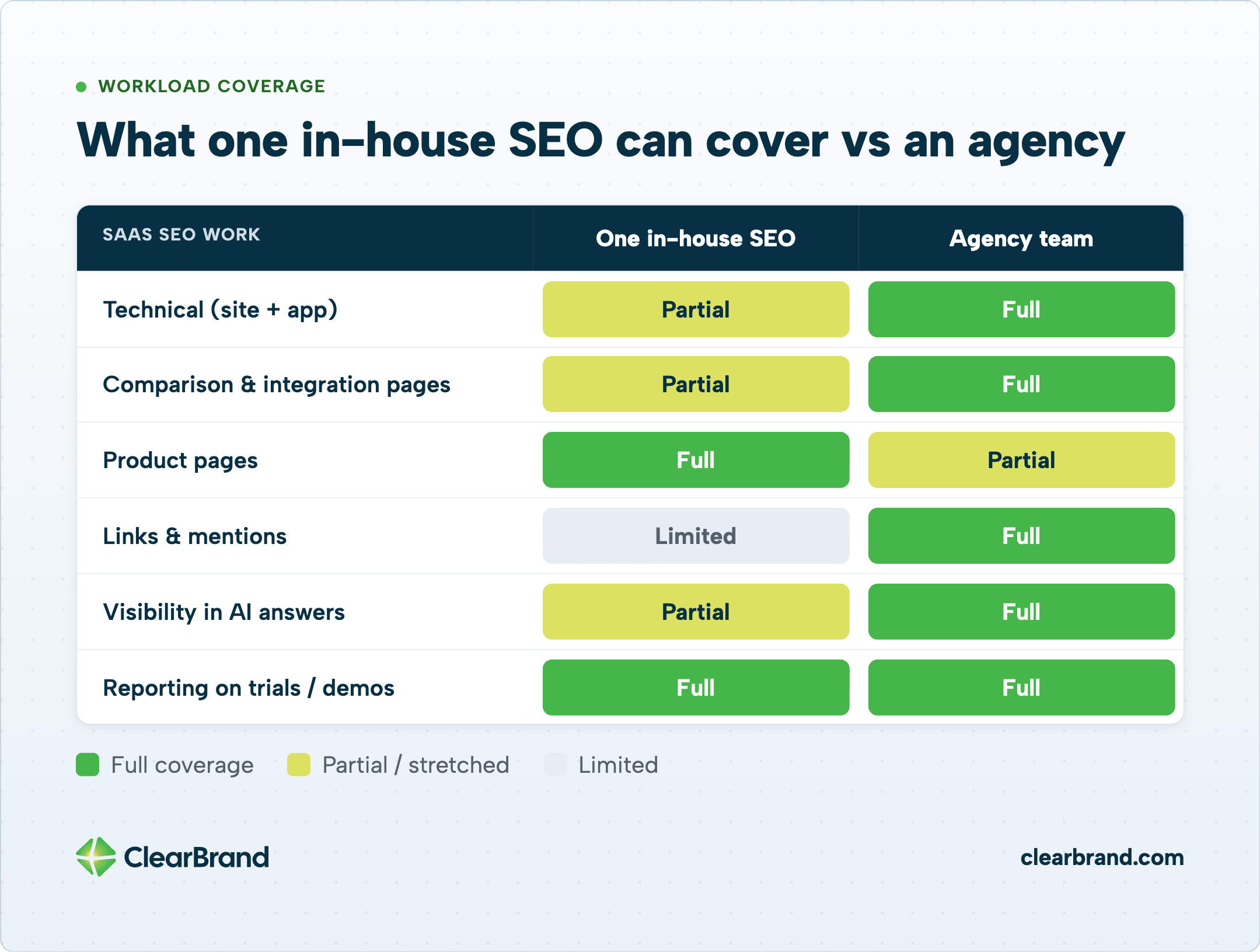
One in-house SEO on a SaaS program handles technical work on the marketing site and the app domain, comparison and integration pages, pages about the product, links or mentions, visibility in AI answers, and reporting tied to trials or demos.
That person can own the roadmap and some of the publishing. They cannot sit in the engineering queue, ship a set of comparison pages, and run outreach as a multi-person team would in the same quarter.
An agency spreads that work across people. Someone inside the company still has to answer product questions, approve copy, and get tickets into the sprint. If that internal time is missing, the agency writes drafts that stall in review and tickets that never ship.
I’ve built our company using the same basic principles as a manufacturing facility. Think of building a car. If you hired somebody to build you a custom car, you could go be extremely proud that nobody on the planet has that exact car.
At the same time, that person is not able to become an expert in each of the elements of car building, so it generally also will not be as good overall.
Car manufacturers have a massive edge on the general public because they can:
- Become experts in every tiny piece of building a car
- Systematize it to a much greater extent than any one person could do
So, the right agency can, if done well, produce incredible content, technical, and authority for multiple companies at a great price if they are refining each element like a factory does.
Product knowledge, engineering access, and who owns pipeline
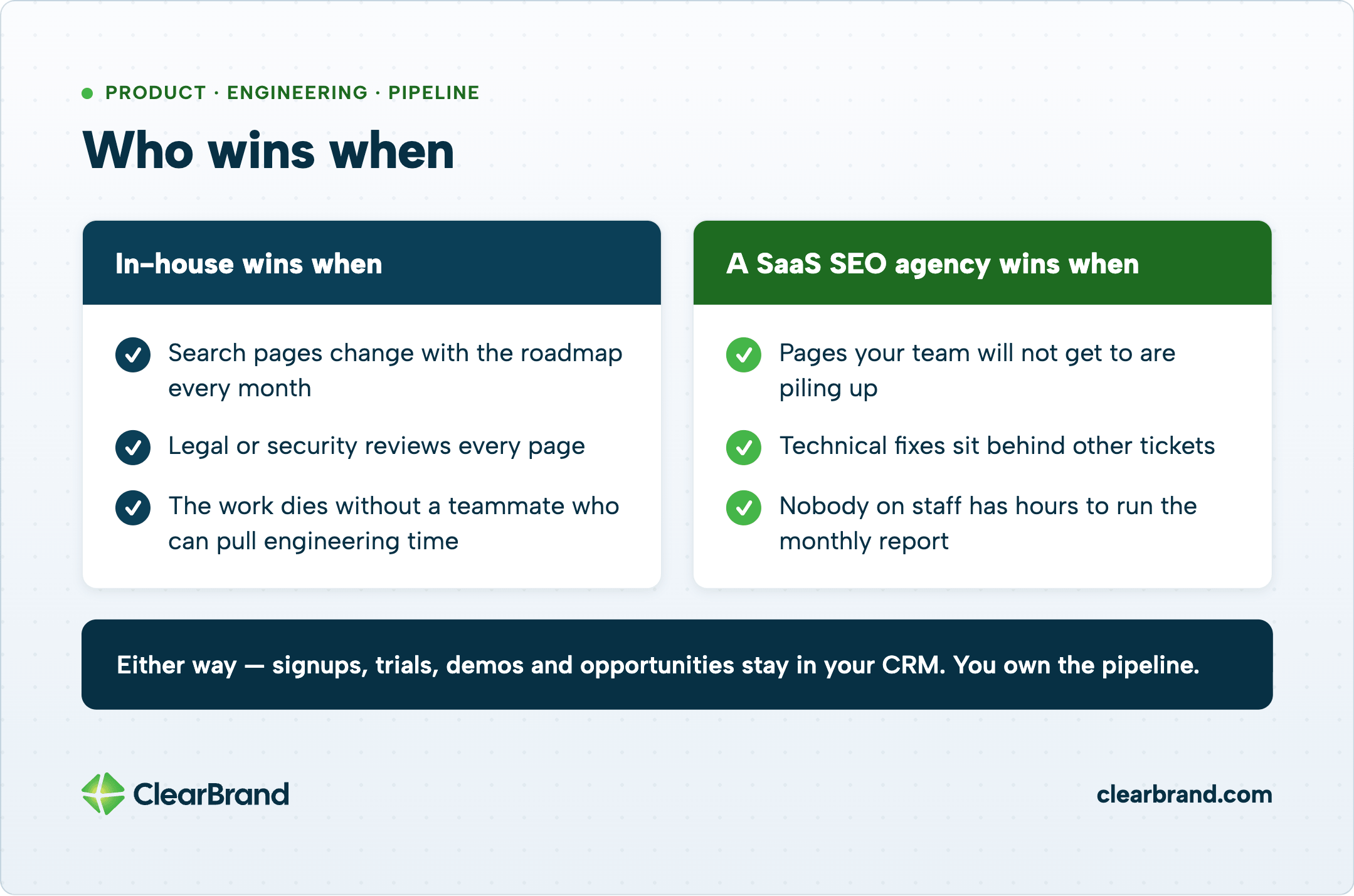
An in-house SEO hire wins when search pages have to change with the roadmap every month, when legal or security reviews every page, and when the work dies without a teammate who can pull engineering time. That hire can sit in the standup, hear that a feature is slipping, and rewrite the comparison page before it ships stale.
A SaaS SEO agency wins when the missing piece is production: pages your team will not get to, technical fixes sitting behind other tickets, and a monthly report nobody on staff has hours to run. The agency can move on those jobs if someone inside still answers Slack and signs off on copy.
At ClearBrand, we also solve a couple of the standard issues that would lead to an in-house hire. We regularly interview our clients to find out what is needed, pivot quickly, and also to gain expert insider information, perspective, and opinions that inform the content that we write.
We also build in a two- to five-day review period where the client can make factual corrections, the way that an internal team member might be able to.
Signups, trials, demos, and opportunities stay in your CRM either way. The agency or the hire can pull Search Console and suggest pages.
When to hire a SaaS SEO agency, go in-house, or run both
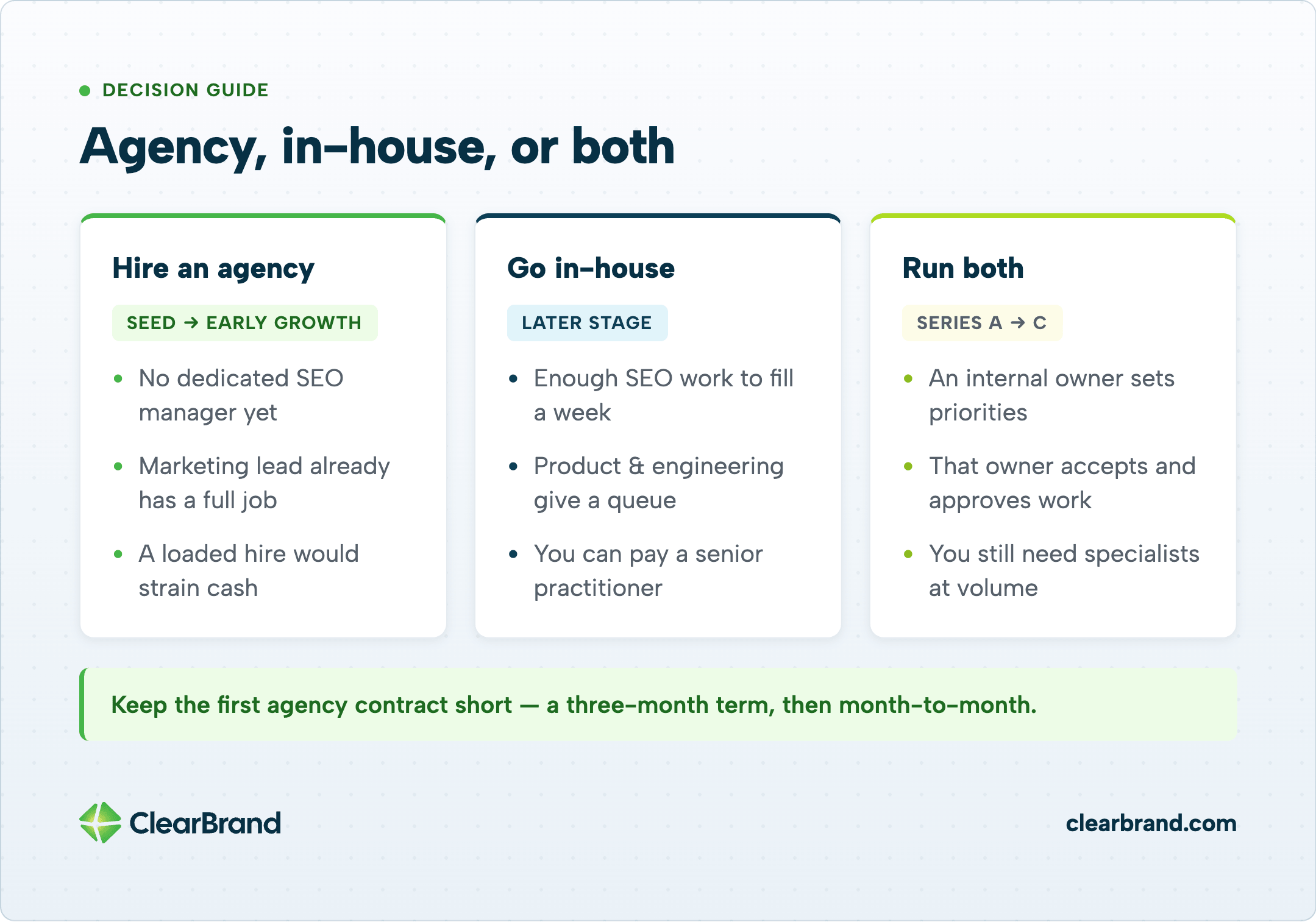
Hire a SaaS SEO agency when you don’t have a dedicated SEO manager, your marketing lead already has a full job, or a fully loaded hire would put pressure on cash. Seed through early growth is the usual fit. If the open question is whether search should be funded at all, start with whether SEO is worth it.
Hire in-house when there is already enough SEO work to fill a week, product and engineering will give that person a queue, and you can pay a senior practitioner rather than a junior generalist who will need a teacher. Making an SEO hire with no manager and no engineering access risks spending the quarter writing tickets and waiting on reviews.
Run both when you can name an internal owner who sets priorities and accepts work, and you still need specialists to produce at volume. Most Series A to C teams keep strategy inside and send production to a partner once search is producing enough work to manage every week.
Keep the first agency contract short. A three-month first term, then month-to-month, is enough time to see early signals without locking a year on day one.
If you have already picked a partner, use 15 questions to ask an SEO agency before you sign.
If you want a SaaS-specific team to run the work, see SEO for SaaS.
How to judge the choice after 90 days
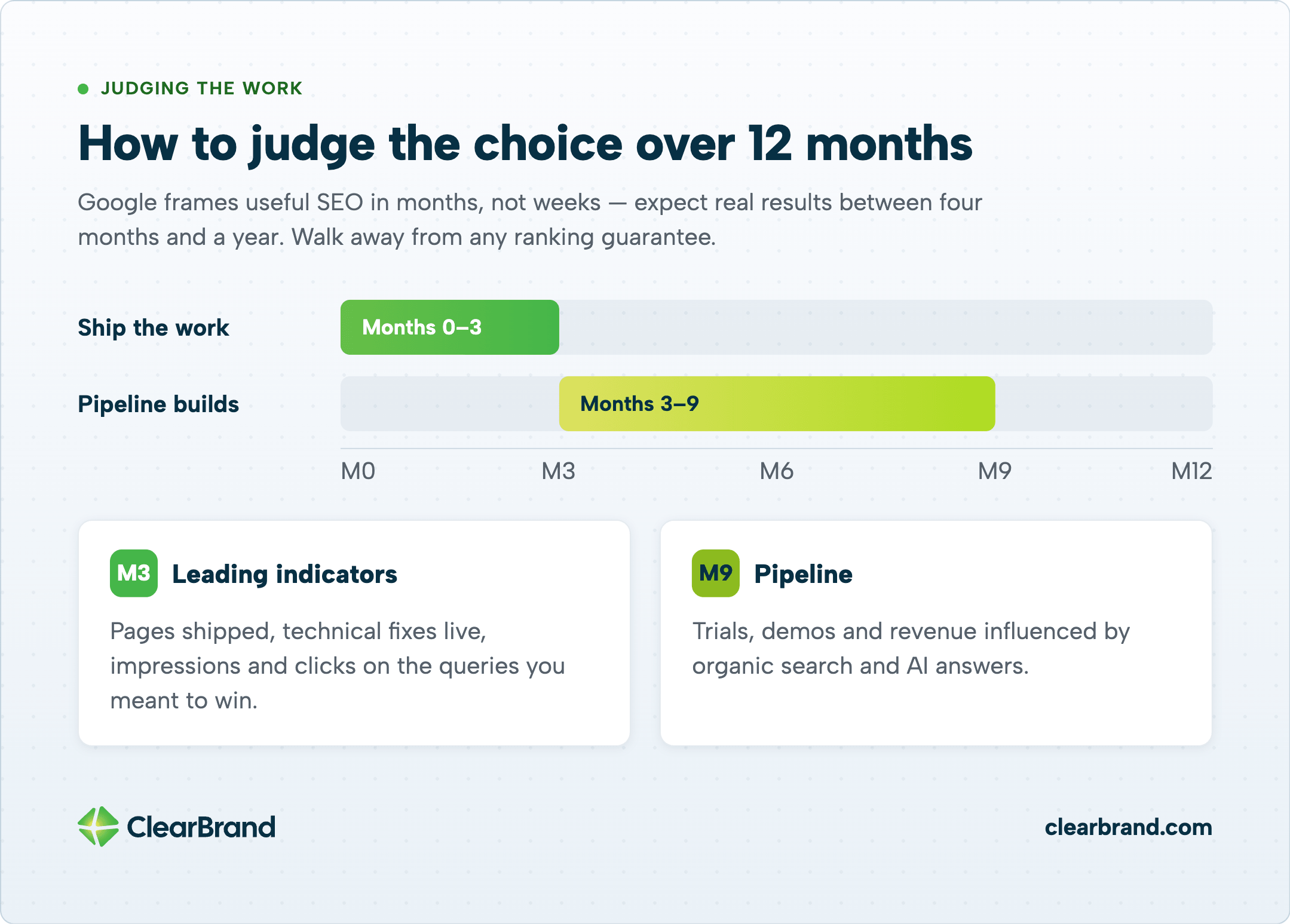
Google’s hiring guidance tells you to judge SEO work in months, not weeks, whether you hired an agency or an in-house person. Useful results often take four months to a year. Ask any firm or candidate what they expect to see in that window and how they will measure it. Walk away from a ranking guarantee.
By month 3, look at leading indicators: pages shipped, technical fixes live, impressions, and clicks on the queries you meant to win. Those numbers tell you whether the work is on the site and whether search is starting to notice it.
By month 9, look at pipeline: trials, demos, and revenue influenced by organic search and AI answers.
If those signals are missing, the staffing choice may be wrong. The brief, the site, or the engineering queue may be wrong too. Changing vendors or posting a job does not fix a page that never shipped.
FAQ
Is a SaaS SEO agency cheaper than an in-house hire?
A SaaS SEO agency is usually cheaper than a fully loaded in-house specialist once you add benefits, tools, and hiring time. A mid-level specialist wage around $81,000 becomes a much larger number after payroll costs and software. Compare that to a retainer that already includes a mix of specialists.
Can one in-house SEO do what an agency does?
One in-house SEO almost never covers the full SaaS stack of technical work, comparison pages, content, links, and AI search. They can own strategy and some of the publishing. The rest is extra work for a freelancer, a second hire, or a partner.
How long does a SaaS SEO agency take to learn our product?
Most SaaS SEO agencies need about 30 days to learn the product, audience, and stack. That is still shorter than a hire-and-ramp cycle of several months.
When should a SaaS company move SEO in-house?
Move in-house when search already brings customers, you can pay a senior hire, and product and engineering will work with that person every week. Most teams wait until they also have someone who can manage the hire.
How much does a SaaS SEO agency cost per month?
Specialized SaaS retainers in current comparison articles usually land between $5,000 and $15,000 a month. Broader industry surveys put the average closer to $3,200. The monthly number depends on the work in the contract.
How long until either model produces pipeline?
A SaaS SEO agency or an in-house hire should show leading indicators by month 3 and pipeline movement by month 9. Neither produces a reliable pipeline in the first few weeks. Google still frames useful SEO work in a four-month to one-year window.
Should we start with an agency and hire in-house later?
Yes. Start with an agency to get a system and a baseline, then hire an internal owner once the channel is worth managing every day. Keep the agency if that person still needs production help.