

An SEO retainer is a fixed monthly fee for ongoing search work: technical fixes, pages, authority, and reporting that continue after the first audit.
Most quotes hide what you are buying. You get a number, a list of activities, and a six- or twelve-month commitment. Before you sign, you need to know what the fee buys this month, what it leaves out, how to judge the first 90 days, and which contract lines actually bind anyone.
Key Takeaways
- An SEO retainer pays for recurring work on a live site, not a one-time report.
- A complete retainer covers technical work, pages that match real queries, authority, and reporting tied to leads and sales.
- Ads, conversion-rate rebuilds, and a new website stay outside the SEO fee unless the contract names them.
- Use a project for a single job, and a retainer when the site needs work every month.
- Industry surveys put most agency retainers near $3,200 a month. That number only makes sense next to scope.
- By month 3, look at impressions, live pages, and early rankings. By month 9, look at leads and revenue.
What an SEO retainer is
You pay a set monthly fee. The agency or consultant keeps working on the site instead of delivering one audit and leaving.
The monthly model exists because the site does not sit still. Competitors publish. Templates break. Google and answer engines change what they show. A finished PDF cannot keep up.
Ahrefs’ pricing survey of 439 providers found that 78.2% charge a monthly retainer. That is how most SEO work is sold.
No retainer can guarantee first place. Google’s hiring guidance tells you to ask for a timeframe and for examples of prior work, and to leave if someone promises a ranking. You are still responsible for what the hired firm does on your site.
What an SEO retainer includes
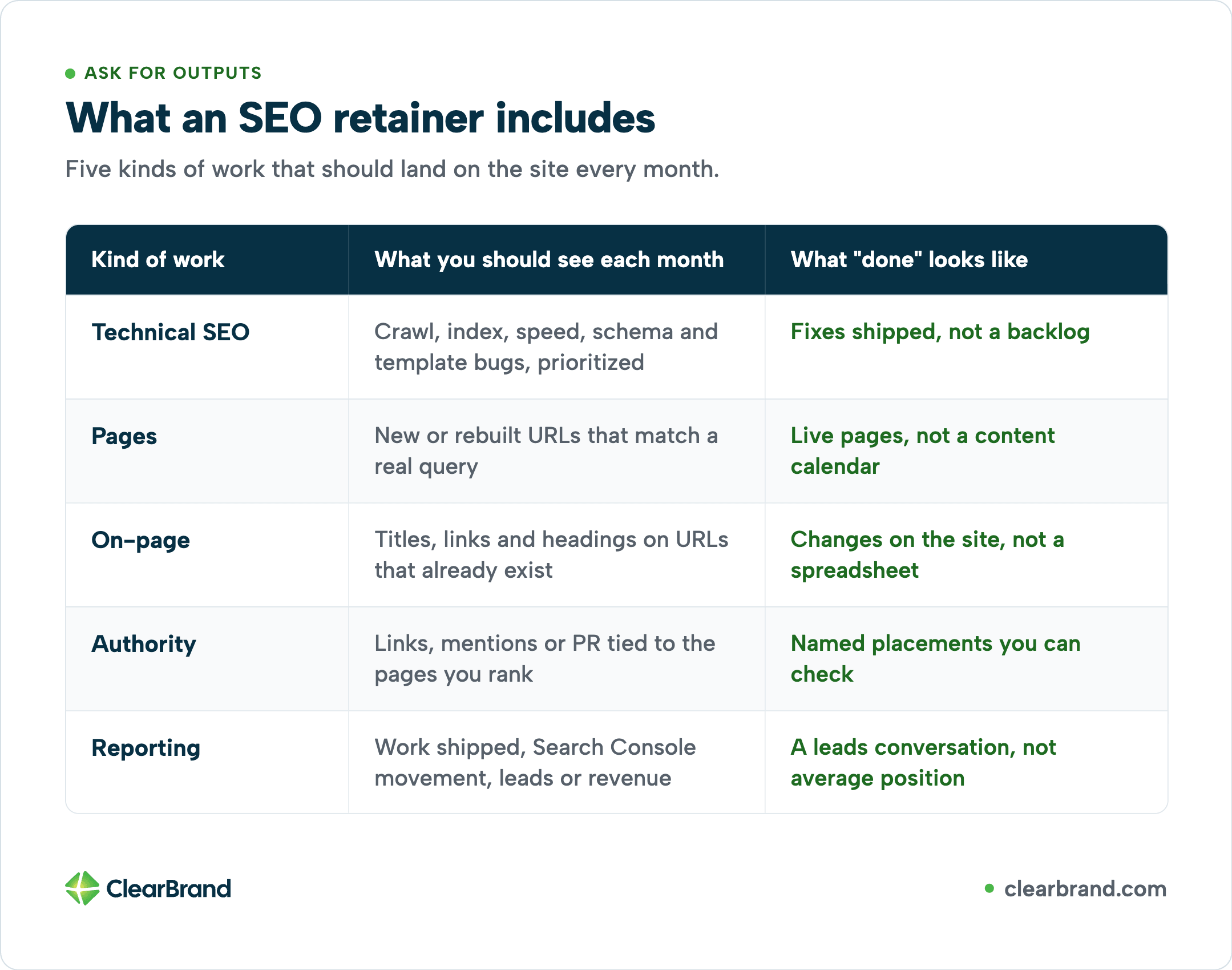
Ask for outputs. “Ongoing optimization” does not tell you what lands on the site. These five kinds of work do.
| Kind of work | What you should see each month | What “done” looks like |
|---|---|---|
| Technical SEO | Crawl, index, speed, redirects, schema, and template bugs, prioritized | Fixes shipped, not a backlog of recommendations |
| Pages | New or rebuilt URLs that match a real query | Live pages with a next step, not a content calendar |
| On-page | Titles, internal links, headings, and copy on URLs that already exist so they match the search | Changes on the site, not a spreadsheet of suggestions |
| Authority | Links, mentions, or digital PR tied to the pages you are trying to rank | Named placements you can check, not a link quota |
| Reporting | Work completed, Search Console movement, and leads or revenue from organic | A conversation about leads and sales, not only average position |
AI search belongs in the same monthly work. That means pages worth citing, schema that matches the page, and a record of whether ChatGPT, Perplexity, Gemini, or AI Overviews mention you. How to rank in AI Overviews covers that page work if you need the mechanics.
If the map results Google shows for local searches are part of the job, Google Business Profile work belongs in the scope in writing. If it is not written down, do not assume it is included.
Technical work that actually ships
In the first useful month, the team usually spends more time on the site than on new articles. Later pages cannot rank until indexation, robots, canonicals, 404s, redirect chains, and Core Web Vitals are in acceptable shape.
Ask who implements the fixes. Some retainers only write tickets for your developers. That can work if you have the engineering time. If you do not, the audit sits in a folder and the monthly fee buys a reminder.
Priority matters as much as the list. A retainer that finds forty issues should ship the three that block indexation, not send you the spreadsheet. If the firm only writes tickets and never changes the site, the monthly fee is paying for a document.
Pages that match a search
Content inside a retainer should map to a search. Comparison, alternatives, use-case, service, and integration pages do that. A monthly blog count does not.
A useful scope names a publishing schedule and the page types. Some agreements say two pages a week. Others say eight or nine URLs a month. Either version works if the page types are written down and the URLs exist on the site when the month ends.
If the scope says eight articles and never names the URLs, you will get drafts instead of pages a buyer would find.
Which page to build first depends on how your buyers shop. For a longer B2B cycle, that page order lives in the B2B SEO strategy guide. The retainer should point at pages written for people who are ready to buy, then use guides to support them. Expert interviews belong on the calendar if the pages need a point of view only your team has. Without that time, the writer fills the gap with generic category copy.
Authority work you can check
Off-site work in the retainer should support pages you already planned. A mention next to a query you care about is useful. A mass directory submission that never names those pages is not.
Ask for the placement, the date, and the page it was meant to help. If the report only shows a link count, you cannot tell whether the work reached the pages that produce leads.
Reporting a leadership team can use
Rankings and impressions show that search visibility started to move. Leads and revenue decide whether the monthly fee is worth keeping.
A usable monthly report answers three questions: what shipped, what moved in Google Search Console, and whether organic produced leads, demos, trials, or revenue.
One week of rising impressions and falling clicks is a note. Look at the query. AI Overviews may have started appearing. A competitor may have taken the snippet. The page may not match the search. None of that replaces the leads question. If leads are flat for a quarter, that is the conversation, even if the ranking chart looks fine.
What an SEO retainer does not include
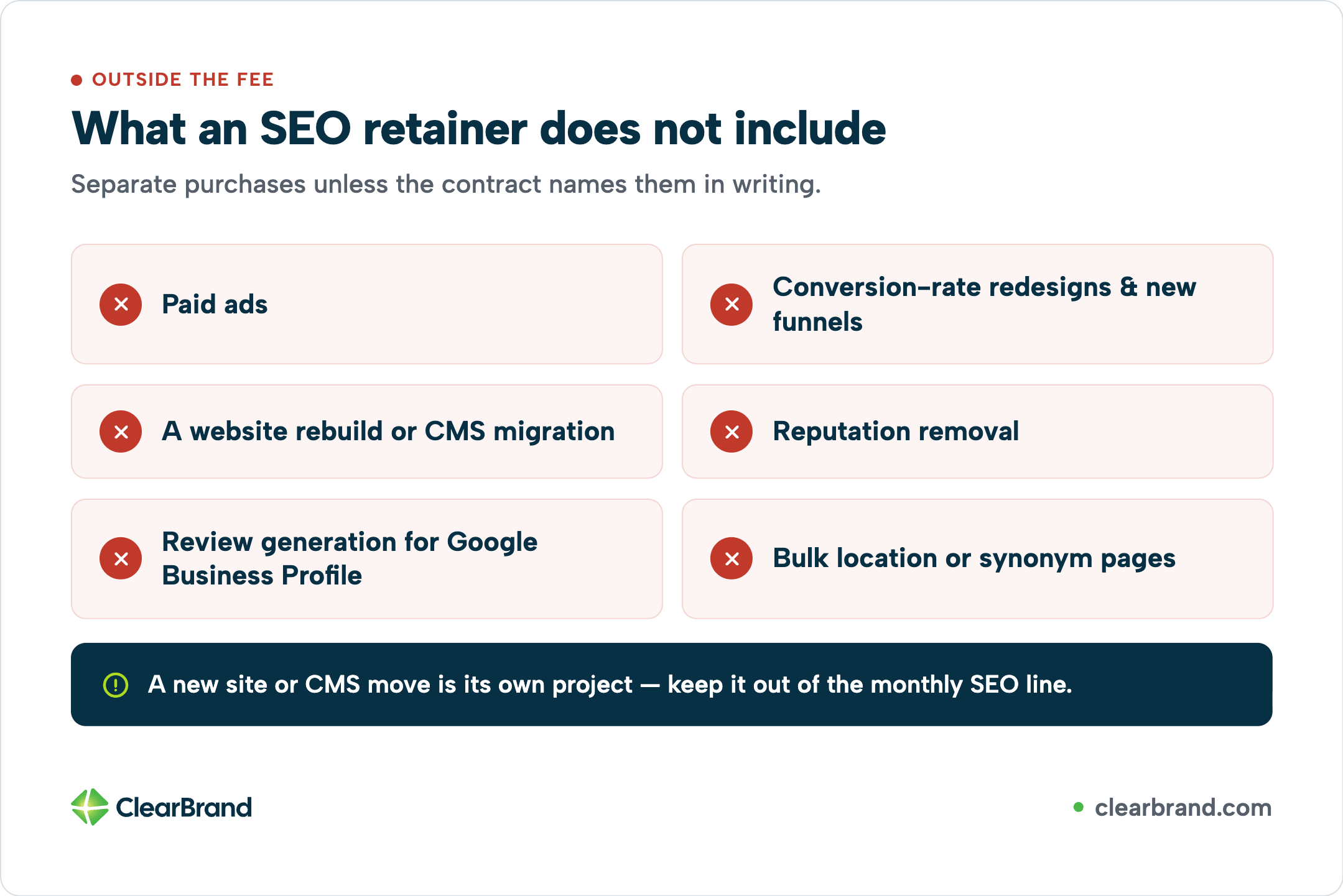
These are separate purchases unless the contract names them:
- Paid ads
- Conversion-rate redesigns and new funnels
- A website rebuild or a CMS migration
- Reputation removal
- Review generation for Google Business Profile
- Bulk-generated location or synonym pages with little unique content
A new site or a move to a new CMS is its own project. The monthly SEO fee assumes the site already exists and needs ongoing search work. Mixing a rebuild and a search program in one line item makes both harder to judge. You cannot tell whether a slow month is a search problem or a launch problem.
SEO retainer vs project vs hourly
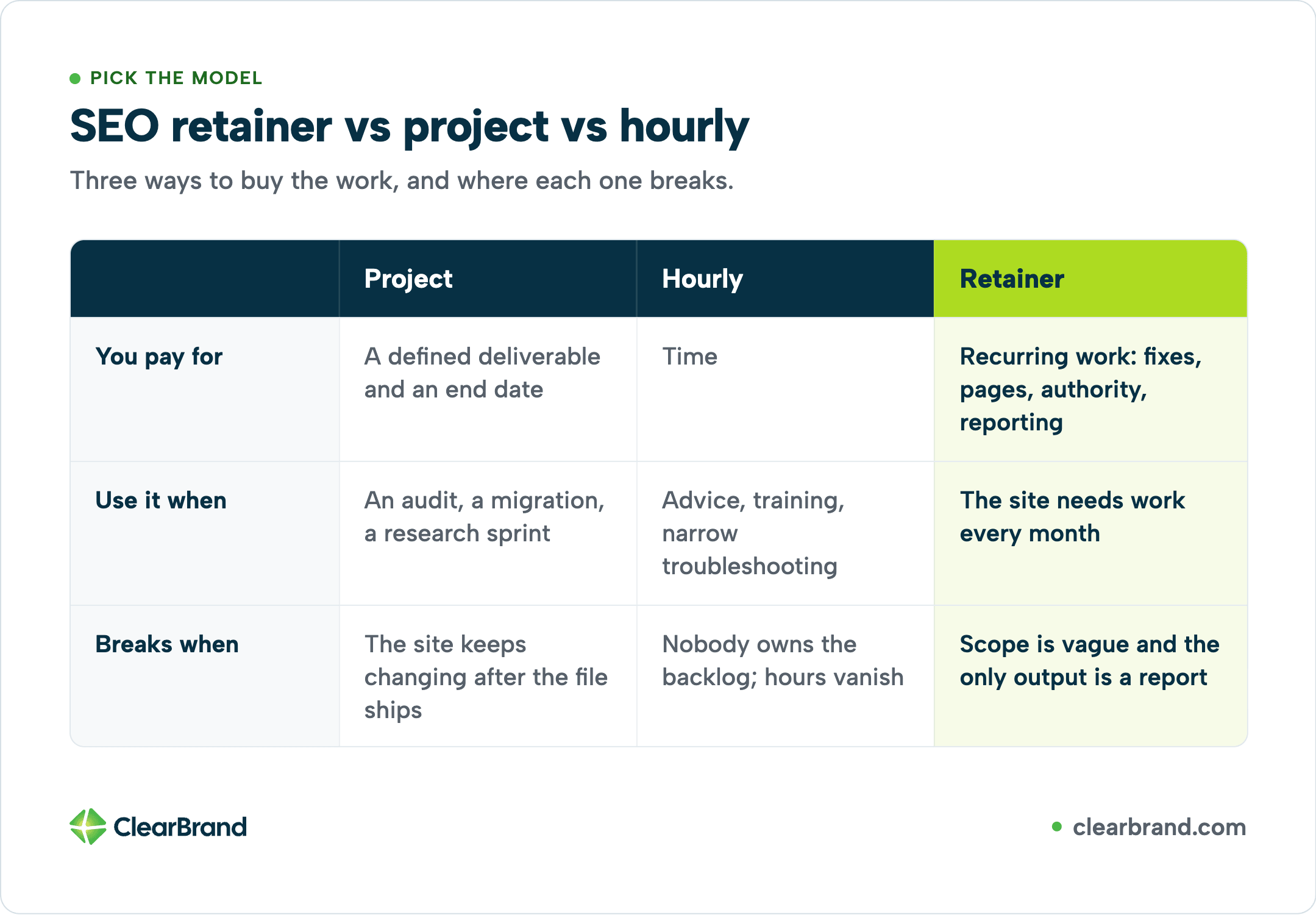
| Model | You pay for | Use it when | Breaks when |
|---|---|---|---|
| Project | A defined deliverable and an end date | An audit, a migration, a research sprint | The site keeps changing after the file is delivered |
| Hourly | Time | Advice, training, a narrow troubleshooting block | Nobody owns the backlog and unused hours vanish |
| Retainer | Recurring work across technical fixes, pages, authority, and measurement | The site needs work every month | Scope is vague and the only output is a report |
A clean sequence for most companies is a short diagnostic project, then a retainer that executes the plan. The diagnostic should produce a list of queries mapped to URLs, a technical priority list, and a 90-day schedule. Signing a twelve-month retainer before anyone has seen the site is how you buy the wrong scope.
Hourly work can sit inside a retainer. Some firms sell a block of hours and call it a retainer. Ask whether unused hours roll over. Most do not. If the agreement is deliverables, hours are the wrong unit to track.
The other split is who holds the leftover tasks. In a project, those tasks end when the file is delivered. In a retainer, someone has to decide what gets cut when a launch, a migration, or a penalty shows up mid-month. If that decision is not written down, the loudest request wins and the pages meant for buyers wait.
What the first 90 days of an SEO retainer look like
Month 1 of a retainer should show access, a plan, and the first fixes on the site. Do not treat revenue in month 1 as proof the retainer works.
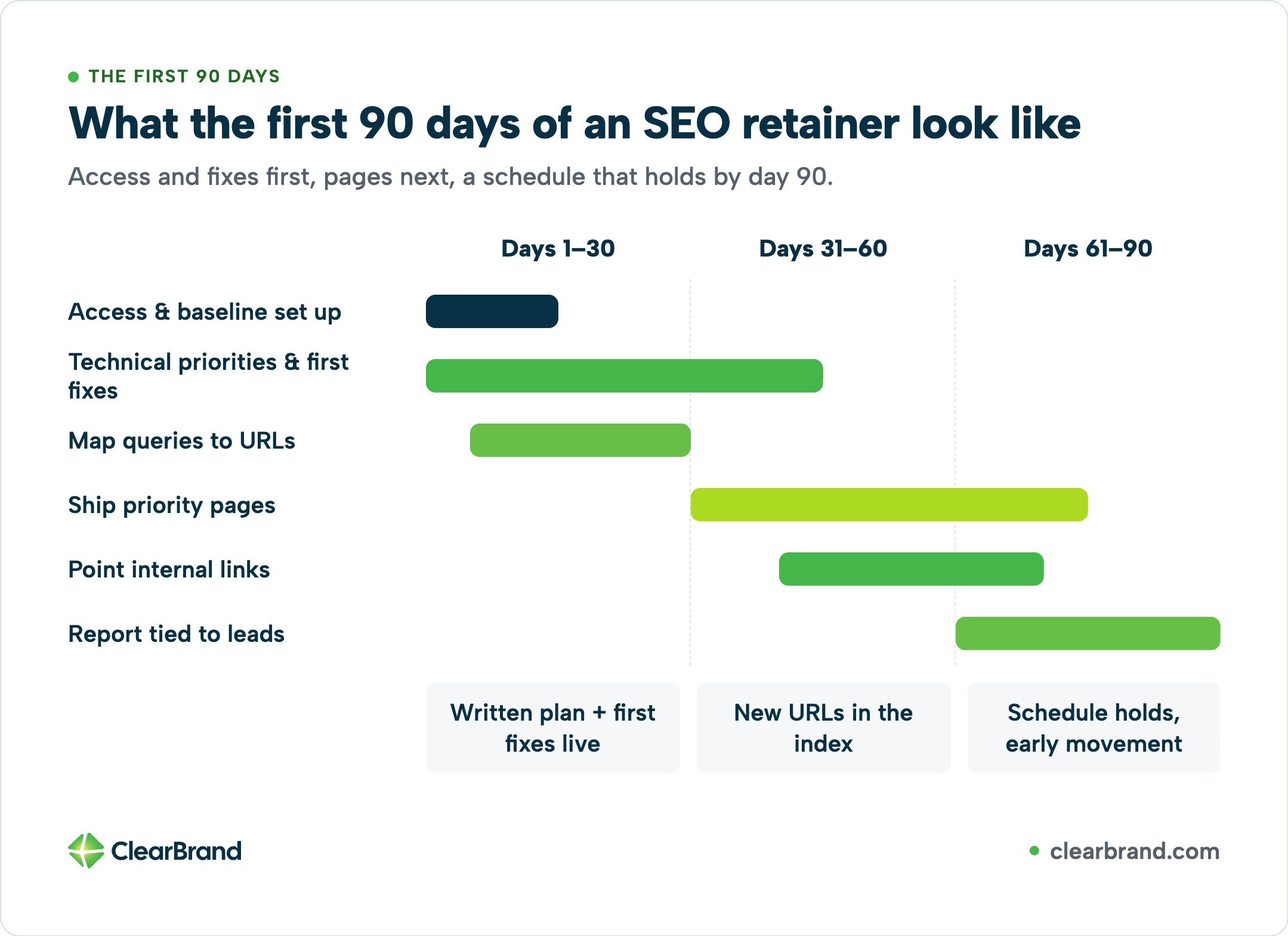
| Window | Work that should happen | What “working” looks like |
|---|---|---|
| Days 1–30 | Access, baseline in Search Console and analytics, technical priorities, queries mapped to URLs | A written plan and the first fixes live |
| Days 31–60 | Priority pages for ready-to-buy searches shipped or rebuilt, internal links pointed at those URLs | New or improved URLs in the index |
| Days 61–90 | The schedule holds. Early movement on easier terms. Reporting tied to leads, not only positions | You can name what shipped and what it is for |
Days 1–30 are access and diagnosis. You should see Search Console and analytics connected, a list of technical blockers in priority order, and a map of queries to URLs. The first fixes should land on the site in that window, not in a slide.
Days 31–60 are when pages for ready-to-buy searches start to exist or get rebuilt. Internal links should point at those URLs. If the only new files are blog drafts with no destination, the schedule has already slipped.
Days 61–90 test whether the monthly schedule still holds. You may see movement on easier terms. You should be able to name the pages that shipped and the searches they target. Revenue here is welcome and still too early to decide the retainer.
After day 90, a month should look the same on paper: plan against Search Console, ship fixes that do not need a rebuild, publish the planned pages, do authority work for those URLs, and report what shipped and what it did to leads.
Most sites need four months to a year before this work shows up as revenue. Ask for that timeframe before you sign. If the first 90 days produce only slide decks, nothing from the monthly fee has been published or fixed on the site.
How SEO retainers are priced
There is no honest public menu that fits every site. Scope, competition, current technical debt, and who does the writing all move the fee.
What you can use as a market check is survey data, not a vendor tier table.
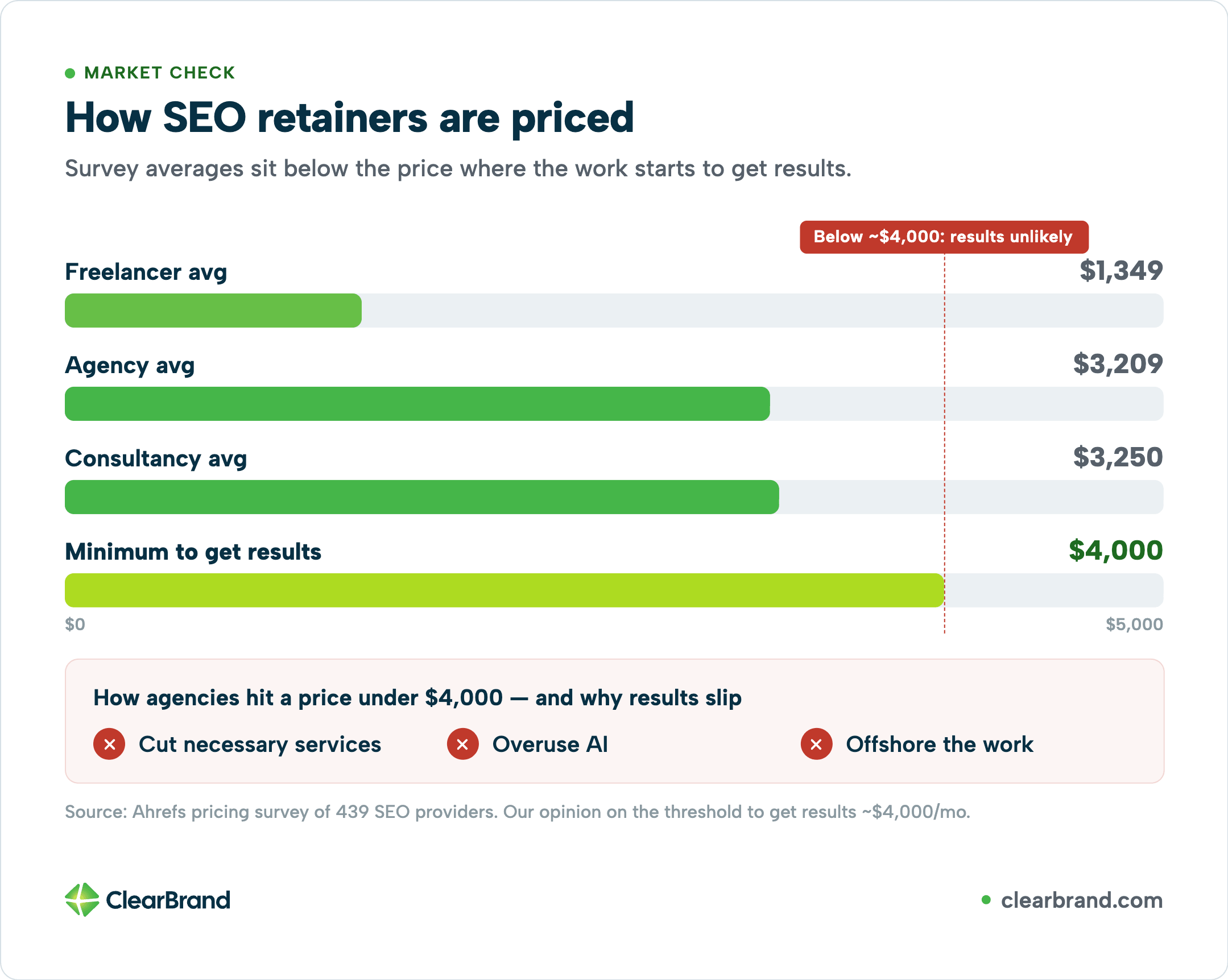
Ahrefs polled 439 SEO providers and reported an average agency retainer of $3,209 a month, $3,250 for consultancies, and $1,348.63 for freelancers. The most common band in that survey was $501–$1,000. Those figures mix local shops and national programs. Treat them as a reference, not a quote.
A $900 retainer that publishes two generic posts and a ranking screenshot is a different product from a $4,000 retainer that ships pages for ready-to-buy searches and technical fixes.
When designing our SEO packages, the question that we kept coming back to was, “Will this actually get results for our clients?” From there, we built the packages to ensure, as much as we could, that we would get results. Only then did we price it out. Our starting price is $5,000/mo with what we would consider to be the minimum services required to increase leads and revenue.
With this in mind, we think packages under about $4,000 per month are unlikely to get results. As far as we can tell, the main ways that an agency would be able to get to a price lower than that is by:
- Not including services that we would consider necessary or minimum
- Overusing AI
- Outsourcing the work to a cheaper country
In all of those scenarios, the likelihood of achieving actual results goes down.
When making a decision, compare the fee to lifetime value and payback, not to the cheapest PDF on page one. The payback math is in whether SEO is worth it. If cash flow cannot carry four to twelve months, wait. A clean proposal does not give you more months of cash.
How to read an SEO retainer contract
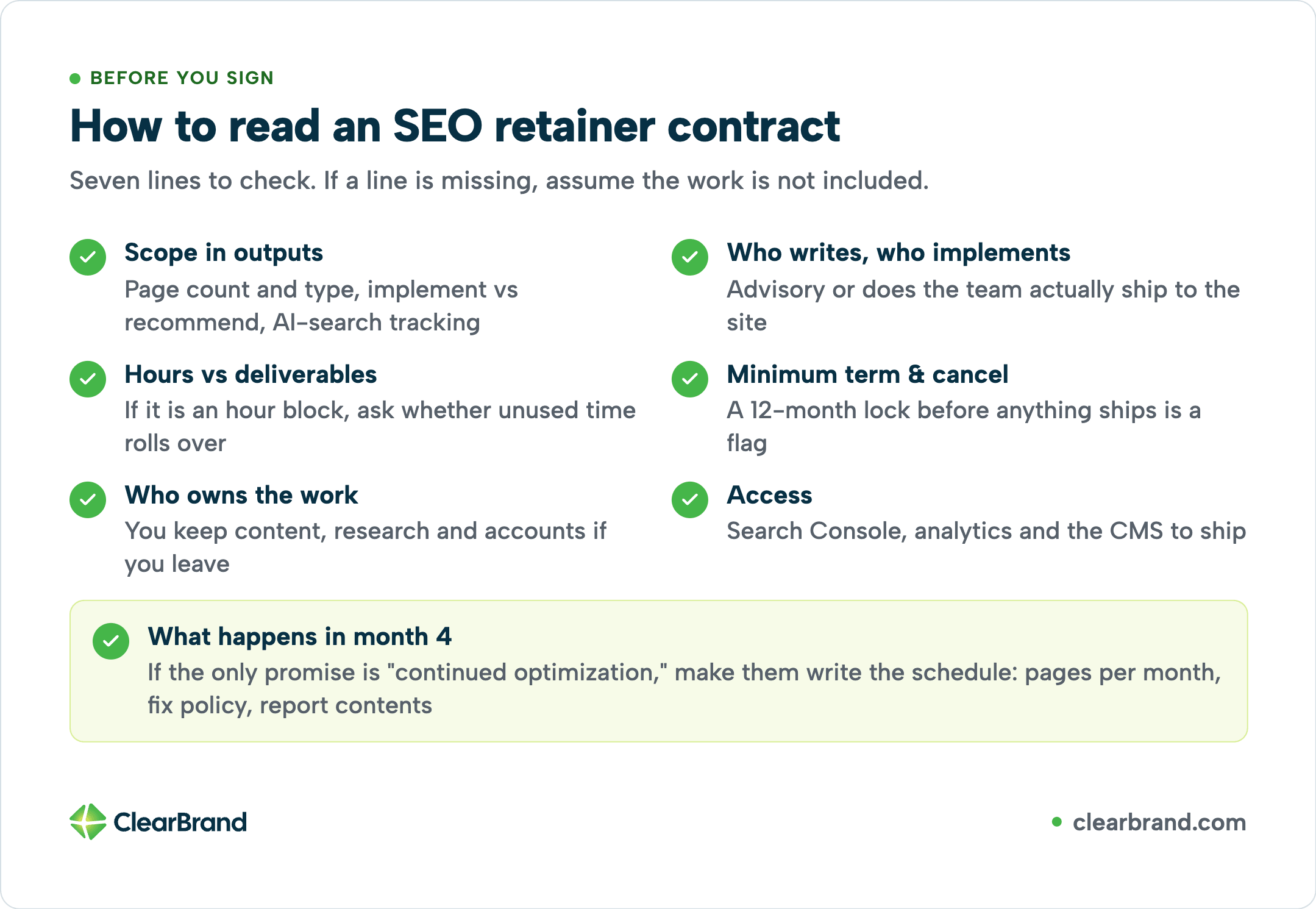
Read the contract for what you will actually receive. If a line is missing, assume that work is not included.
Check these before you sign:
- Scope in outputs. Number and type of pages, technical implementation versus recommendations, and whether AI-search tracking is in the fee.
- Who writes, who implements. If your team has to publish and your developers have to build every fix, the retainer is advisory. That can be the right buy. It is a different buy from a retainer that ships.
- Hours versus deliverables. If the fee is an hour block, ask what happens to unused time. Most retainers do not roll hours.
- Minimum term and cancel. Three- to twelve-month minimums are common. We start with a three-month contract, then month-to-month, because we think you should see some early results inside that first window. After month 3, you should not need a year-long lock to keep the work going. A twelve-month commitment before the firm has shipped pages and shown movement is a flag.
- Who owns the work. Work-for-hire should mean you keep the content, research, and accounts if you leave. Ask where the drafts live and who holds the tool logins.
- Access. Search Console, analytics, and the CMS. Read-only Search Console is enough for a first audit. Ongoing work needs the ability to ship.
- What happens in month 4. If the only promised artifact is “continued optimization,” make them write the schedule. Pages per month. Fix policy. Report contents.
For the questions to run on the sales call, use 15 questions to ask an SEO agency.
How to tell if an SEO retainer is working
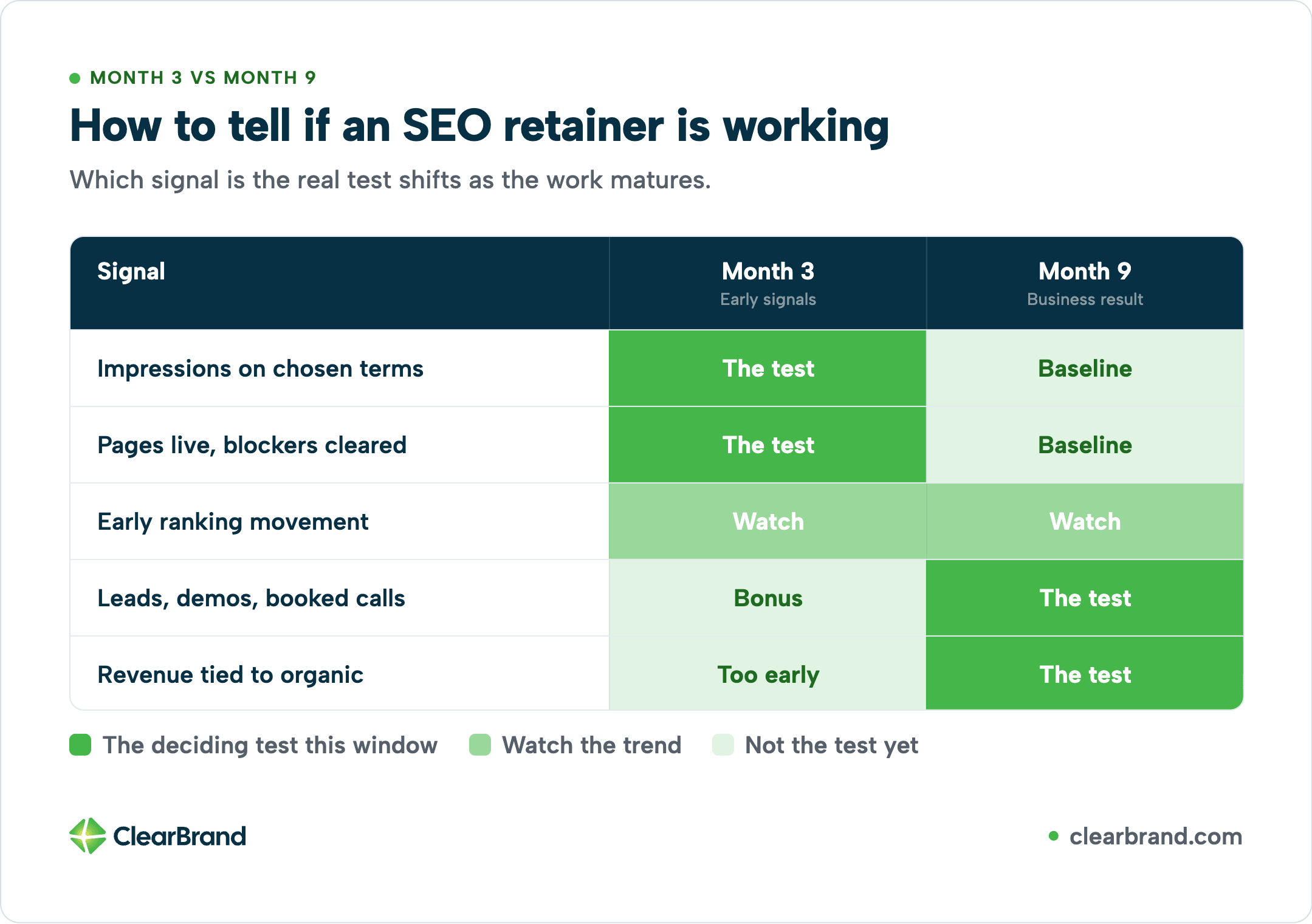
Month 3 and month 9 of a retainer are different tests.
By month 3 you want early signals: impressions on the terms you chose, pages live, technical blockers cleared, early ranking movement on easier queries. Leads in month 3 are a bonus. They are not the test. The work is still early.
By month 9 you want the business result: trials, demos, booked calls, or revenue you can tie to organic. If rankings look fine and sales are flat, the monthly fee is buying a dashboard.
One noisy week in Search Console is not a trend. A quarter of rising impressions and falling clicks can mean AI Overviews took the result, a competitor took the snippet, or the pages do not match the query. Keep looking at those causes. Then return to leads.
If you want this run as a program rather than a stack of tasks, that work lives on the SEO agency page.
Frequently asked questions
What is an SEO retainer?
An SEO retainer is a fixed monthly fee for ongoing search work from an agency, consultant, or freelancer. It covers a repeating mix of technical fixes, pages, authority, and reporting instead of a single project with an end date.
What does an SEO retainer typically include?
A complete SEO retainer typically includes technical SEO, on-page work, new or rebuilt pages, authority or digital PR, and monthly reporting. Local businesses should also see Google Business Profile work in writing. AI-search visibility belongs in the same program, not as a surprise add-on.
How much does an SEO retainer cost?
Most agency SEO retainers cluster near $3,200 a month in Ahrefs’ survey of 439 providers, with freelancer retainers near $1,350. The useful number is the fee against the pages, fixes, and leads the scope is supposed to produce.
How long should you keep an SEO retainer?
Plan on four months to a year before retainer work shows up as revenue. Google’s hiring guidance tells you to ask for a timeframe up front. We start at three months, then month-to-month, because some results — live pages, technical fixes, early movement on easier terms — should be visible by then. A twelve-month lock from day one is how a firm avoids that test.
Is a monthly retainer better than a one-time SEO project?
A retainer is better when the site needs work every month. A project is better for one job: an audit, a migration, or a defined research sprint. Many companies should buy the project first, then the retainer.
Do unused retainer hours roll over?
Unused retainer hours usually do not roll over. If the agreement is an hour block, unused time typically expires at month end. If the agreement is deliverables, unused hours are the wrong unit. Ask which model you are buying before you sign.
What to do with the quote in front of you
Read an SEO retainer quote as a scope document. Circle the outputs. Cross out the adjectives. If the page types, the implementation owner, the reporting metrics, and the exit terms are not on the page, send it back.
Keep paying if the same kinds of pages and fixes ship again next month, and if the team can point to leads when Search Console jumps around.