

Home Builder Digital Marketing: Search Still Fills the Pipeline
Home builder digital marketing: the website, search, ads, social, email, and reviews, and why search keeps filling the pipeline when paid costs rise.
Originally published: November 19, 2026 Last updated: November 19, 2026
Home builder digital marketing is the online work a home builder uses to get in front of buyers who are already researching a build, and to turn that attention into consultations and signed work. It usually includes the website, search, paid ads, social, email, video, and reviews.
When ads get expensive, the part of digital marketing for home builders that can still produce conversations is the search work those buyers are already doing.
Paid ads can put your name in front of a high-intent query this week. They can also get costly on competitive builder terms, and they stop the day the budget stops.
Buyers, meanwhile, often spend months on Google and in AI tools comparing builders, plans, and towns. If your site is the one they keep finding in that research, conversations can continue after a campaign pauses.
If you want the research path itself, from the first Google search to the consultation, start with home builder marketing.
Why search still fills a home builder pipeline when paid costs rise
A custom home is a long decision. A family may spend months looking at plans, walking lots, and comparing a short list of builders before they ask for a meeting. A lot of that work now happens in a search box, or in a question typed into ChatGPT, Claude, or Gemini.
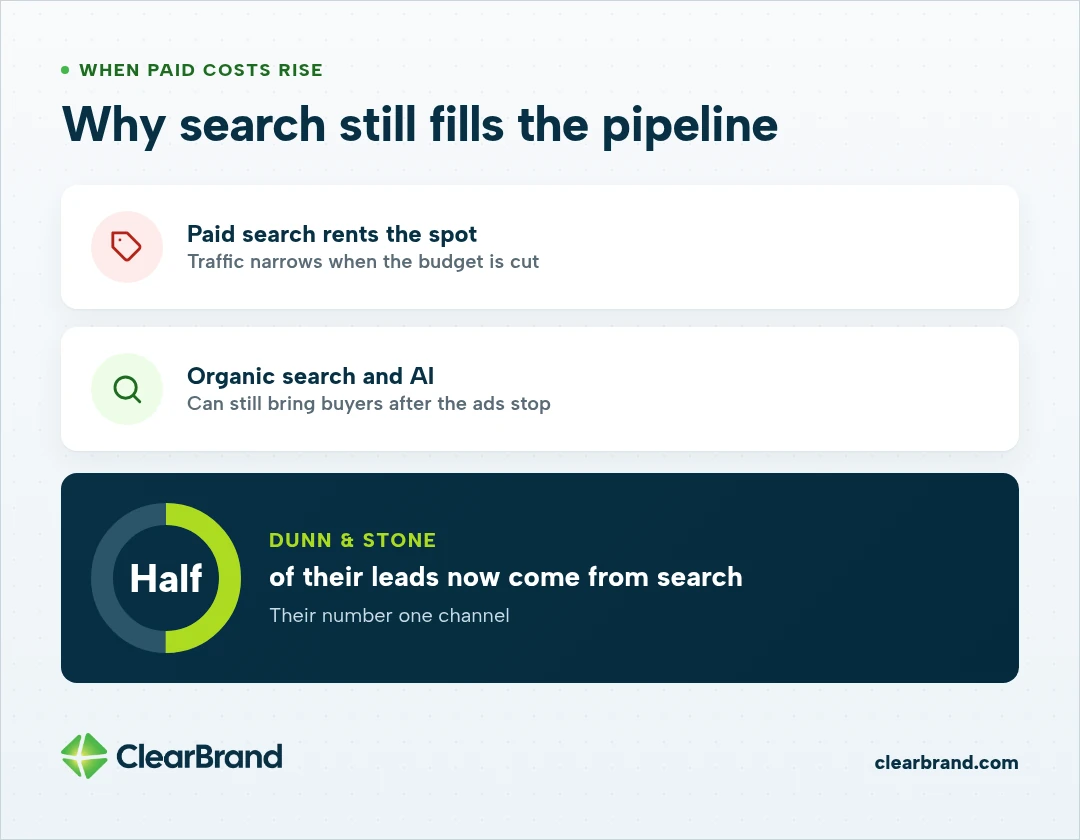
Paid search can meet those buyers at the exact moment they type a query, but you’re renting that spot. You pay for the click, and when bids rise or the budget is cut, that traffic narrows.
Organic search and AI answers work on a longer timeline. The pages you publish, the technical work that helps Google read them, and the mentions that help people trust your name can still bring in researched buyers after the ads stop.
We saw this with Dunn & Stone, a custom home builder we started working with when the pipeline was empty. The work included SEO and digital ads together.
Over time, organic search and AI became their number one channel. Half of their leads now come from search, and some of the deals they have closed started in AI answers. Ads brought in quick leads early, and search became the channel that carried the pipeline.
If you are weighing this kind of work for your own firm, our home builder SEO page is the closer look at how we approach it.
What home builder digital marketing actually covers
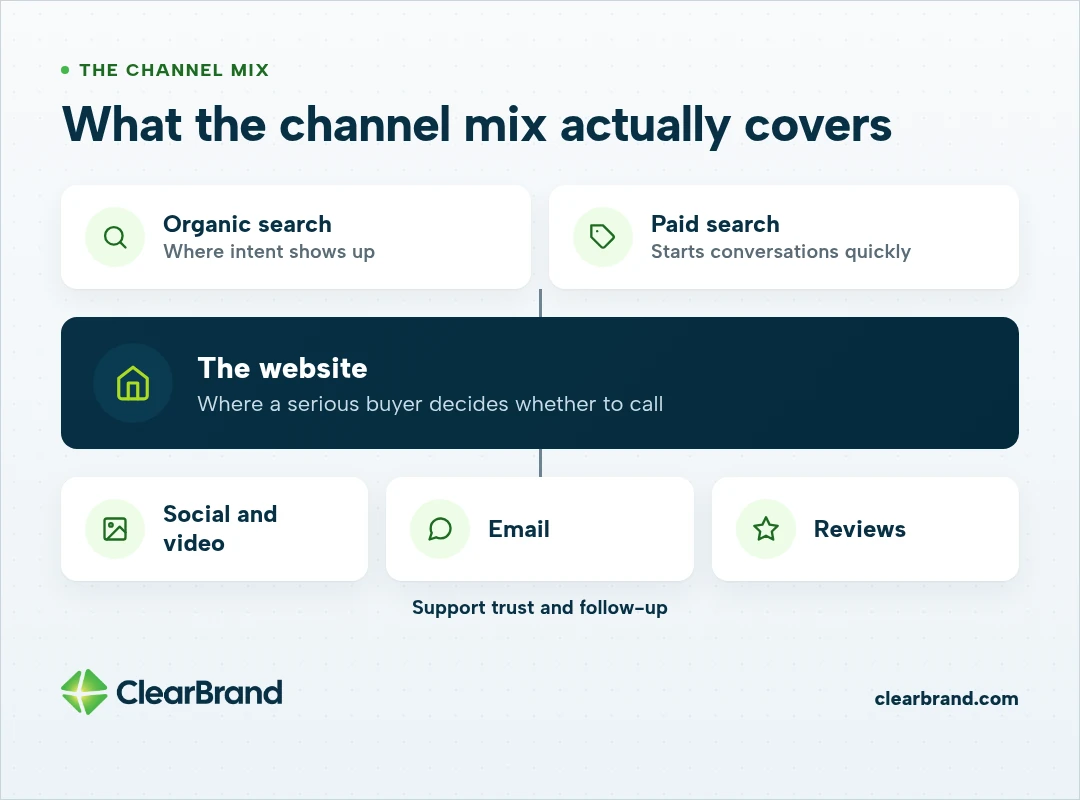
Most guides on this topic list the same channels, and the list is basically right. A complete home builder digital marketing program usually covers:
- A website buyers can use to compare your work, your process, and where you build
- Organic search, including the questions buyers now ask AI tools
- Paid search, for high-intent queries you want to reach quickly
- Social and video, so people can see work in progress and finished homes
- Email, so you can stay in touch during a long decision
- Reviews, so a buyer who has already found you can check that the work holds up
Those channels aren’t interchangeable. Search is where intent shows up. The website is the place a serious buyer goes to decide whether to call.
Paid can start conversations quickly while the organic work is still getting underway. Social, email, video, and reviews support trust and follow-up. They rarely replace the research a custom-home buyer is already doing in search.
For the search side of this mix, SEO for home builders is the guide to town pages, the pages that actually produce builder leads, and how AI tools decide which builders to cite.
Start with the website buyers use to compare you
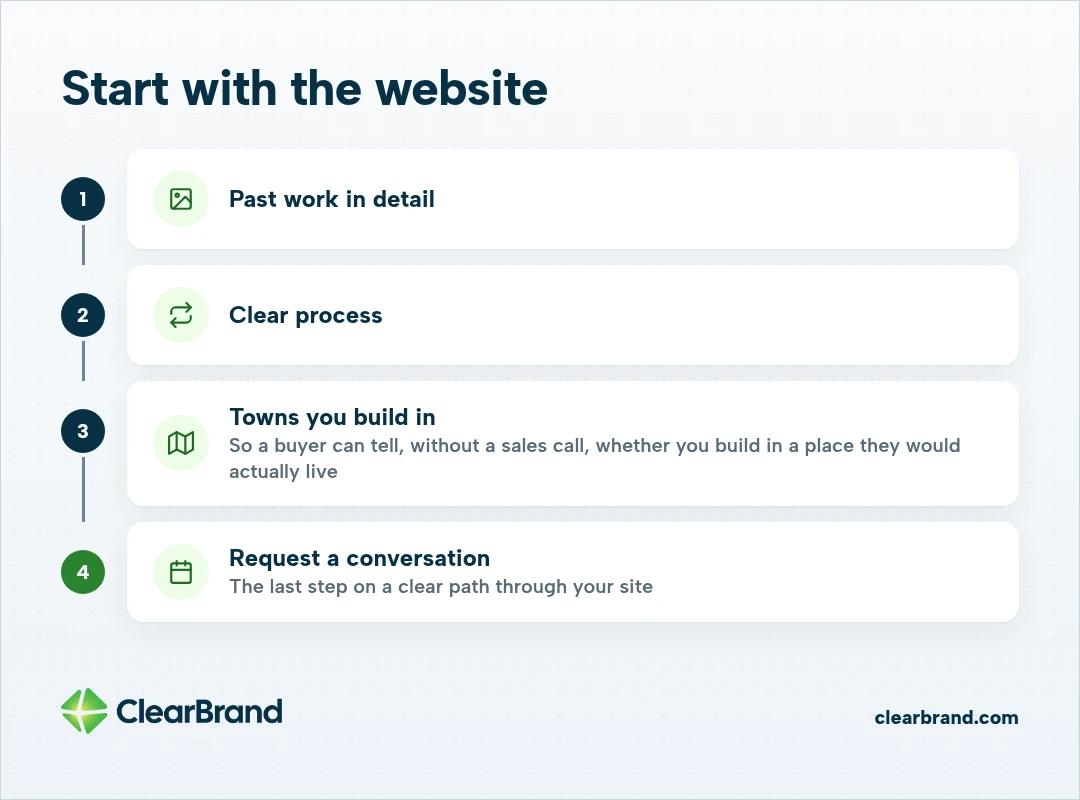
Before a family asks for a consultation, they want to see what you have built, how you work, and whether you build in the area they care about. If the site can’t answer those questions, paid traffic and social posts have nowhere solid to land.
The site doesn’t need to look like a luxury magazine. It does need a clear path: past work with real detail, a straightforward description of your process, the towns or areas you build in, and an easy way to request a conversation. A buyer should be able to tell, without a sales call, whether you build the kind of home they want in a place they would actually live.
Project pages and area pages do a lot of that work. A gallery of photos with no specs, no location, and no story of the build is weaker than it looks. Buyers, and the AI tools they use, need something they can actually read.
Pages also have to load, make sense on a phone, and be readable by Google. The writing has to be specific enough that a person and an AI tool can both use it. That’s ordinary technical SEO and clear writing, done on purpose.
Organic search and AI answers after the ads pause
When a buyer is months from signing, they ask questions like who builds a certain kind of home in a certain town, what a custom build usually involves, and which firms have actually finished work like theirs. Those questions go into Google, and they increasingly go into AI tools that answer in a paragraph and cite a few sources.
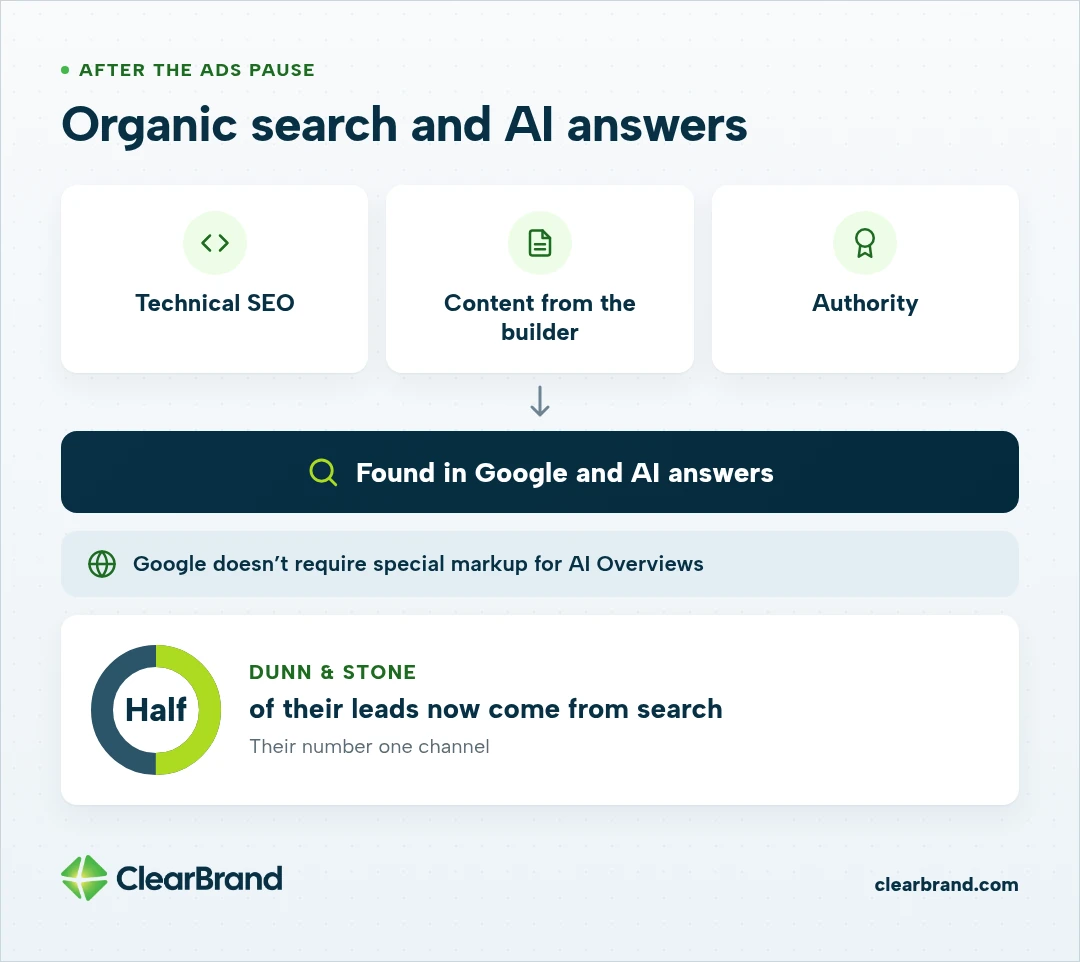
Showing up there is the work of SEO for home builders. It is technical SEO so the site can be crawled and understood, high-quality content that comes from regular conversations with the builder, and authority from brand mentions and backlinks.
Google doesn’t require special markup for AI Overviews. The same useful, indexable pages are what an AI system can draw on, which is in line with Google’s own guidance on AI features.
This side of the mix takes longer to build than a new ad campaign. It also doesn’t vanish at the end of the month. You’re publishing pages and earning mentions that can still be found next quarter, and the quarter after that.
For Dunn & Stone, that compounding is why organic search and AI became the number one channel, and why half of their leads now come from search.
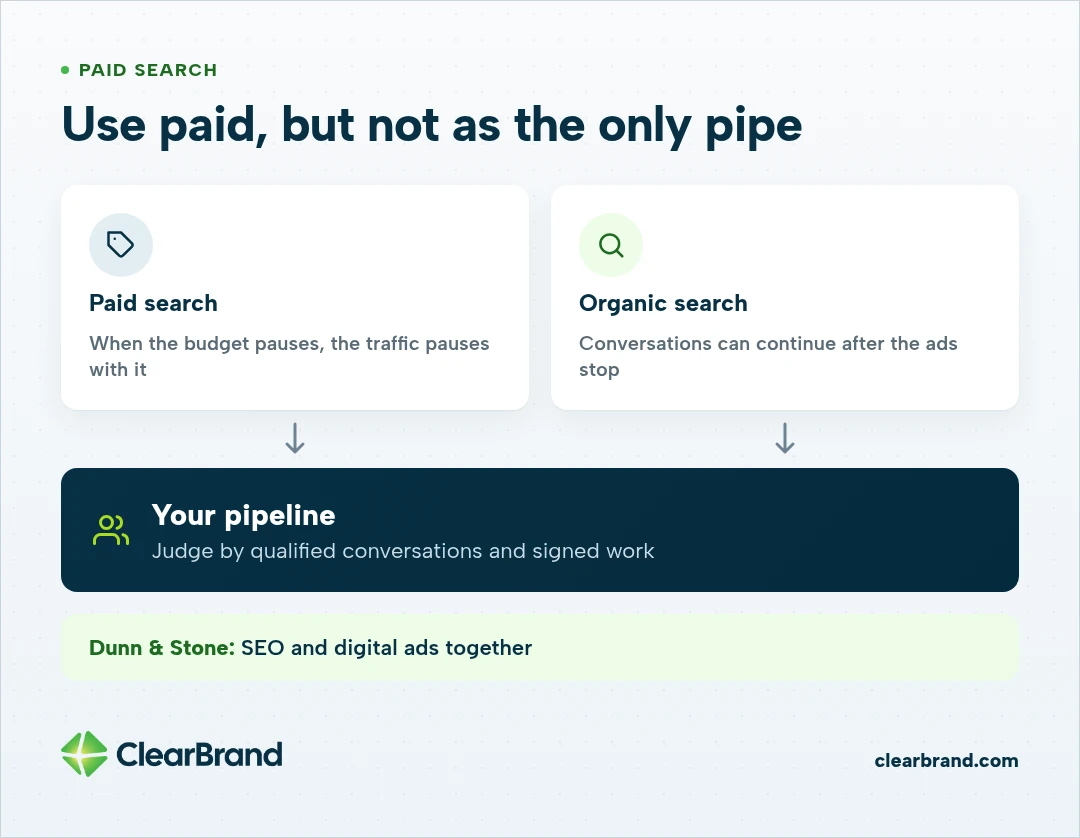
Paid search: use it, but don’t let it be the only pipe
Paid search still has a job. If you have a community to fill, a plan you want more people to see, or a pipeline that needs conversations this quarter, ads can put you in front of people who are already looking for a builder. That’s a reasonable way to buy time while the organic work is getting underway.
On competitive builder terms, that placement can get expensive, and when the budget pauses, the traffic pauses with it. If ads are the only way buyers find you, the pipeline follows the spend.
The setup we used with Dunn & Stone was SEO and digital ads together, with paid filling gaps and organic search becoming the channel that continued to produce consultations. You don’t need to turn ads off. Just make sure they aren’t the only way a qualified buyer can find you.
Judge the ads the same way you judge the rest of the mix, by qualified conversations and signed work, not by clicks alone. A cheaper click that never becomes a real conversation doesn’t help you. A more expensive click that becomes a consultation inside your build radius may be worth it.
Social, email, video, and reviews as support
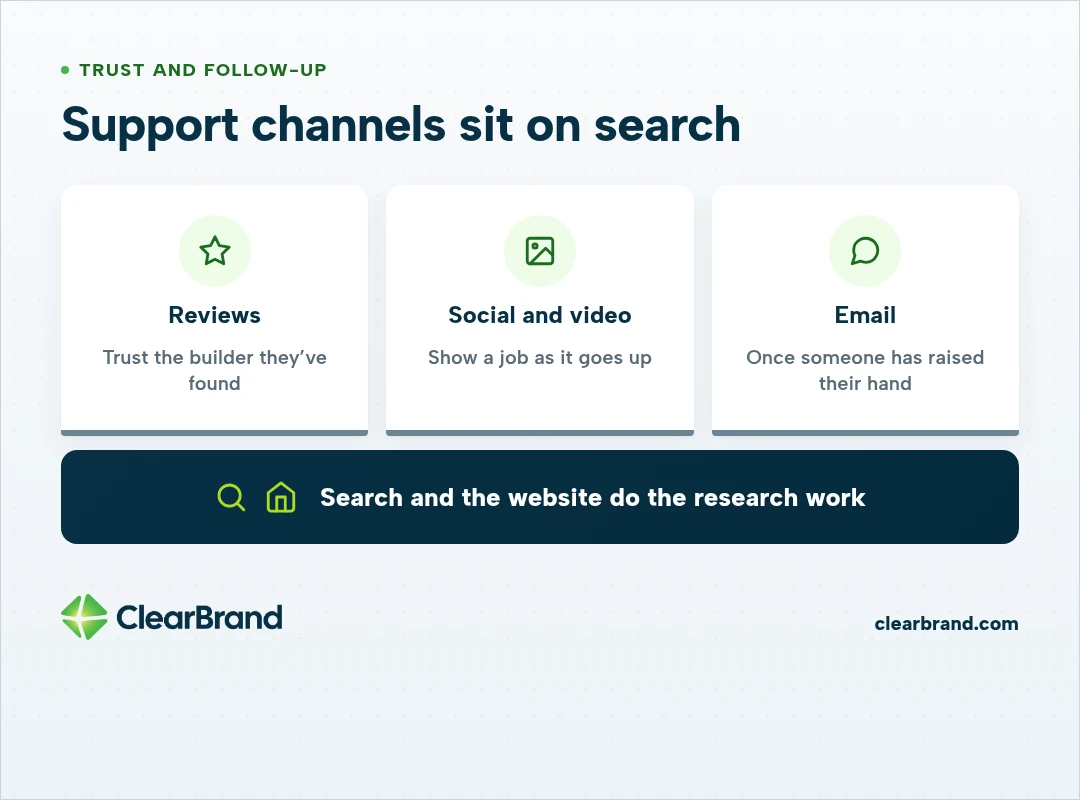
Reviews help a buyer trust the builder they’ve already found. A family that has spent weeks on your project pages will often check what past clients said before they book a meeting. Asking for those reviews, and making them easy to find, is part of the work.
Social and video are how many builders show a job as it goes up, or walk a finished home. That content is worth making, but it’s rarely the first place a serious custom-home buyer starts. People see the work, then they go look you up.
Email is useful once someone has already raised their hand. A long decision leaves plenty of time to go quiet. A simple follow-up that answers real questions, or shares a relevant finished home, keeps you in the conversation without asking the buyer to start over.
Keep these channels in the mix, and let search and the website do the research work buyers lean on before they call.
How to measure home builder digital marketing
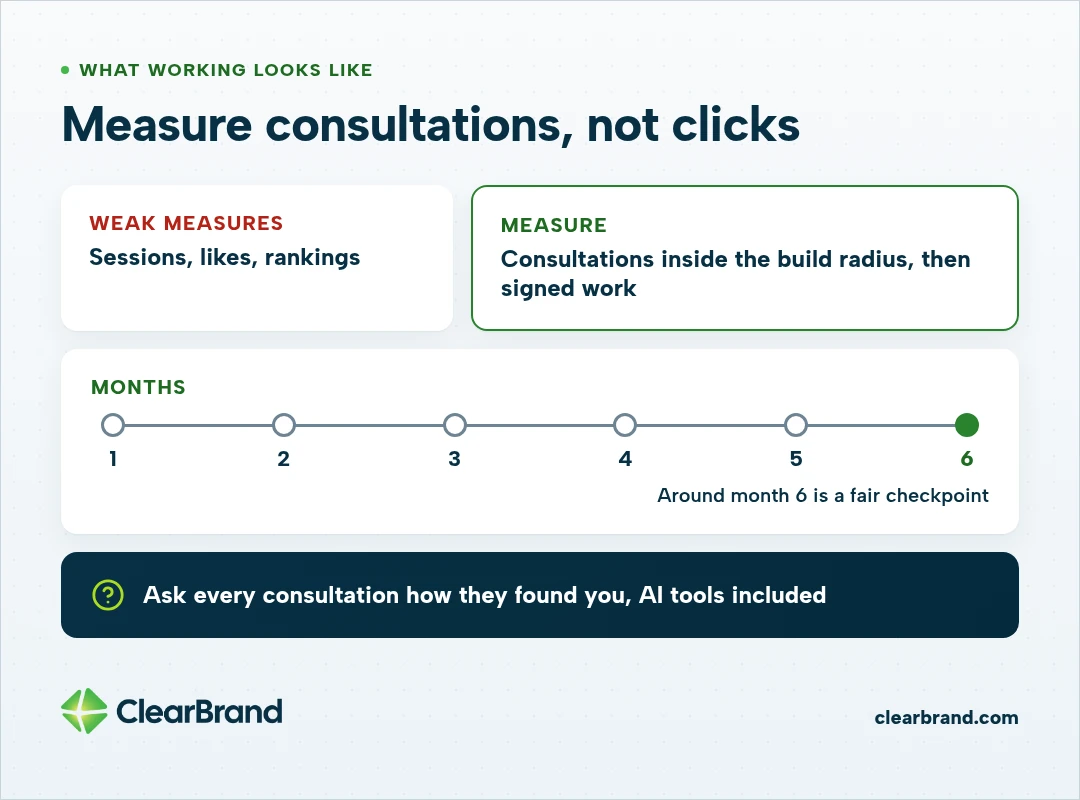
Sessions, likes, and even rankings are weak measures for this work. A builder needs consultations from people inside the build radius, and eventually signed work.
Ask every consultation how they found you, and include AI tools as an option. That one question shows you which conversations started in tools like ChatGPT, Claude, and Gemini. It’s also how you’ll know whether organic search is carrying more of the pipeline when paid costs go up.
Watch the mix over a few months, not a few days. Organic work often shows early movement in the first months, and it’s fair to treat around month 6 as a checkpoint. Every site moves at its own pace, especially in a business where one project is a major decision.
Keep asking whether qualified buyers are still finding you when you aren’t paying for the click.
FAQ
What is home builder digital marketing?
Home builder digital marketing is the online work a builder uses to reach people who are already researching a custom or new home, and to turn that research into consultations and signed projects. It typically includes the website, organic search and AI visibility, paid search, social, email, video, and reviews.
The channels work together, but they aren’t equal. Search is where a lot of the intent shows up, and the website is where a serious buyer decides whether to call.
How much should a home builder spend on digital marketing?
The most useful way to plan the spend is to fund the website and the search work first, then use paid ads as a complement rather than the only source of leads. There isn’t an honest one-number answer, because markets, average job size, and how much of the work you already have in place all change the math.
Judge the budget by the cost of a qualified consultation and, over a longer stretch, by signed work. If most of your conversations disappear when you pause ads, the organic side of the mix isn’t doing enough yet.
What is the most effective digital marketing channel for home builders?
For most custom builders, the most durable channel is organic search, including the questions buyers now ask AI tools. That’s where people go to compare builders, plans, and towns, and it’s the work that can still produce consultations when a paid campaign stops.
Paid search is often the fastest way to start conversations. Social, email, video, and reviews support the decision. The most effective program usually uses ads and organic together, then lets search become the channel that carries the pipeline.
How long does home builder digital marketing take to work?
Paid campaigns can start sending traffic as soon as they’re live. Organic search takes longer. In our work, we often see early movement in the first months, and we treat around month 6 as a checkpoint, knowing that every site moves at its own pace.
A custom home is also a long sale, so a new conversation today may not become a signed project for some time. Measure leading indicators, consultations, and eventual signed work on their own timelines, rather than expecting the whole mix to mature in a few weeks.
Do home builders still need SEO if they already run ads?
You still need it if you want a pipeline that doesn’t shrink the moment the ad budget is cut. Ads and SEO reach the same kind of buyer, but ads stop when the spend stops, while SEO is the work of becoming the builder people find and cite in search and AI answers.
The firms we’ve seen get the most out of home builder digital marketing use both, and they let organic search become the channel that continues to fill the pipeline.
See where your site stands in the mix
If you want a clear picture of where your site stands in that mix, get your free SEO audit. It’s a full review of your site and an initial 90-day strategy, and you keep it whether you work with us or not. We focus on helping 7- and 8-figure companies, including custom home builders who want search to do more of the work ads have been carrying alone.