

Programmatic SEO is the practice of generating many search pages from one template plus a structured dataset, each page targeting a distinct long-tail query variant. It works when every URL carries information a searcher could not get from a find-and-replace of the keyword. It fails when only the modifier changes.
This guide covers the definition, the difference from writing pages one at a time, examples where each URL actually differs, and the quality test Google now applies before you scale.
Key Takeaways
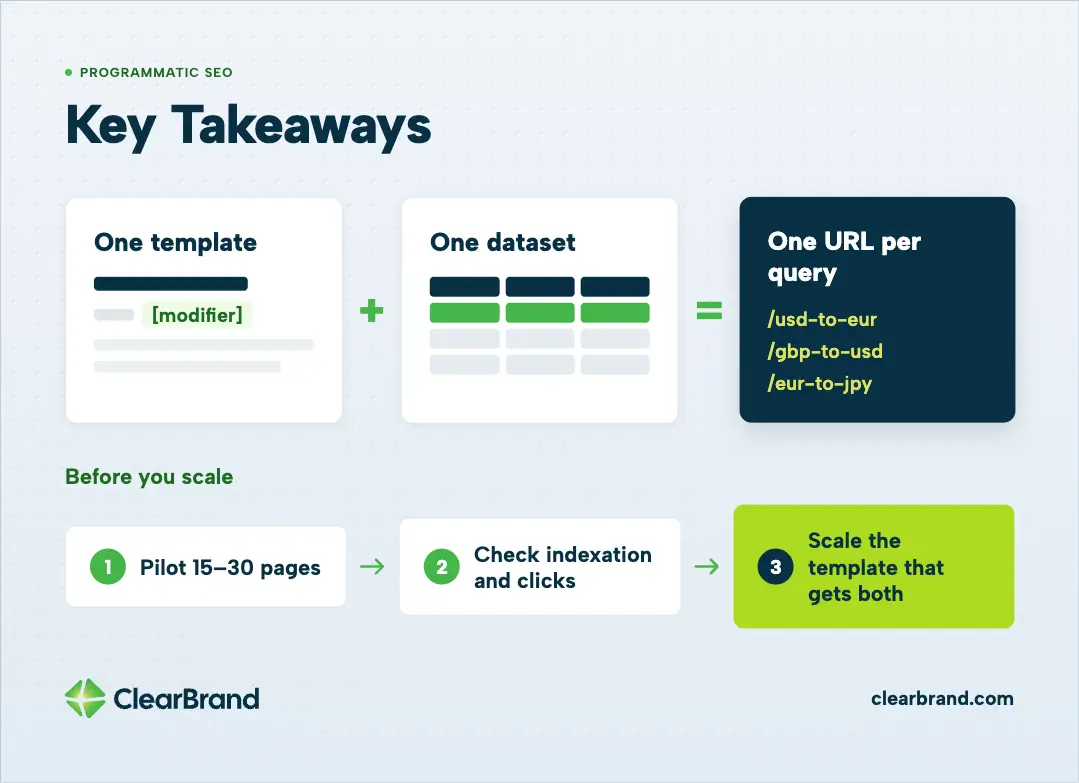
- You design one template, fill it from a dataset, and publish one URL per real query pattern.
- Traditional SEO writes fewer pages by hand. Programmatic SEO scales a pattern. Most useful sites do both.
- Zapier integrations, Wise currency pairs, and Tripadvisor location pages work because the data on each URL is different.
- Ship a 15–30 page pilot, watch Google Search Console for indexation and clicks, then scale only the template that gets both.
What programmatic SEO is
![What Programmatic SEO Is diagram: Head term plus Modifier equals one page per pairing, with a table of patterns like [app] + [app] integration, [currency] to [currency], and Things to do in [city].](/images/cms/02-what-programmatic-seo-is.webp)
Programmatic SEO, often shortened to pSEO, is a way to publish a large set of pages that follow one keyword pattern. You design the page once. You fill it from a spreadsheet, a CMS collection, or a database. Each row becomes one URL.
You have seen this even if you have never named it. Search “Slack Google Sheets integration,” “USD to EUR,” or “things to do in Lisbon,” and the result is usually a page built from a template, not an article someone wrote from a blank document.
The pattern is usually a head term plus a modifier: [app] + [app] integration, [currency] to [currency], [service] in [city], [template type] template. The searcher wants that pairing. They are not looking for a generic essay about the category.
The pages still have to do the rest of SEO. They need a crawlable URL, a title that matches the query, and internal links. A template that only swaps a word in the H1 is still one document with many addresses.
Programmatic advertising is a different term. It means buying ads through an auction. This article is about pages on your site.
Programmatic SEO vs product-led SEO
Product-led SEO is what happens when the product itself answers the query. A live flight result. A working currency converter. A template you can open and edit.
Programmatic SEO is how those pages get built. The two can overlap: Wise publishes currency URLs from a template, and the converter on each URL is the product. A marketing site that copies the same URL pattern and pastes a static table across every page is only doing the publishing part. The searcher still has nothing to use.
Programmatic SEO vs traditional SEO
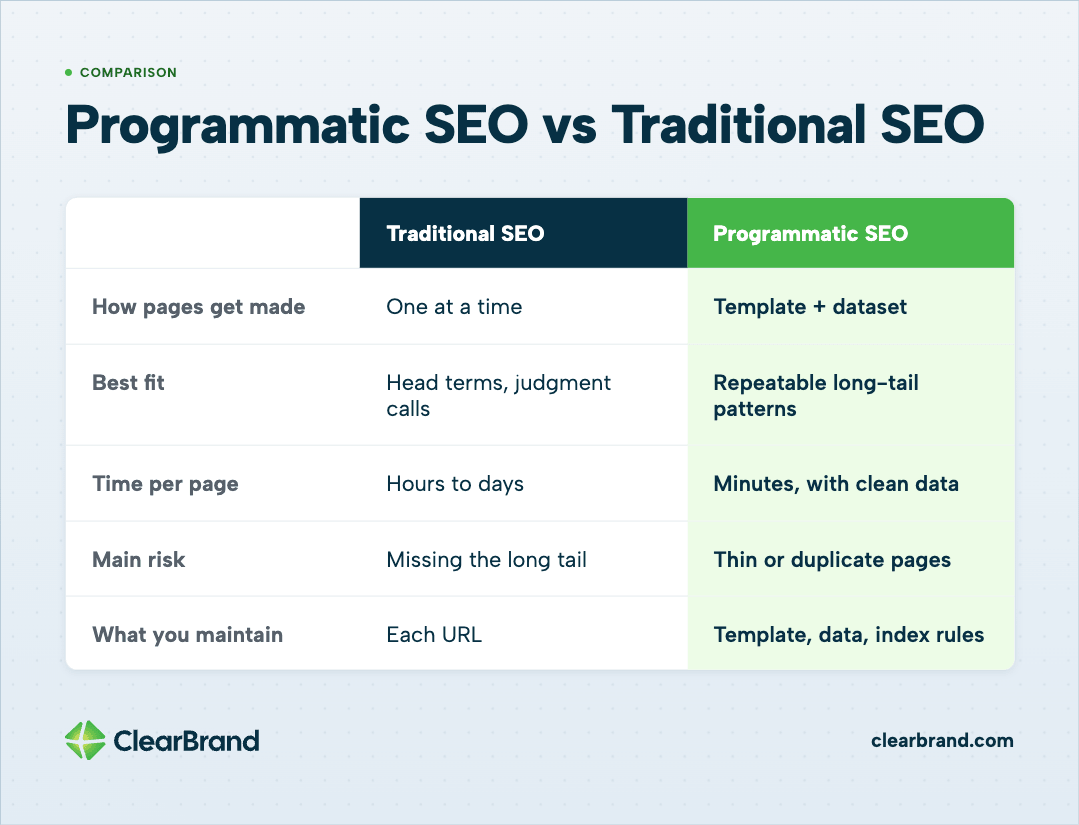
Traditional SEO and programmatic SEO solve different production problems.
| Traditional SEO | Programmatic SEO | |
|---|---|---|
| How pages get made | Written one at a time | Generated from a template and a dataset |
| Best fit | Head terms, explanations, judgment calls | Repeatable long-tail patterns with real data per row |
| Time per page after setup | Hours to days | Minutes, if the row is already clean |
| Main risk | You never cover the long tail | Thin or duplicate pages drag the whole site down |
| What you maintain | Each URL | The template, the data, and the index rules |
Use a hand-written page when the answer needs reporting, a point of view, or a comparison only a person can stand behind. “Should you switch CRMs” is that kind of page. So is a guide that has to weigh tradeoffs.
Use a programmatic page when the searcher wants a specific entity, pairing, or location and you actually have the facts for that row. “Connect HubSpot to Slack” can be a template if each pair has its own triggers and setup steps. “Plumber in [city]” can be a template if each city page has hours, service area, staff, and reviews that belong to that office.
Most useful sites do both. Hand-written guides sit next to the templated pages. The SaaS SEO guide covers comparison and integration pages you may still write by hand, one URL at a time, because the difference between two products does not live in a spreadsheet.
How programmatic SEO works
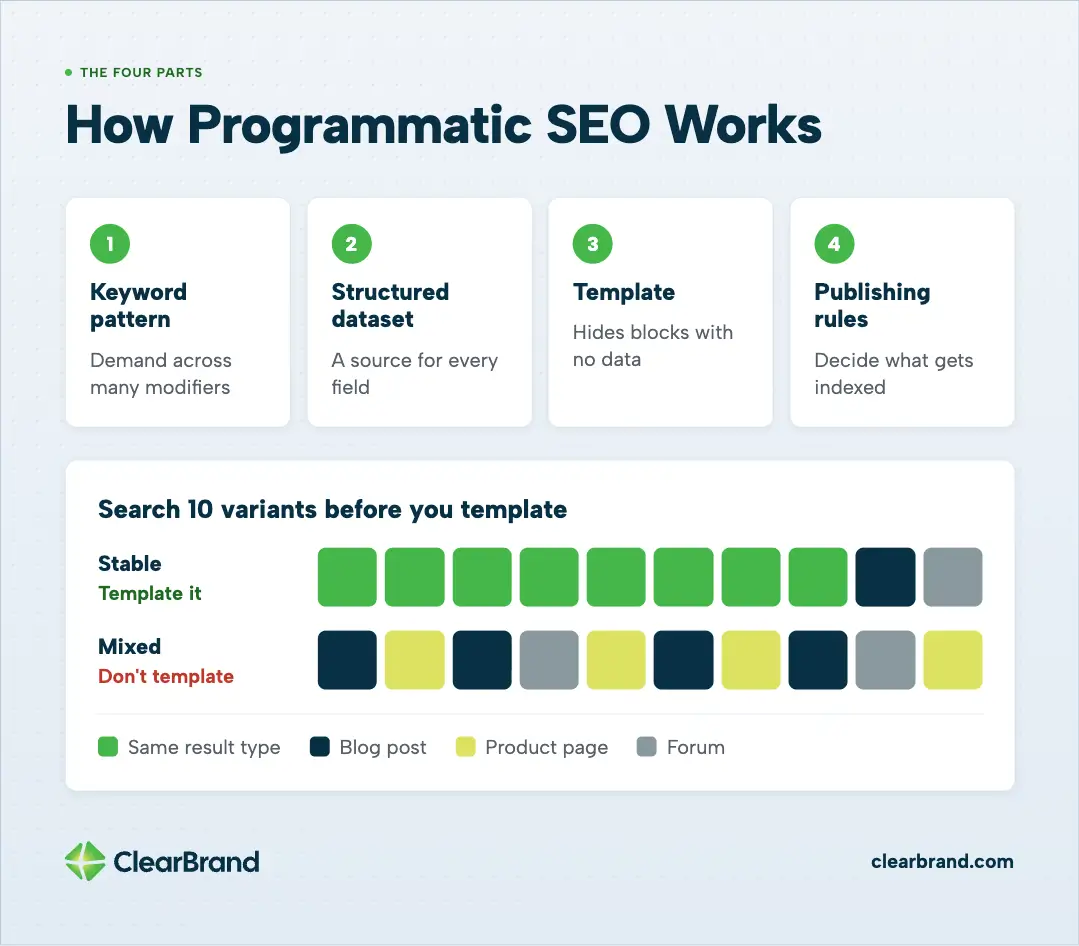
Four parts have to exist before you generate programmatic SEO pages.
- A keyword pattern with real demand across many modifiers, and a results page that stays the same shape from one variant to the next.
- A structured dataset where every field on the page has a source. City name alone is not a dataset.
- A template with slots for the fields that change, plus blocks that only show when that row has the data.
- Publishing rules: which rows go live, which stay out of the index, how the sitemap and internal links introduce new URLs.
Search the pattern first. Do not start by picking a page count. Try ten variants of the same structure. If eight of them show the same kind of result — a listing, a converter, an integration setup — you have a candidate. If half the variants are blog posts, half are product pages, and two are forums, the pattern is not stable enough to template.
The dataset is the part teams skip. A useful row has a source for every field the template will print: the entity name, the facts that change, the proof that belongs to that row, and the internal links that should appear. “Denver” in a city column is a label. Denver plus hours, a real address, staff who work there, and reviews from that office is a row.
The template should hide empty blocks. If a row has no pricing, the pricing block should not print a heading over a blank. If a row has no reviews, do not print “What customers say” above a placeholder. Empty sections make two pages look identical even when one field changed.
You decide which rows Google is allowed to see. Not every row should be indexable on day one. A sitemap that dumps 4,000 new URLs overnight is how you spend crawl time on pages you have not checked. A category page that links to the live rows, plus a rule that keeps empty rows out of the index, is the slower version that usually survives.
A CMS collection, a static site generator, or a script can publish the pages. If two rows would read as the same document to a searcher, publish one URL.
Programmatic SEO examples that change more than the heading
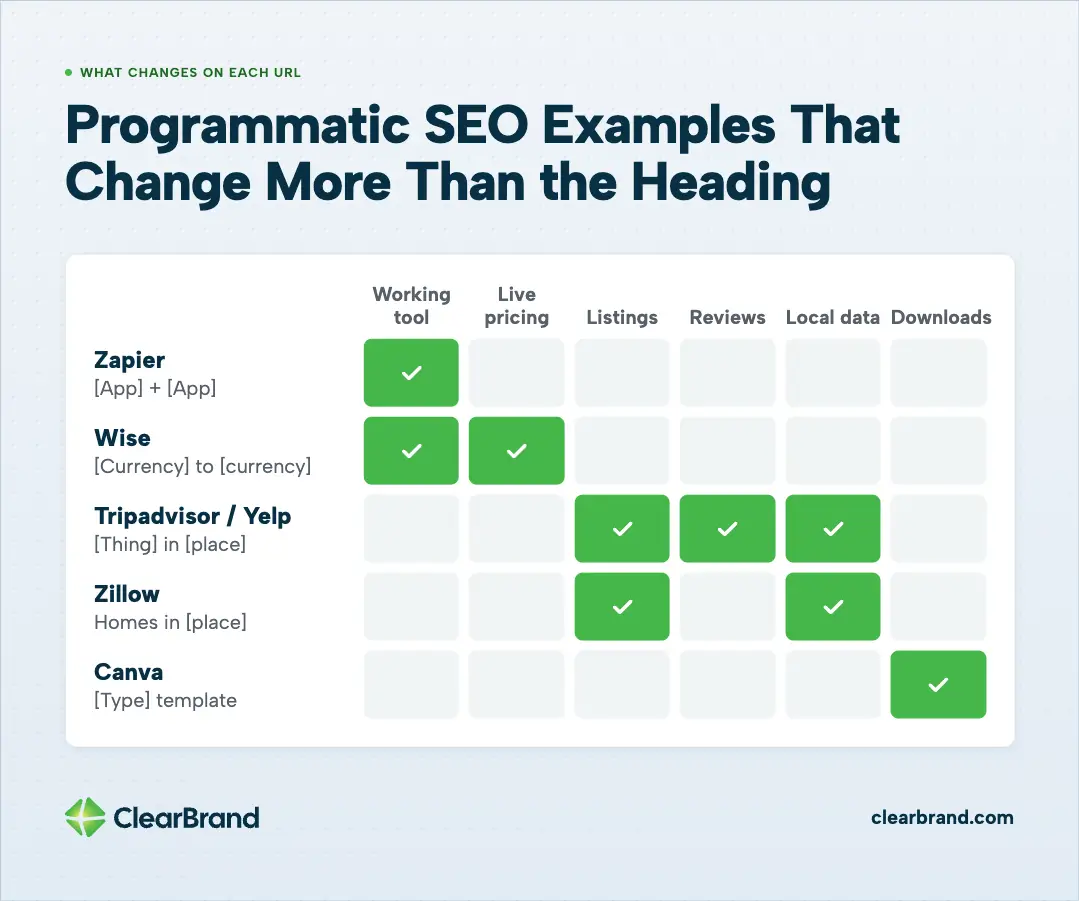
Zapier, Wise, Tripadvisor, Yelp, Zillow, and Canva are the usual programmatic SEO references. Open one URL from each and you can see what changed besides the heading.
| Company | Pattern | What is actually different on each URL |
|---|---|---|
| Zapier | [App] + [App] integration | Triggers, actions, and a working connection for that pair |
| Wise | [Currency] to [currency] | Live rate, fees, and a converter for that pair |
| Tripadvisor / Yelp | [Thing] in [place] | Listings, reviews, hours, and maps for that place |
| Zillow | Homes in [place] | Listings and local housing data for that market |
| Canva | [Type] template | Downloadable designs for that template type |
Zapier can support a huge integration library because the product creates the data for each pair. You do not get that library by rewriting “connect A to B” two thousand times.
Look at one live URL before you copy how they built it. Open a Wise pair and notice the rate, the fee, and the transfer path change with the currencies. Open a Yelp city page and notice the businesses, hours, and reviews belong to that city.
When programmatic SEO works, and when it fails
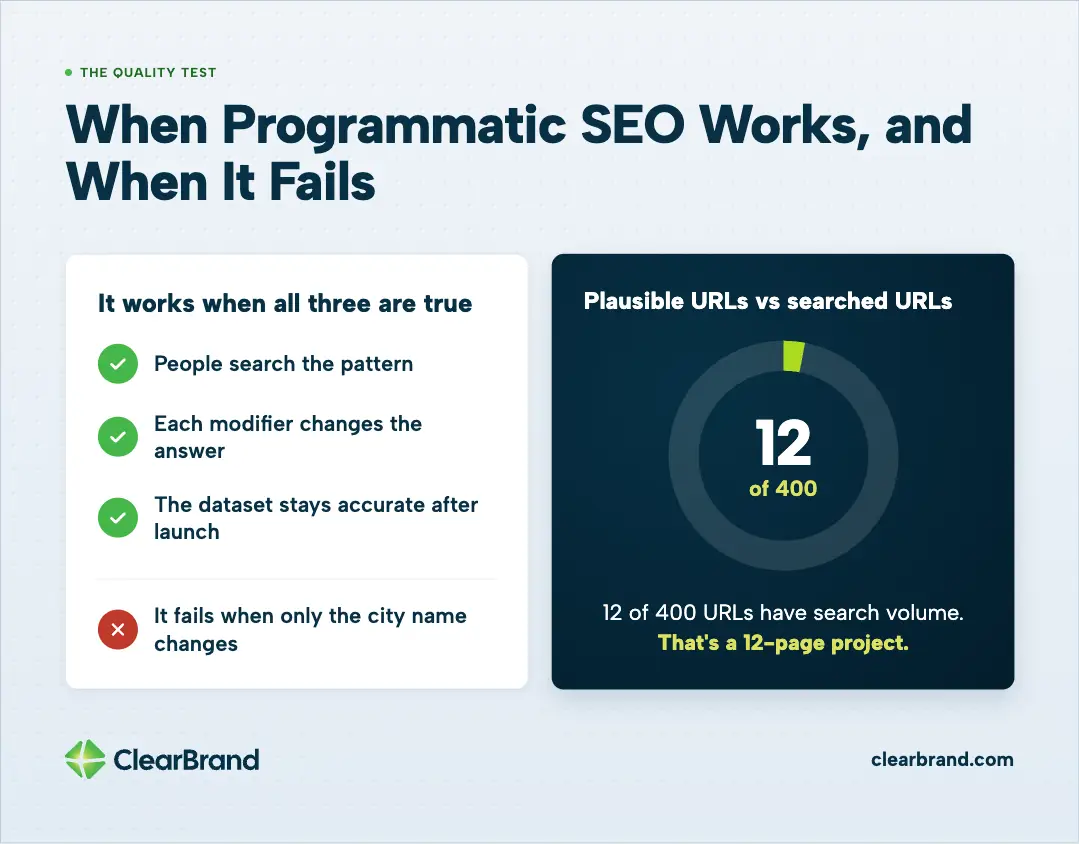
Programmatic SEO works when three things are true at the same time: people search the pattern, each modifier changes the answer, and you can keep the dataset honest after launch.
Check search demand first. A pattern with 400 plausible URLs and search volume on twelve of them is a twelve-page project, not a 400-page project. The other rows can sit in the database until someone actually searches them.
The dataset ages. Prices change and integrations break. Offices close. A template that published cleanly in March can be wrong in September if nobody owns the data. Wrong rows keep ranking long enough to waste a click, then they teach Google those pages are sloppy.
Programmatic SEO fails when the template is a doorway. Years ago we shipped the same service copy across a set of location URLs. Each city got its own path. The body was the same paragraph with the city name swapped. After Google tightened Scaled Content Abuse and Doorway abuse, those URLs stopped earning impressions and we took them down. A location page works when the business is in that location, with proof that belongs there. Duplicating one service page across cities is just reprinting the same page.
We would still ship a page for a city where the company has an office. We would not invent a page for a city we wanted to rank in. “We serve this area” can live on a service page. Pretending there is a location on every street in the state is how the old pages got built, and why they had to come down.
Google’s Scaled Content Abuse policy says many pages created to manipulate rankings, with little value for users, are spam “no matter how it’s created.” The problem is the low-value volume, whether a person or a script published the file.
John Mueller said the same thing about low-value generated pages more bluntly on September 7, 2026. He was describing a site that iterated through domain names, technologies, and attributes and published every combination. Programmatic SEO like that, he wrote, often produces a site that is spam, borderline spam, or low quality, and Google’s systems can lose faith based on the old pages. Recovery takes time and significant effort. The public record is on Search Engine Roundtable.
The usual failure is publishing every combination: every tool, every attribute, every city, each as its own URL. Most of those URLs never had a search behind them. The ones that did share the same body. That is the pattern Mueller was describing.
Remove from the index, or delete, rows that never get a click. Do not add a thousand more. Google Search Console will show you which URLs were crawled, which were indexed, and which collected impressions without a click. A template that cannot get a click on thirty URLs will not get healthier at three thousand.
SaaS teams run into a specific version of that failure: a catalog of “[tool] for [use case]” or “[tool] vs [tool]” pages with the same three paragraphs and a swapped noun. We do not build those catalogs. If you already launched one, our guide to programmatic SEO mistakes shows how to diagnose and fix a failing page set.
How to build programmatic SEO without damaging the site
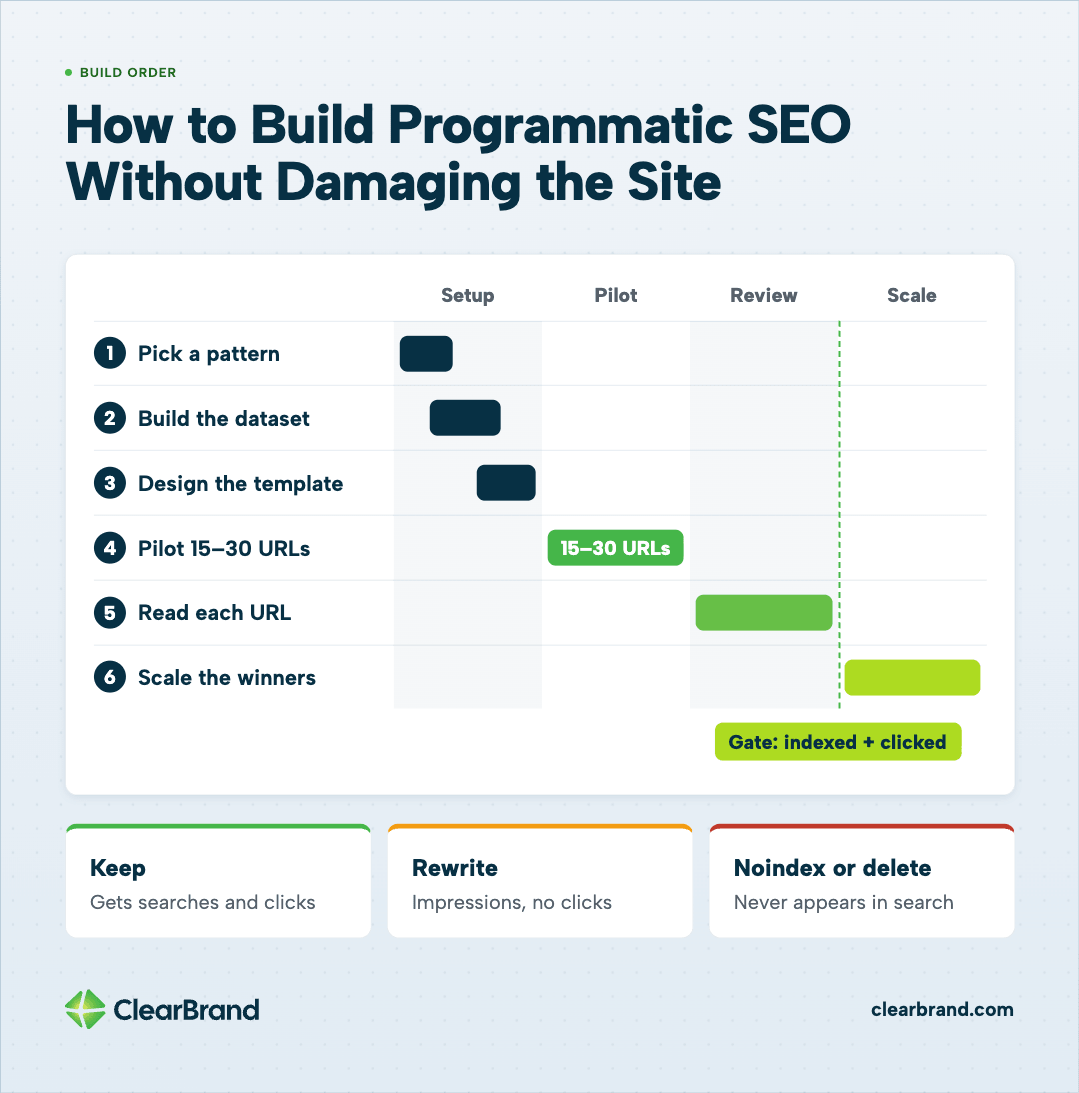
Build programmatic SEO in this order. Do not generate the full library on day one.
| Step | What you do | What “done” looks like |
|---|---|---|
| 1. Pick a pattern | Search 10 variants. Confirm the result type stays the same. | A pattern you can name in one line |
| 2. Build the dataset | One row per future URL. Every on-page field has a source. | No empty required fields |
| 3. Design the template | Slots for the fields that change. Hide blocks when the data is missing. | Empty fields do not print |
| 4. Pilot 15–30 URLs | Index only the pilot. Link them from a category page. | Search Console shows crawled and indexed, not just submitted |
| 5. Read each URL, not the average | Impressions, clicks, and indexation by URL. Kill rows that never get a query. | A keep / rewrite / noindex list |
| 6. Scale the winners | Raise the row count only after the template gets clicks. | New URLs follow the same field rules |
Write the structure on a line: “[service] in [city],” “[app] + [app] integration,” “[currency] to [currency].” Then search the first ten modifiers you would actually publish. If the results keep changing shape, stop. You would be building one template for several different jobs.
Building the dataset is slower than people expect. Pull from a system you already trust: product data, a location list with real addresses, an integration directory the product supports, a template library that already exists. Do not scrape a competitor’s titles and call that a dataset. If you cannot say where a field came from, it should not print.
The template is easier to judge if you read it with the brand name covered. What remains should still answer the query. If what remains is a generic paragraph and a button, the template is not finished.
The pilot is the part most teams skip because it feels small. Fifteen to thirty URLs is enough to see whether Google will index the template and whether anyone clicks it. Link those URLs from a category page that already has some trust. Submit that page and the pilot in Search Console. Wait until you can see crawled and indexed, not just “submitted.”
When you read the results, do not average every URL together. One strong page can hide twenty dead ones. Sort by impressions and clicks. Keep the rows that get searches. Rewrite rows that get impressions and no clicks. Keep out of the index, or delete, rows that never appear for anything.
Scale only after that list exists. New rows follow the same field rules as the pilot. If you cannot fill a required field, the row stays out of the index.
You will need four kinds of tools: a place to store the data, a template or CMS that can publish pages, a way to generate or sync rows, and Search Console to see what actually got indexed. Platform setup is a separate job. If you ship this on Webflow, use the programmatic SEO in Webflow walkthrough.
Internal links are part of the system. A category page should point to live rows. Related rows should point at each other. Generated URLs with no links in or out waste crawl time. After the pages are live, someone still has to watch indexation and refresh the data.
If a 30-page pilot does not get indexed and clicked, do not fund a thousand-page build.
Programmatic SEO FAQ
What is programmatic SEO?
Programmatic SEO is the practice of generating many search pages from one template plus a structured dataset, each page aimed at a distinct long-tail query. The template holds the layout. The dataset holds the facts that change. The result is a set of URLs you could not afford to write one by one.
How is programmatic SEO different from traditional SEO?
Traditional SEO creates pages individually. Programmatic SEO creates many pages from one template and a dataset. You still need keyword research, on-page work, and a reason for each URL to exist. What changes is how the pages get made.
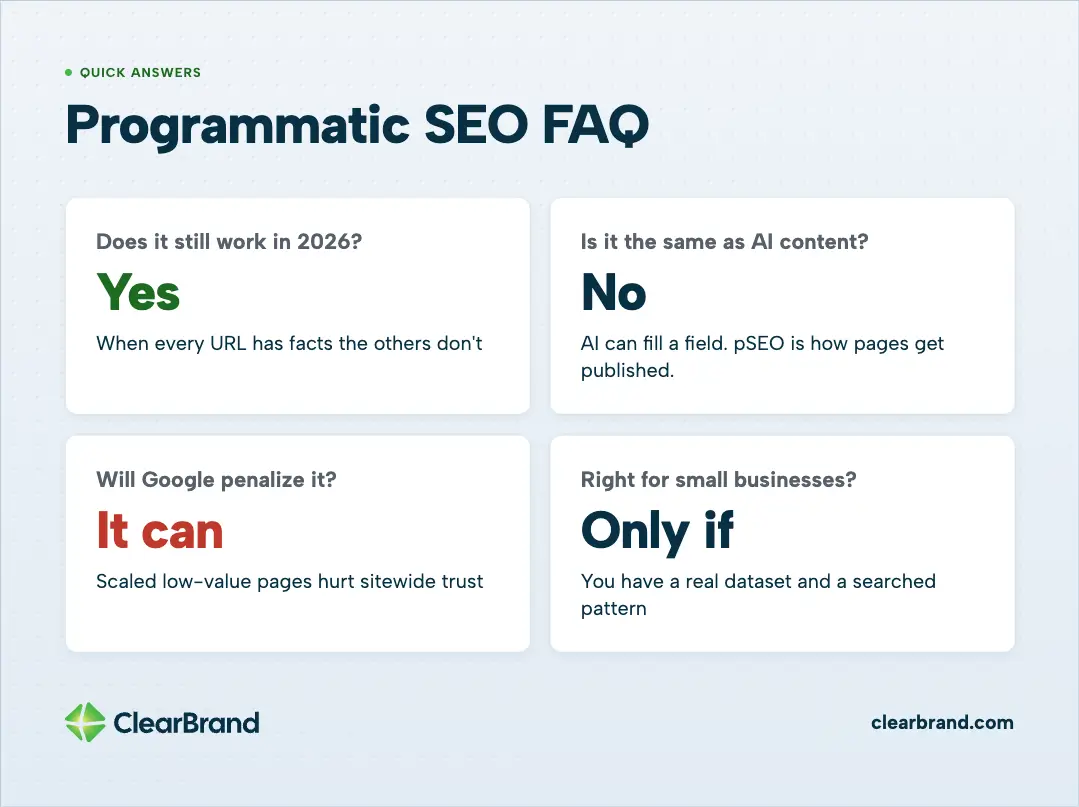
Does programmatic SEO still work in 2026?
Yes, when each programmatic URL answers its query with facts the other URLs do not have, and the site already has enough trust to carry new pages. Google’s 2026 policy language judges the value of the pages, not whether a script published the file.
Is programmatic SEO the same as AI-generated content?
No. Programmatic SEO is how the pages get published. AI-generated content is one way to fill a field. You can run programmatic pages with human-written fields, structured product data, or user reviews and never touch a language model. Using a model to write 5,000 near-duplicate intros is how teams walk into Scaled Content Abuse.
Will Google penalize programmatic pages?
Google can demote or ignore a set of pages that exist to manipulate rankings and do not help users. The policy is Scaled Content Abuse. The damage is often sitewide trust, not a single URL slapped with a label.
Is programmatic SEO right for small businesses?
Only if the business has a real dataset and a pattern people search. A local firm with three offices can support three location pages. It cannot support 200 city pages of the same paragraph. Small sites get hurt faster when Google loses confidence in the domain.