
Medical Practice Marketing That Starts With Search
Medical practice marketing that wins new patients from Google and AI answers: conversion pages first, an easy first step, then content, with HIPAA in mind.
Originally published: October 21, 2026 Last updated: October 21, 2026
Medical practice marketing is how a clinic gets found and chosen by new patients. For many practices, the channel that keeps paying off is search: showing up when people look up their symptoms, the treatment they want, or a care model like direct primary care, in Google and in AI answers.
A list of tactics is a fine place to start, but it leaves out the order.
So I’ll walk through the order that made organic search the number one marketing channel for one of our direct primary care clients, and how we measure it without seeing patient data.
Key takeaways
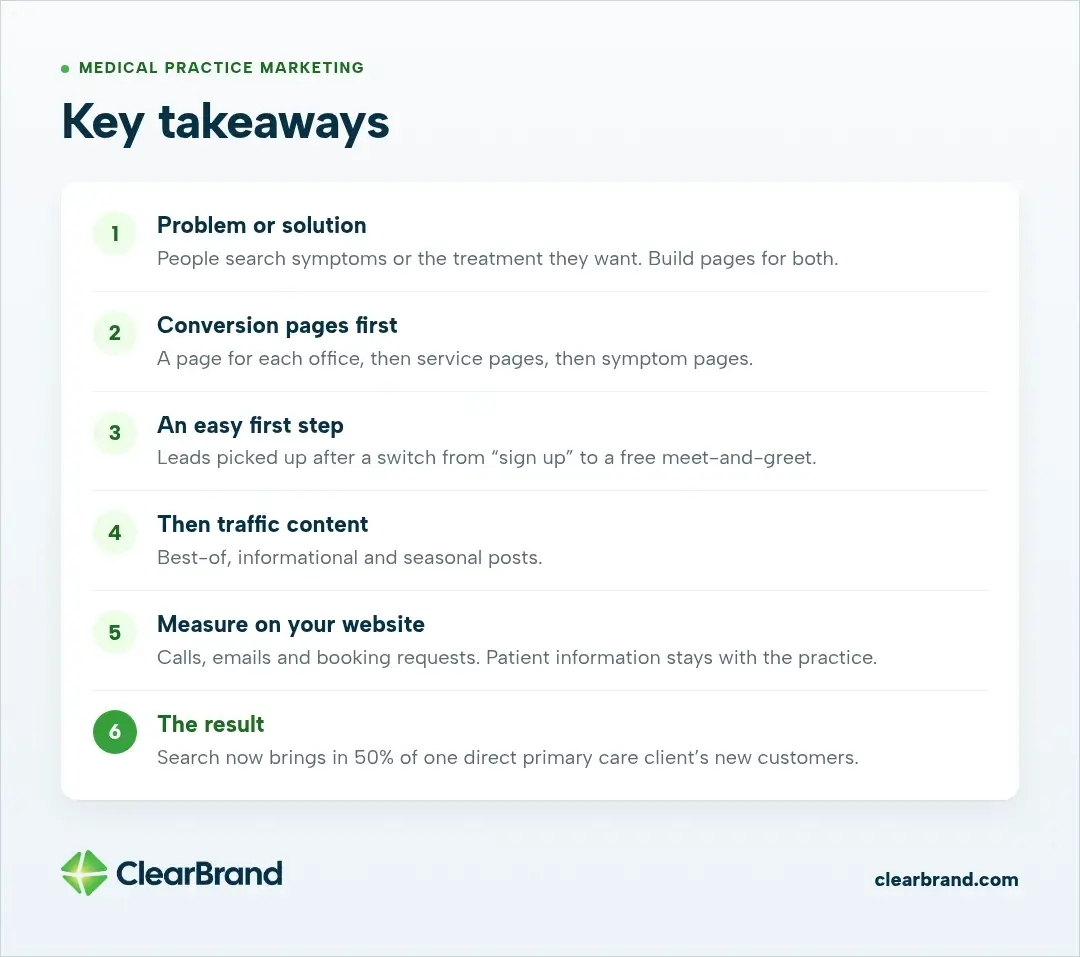
- People search for a problem (their symptoms) or a solution (the service or treatment they want). A practice needs pages for both.
- Build the pages that convert first: a page for each office, then service pages, then symptom pages.
- Make the first step easy. One direct primary care client’s leads picked up after it switched its calls to action from “sign up” to a free meet-and-greet.
- Add best-of, informational and seasonal content once the conversion pages are in place.
- Measure on your own website: clicks to call, clicks to email and booking requests. Patient information stays with the practice.
- Search now brings in 50% of one direct primary care client’s new customers.
What is medical practice marketing when search is the channel?
Medical practice marketing is patient acquisition. When search is the channel, it means your practice shows up at the moment someone is looking for the care you give, then makes it easy for that person to take the next step.
People search for a problem or a solution
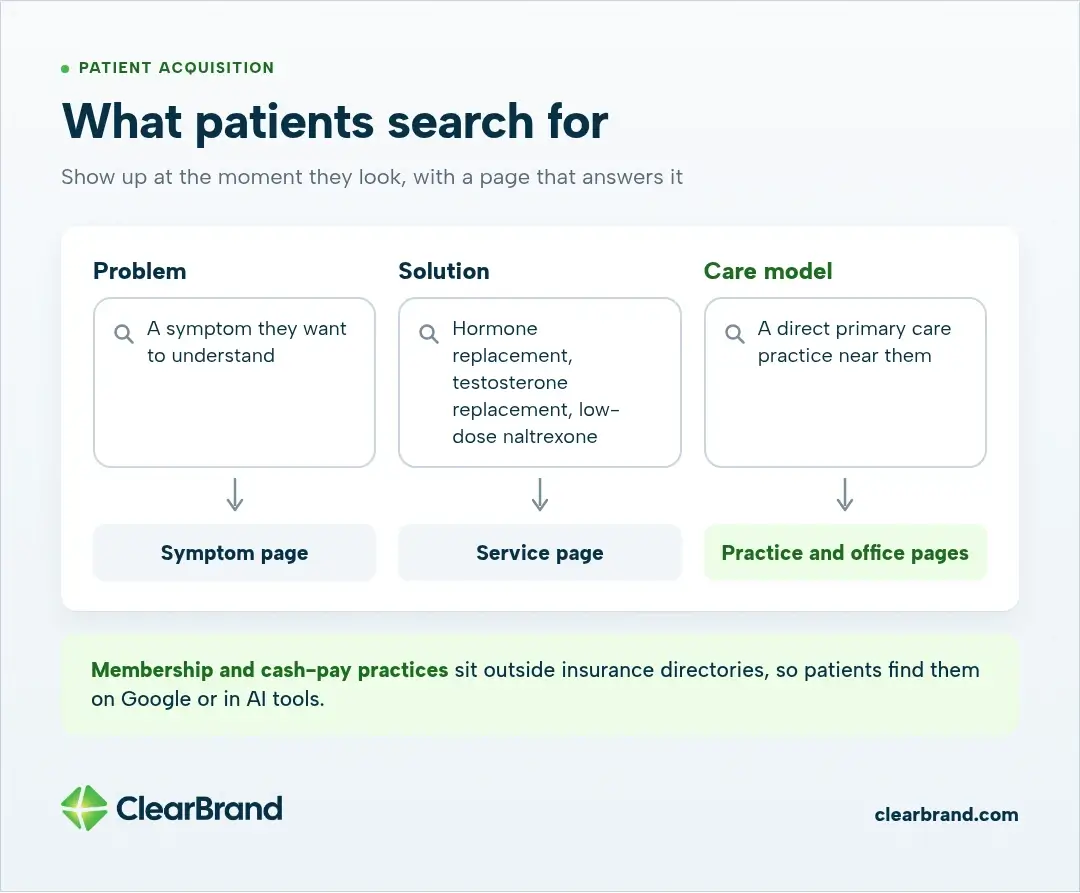
Some people search for the problem. In medicine, that’s usually a symptom they want to understand.
Others search for the solution: a service or treatment they already have in mind, like hormone replacement, testosterone replacement or low-dose naltrexone.
And a third group searches for the care model itself. Once someone learns what direct primary care is, their next search is often for a direct primary care practice near them, and I want our clients winning that search.
How membership and insurance-based practices use search
In my experience, search matters most for direct primary care, membership and cash-pay practices. Many patients with insurance start in their plan’s directory to see who’s covered. Membership practices sit outside that directory, so people look for them on Google or ask an AI tool.
Insurance-based practices still get real value from search, because it lets them shape how patients first meet them online.
How one direct primary care client made search its number one marketing channel
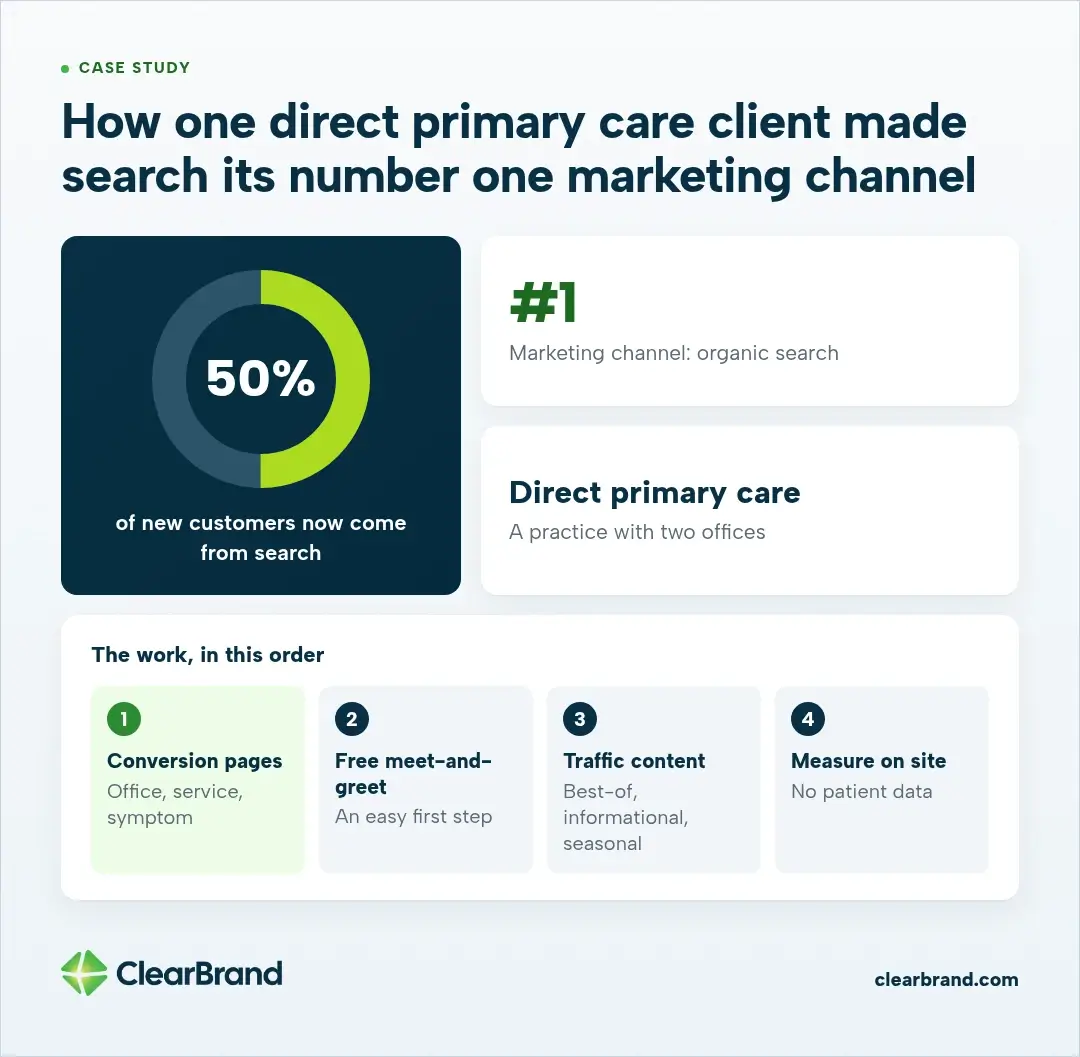
This client is a direct primary care practice with two offices. Members pay one monthly price for direct access to their doctor.
Organic search became their number one marketing channel, and search now brings in 50% of their new customers.
The work followed four steps, in this order:
- Build the pages that convert: a page for each office, then service pages, then symptom pages.
- Make the next step easy by switching the call to action to a free meet-and-greet.
- Grow traffic with best-of pages, informational posts and seasonal pieces like Medicare open enrollment.
- Measure on the website, without handling patient data.
Step 1: Build the pages that convert first
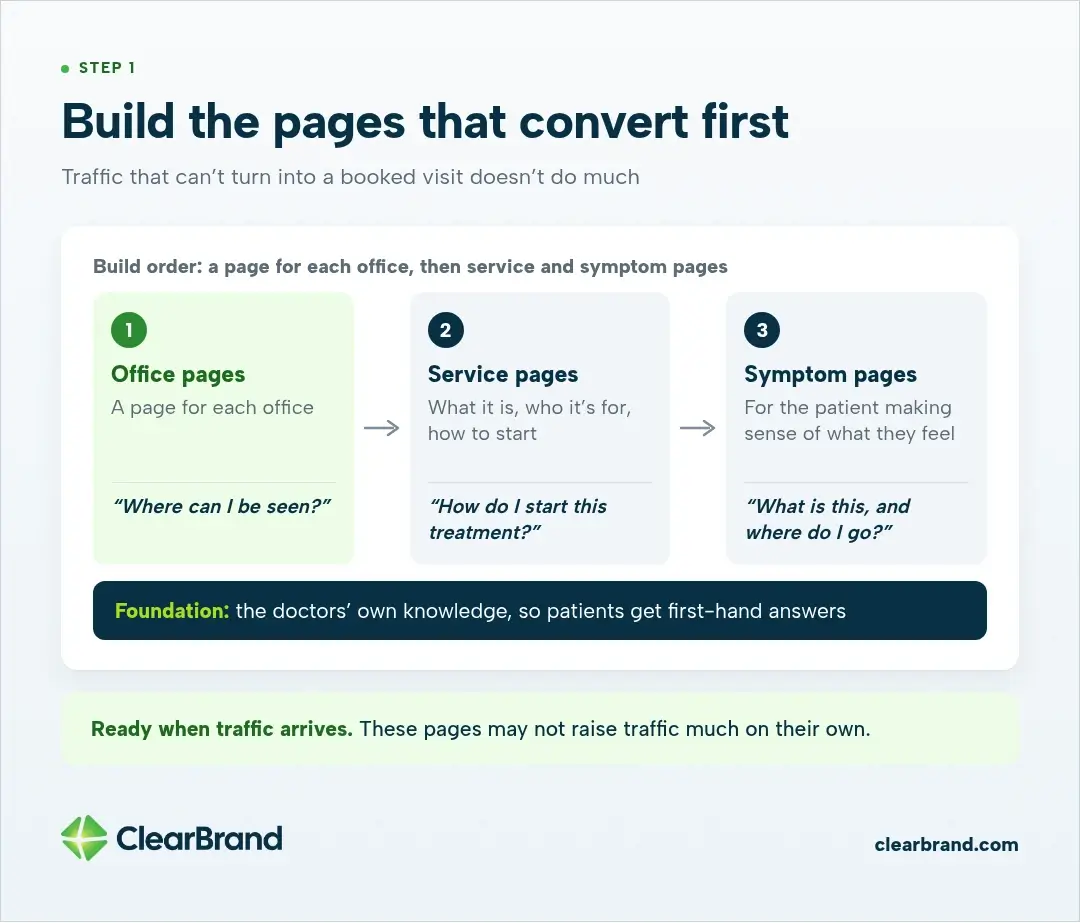
For medical practices, I usually start with conversion pages, because traffic that can’t turn into a booked visit doesn’t do much for the practice.
Conversion pages may not raise traffic much on their own. Their job is to be ready when the traffic arrives.
A page for each office
The practice has two offices, so we started with a location page for each one. Each page speaks to the people that office serves and is accurate about where patients can be seen.
Practices with more offices can give every location its own page the same way.
Service and symptom pages
Next came service pages, which answer the solution search: what the treatment is, who it’s for and how to start.
Then came symptom pages, written for the patient who is trying to make sense of what they’re feeling and deciding where to go.
I build these pages on the doctors’ own knowledge, so a patient gets specific, first-hand information before booking anything.
Step 2: Make the first step a free meet-and-greet
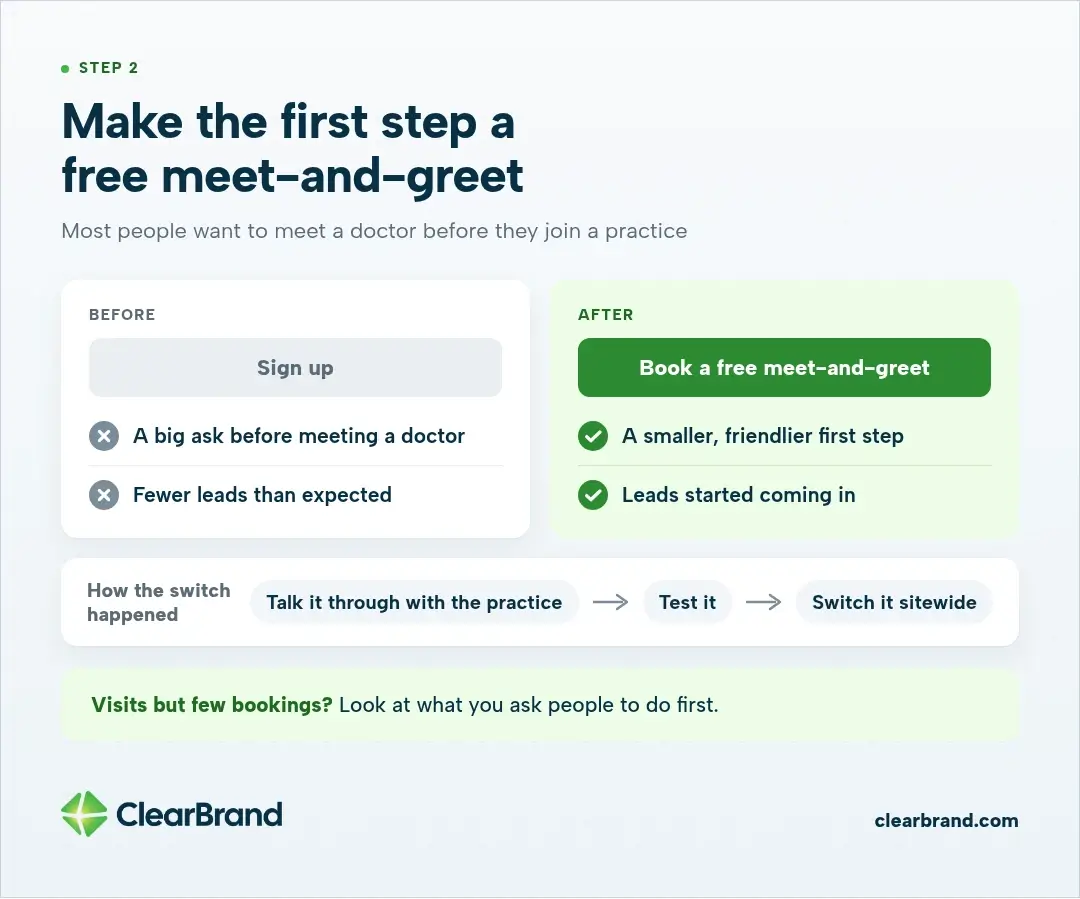
At first, the new pages didn’t bring in the leads we expected. So we ran a conversion-rate pass on the calls to action.
The buttons had been sending people to a signup. That’s a big ask, because most people want to meet a doctor before they join a practice.
We talked through a free meet-and-greet with the practice first, then tested it, then switched the call to action sitewide. Leads started coming in.
If your pages get visits and few bookings, look at what you’re asking people to do first. A smaller, friendlier first step often makes the difference.
Want to know which of your pages are ready to convert? Get your free SEO audit.
Step 3: Add best-of, informational and seasonal content
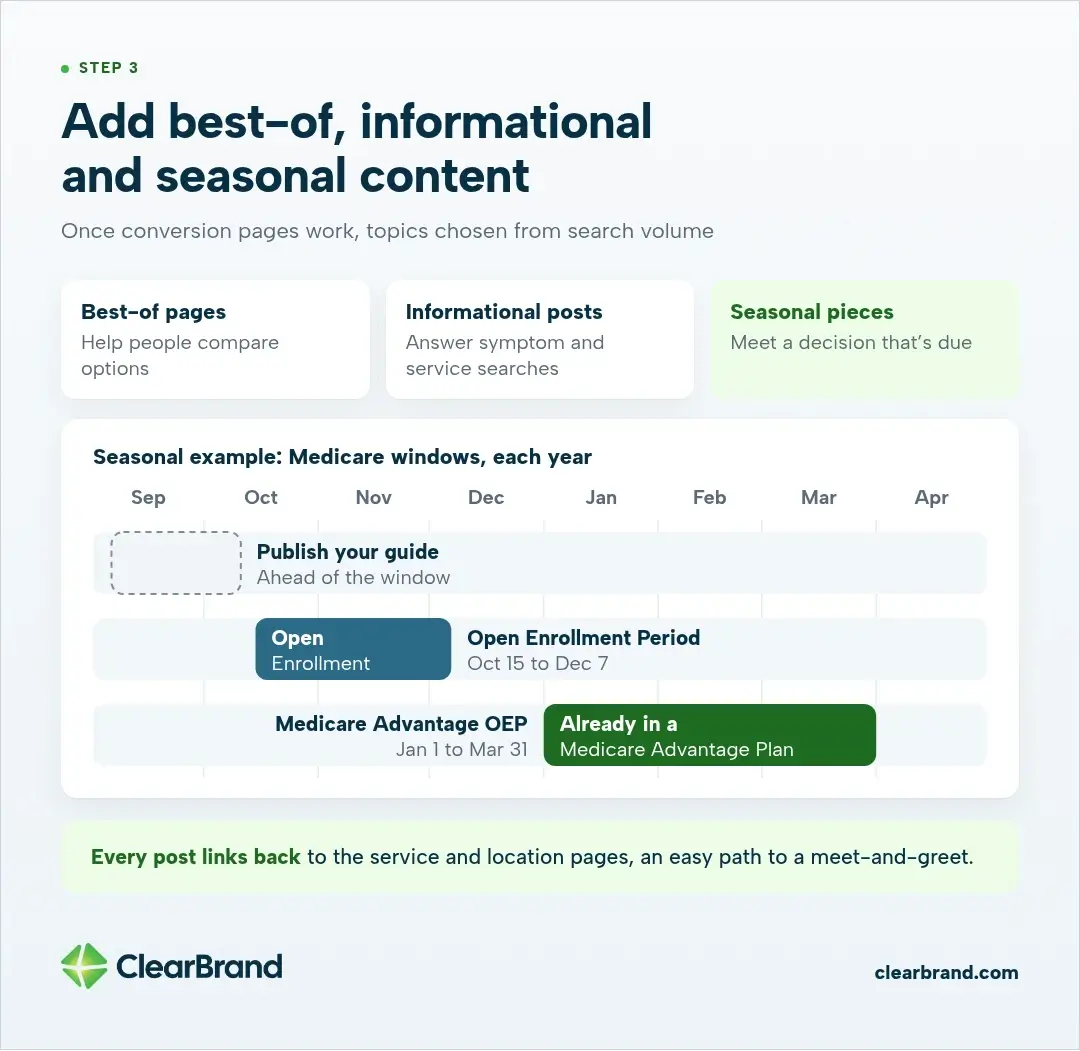
Once the conversion pages were working, we moved into traffic pages: best-of pages, informational posts and seasonal pieces.
Every topic was chosen from search volume. Informational posts answered the problem searches (symptoms) and the solution searches (services). Best-of pages help people compare their options, and across our work they’re some of the pages that gain the most ground in AI answers.
Seasonal content meets patients at the moment a decision is due. Medicare open enrollment (the Open Enrollment Period) runs October 15 to December 7 each year, and the Medicare Advantage Open Enrollment Period runs January 1 to March 31 for people already in a Medicare Advantage Plan. A clear guide published ahead of those windows can reach people while they’re comparing options.
Each of these posts links back to the service and location pages, so new readers have an easy path to a meet-and-greet.
Step 4: Measure on your website, with HIPAA in mind
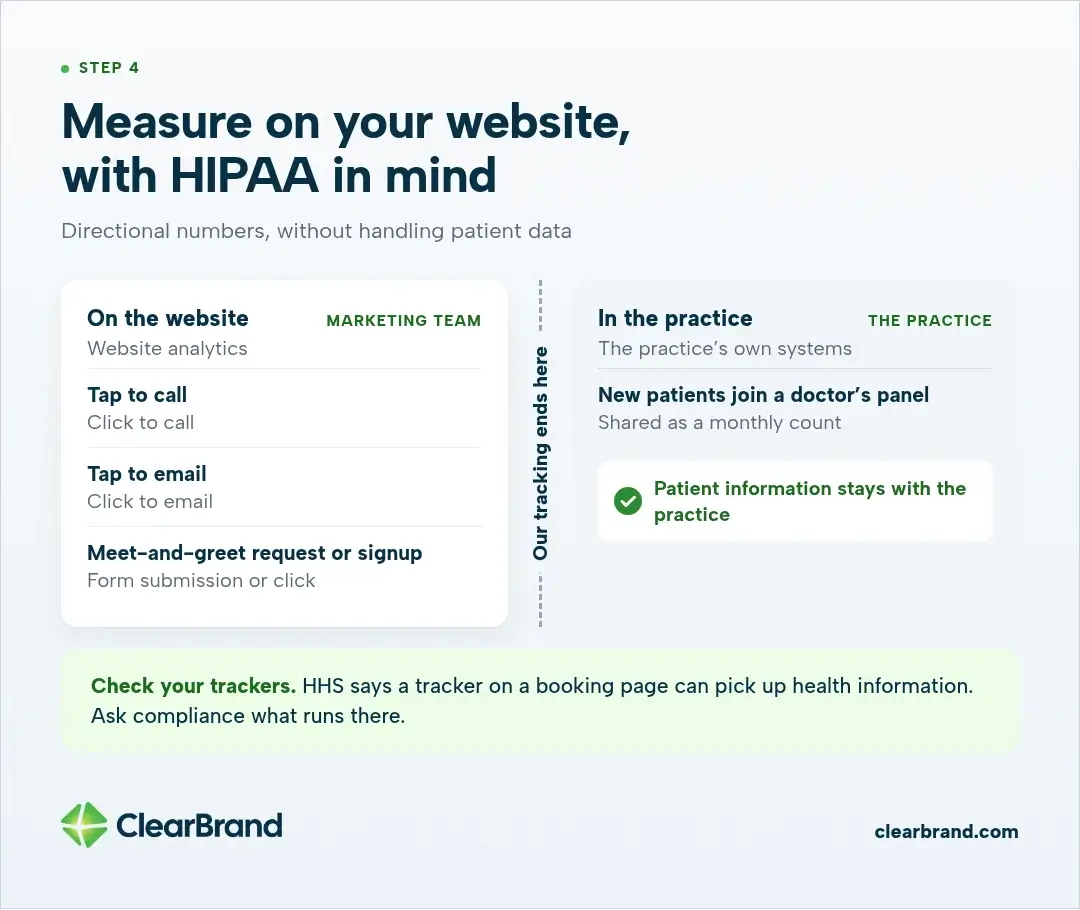
Medical practices can measure much of their marketing without handling patient data by stopping at the website. Track clicks to call, clicks to email and booking or meet-and-greet requests, and let the practice count new patients on its side.
Most medical practices fall under HIPAA, so patient information stays with the practice. We don’t see it and don’t want it. Our tracking ends at the website.
Even so, the tools on a website aren’t automatically safe. HHS guidance on online tracking tools says a tracker on a booking or sign-up page can pick up protected health information. A 2024 court ruling set aside part of that guidance, but the rest still stands, so ask whoever handles your compliance which tools run on those pages.
The numbers are directional, but they’re enough to show which pages bring patients in and which need work.
With this client, we track free meet-and-greet requests and the new patients added to each doctor’s panel every month. Those are the same numbers the practice already uses to run the business, which keeps the reporting simple.
| What happens | Where it’s tracked | Who owns it |
|---|---|---|
| A visitor taps to call | Website analytics (click to call) | Marketing team |
| A visitor taps to email | Website analytics (click to email) | Marketing team |
| A visitor requests a meet-and-greet or signs up | Website analytics (form submission or click) | Marketing team |
| A new patient joins a doctor’s panel | The practice’s own systems, reported as a monthly count | The practice |
How AI answers fit into medical practice marketing
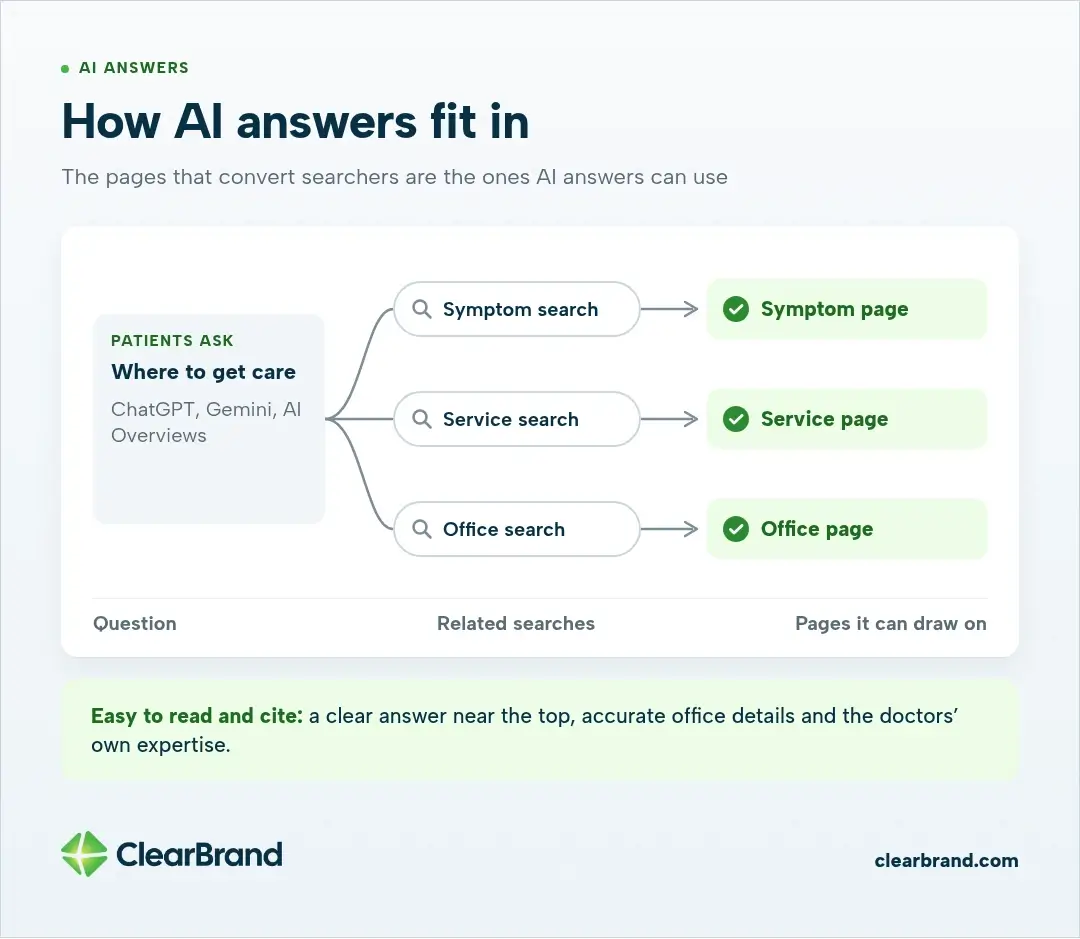
Patients now ask ChatGPT and Gemini, or read Google’s AI Overviews, to learn where to get care and what their symptoms might mean.
Google says AI Overviews need no special optimization: a page has to be indexed and eligible to appear in Search, and normal SEO best practices apply. Its AI features may also run related searches behind the scenes (query fan-out). That means the same symptom, service and location pages that convert searchers are the ones AI answers can draw on.
So I write each page for a patient deciding where to go, then structure it so Google and AI tools can read and cite it: a clear answer near the top, accurate office details and the doctors’ own expertise.
Across our clients, I’m seeing more people arrive from AI answers, and they often arrive ready to take the next step.
Where SEO fits in the rest of your practice marketing
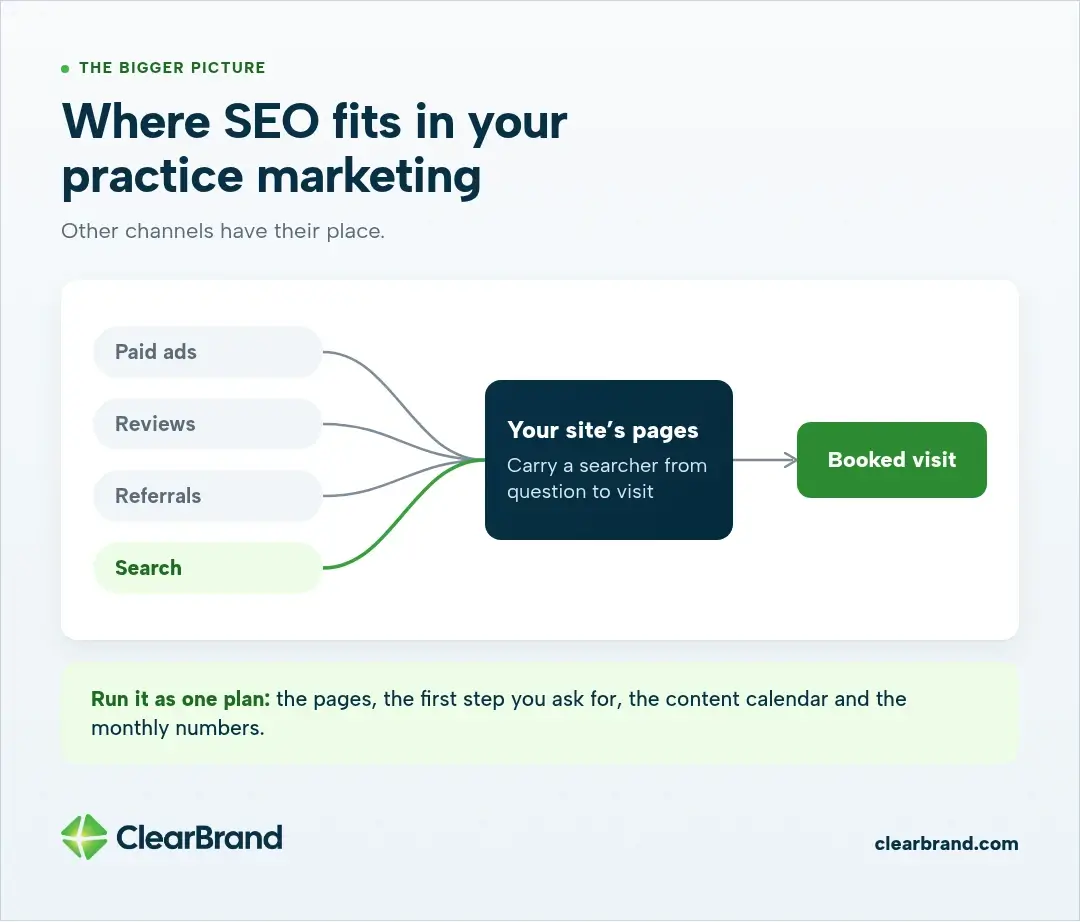
Map listings, reviews, paid ads and referrals get a lot of attention in medical marketing advice, and they have their place. The pages on your own site are what carry a searcher from a question to a booked visit.
Medical practice SEO is the work that runs through all four steps. For the mechanics, including keyword research, medical review and schema, read our guide to healthcare SEO.
For a private practice, marketing works best as one plan: the pages, the first step you ask patients to take, the content calendar and the numbers you watch every month.
Medical practice marketing FAQ
What is medical practice marketing?
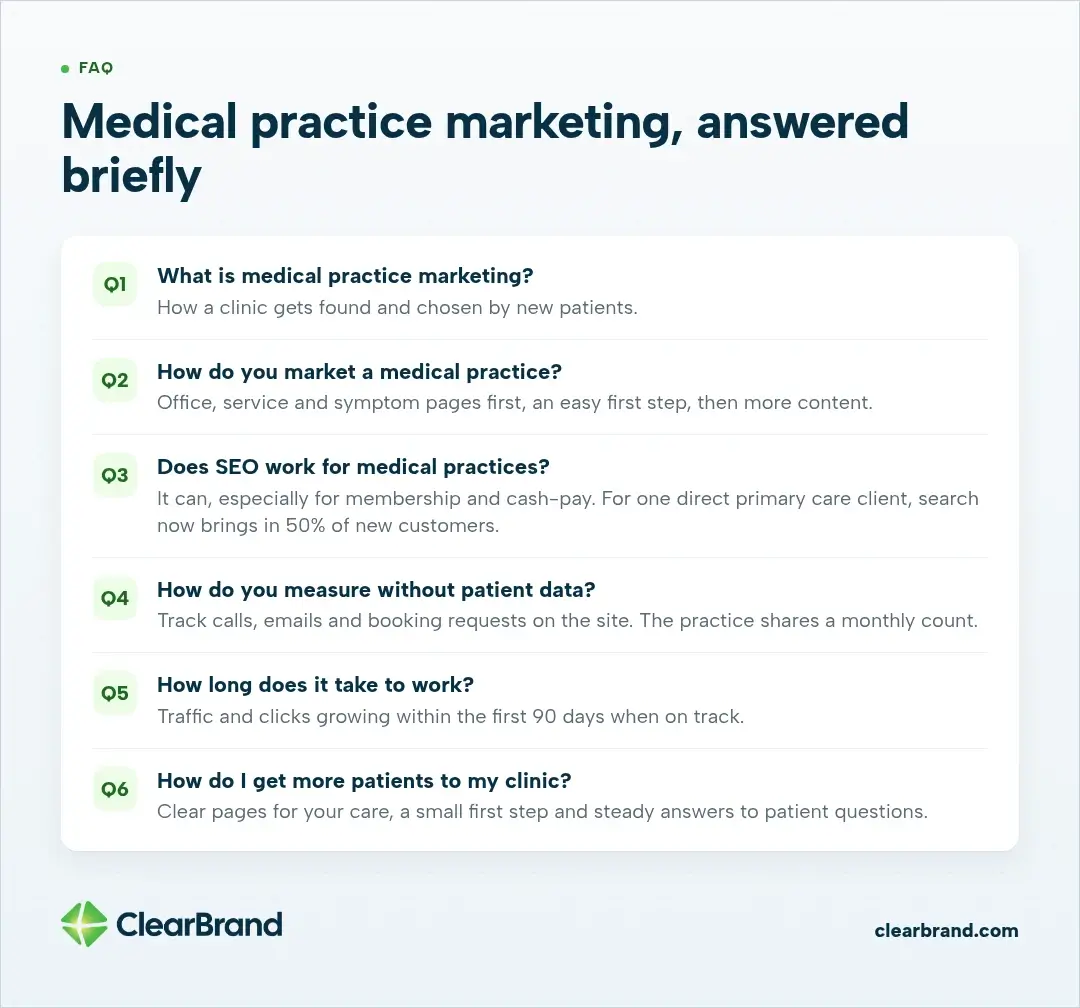
Medical practice marketing is how a clinic gets found and chosen by new patients. For many practices, search brings in a lot of new patients, because it reaches people at the moment they’re looking up a symptom, a treatment or a type of care.
How do you market a medical practice?
A good way to market a medical practice is to start with pages that convert: one for each office, then pages for the services you offer and the symptoms you treat. Make the first step easy, such as a free meet-and-greet, then add informational and seasonal content that brings in more readers.
Does SEO work for medical practices?
SEO can work well for medical practices, especially membership and cash-pay practices that patients can’t find in an insurance directory. For one of our direct primary care clients, search now brings in 50% of new customers.
How do you measure medical marketing without patient data?
You can measure medical marketing by tracking what happens on the website: clicks to call, clicks to email and booking requests. The practice keeps patient information in its own systems and shares a monthly count of new patients, which keeps patient details out of the marketing reports.
How long does medical practice marketing take to work?
When the work is on track, I expect to see traffic and clicks growing within the first 90 days. When conversion pages come first, bookings can rise even before traffic jumps.
How do I get more patients to my clinic?
A dependable way to get more patients is to make it easy for the right people to find you and say yes. Build clear pages for the care you offer, ask for a small first step like a meet-and-greet, and keep publishing answers to the questions your patients already search.
Building your practice’s search plan with a partner
Some practices run this in-house. Others want a team that handles the strategy, the doctor interviews, the writing and the measurement, which is how we run SEO for clinics and practices.
Your free SEO audit is a full review of your site and an initial 90-day strategy, and you keep it whether you work with us or not.
We’d love to look at your practice’s site and show you where your next patients are searching. Get your free SEO audit.