
Healthcare SEO: Rank Where Patients Actually Search
Healthcare SEO ranks clinics for the searches patients already run, under YMYL rules. Covers keywords, local pages, medical review, and how to measure new patients.
Originally published: September 15, 2026 Last updated: October 10, 2026
Healthcare SEO is the work of ranking a medical website for the searches patients, caregivers, and referrers already run, on Google and inside AI answers, so those visits become appointments and new patients.
Most practices publish symptom posts and hope the phone rings. The pages that usually produce a booking are simpler: a named service in the patient’s city, with a clinician the patient can check. This guide covers the keyword map a clinic can actually win, the page types that produce patients, the quality bar Google applies to health content, and the numbers that tell you whether the work is working.
Key Takeaways
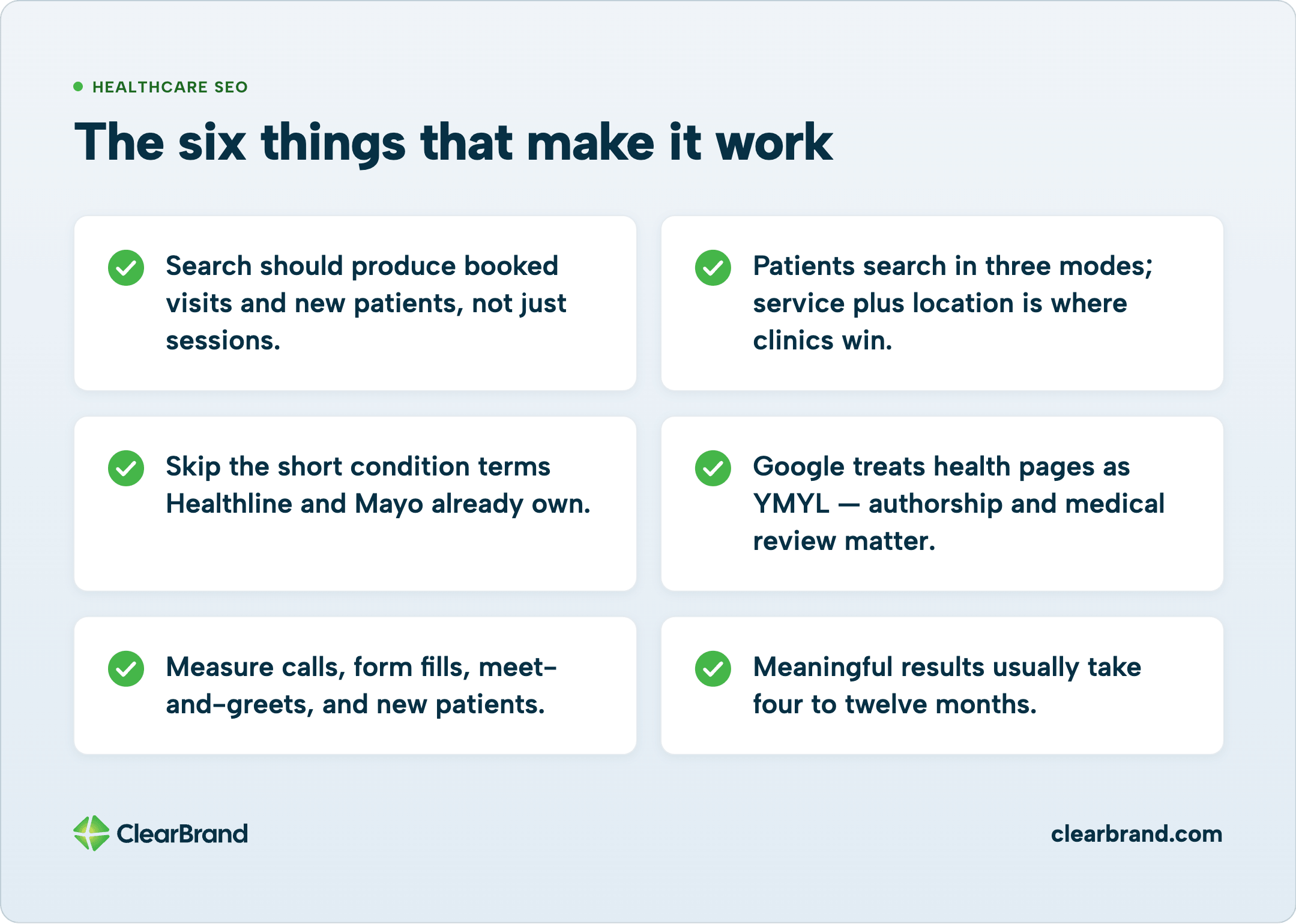
- Healthcare SEO exists to produce booked visits and new patients from search. Session counts alone do not prove that.
- Patients search in three modes: symptoms, conditions and treatments, and service plus location. The last group is where most clinics can rank.
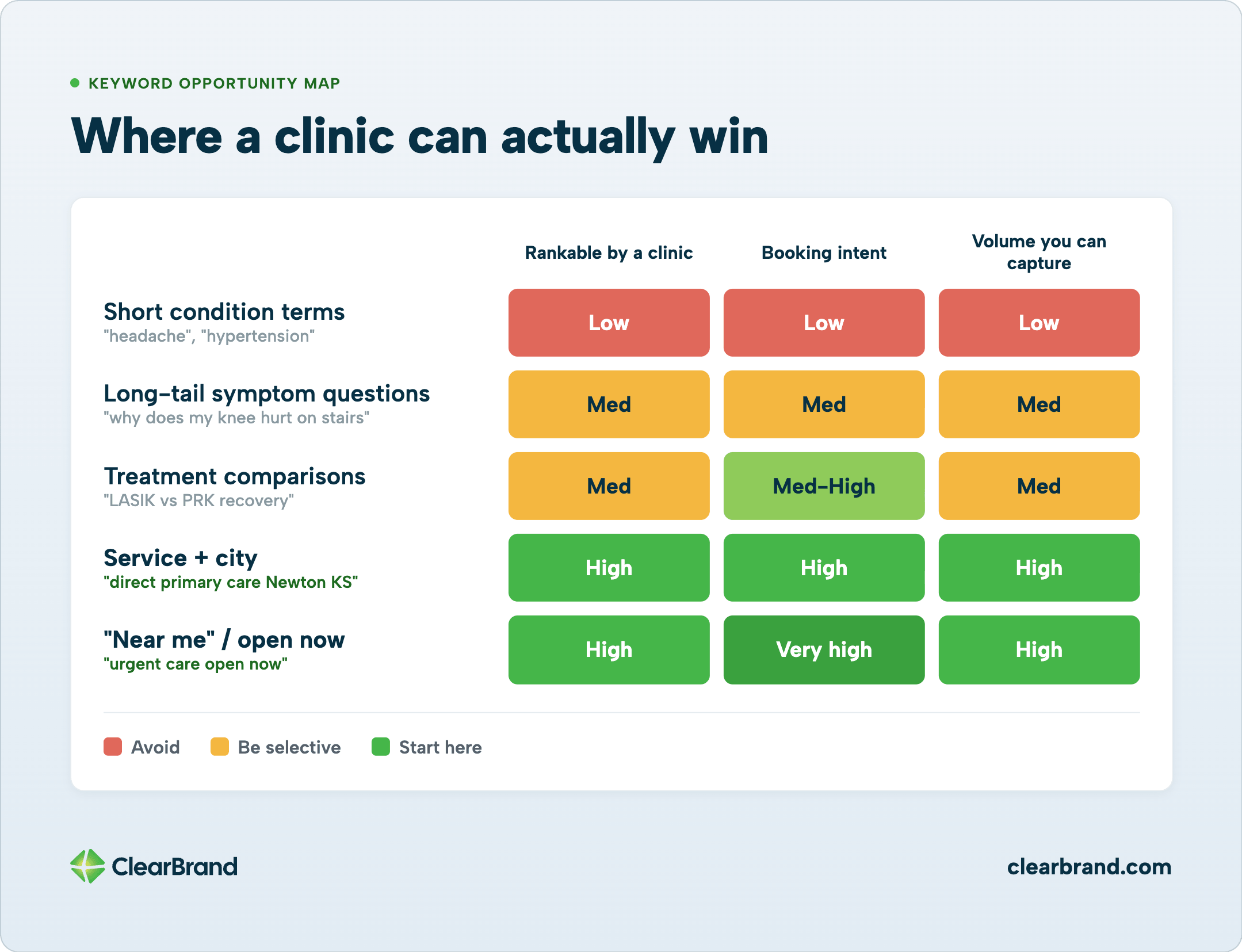
- Do not start by targeting the same short condition terms that Healthline, Mayo Clinic, and Cleveland Clinic already own.
- Google treats health pages as YMYL (Your Money or Your Life). Named authors, medical review, accurate claims, and a real business presence matter more here than they do on a restaurant site.
- Measure organic calls, form fills, meet-and-greets, and new patients. Rankings are an early signal only.
- Meaningful healthcare SEO results, like calls and new patients, generally come by about month 6. Google’s own hiring guidance allows four months to a year.
What healthcare SEO is
Healthcare SEO is the practice of ranking a medical website for the searches patients and referrers already run so those visits become appointments and new patients. The work includes keyword research, on-page and technical SEO, local listings, content, schema, and authority. Success looks like a patient taking the next step: a call, a form, a meet-and-greet, or a booking. For the order a practice should build those pages in, and how to measure them without patient data, see our guide to medical practice marketing.
You still research keywords, fix the site, and write pages. A thin health page is worse than a thin retail page because someone may act on bad medical information.
Google has said for years that a large share of queries are health-related. In 2015 it put the figure at one in 20 searches. That demand did not go away. What changed is how hard those pages have to work to be trusted.
Why healthcare SEO is different from regular SEO
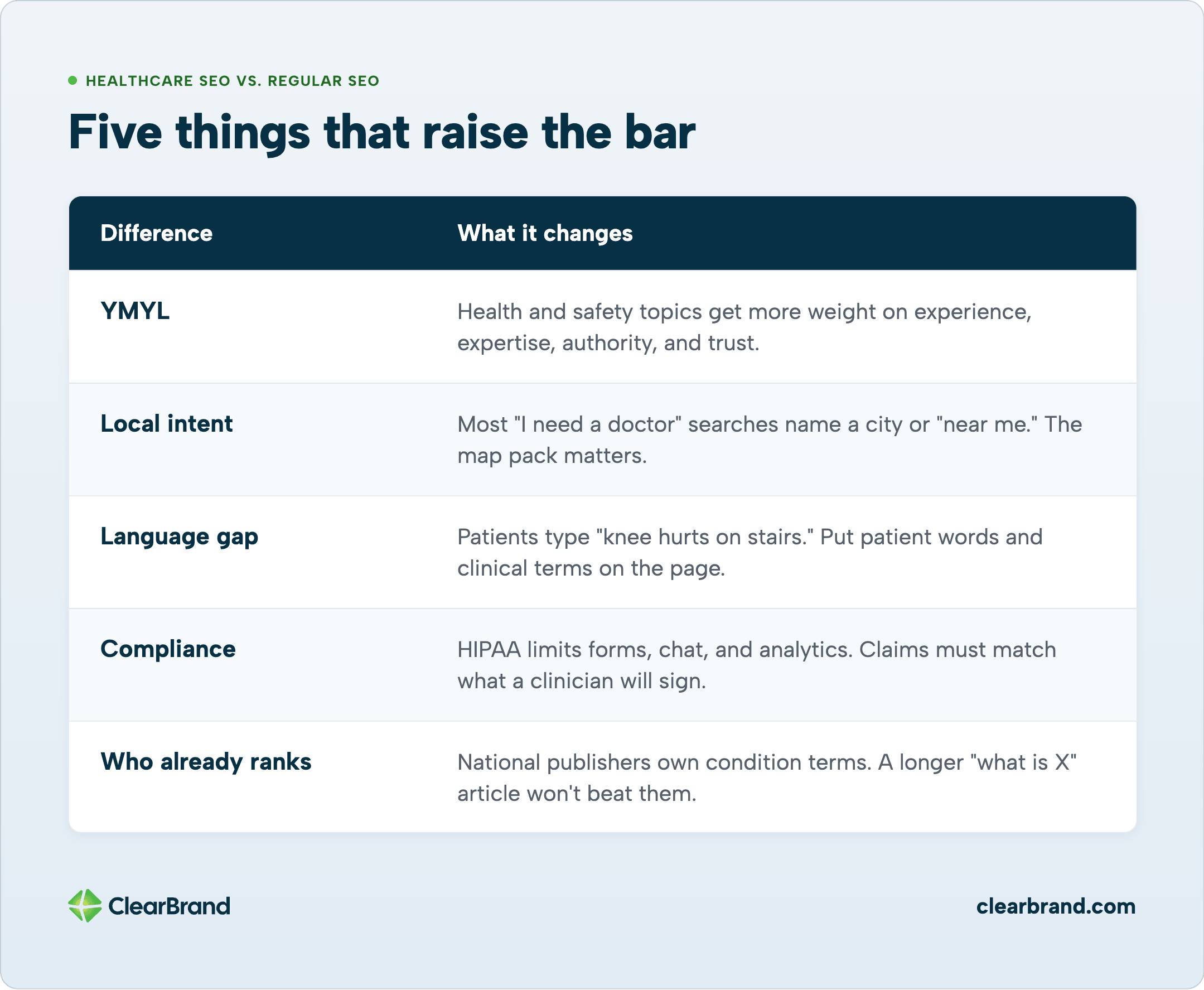
Regular SEO can treat a visit as progress. Healthcare SEO also has to satisfy Google’s YMYL standard, local intent, and privacy rules a retailer does not carry.
| Difference | What it changes |
|---|---|
| YMYL | Google’s systems give more weight to experience, expertise, authoritativeness, and trust on topics that can affect health or safety. See Google’s helpful-content guidance. |
| Local intent | Most “I need a doctor” searches include a city or “near me.” The map pack and Google Business Profile often matter as much as the website. |
| Language gap | Patients type “knee hurts going upstairs.” Clinics write “patellofemoral pain syndrome.” Put both on the page. Most people search the first version. |
| Compliance | HIPAA limits what you put in forms, chat tools, and analytics. Claims language has to match what a clinician will stand behind. |
| Who already ranks | Informational condition results are owned by national publishers and health systems. A single clinic does not beat that set by writing a longer “what is hypertension” article. |
Ahrefs’ 2024 interviews with healthcare SEOs made the same point: headache is a six-figure search term that a local practice will not take from Mayo. The workable list is the longer phrases and the local service terms sitting under it.
HIPAA limits what you can put in analytics. Do not send names, appointment details, or other protected health information into a general analytics property. Start from HHS HIPAA guidance before you wire a form to a dashboard.
How patients search
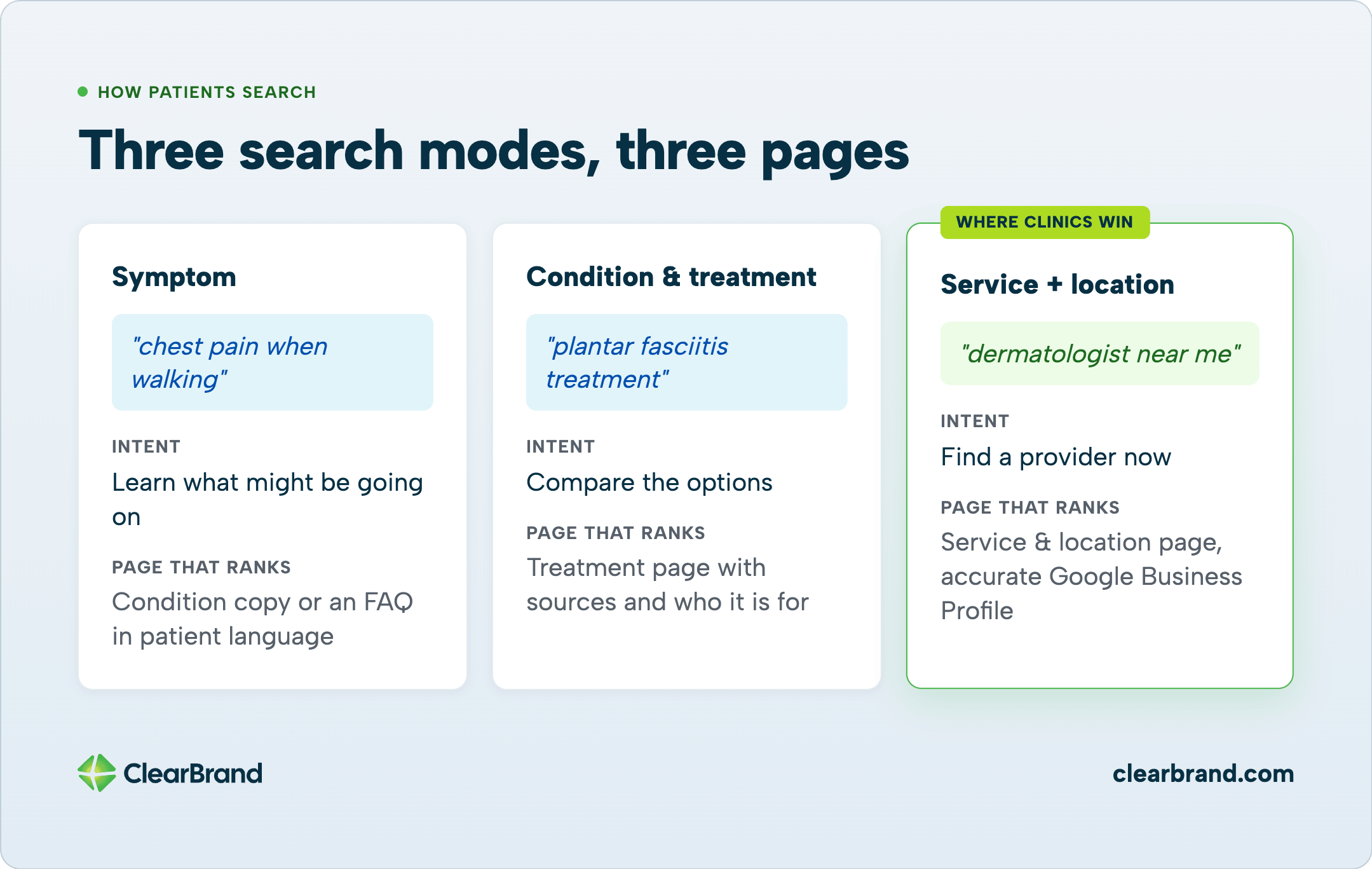
Patients search in three modes. Mix the modes up and you write the wrong page for the query.
| Mode | What it looks like | Intent | Page that should rank |
|---|---|---|---|
| Symptom | “chest pain when walking,” “why does my knee hurt on stairs” | Learn what might be going on | Condition copy or an FAQ block on a service page, written in patient language, with a clear next step. Do not pretend this is a diagnosis. |
| Condition / treatment | “plantar fasciitis treatment,” “LASIK vs PRK recovery” | Compare options | Treatment or condition page with sources, who it is for, and how your practice handles it. |
| Service + location | “direct primary care Newton KS,” “urgent care open now,” “dermatologist near me” | Find a provider | Service page, location page for a real office, and an accurate Google Business Profile. |
Symptom and condition pages help people understand the problem. Service and location pages are the ones that usually produce the call or booking. A site that only publishes encyclopedia posts may rank for research queries and still get few appointments.
Referring physicians search differently. Referrers want program details, referral steps, and who is on the panel. If that audience matters, give them a page. Do not hide the referral page inside a patient blog.
Healthcare SEO keyword research starts where you can win
Start keyword research from searches that already imply a visit in a place you serve. Then work upward only as far as you can support with a real clinician and a real page.
How to build the list:
- Write the services you actually offer, in the words a patient would use on the phone.
- Pair each service with each real city or neighborhood you practice in.
- Add the condition and treatment phrases your clinicians hear in the exam room.
- Search those phrases. Note who ranks: a national publisher, a health system, a directory, or another clinic.
- Keep terms you can rank and that a person ready to book would type. Drop short, generic terms you cannot beat.
A high-volume condition term that never leads to a booking will grow traffic without growing the practice. A lower-volume query like “pediatric dentist accepting new patients in [city]” can still be the better keyword if it produces calls.
Use Google Search Console on pages you already have. Use the search terms report inside Google Business Profile. Both show phrasing a keyword tool will miss. Then open People Also Ask on the live results for each service. Those questions belong in the FAQ on the service page. They are not a reason to start a second blog.
Do not build a page for every synonym. One strong service URL can cover the close variants if the H1, first paragraph, and FAQ use the language patients type.
The healthcare SEO pages that produce patients
Finish service, location, and provider URLs first. Blog posts come after those pages exist, or they support service pages that already exist.
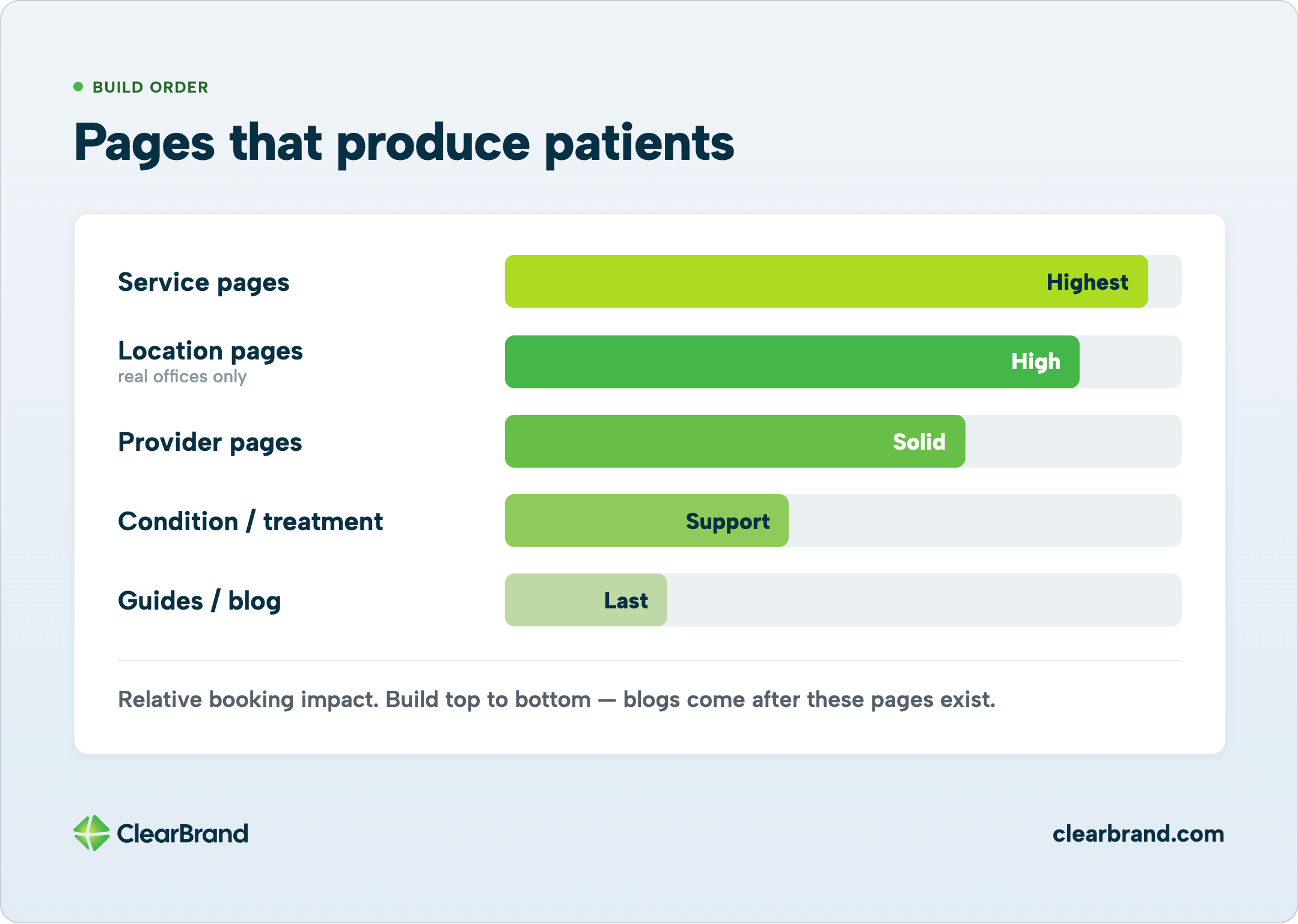
Service pages
Give each service its own page, say who it is for, and end with one way to book. “Direct primary care” or “sports physical therapy” beats a generic “our services” dump because the query already named the job.
Write what the service is, who it is for, what a first visit looks like, insurance or cash-pay rules if you can state them, and the booking action. Keep clinical claims inside what your reviewers will sign.
Location pages, only for real offices
A location page is useful when the practice actually sits at that address. Put the name, address, phone, hours, parking, services at that site, and an embedded map on the URL.
Duplicate the same service essay across ten cities and Google treats those URLs as doorway pages: thin pages built to rank for a place you barely describe. Google already limited that pattern. We used to publish those city copies years ago, before the rules tightened. We stopped.
A virtual-only practice should not invent city pages. A line on the service URL that names the region you are licensed to serve is enough.
Provider pages
A named clinician with credentials, a photo, the conditions they treat, and the locations they work helps a patient decide and helps Google see who stands behind the site. Patients and referring doctors both search clinician names.
Condition and treatment pages
Write a condition or treatment page when your clinicians treat that condition and you can source the copy. Cite CDC, NIH, or the relevant specialty board. Put a last-reviewed date and a reviewer name on the page. Link down to the service and location URLs.
Skip the general explainer you cannot keep current. Large publishers update those pages on a schedule a small practice cannot match.
Guides, only as support
A guide is useful when it answers a real question and links to a service page. If the service URLs do not exist yet, write them first.
Local SEO and the Google Business Profile
For any practice with a waiting room, local search is half the job. Patients type “near me.” Google answers with the map pack before it answers with your blog.
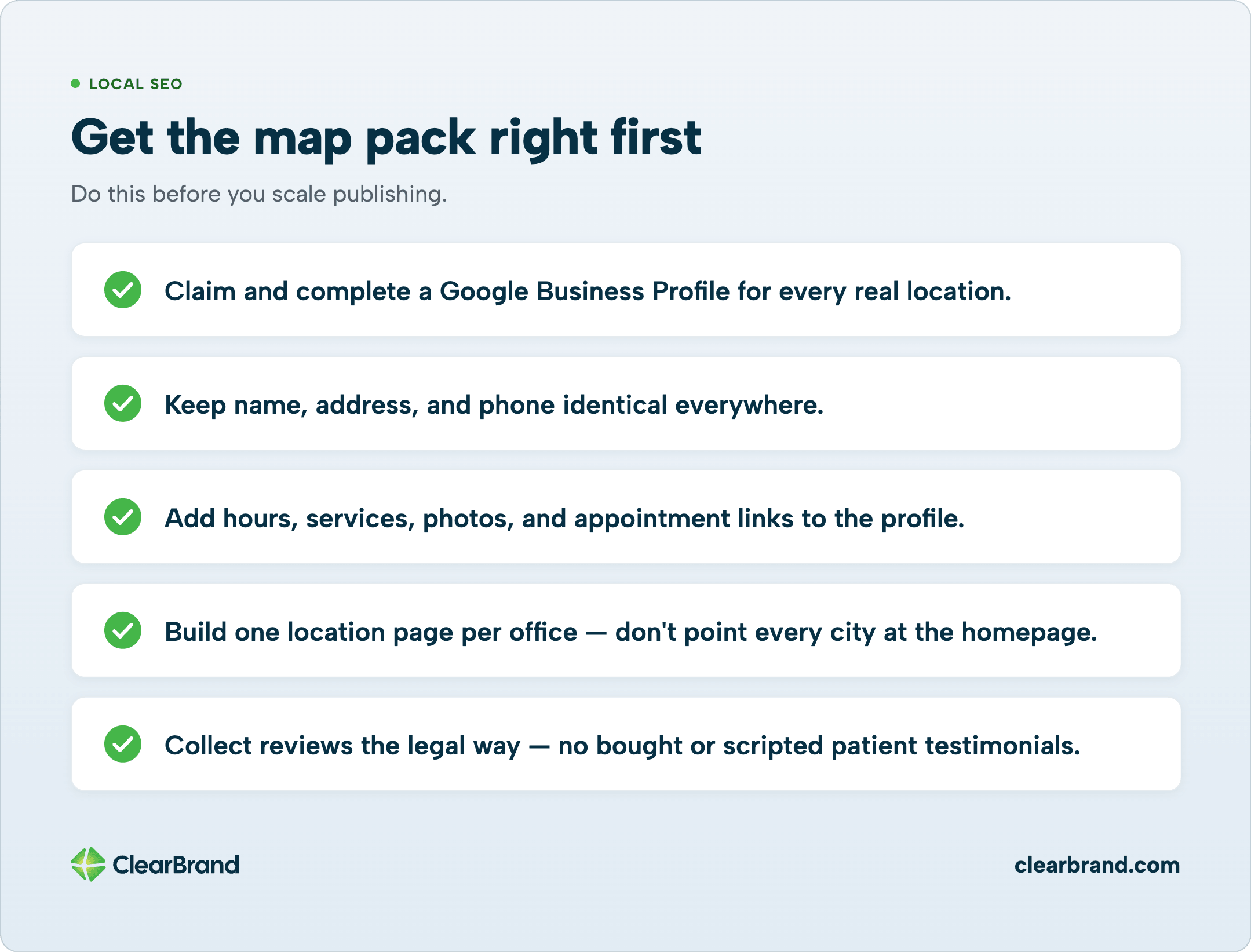
Do this before you scale publishing:
- Claim and complete a Google Business Profile for every real location. Use the most specific category you can defend.
- Keep name, address, and phone identical on the site, the profile, and every directory you still control.
- Put hours, services, photos, and appointment links on the profile. Answer questions there.
- Build one location URL per office. Do not point every city at the homepage.
- Collect reviews the legal way. In many states you cannot buy, trade, or script a named patient testimonial. If a named quote is not allowed, do not publish it.
A single-location practice in a small market often gets more from the profile and a few service pages than from a national content calendar. Keep the website. Do not fund a 40-article plan before the listing is accurate.
Multi-location work scales because each office is another service area. The SEO is similar from site to site. More offices means more local searches you can reasonably win. An outside team can clean up the listing. New reviews still have to come from real patients.
E-E-A-T and medical review
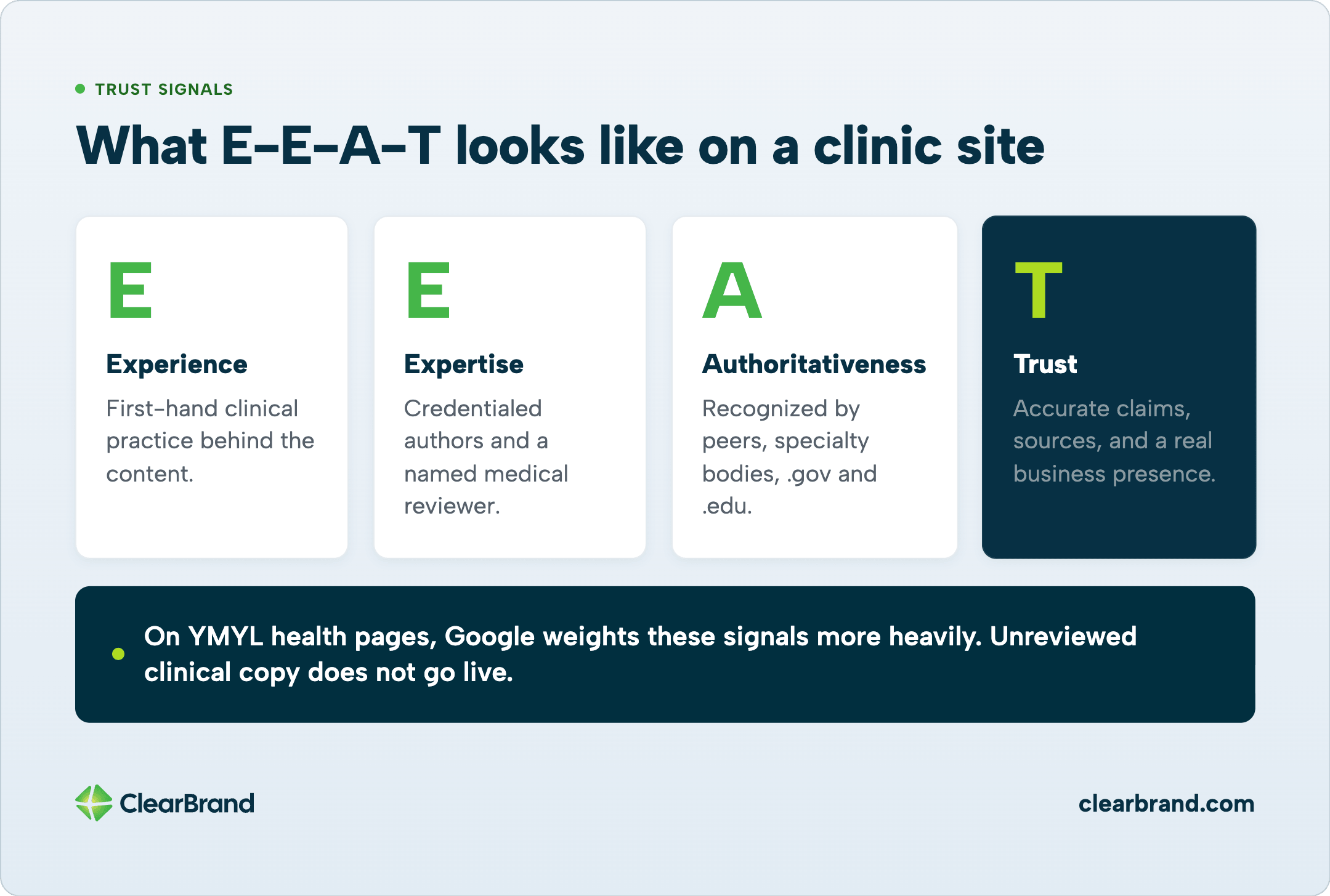
E-E-A-T is Experience, Expertise, Authoritativeness, and Trustworthiness. Google uses a mix of signals that approximate those qualities. You cannot paste a score into a plugin and call the page trusted. On health topics, Google says those signals carry more weight.
What that looks like on a clinic site:
- A named author or medical reviewer with a credential you can verify, linked to a bio.
- Claims a clinician will stand behind. If the doctor would not say it in the exam room, it does not go live.
- Sources on condition and treatment pages.
- A visible last-reviewed date, and a habit of updating pages when guidance changes.
- An About, leadership, and locations set that prove the organization is real.
- Reviews and directory listings that match the legal name of the practice.
You can draft with a writer who is not a clinician. You cannot publish that draft without a review for medical accuracy. A model can outline and clean sentences. Unreviewed clinical copy is how pages invent dosages and “guaranteed” outcomes. Do not publish it.
Links and mentions also come from outside the site: hospital affiliations, specialty societies, .gov and .edu citations when you have original work worth citing. Ahrefs’ healthcare interviews still point at research and innovation as the link path that national publishers cannot copy from a local clinic. That work is slow. It still beats a pile of low-quality directory links.
YMYL is the label for topics that can affect health, money, or safety. Health sits at the center of that set. The public Search Quality Rater Guidelines are how raters are trained to judge those pages. Raters do not rank your URL. The document is still the clearest picture of what trustworthy health content means to Google.
Technical SEO and schema for healthcare sites
A healthcare page Google cannot render or trust will not rank, no matter how much new copy you publish.
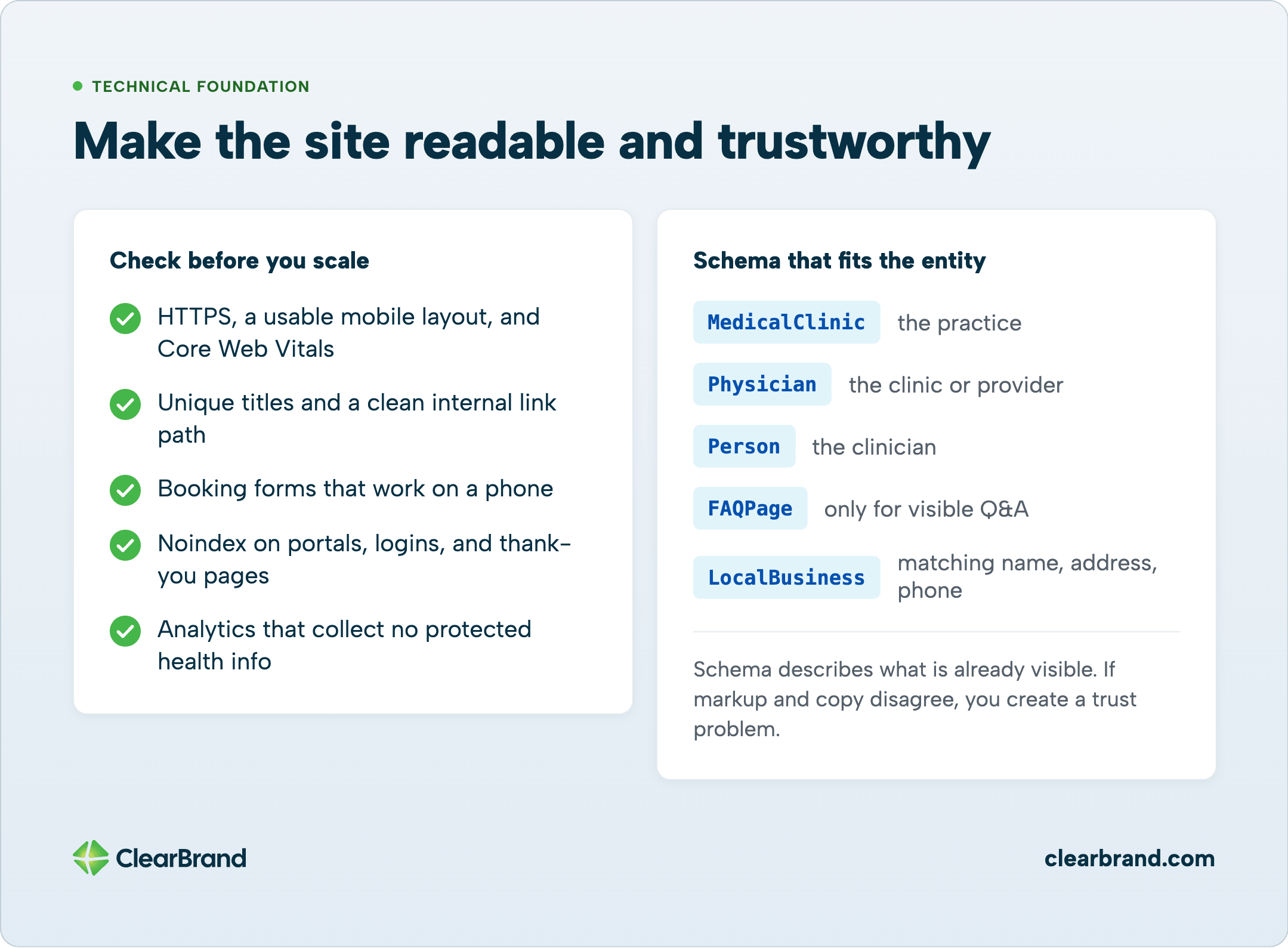
Check these before you scale publishing:
- HTTPS, a usable mobile layout, and Core Web Vitals that do not make a tired parent abandon the page.
- Service, location, and provider URLs that load correctly, with unique titles and a sensible internal link path from the homepage.
- Forms that work on a phone. A booking path that does not hide behind three menus.
- Noindex on portals, patient logins, and thank-you URLs so those pages stay out of the index.
- Analytics that do not collect protected health information.
Schema helps machines read what the page already says. Use types that match the entity: MedicalClinic or Physician for the practice, Person for the clinician, FAQPage only when the questions are visible on the page, and LocalBusiness details that match the name, address, and phone on the site. Schema describes what is already on the page. If the markup disagrees with the visible copy, you create a trust problem.
AI Overviews and answer engines pull from the same useful pages. You do not need a second program. Write a direct first sentence, keep facts visible, and mark up the entity. How those systems choose sources is covered in What is AEO?.
How to measure healthcare SEO
If the dashboard is sessions and average position, you cannot tell whether healthcare SEO is working.
Track this stack:
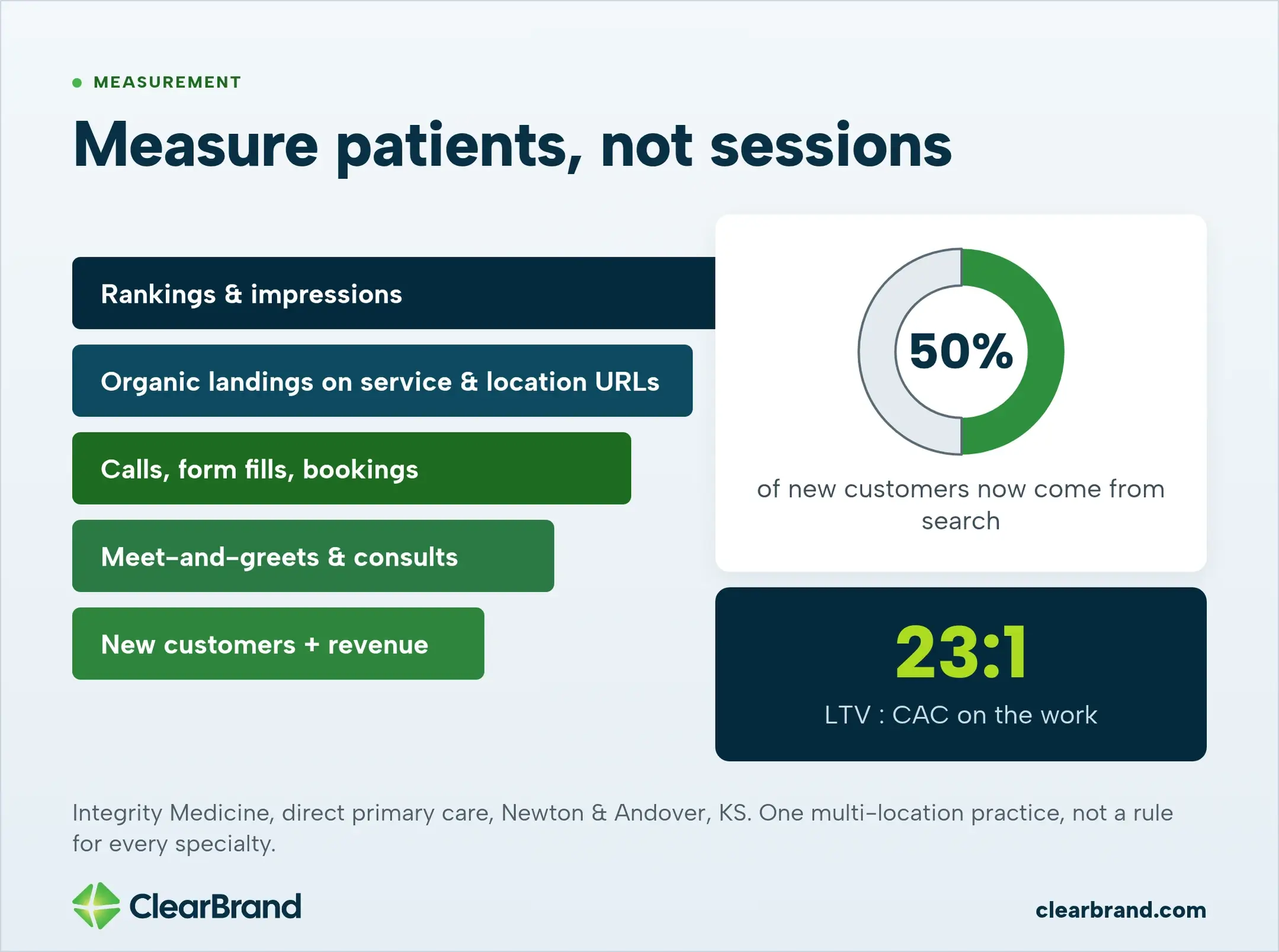
- Rankings and impressions on the service and location terms you chose
- Organic landings on those URLs, not only on the blog
- Calls, form fills, and online bookings from those landings
- Meet-and-greets or consults that came from search
- New patients, and the revenue or membership those patients add
A page that ranks and never converts needs a clearer offer or a better match to the query. A page that converts and sits on page two is the one to support with links and internal anchors.
Paid search will look cheaper in month one. Judge healthcare SEO from about month 6 against what those patients are worth over time, not against last week’s cost per click.
Integrity Medicine is a direct primary care practice with offices in Newton and Andover, Kansas. New patients join a monthly membership, so the useful number is new patients attributed to search, not sessions. At Integrity Medicine, search now brings in 50% of new customers, organic search became the practice’s number one marketing channel, and the work runs at a 23:1 LTV:CAC. That is one multi-location practice, not a rule for every specialty. Count new patients even if the traffic graph looks noisy. It’s the first number we report on in our healthcare SEO agency work.
How long healthcare SEO takes
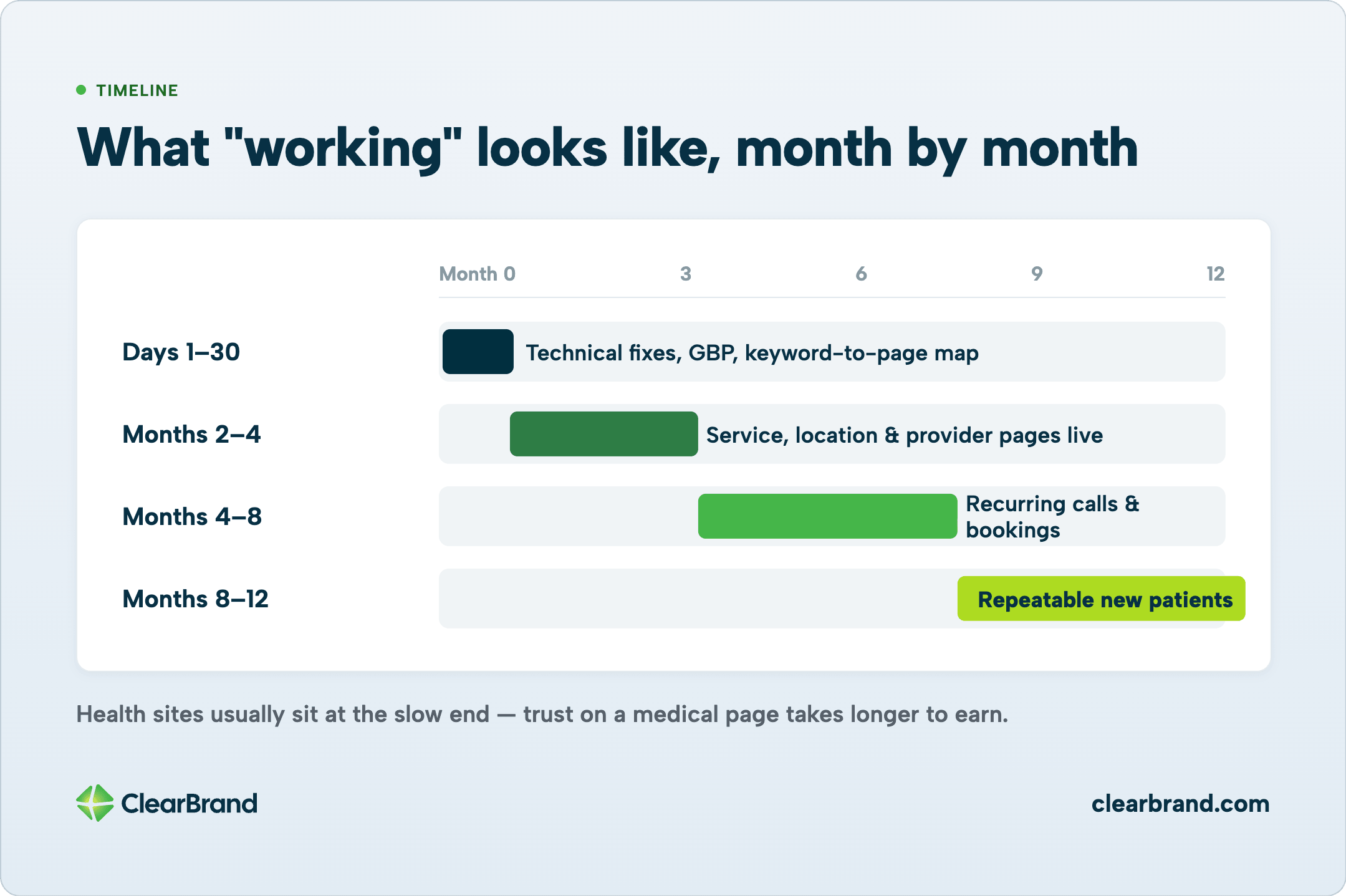
Google’s guidance for hiring SEO help is four months to a year before most sites see a benefit. When the work is on track, healthcare sites generally see new patients from search by about month 6, even though trust on a health page takes longer to earn than a listing for a restaurant.
| Stage | What “working” looks like |
|---|---|
| Days 1–30 | Technical issues fixed. Google Business Profile accurate. Keyword-to-page map written. Existing service and location URLs improved. |
| Months 2–4 | New or rebuilt service, location, and provider pages live. Early movement on easier local terms. |
| Months 4–8 | Recurring calls or bookings from a few URLs. Condition pages internally linked to services. |
| Months 8–12 | Organic search produces new patients on a repeatable basis, not only a traffic report. |
Cost follows scope: number of locations, number of service lines, and whether a clinician will review copy on time. Multi-location work costs more than a single site.
If you do not have the hours to finish service pages and keep them medically current, you need more hands. You still research the same service and city terms. Comparing partners is a different job. Start with the healthcare SEO agencies for clinics list if that is the decision you are making.
Healthcare SEO FAQ
What is healthcare SEO?
Healthcare SEO is the practice of ranking a medical website for the searches patients and referrers already run so those visits become appointments and new patients. The same technical and content tools apply as in other SEO. A booked visit is the conversion.
How is medical SEO different from regular SEO?
Medical SEO is different because Google treats health content as YMYL and because most ready-to-book searches are local. That raises the bar on credentials, accuracy, and Google Business Profile work.
What is YMYL in healthcare SEO?
YMYL means Your Money or Your Life: topics where bad information can affect someone’s health, finances, or safety. Health content sits at the center of that set, which is why Google weights E-E-A-T more heavily on these pages.
How long does SEO take for a healthcare website?
Healthcare SEO generally starts producing new patients by about month 6, and the flow grows steadier after that. Easier local service terms can move in 3 to 6 months. New domains and competitive metros take longer.
How do I do local SEO for a medical practice?
Start with a complete Google Business Profile, identical name, address, and phone on every listing, and one location page per real office. Then rank service pages for the city terms patients type.
How much does healthcare SEO cost?
Healthcare SEO cost depends on scope, and it rises with locations, service lines, and medical review. Cheap retainers that skip that review are not a bargain.
Is AI-written content safe for healthcare SEO?
AI-written clinical content is safe only after a qualified reviewer checks every claim. Drafting an outline with a model is fine. Publishing unreviewed medical advice is how practices put errors on the live site.
Can telehealth practices use healthcare SEO?
Telehealth practices can use healthcare SEO by targeting the states or regions they are licensed to serve and the service terms patients type, instead of inventing city pages for offices they do not have.
Close
Publish the service and city pages a patient would search, and only keep claims a clinician will sign.