
Healthcare Content Marketing That Passes YMYL: A System for Practices and Clinics
Healthcare content marketing for practices and clinics: who writes, who reviews, which pages come first, and how to refresh and measure every page.
Originally published: October 28, 2026 Last updated: October 28, 2026
Healthcare content marketing is publishing accurate, clinician-reviewed answers to the questions patients search, then connecting each answer to the page where a patient can take the next step. For practices and clinics, it works when every page has a writer, a qualified reviewer, a target search and a clear next step.
Many guides stop at a list of ideas: write blogs, make videos, share patient stories. The ideas are fine. What makes them hold up is the system behind them, the part that decides who writes, who signs off and what goes live first.
The system we use with practices and clinics runs from the first content strategy to the monthly numbers. The steps stay basically the same whether a practice offers direct primary care, dental or specialty care, from one office or several. What changes is the topics and who reviews them.
What is healthcare content marketing?
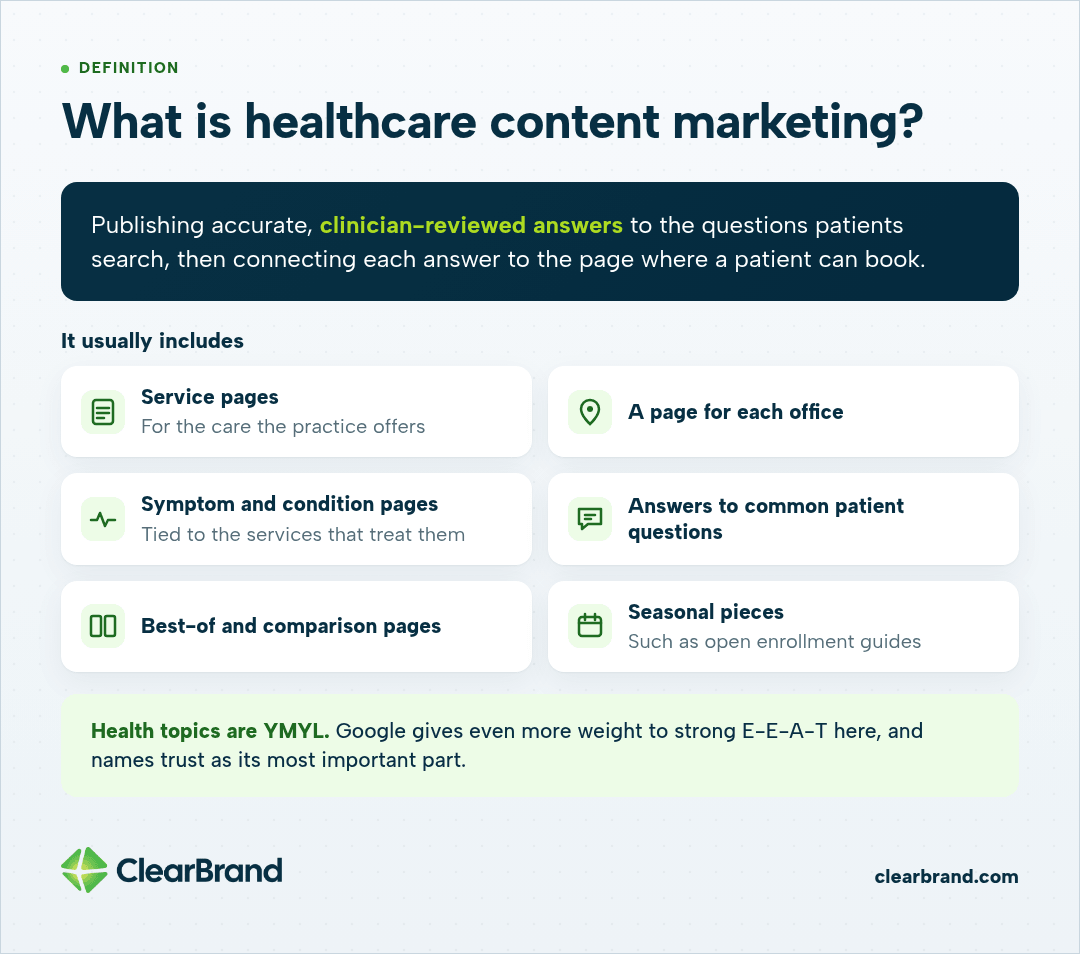
Healthcare content marketing is publishing accurate, clinician-reviewed answers to the questions patients search, then connecting each answer to the page where a patient can book. For a practice or clinic, every piece has a reviewer, a target search and a next step.
It usually includes:
- Service pages for the care the practice offers
- A page for each office
- Symptom and condition pages tied to the services that treat them
- Answers to common patient questions
- Best-of and comparison pages
- Seasonal pieces, such as open enrollment guides
Health topics carry extra weight in search. Google says its systems give even more weight to content with strong E-E-A-T on topics that could significantly affect people’s health, and it calls these Your Money or Your Life topics, or YMYL (Google Search Central: Creating helpful, reliable, people-first content). Google also names trust as the most important part of E-E-A-T.
That’s why a practice’s content has to earn trust before it can rank well.
The healthcare content system at a glance
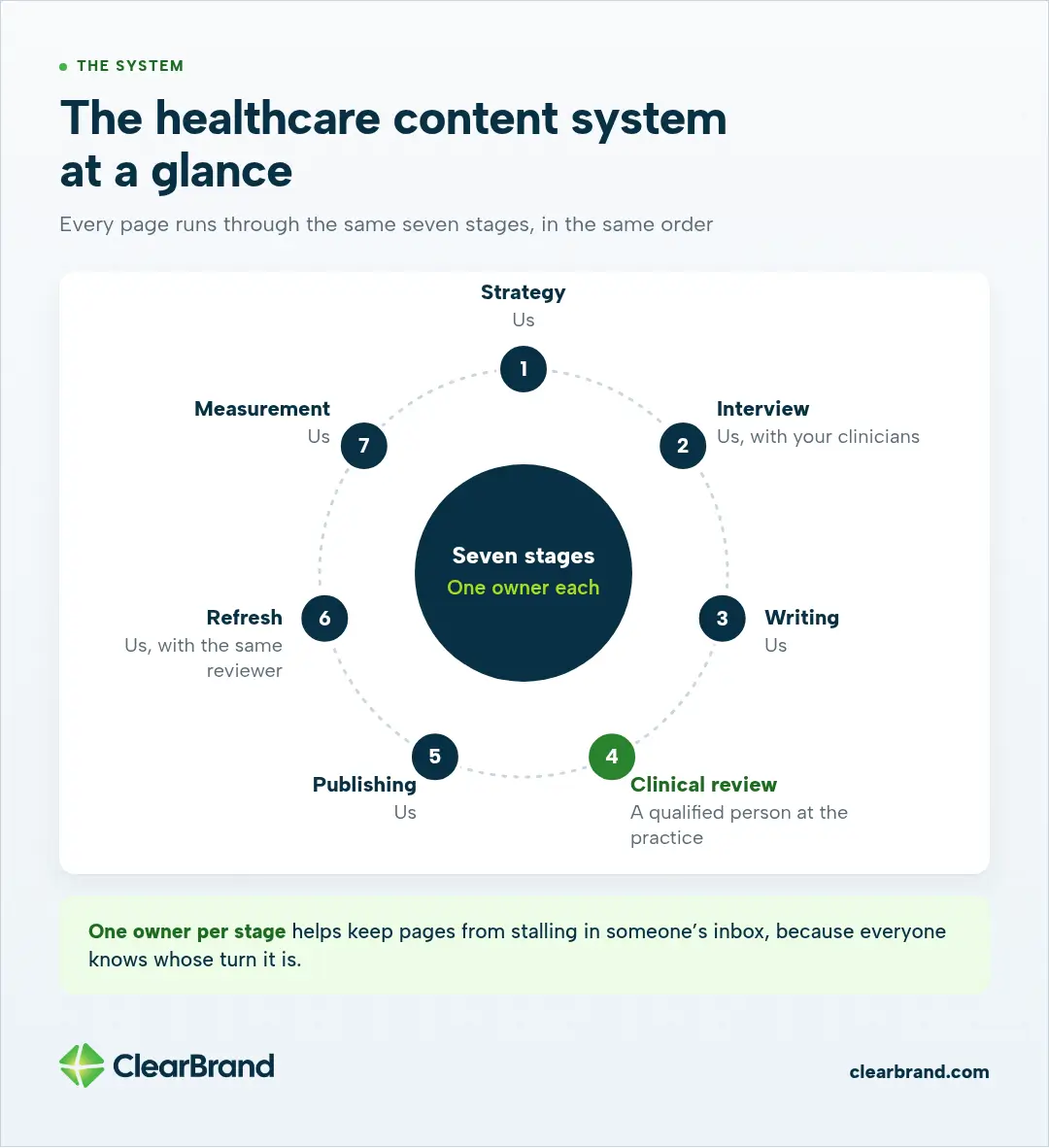
How do you build a healthcare content marketing system? Run every page through the same seven stages, in the same order.
| Stage | Who owns it | What it produces |
|---|---|---|
| 1. Strategy | Us | A list of the searches patients make, ranked by what the practice offers and what it can win |
| 2. Interview | Us, with your clinicians | The practice’s own answers, opinions and examples for the page |
| 3. Writing | Us | A draft in plain language, sourced to guidelines and research |
| 4. Clinical review | A qualified person at the practice | Approved claims, corrections and anything escalated to a second reviewer |
| 5. Publishing | Us | A live page with a named author and reviewer and a clear next step |
| 6. Refresh | Us, with the same reviewer | An updated page whenever the facts, the care or the season change |
| 7. Measurement | Us | Monthly on-site actions and new customers from search |
Each stage has one owner. That one detail helps keep pages from stalling in someone’s inbox, because everyone knows whose turn it is.
Build the healthcare content strategy around how patients search
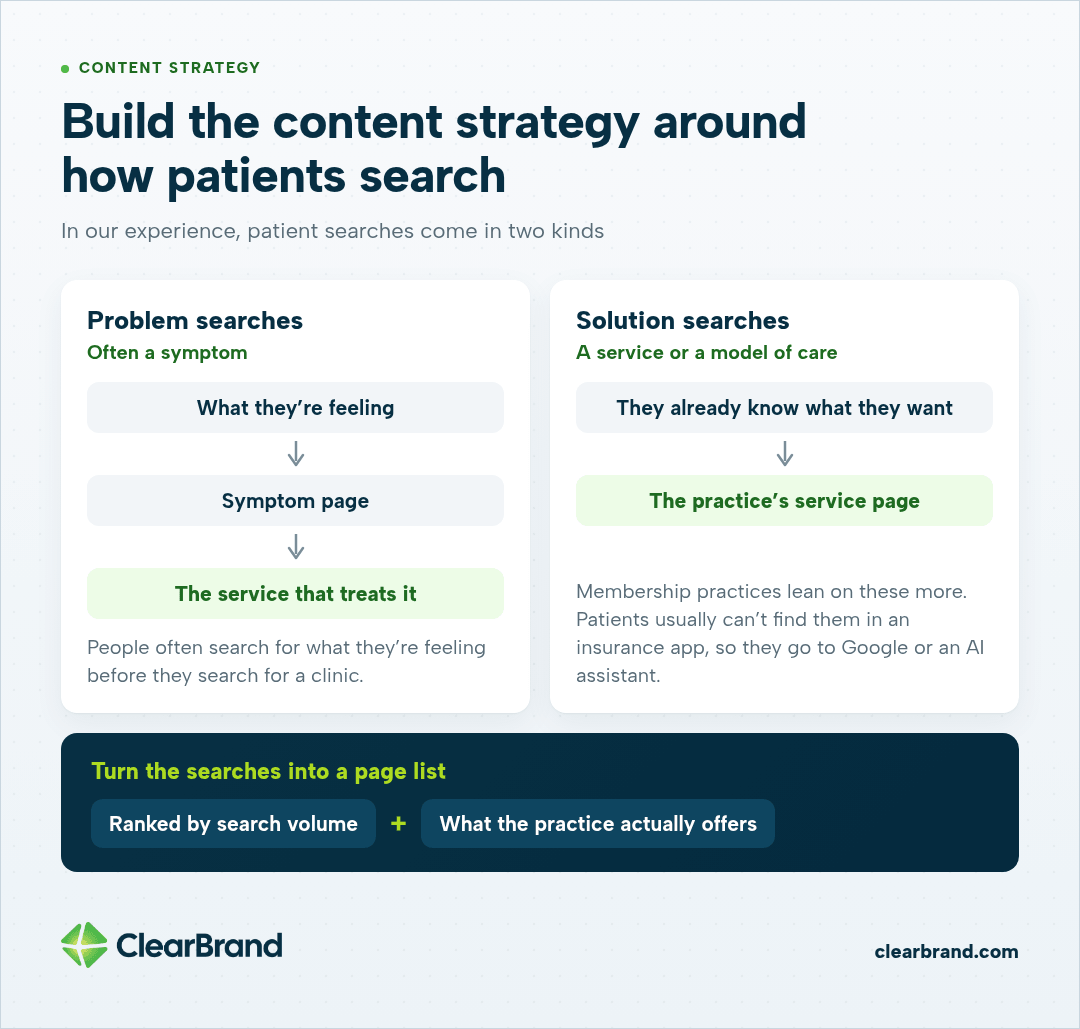
A healthcare content strategy starts with the searches patients already make. In our experience they come in two kinds.
Problem searches
In medicine, the problem is often a symptom. People often search for what they’re feeling before they search for a clinic, so symptom pages meet them early and point them toward the service that treats the problem.
Solution searches
Other people already know what they want. They search for a service or a model of care. Direct primary care is a good example: once someone learns how it works, they search for a direct primary care practice near them, and the practice’s pages should be there when they do.
Membership practices lean on these searches even more. These practices sit outside the insurance networks, so patients usually can’t find them in an insurance app. They go to Google or an AI assistant instead.
Turn the searches into a page list
We rank the list by search volume and by what the practice actually offers. Each page on it ties back to care the practice provides, so every page has somewhere useful to send the reader.
Who writes: medical content writing with your clinicians’ knowledge in it
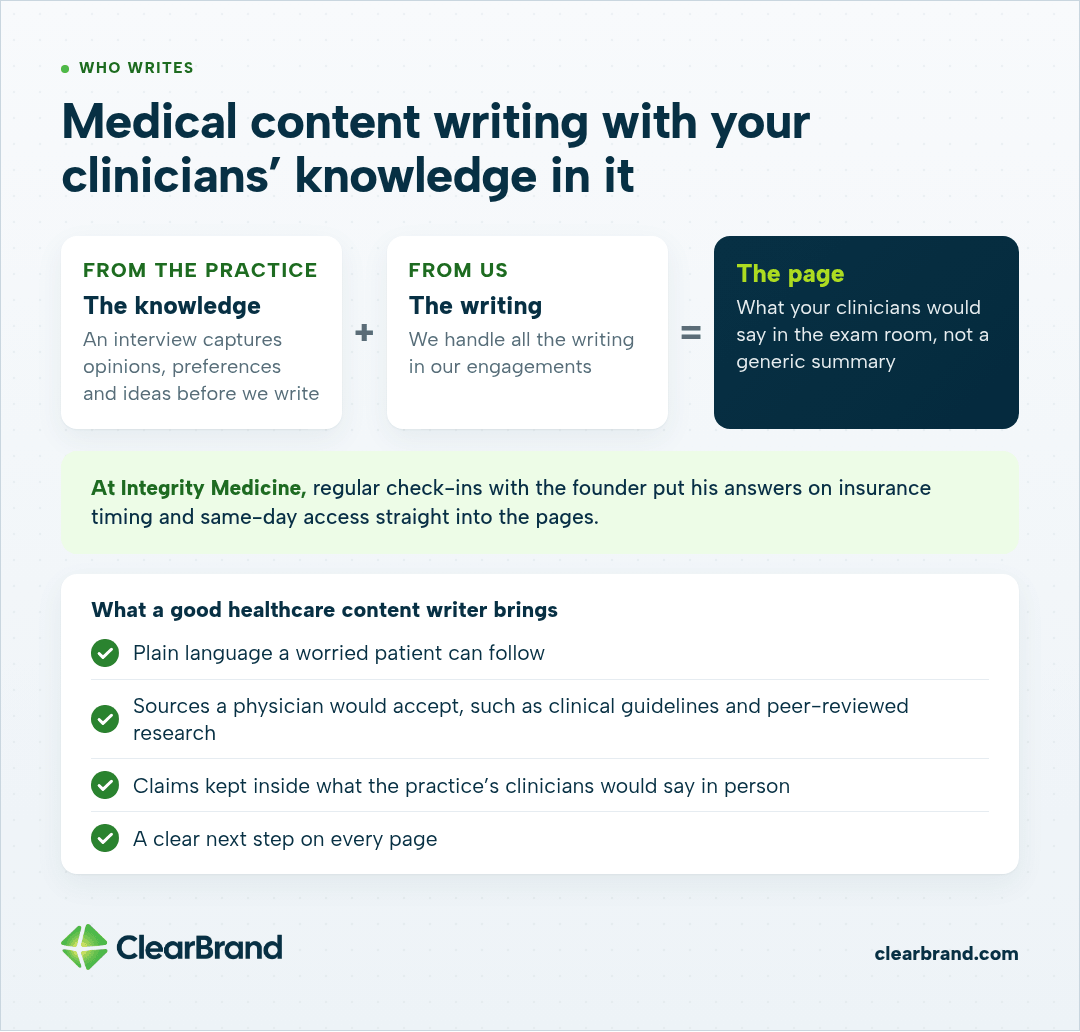
We handle all the writing in our engagements, and the knowledge comes from the practice.
Before we write, we interview the client to get their opinions, preferences and ideas into the article. Every article includes that expert input, so the page carries what your clinicians would say to a patient in the exam room instead of a generic summary.
At Integrity Medicine, a membership-based direct primary care practice in Newton and Andover, Kansas, we sit down with founder Dr. Robert Roeser in regular check-ins. His answers on real prices, insurance timing and what same-day access looks like go straight into the pages.
What a good healthcare content writer brings
- Plain language a worried patient can follow
- Sources a physician would accept, such as clinical guidelines and peer-reviewed research
- Claims kept inside what the practice’s clinicians would say in person
- A clear next step on every page
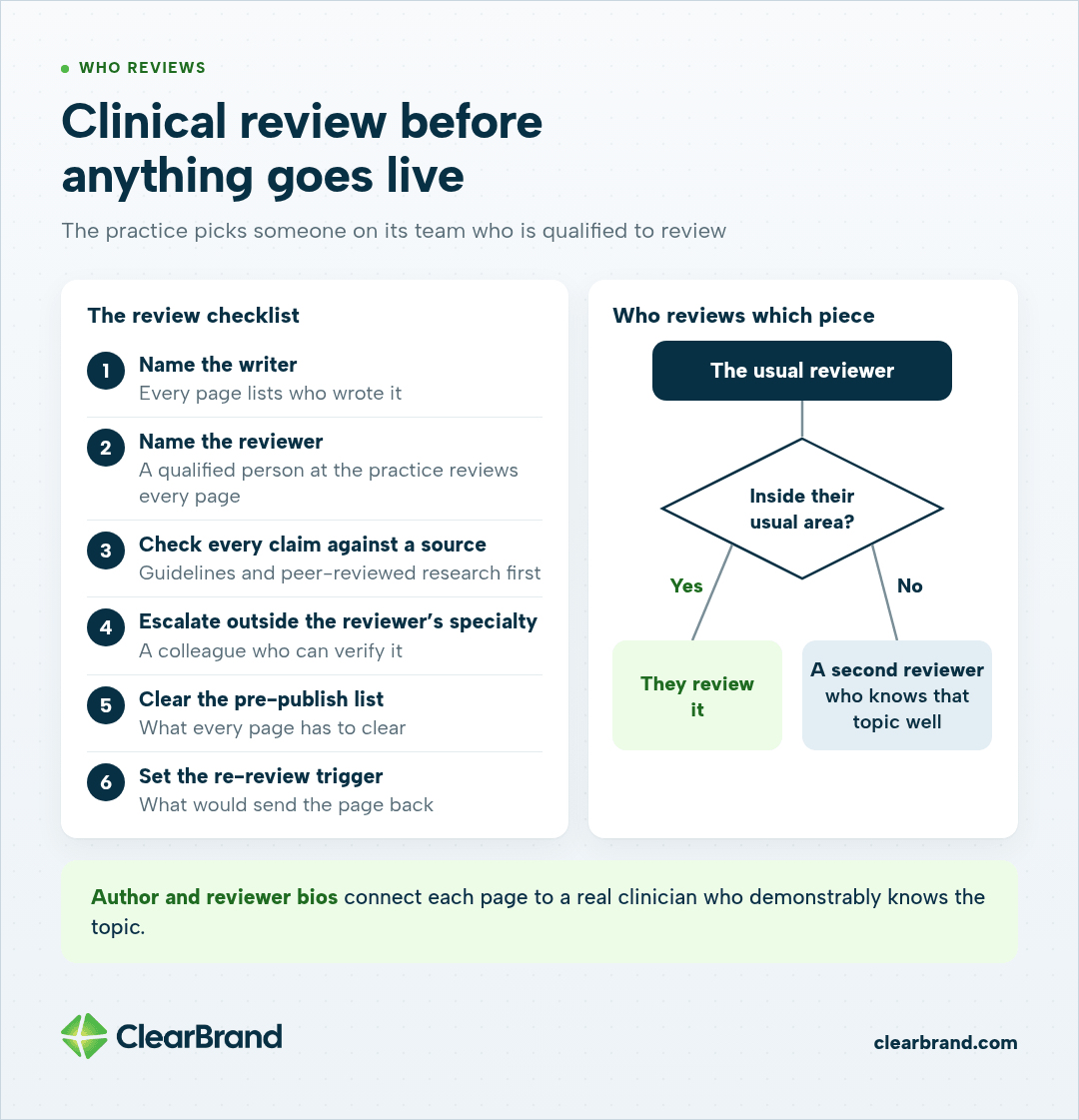
Who reviews: clinical review before anything goes live
The practice picks someone on its team who is qualified to review the piece. Most of the time, the same person reviews every piece. When an article goes deeper than their usual area, the practice sends it to a second reviewer who knows that topic well.
The healthcare content review checklist
- Name the writer. Every page lists who wrote it.
- Name the reviewer. A qualified person at the practice reviews every page before it goes live.
- Check every claim against a source. Guidelines and peer-reviewed research come first.
- Escalate outside the reviewer’s specialty. A claim beyond their area goes to a colleague who can verify it.
- Clear the pre-publish list. The next section covers what every page has to clear.
- Set the re-review trigger. Note what would send the page back for another look.
Author and reviewer bios connect each page to a real clinician. Google’s own guidance asks whether content is written or reviewed by an expert who demonstrably knows the topic, and a named reviewer helps answer that question on the page.
For the technical side, such as schema and site structure, our healthcare SEO guide goes deeper.
What every page has to clear before it goes live
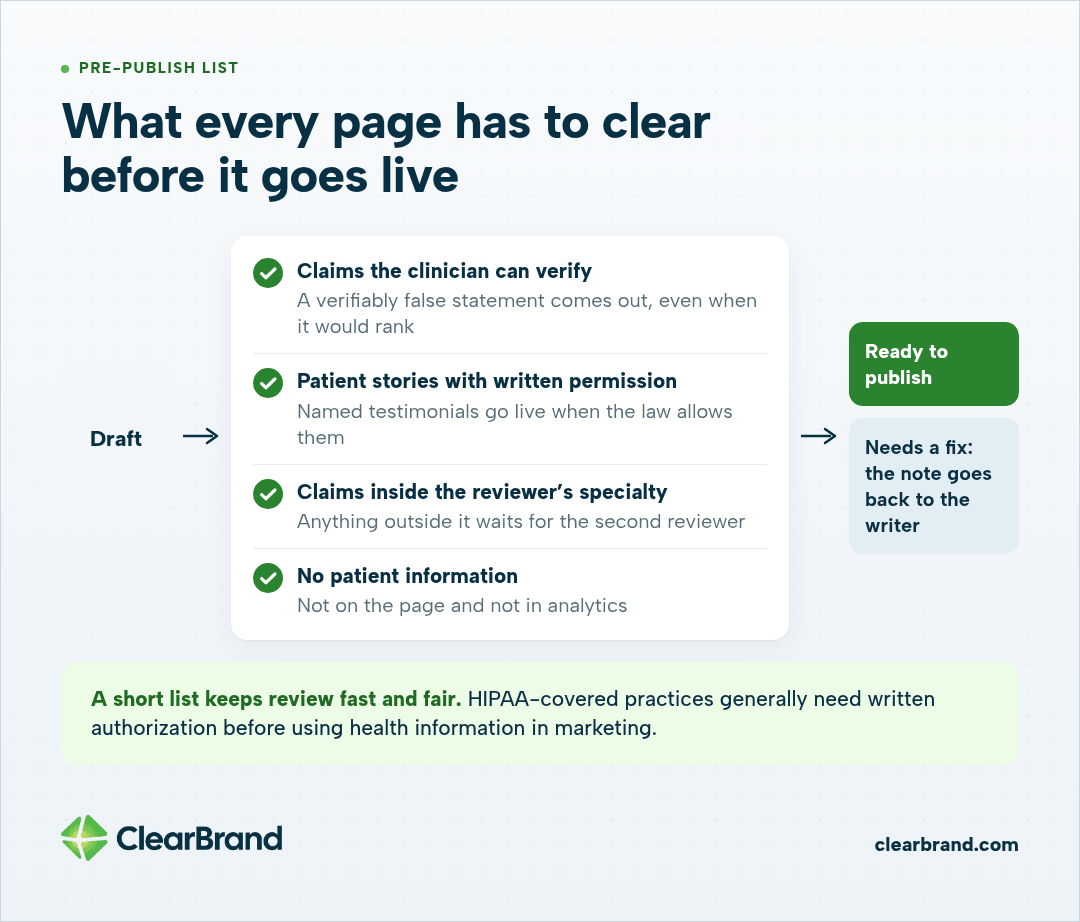
A short list keeps review fast and fair. Every page clears these before we publish it.
- Claims the clinician can verify. If a statement is verifiably false, it comes out, even when it would rank.
- Patient stories with written permission. Named testimonials help, and they go live when the law allows them. For practices covered by HIPAA, the Privacy Rule generally requires a patient’s written authorization before their health information is used in marketing (HHS: Marketing).
- Claims inside the reviewer’s specialty. Anything outside it waits for the second reviewer.
- No patient information on the page or in analytics. We don’t need patient information to do this work, so we don’t ask for it.
When a page clears the list, it’s ready. When something needs a fix, the reviewer’s note goes back to the writer and the page moves forward from there.
Which pages to publish first
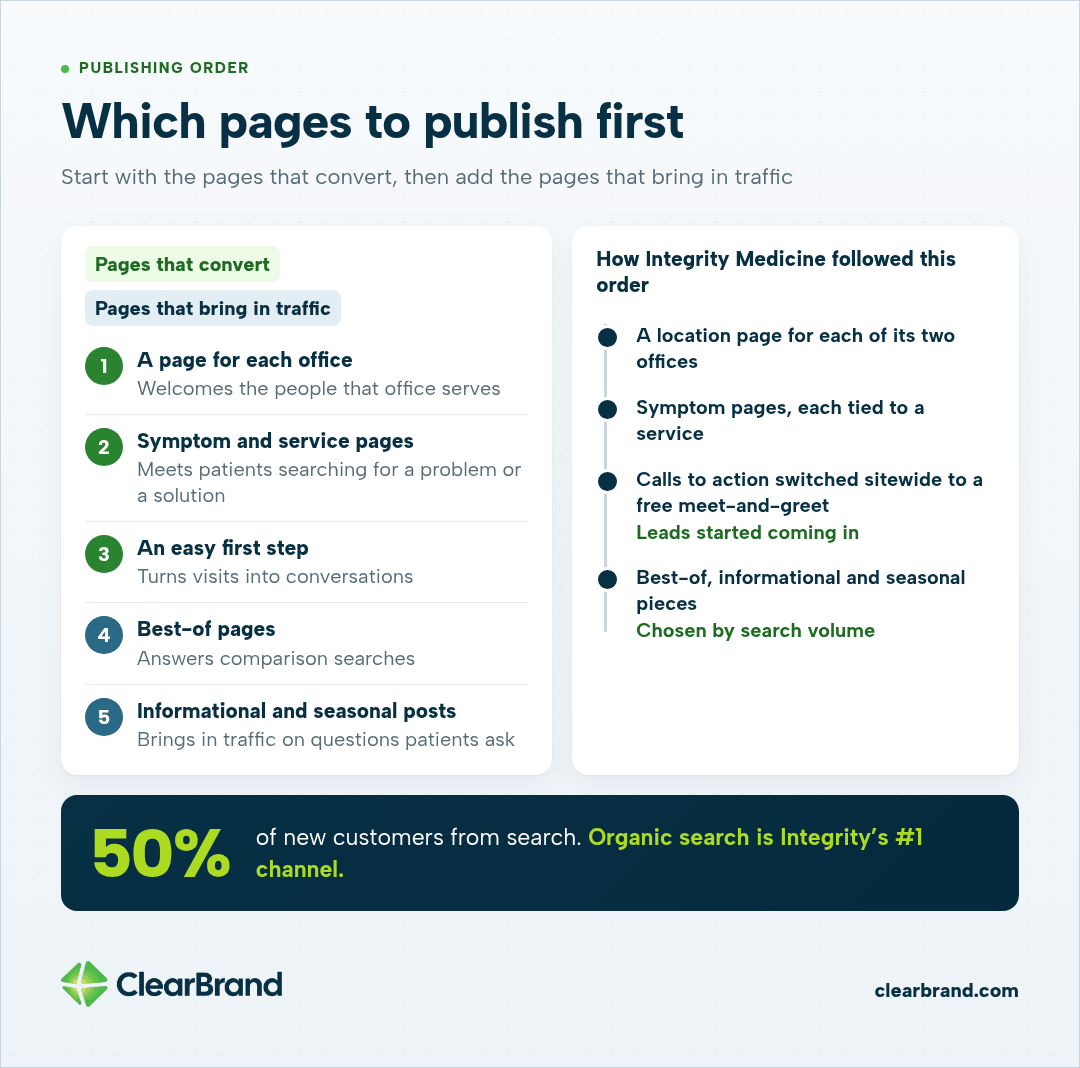
What content should a medical practice publish first? We usually start with the pages that convert, then add the pages that bring in traffic.
| Order | Page type | What it does | Example |
|---|---|---|---|
| 1 | A page for each office | Welcomes the people that office serves | A page for each of a practice’s towns |
| 2 | Symptom and service pages | Meets patients searching for a problem or a solution | A symptom page linked to the service that treats it |
| 3 | An easy first step | Turns visits into conversations | A free meet-and-greet, sitewide |
| 4 | Best-of pages | Answers comparison searches | A best-of list for the practice’s care model |
| 5 | Informational and seasonal posts | Brings in traffic on questions patients ask | A Medicare open enrollment guide each fall |
If your practice has more than one office, our guide to SEO for multi-location clinics covers how to build a page for each one.
How Integrity Medicine followed this order
We started Integrity Medicine with a location page for each of its two offices, then symptom pages, each tied to a service it offers. Leads were slow, and the calls to action pointed to a signup. Many people want to meet the doctor before they join, so after a test the practice switched its calls to action sitewide to a free meet-and-greet, and leads started coming in.
From there we added best-of pages, informational posts and seasonal pieces such as Medicare open enrollment, all chosen by search volume. Organic search is Integrity’s #1 channel, with 50% of new customers from search. The Integrity Medicine case study has the full story.
Refresh: keep every page as current as your care
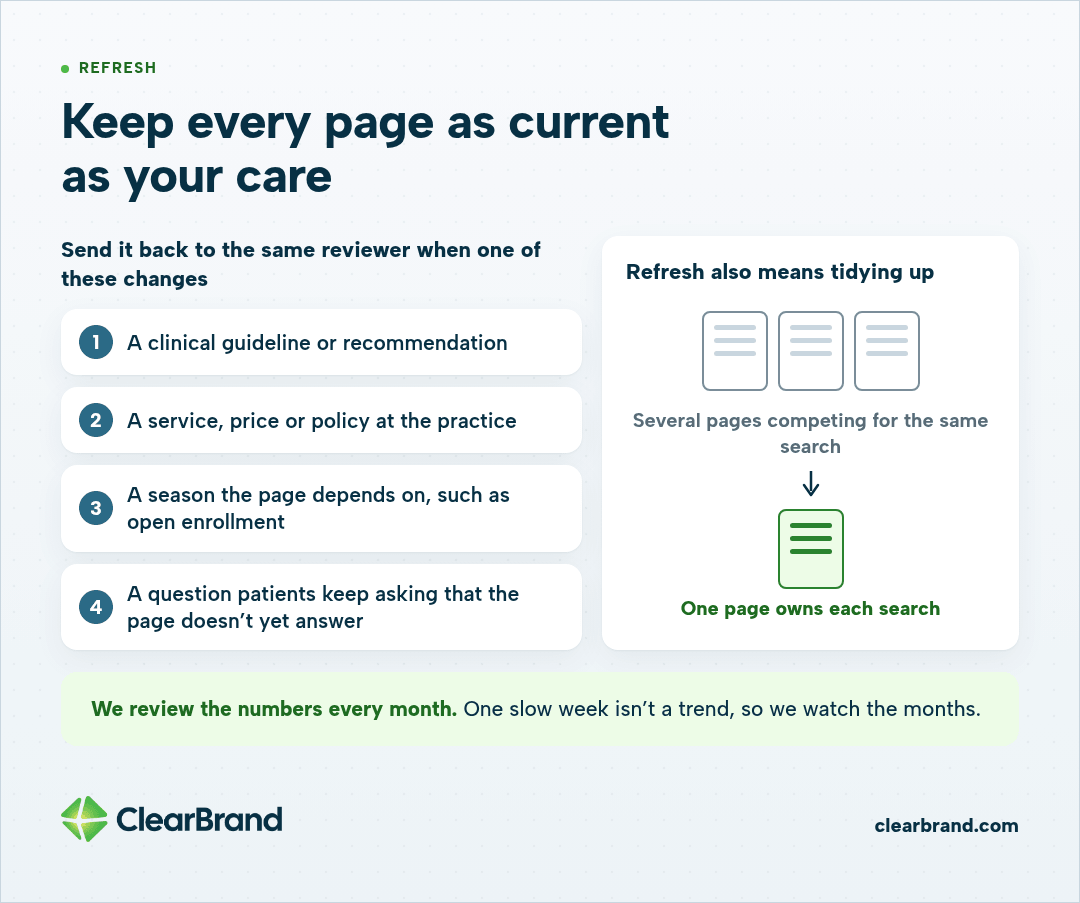
We send a page back to the same reviewer whenever one of these changes:
- A clinical guideline or recommendation
- A service, price or policy at the practice
- A season the page depends on, such as open enrollment
- A question patients keep asking that the page doesn’t yet answer
Refresh also means tidying up. At Integrity Medicine, several pages were competing for the same searches, so we combined them and let one page own each search.
We review the numbers every month, and those numbers decide what we work on next. One slow week isn’t a trend. Sometimes it’s seasonal, and sometimes it’s worth a closer look, so we watch the months.
How to measure healthcare content marketing without patient data
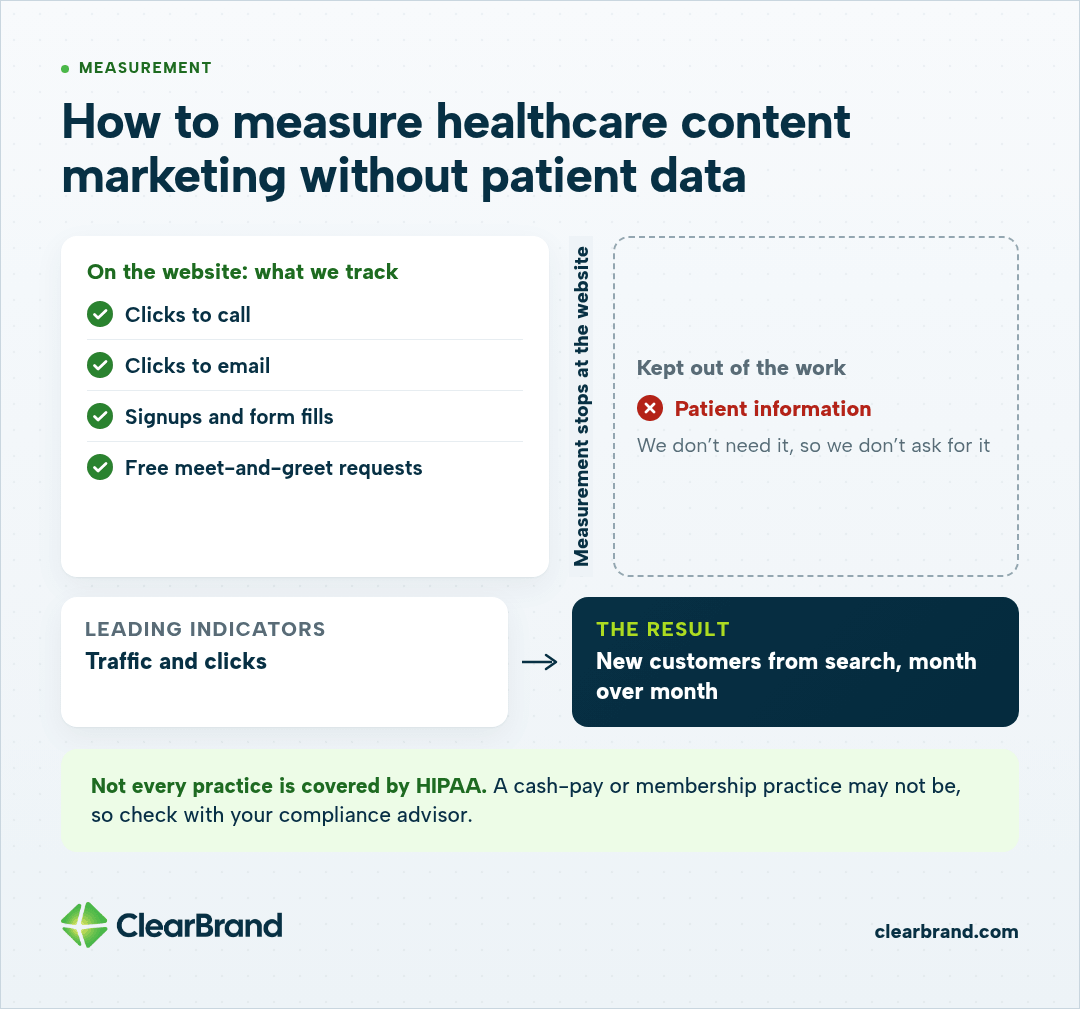
Many practices are covered by HIPAA, but not all. Under HHS’s definition, a health care provider is a covered entity only if it sends health information electronically for transactions HHS has set standards for, such as insurance claims. A cash-pay or membership practice may not be covered, so it’s worth checking where your practice stands with your compliance advisor. Either way, we keep patient information out of the work, and measurement stops at the website. We track the actions people take on the site:
- Clicks to call
- Clicks to email
- Signups and form fills
- Free meet-and-greet requests
Traffic and clicks are leading indicators. The result a practice cares about is new customers from search, month over month.
At Integrity Medicine, we track free meet-and-greets and the members added to each doctor’s panel every month, the same numbers the practice already uses to run the business. Each page we write is also structured so Google and AI search tools can read and cite it.
Healthcare content marketing FAQ
What is healthcare content marketing?
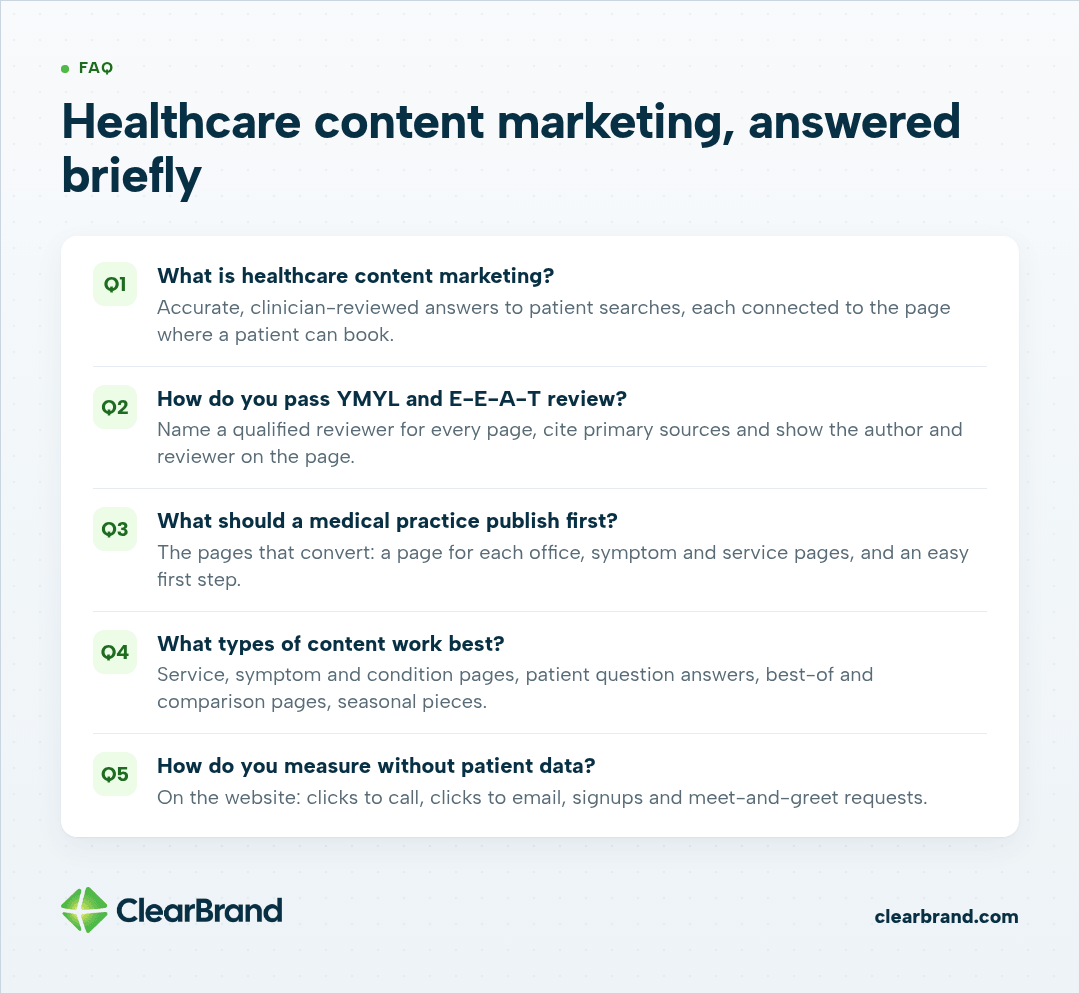
Healthcare content marketing is publishing accurate, clinician-reviewed answers to the questions patients search, then connecting each answer to the page where a patient can book. For a practice or clinic, it works best when every page has a writer, a reviewer, a target search and a next step.
How do you make healthcare content pass YMYL and E-E-A-T review?
You make healthcare content pass YMYL and E-E-A-T review by naming a qualified reviewer at the practice for every page, citing primary sources and showing the author and reviewer on the page. Claims outside the reviewer’s specialty go to a second reviewer, and anything the clinician can’t verify comes out before publishing.
What content should a medical practice publish first?
We usually start a medical practice with the pages that convert: a page for each office, symptom and service pages, and an easy first step such as a free meet-and-greet. Best-of, informational and seasonal posts come next, once the practice has somewhere useful to send that traffic.
What types of content work best for healthcare?
The content types that work best for practices and clinics are service pages, symptom and condition pages, answers to common patient questions, best-of and comparison pages, and seasonal pieces such as open enrollment guides. Each one works best when it leads to a clear next step.
How do you measure healthcare content marketing without patient data?
You measure healthcare content marketing on the website, by tracking clicks to call, clicks to email, signups and meet-and-greet requests, with no patient information in analytics. Traffic is an early signal, and new customers from search each month are the result to watch.
Build a content system your clinicians can stand behind
Healthcare content marketing works when every page has an owner, a reviewer and a next step. Start with the pages that convert, review every claim, refresh on a schedule your clinicians trust, and measure the actions patients take.
If you’d like a partner to run that system, our healthcare SEO agency page shows how we work with practices and clinics. If you’re comparing options, our list of the best healthcare SEO agencies for clinics can help.
We’d love to take a look at your site. Your free SEO audit is a full review and an initial 90-day strategy, and it’s yours whether you work with us or not. Get your free SEO audit.