
B2B SaaS SEO: What Changes After Product-Market Fit
B2B SaaS SEO after product-market fit: build keywords from sales calls and closed deals, write for the buying committee, judge it by demos and pipeline.
Originally published: October 26, 2026 Last updated: October 26, 2026
B2B SaaS SEO is ranking a software company’s pages for the searches its buying committee runs, on Google and in AI answers, so those visits turn into demos, pipeline and recurring revenue. After product-market fit, SEO for B2B SaaS gets built from your ideal customer, your sales calls and your closed deals instead of broad keyword lists.
A lot of B2B SaaS SEO advice covers the same stack of technical fixes, keywords, content and links. Those all matter, but the work looks very different once you know who buys, why they buy, and what they say on a sales call.
That shift touches four things: where the keyword list comes from, how you write for everyone on the buying committee, how a sales-led cycle changes what you measure, and which pages you build first. For the fundamentals, like what SaaS SEO is and how each page type works, start with our SaaS SEO guide.
Key takeaways
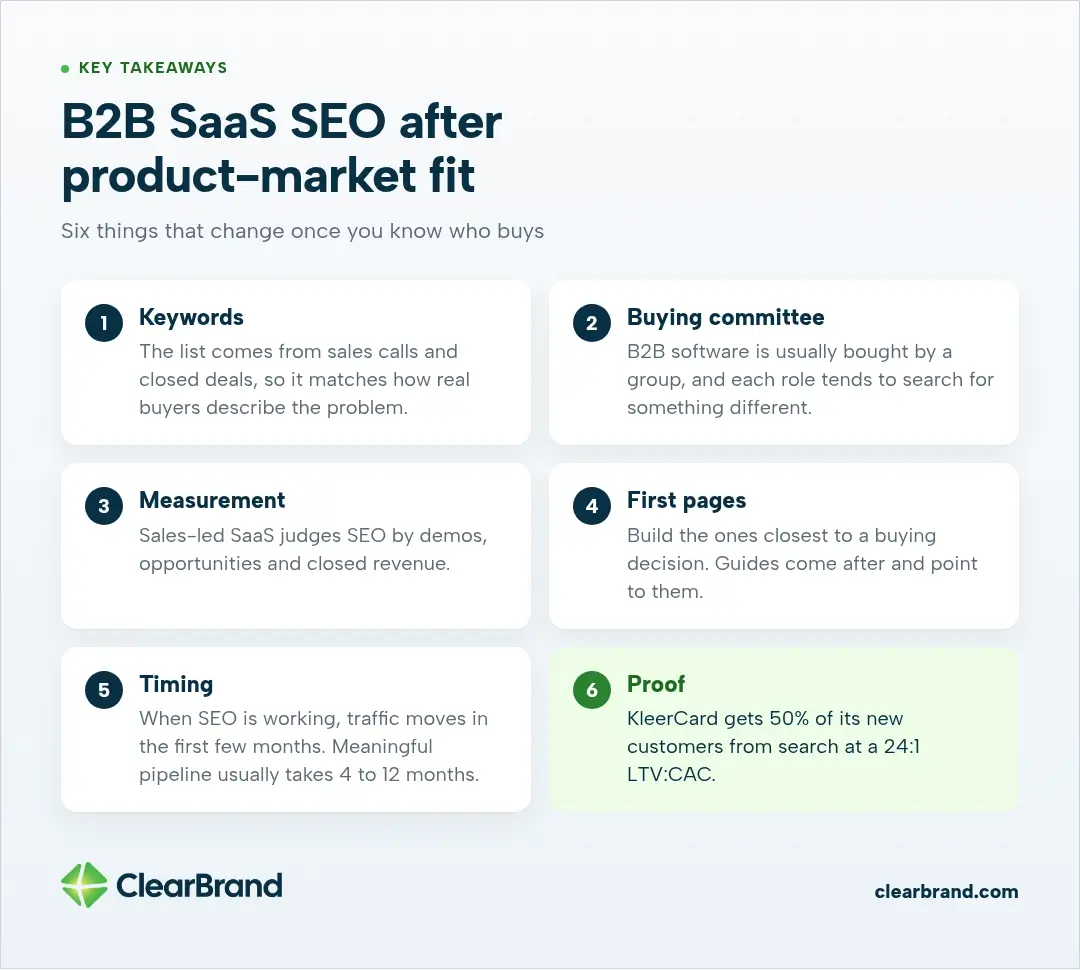
- After product-market fit, the keyword list comes from sales calls and closed deals, so it matches how real buyers describe the problem.
- B2B software is usually bought by a group, and each role tends to search for something different before a deal closes.
- Sales-led SaaS judges SEO by demos, opportunities and closed revenue, and long cycles mean the first page a buyer read often matters months later.
- The first pages to build are the ones closest to a buying decision. Guides come after and point to them.
- When SEO is working, traffic moves in the first few months. Meaningful pipeline usually takes 4 to 12 months, depending on your competition and starting point.
- A strong result shows up in unit economics. KleerCard gets 50% of its new customers from search at a 24:1 LTV:CAC.
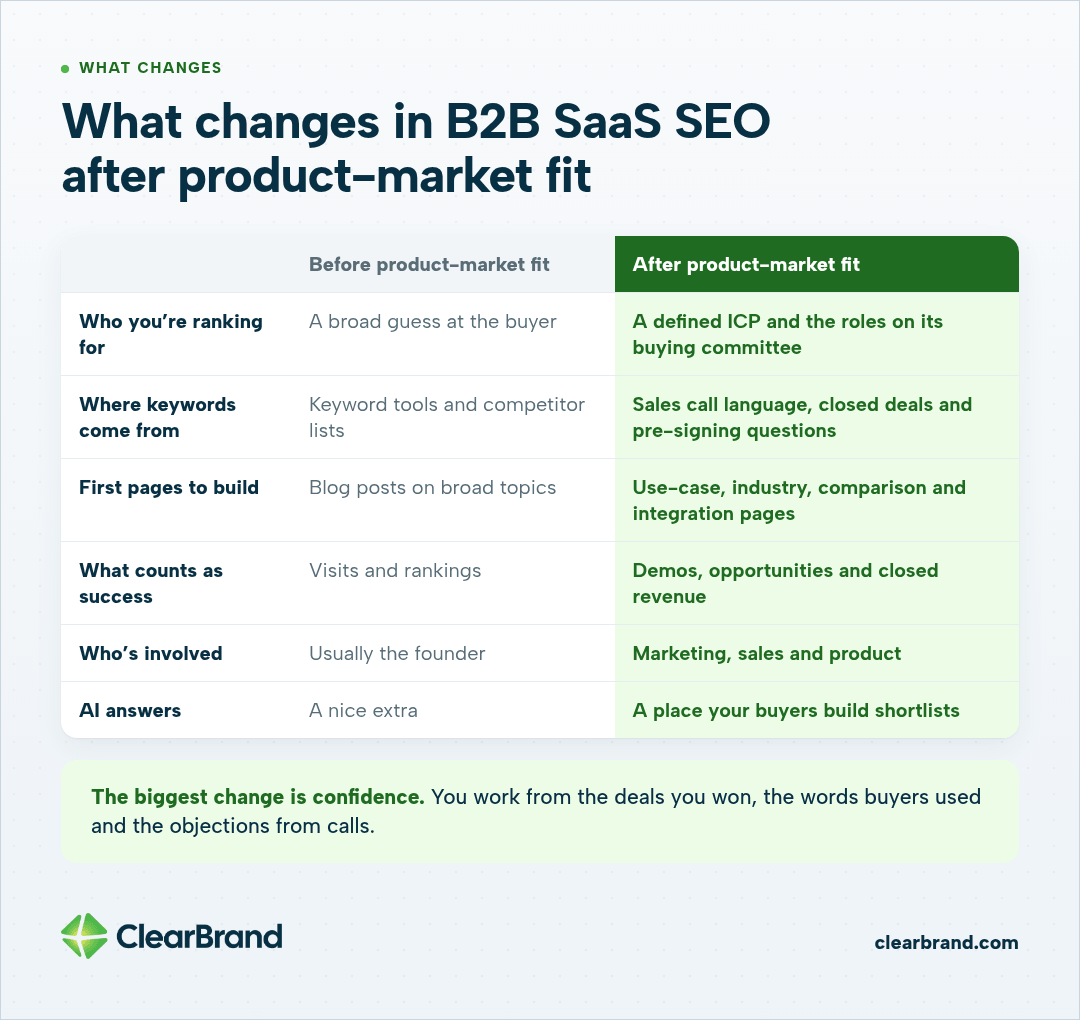
What changes in B2B SaaS SEO after product-market fit
After product-market fit, B2B SaaS SEO shifts from guessing at keywords to building from real buyer data. The keyword list comes from sales calls and closed deals, the first pages target buying decisions, and success is measured in demos and revenue.
| Before product-market fit | After product-market fit | |
|---|---|---|
| Who you’re ranking for | A broad guess at the buyer | A defined ideal customer profile (ICP) and the roles on its buying committee |
| Where keywords come from | Keyword tools and competitor lists | Sales call language, closed deals and the questions buyers ask before they sign |
| First pages to build | Blog posts on broad topics | Pages for buying decisions: use-case, industry, comparison and integration pages |
| What counts as success | Visits and rankings | Demos, opportunities and closed revenue, judged against what a customer is worth |
| Who’s involved | Usually the founder | Marketing, sales and product, with sales feeding buyer questions back regularly |
| AI answers | A nice extra | A place your buyers build shortlists, so being named there matters |
The biggest change is confidence. Before product-market fit, you’re still learning who buys and why, so any keyword list is a guess. After it, you have evidence: the deals you won, the words buyers used, the objections that came up on calls.
That evidence makes SEO easier to get right. You can skip the broad searches that bring in browsers and go straight to the ones your best customers ran. If you’re weighing whether search fits your business at all, our guide on when SEO is worth it looks at that question.
When SEO starts paying off for a B2B SaaS company
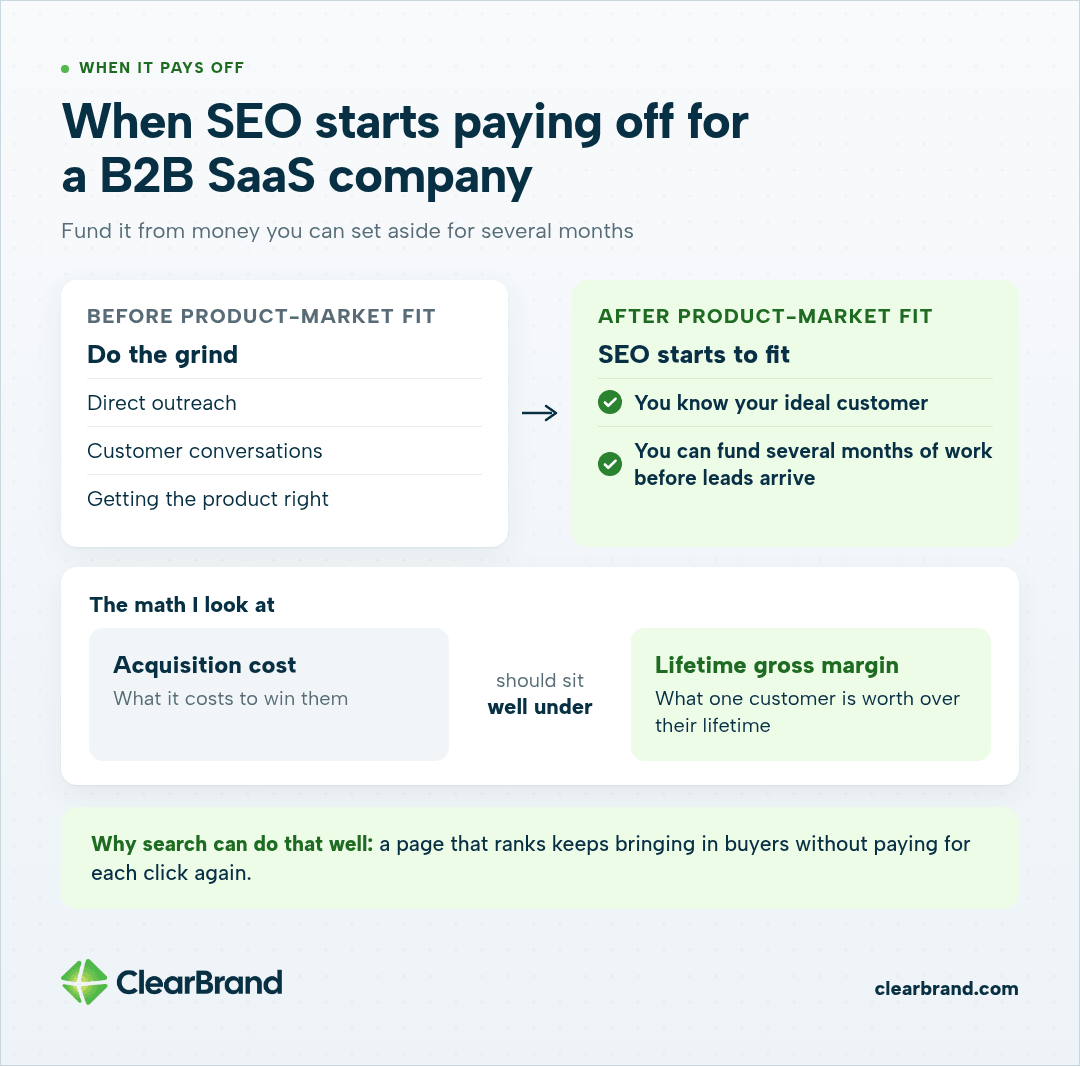
SEO usually starts paying off for a B2B SaaS company after product-market fit, once you know your ideal customer and can fund several months of work before leads arrive. Before that, direct outreach and product work tend to teach you more, faster.
Early on, I’d rather see a founder doing the grind: direct outreach, customer conversations, and getting the product right. That work answers the questions SEO depends on, like who the buyer is and what they call the problem. If you’re weighing search against outbound and paid ads, our guide to SaaS lead generation covers when each one is the better call.
Cash flow matters too. I want every marketing bet to be one you can survive if it takes longer than planned, so fund SEO from money you can set aside for several months.
Once you have product-market fit, the math gets clearer. I look at what one customer is worth over their lifetime and what it costs to win them, and I want acquisition cost to sit well under lifetime gross margin. Search can do that well, because a page that ranks keeps bringing in buyers without paying for each click again.
Build your keyword list from sales calls and closed deals
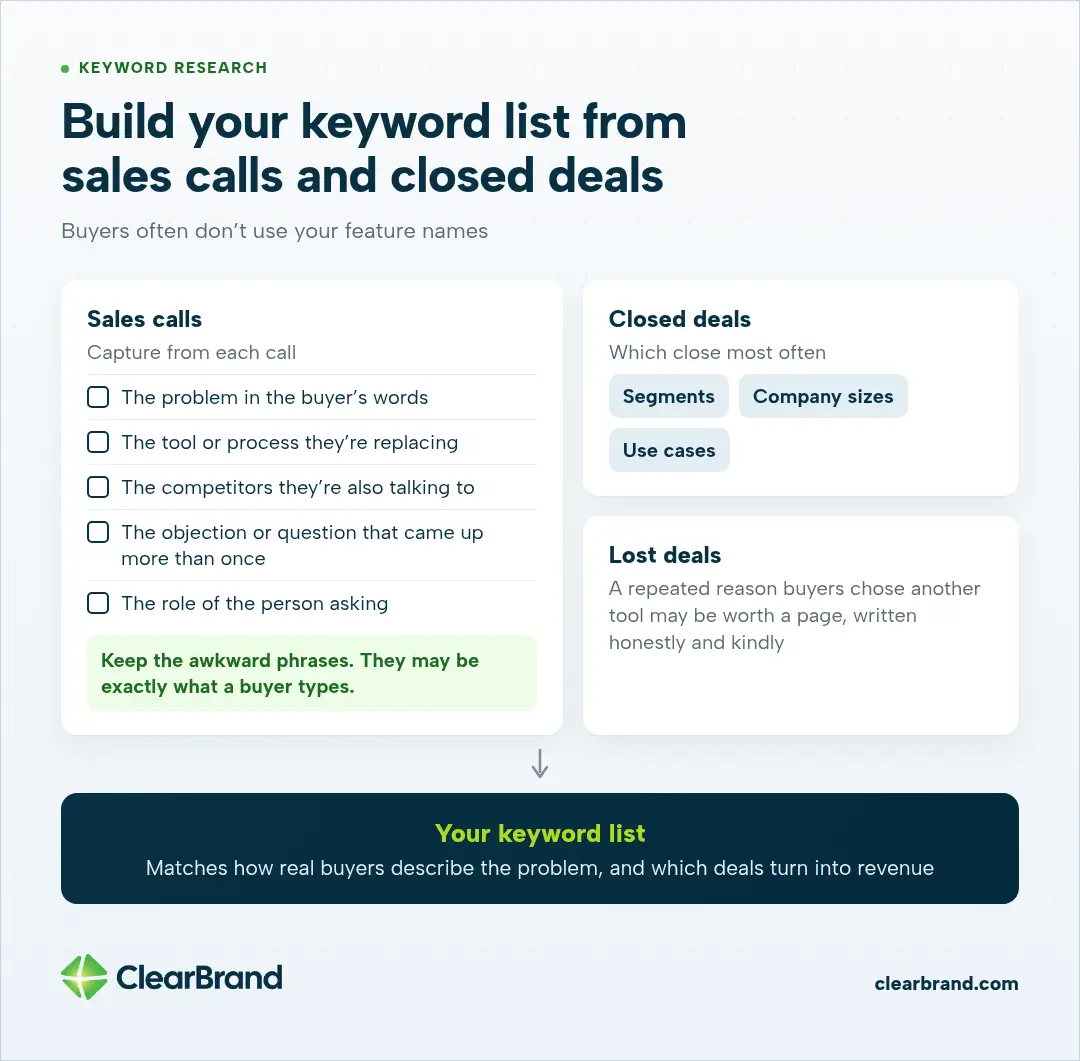
After product-market fit, some of the best B2B SaaS keywords come from your own sales data. Sales calls show the words buyers use for the problem, and closed deals show which segments, use cases and competitors tend to turn into revenue.
What to pull from sales calls
Buyers often don’t use your feature names. On a call, they tend to describe the problem in their own words, name the tool they use today, and ask the question that worries them most. Each of those can be a search someone else is typing right now.
Read or listen to a batch of recent discovery calls and demos, in a call recorder like Gong, Fathom or Fireflies if your team uses one, then write down the exact phrases. Keep the awkward ones. A phrase that sounds clumsy in a meeting may be exactly what a buyer types into Google or asks an AI assistant.
What to capture from each call:
- The problem in the buyer’s words
- The tool or process they’re replacing
- The competitors they’re also talking to
- The objection or question that came up more than once
- The role of the person asking
What closed deals tell you
Closed deals show you where search should focus. Look at the segments, company sizes and use cases that close most often, then build pages for those first. We rely on the client to prioritize opportunities from their internal metrics and closing data. A smaller search that matches your best deals can pay back faster than a big one that matches nobody in particular.
Lost deals can help too. If buyers keep choosing another tool for the same reason, that reason may be worth a page, written honestly and kindly.
Once you have the list, put the order of work into a plan. Our SaaS SEO strategy framework covers how to prioritize it and phase it over 90 days, 6 months and 12 months.
Write for every role on the buying committee
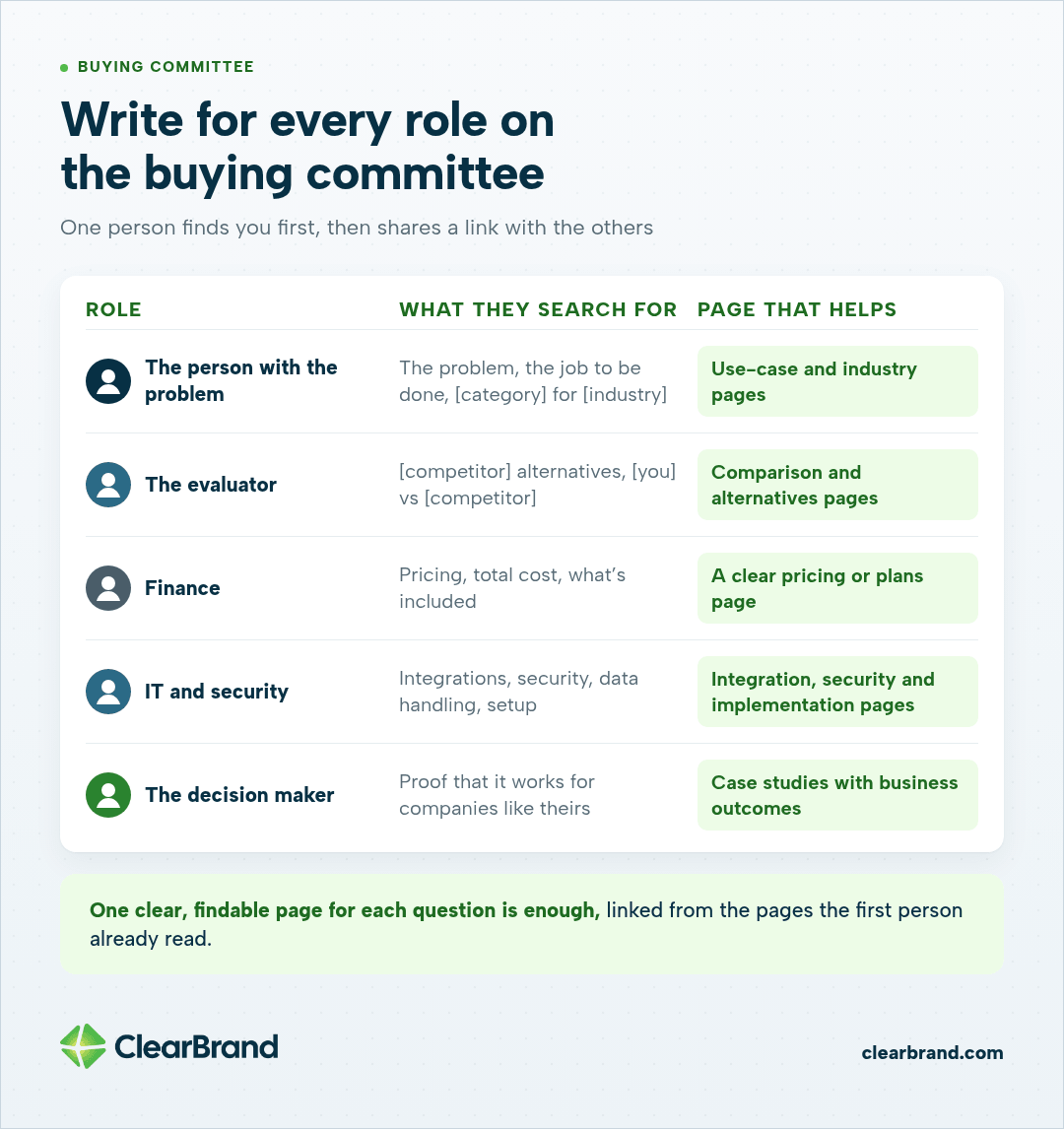
B2B software is usually chosen by several people, and each one may search for something different. A strong B2B SaaS SEO plan gives each role a page that answers its question, so the deal keeps moving after the first person finds you.
One person often finds you first. Then they share a link, and other people start checking your claims: someone looks at cost, someone looks at how it fits the tools they run, and someone signs off on the decision.
Each of those people may search a different phrase for the same product. If your site only answers the first one, the others may go looking elsewhere, often on review sites or in an AI assistant.
| Role | What they search for | Page that helps |
|---|---|---|
| The person with the problem | The problem, the job to be done, [category] for [industry] | Use-case and industry pages |
| The evaluator | [competitor] alternatives, [you] vs [competitor] | Comparison and alternatives pages |
| Finance | Pricing, total cost, what’s included | A clear pricing or plans page |
| IT and security | Integrations, security, data handling, setup | Integration, security and implementation pages |
| The decision maker | Proof that it works for companies like theirs | Case studies with business outcomes |
Skip the separate content program for each role. One clear, findable page for each question is enough, linked from the pages the first person already read.
The roles and their questions vary by product and deal size, so check this table against your own calls. For mapping the committee in more detail, see our B2B SEO strategy guide.
How sales-led cycles change what you measure
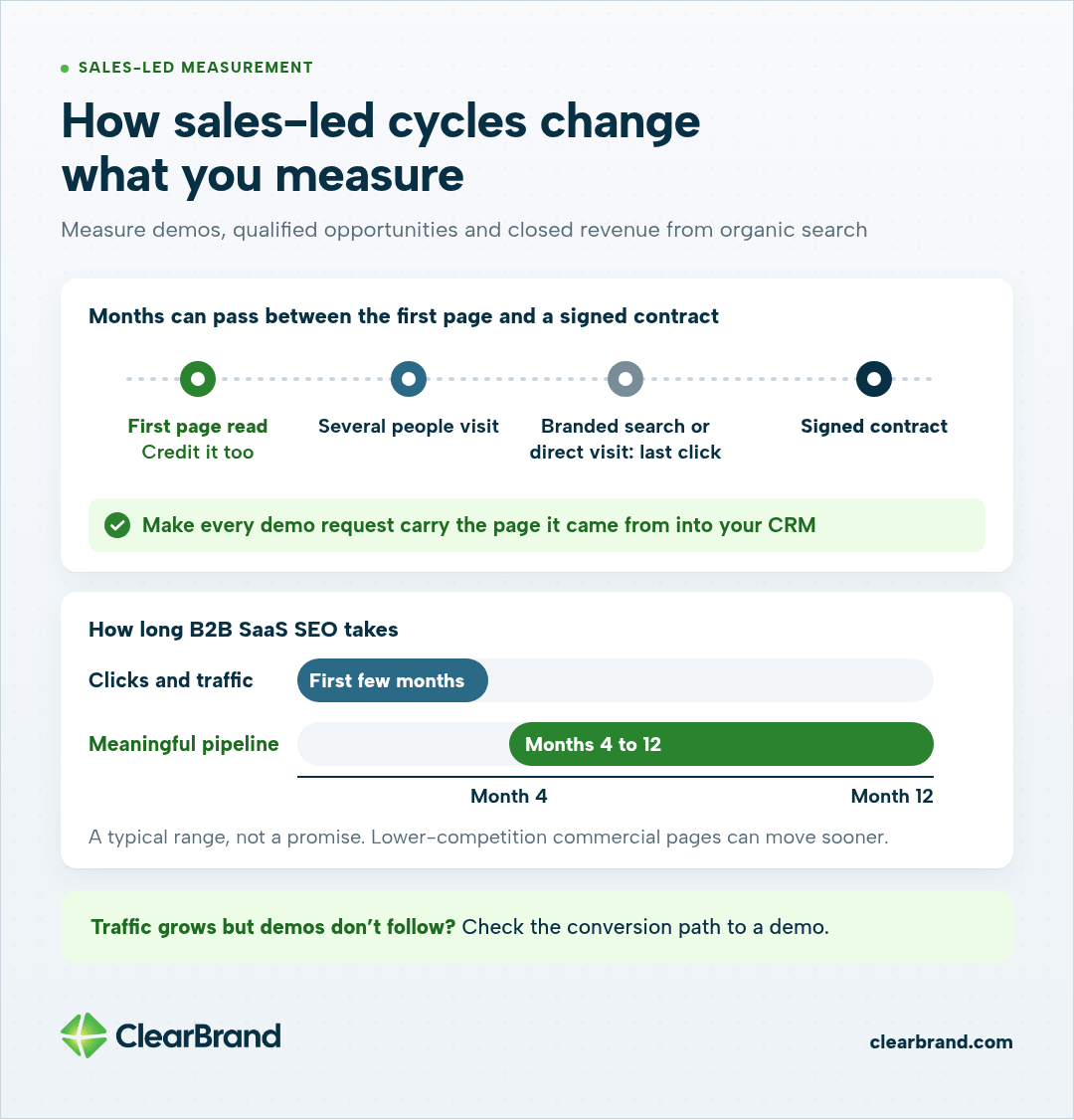
In sales-led B2B SaaS, SEO is measured by demos, qualified opportunities and closed revenue from organic search. Because cycles can run for months, track which pages buyers read early in deals you won, not only the last page before the demo request.
A self-serve product can see a signup on the same visit. A sales-led product often waits months between the first page a buyer reads and a signed contract, with several people visiting in between.
That gap changes the report. Make sure every demo request carries the page it came from into your CRM. Then look back at closed deals and see which pages showed up early, even when a branded search or a direct visit got the last click.
If your product moves upmarket, enterprise SaaS SEO tends to follow the same pattern, with longer cycles and more people who need to approve the purchase.
How long B2B SaaS SEO takes
- First few months: if SEO is working, clicks and traffic start to move.
- Months 4 to 12: meaningful pipeline usually shows up somewhere in this window. Lower-competition commercial pages can move sooner. It’s a typical range, not a promise, because every site starts from a different place.
- If traffic grows but demos don’t follow: check the conversion path. Often the traffic is there and the path to a demo needs work.
Which pages to build first after product-market fit
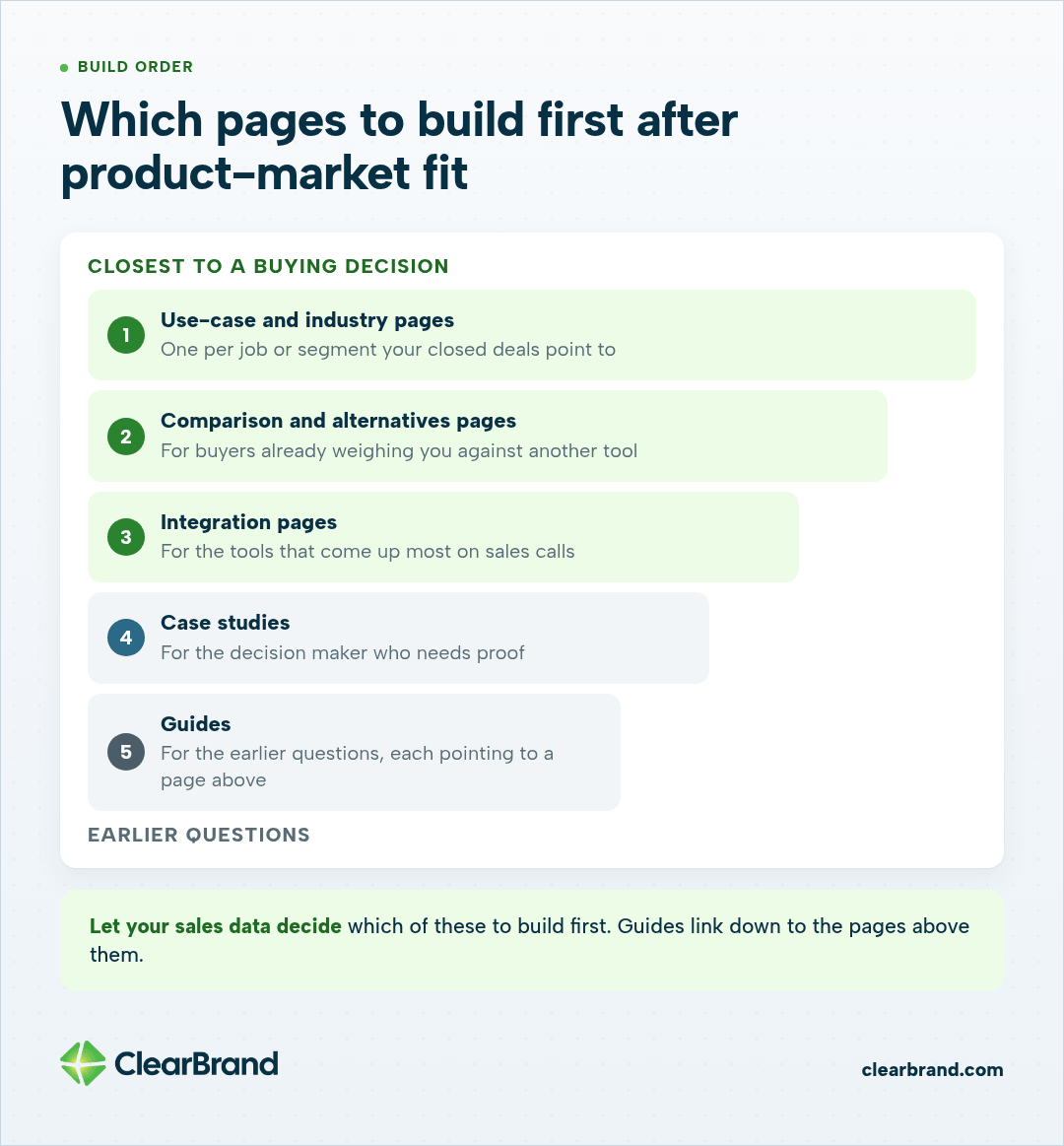
Build the pages closest to a buying decision first: use-case and industry pages for your ICP, comparison and alternatives pages, and integration pages for the tools your buyers already use. Guides come next and link down to those pages.
- Use-case and industry pages: one page per job or segment your closed deals point to.
- Comparison and alternatives pages: for buyers already weighing you against another tool. Our guide to comparison and alternatives pages covers how to build them well.
- Integration pages: for the tools that come up most on sales calls.
- Case studies: for the decision maker who needs proof from a company like theirs.
- Guides: for the earlier questions, each one pointing to a page above.
Our SaaS SEO guide goes deeper on how each page type works. For this list, let your sales data decide which of these to build first.
B2B SaaS SEO case study: KleerCard
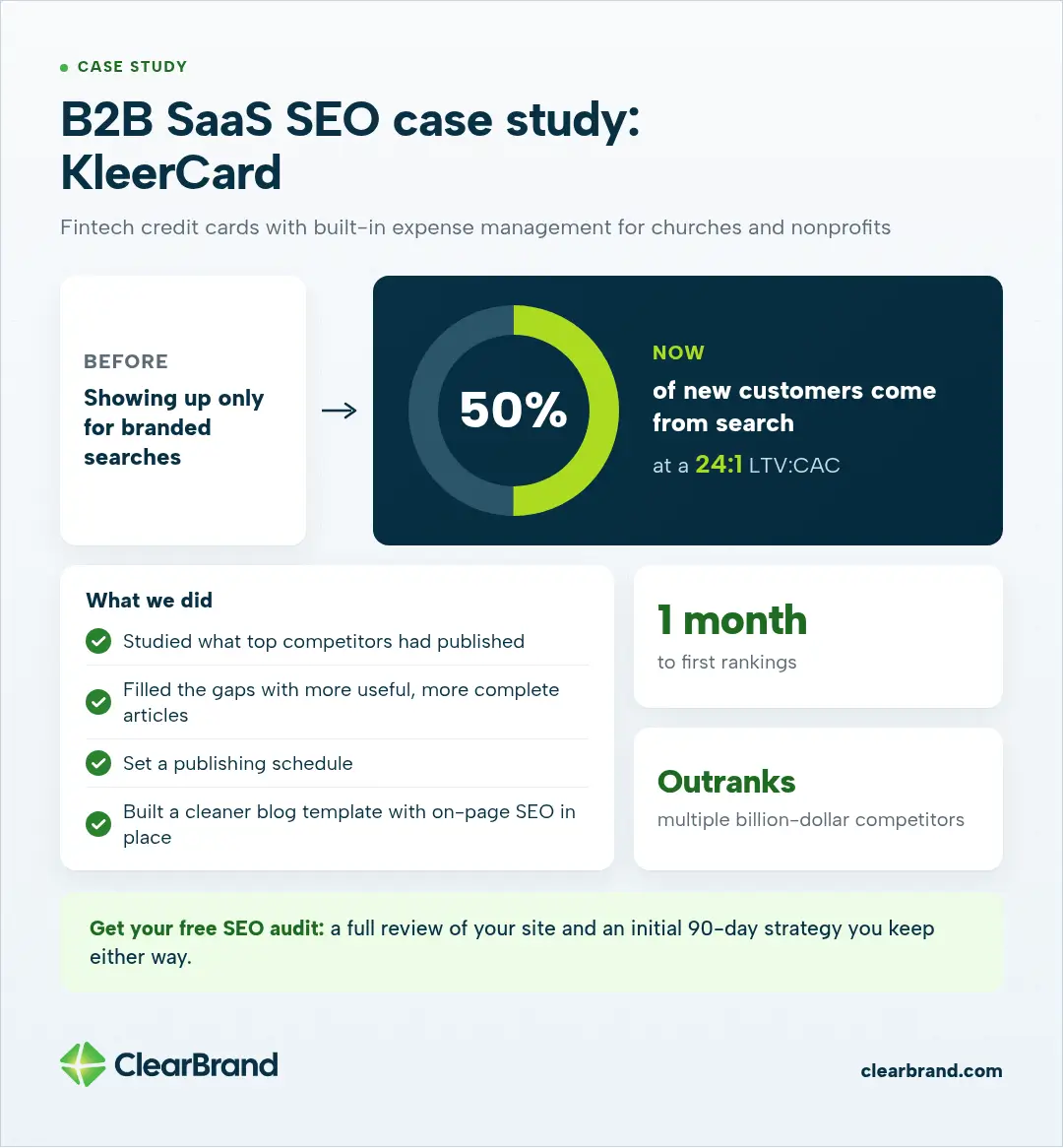
KleerCard, a fintech company that provides credit cards with built-in expense management for churches and nonprofits, went from showing up only for branded searches to 50% of new customers coming from search, at a 24:1 LTV:CAC.
When KleerCard came to us, the company was ready to grow. Buyers who already knew the name could find it, but KleerCard wasn’t showing up for the searches its customers made before they decided to buy.
That’s a common spot for a B2B SaaS company after product-market fit. People who already know you can find you, while new buyers researching the problem never see your name.
So we focused on the exact searches decision makers at churches, nonprofits and educators were using. We studied what the top competitors had published, filled the gaps with more useful and more complete articles, set a publishing schedule, and built a cleaner blog template with on-page SEO in place.
That’s the lesson of product-market fit in one example. KleerCard knew its buyer, so we could write for the high-intent searches that buyer makes, like credit cards for churches and nonprofits, instead of chasing broad terms.
- 1 month to first rankings
- Outranks multiple billion-dollar competitors
- 50% of new customers from search
- 24:1 LTV:CAC
That last number is the one I’d point any B2B SaaS team to. After product-market fit, search should be judged like any acquisition channel, by what a customer is worth against what it cost to win them. The full KleerCard case study has the details.
Get your free SEO audit. It includes a full review of your site and an initial 90-day strategy, and you keep it either way.
Where AI answers fit for B2B SaaS buyers
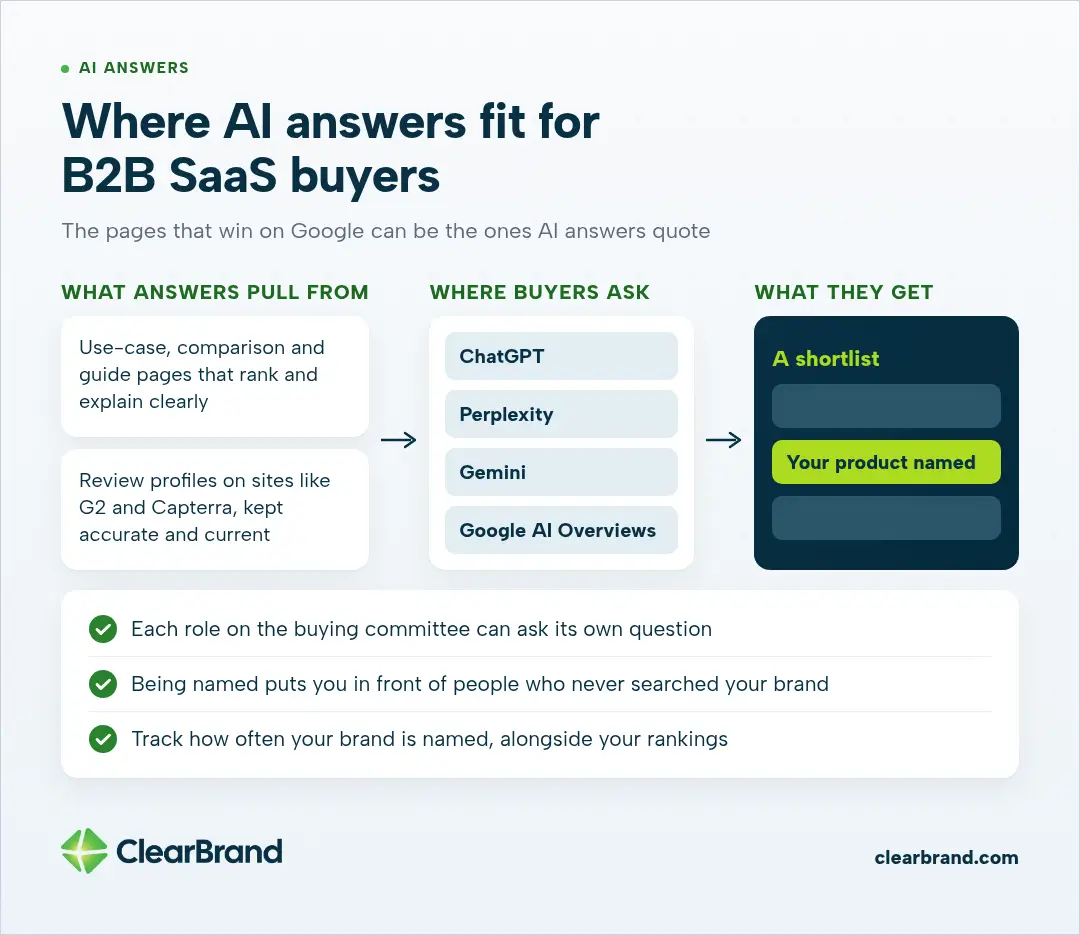
B2B buyers now ask ChatGPT, Perplexity, Gemini and Google AI Overviews to suggest tools, and those answers pull from pages that already rank and explain things clearly. The same use-case, comparison and guide pages that win on Google can also be the ones AI answers quote, when each one explains the job clearly.
AI assistants fit the buying committee well, because each role can ask its own question and get a shortlist in seconds. Being named in that shortlist puts your product in front of people who may never have searched your brand.
Review profiles on sites like G2 and Capterra show up in the same research, so keep them accurate and current.
Track how often your brand is named for the searches that matter, alongside your rankings. We use Rankability as our AI visibility tracker, and our post on AI visibility metrics for SaaS covers what belongs on the report.
Turn what changed into a plan
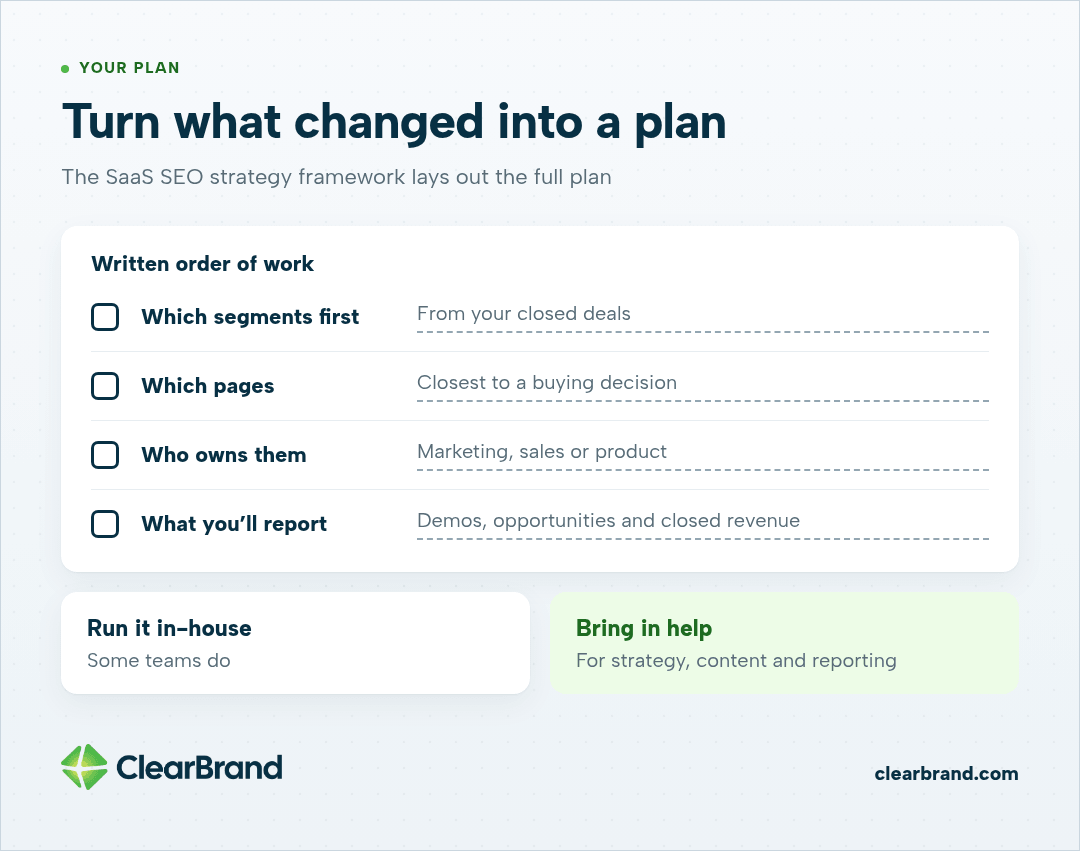
Once you know what changed, the next step is a written order of work: which segments first, which pages, who owns them, and what you’ll report. The SaaS SEO strategy framework lays out that plan, and it’s a good companion to this one.
Some teams run this in-house. Others bring in help for strategy, content and reporting. If you’d rather hand it to a team that does this for SaaS companies every day, you can see how we work with SaaS companies.
B2B SaaS SEO FAQ
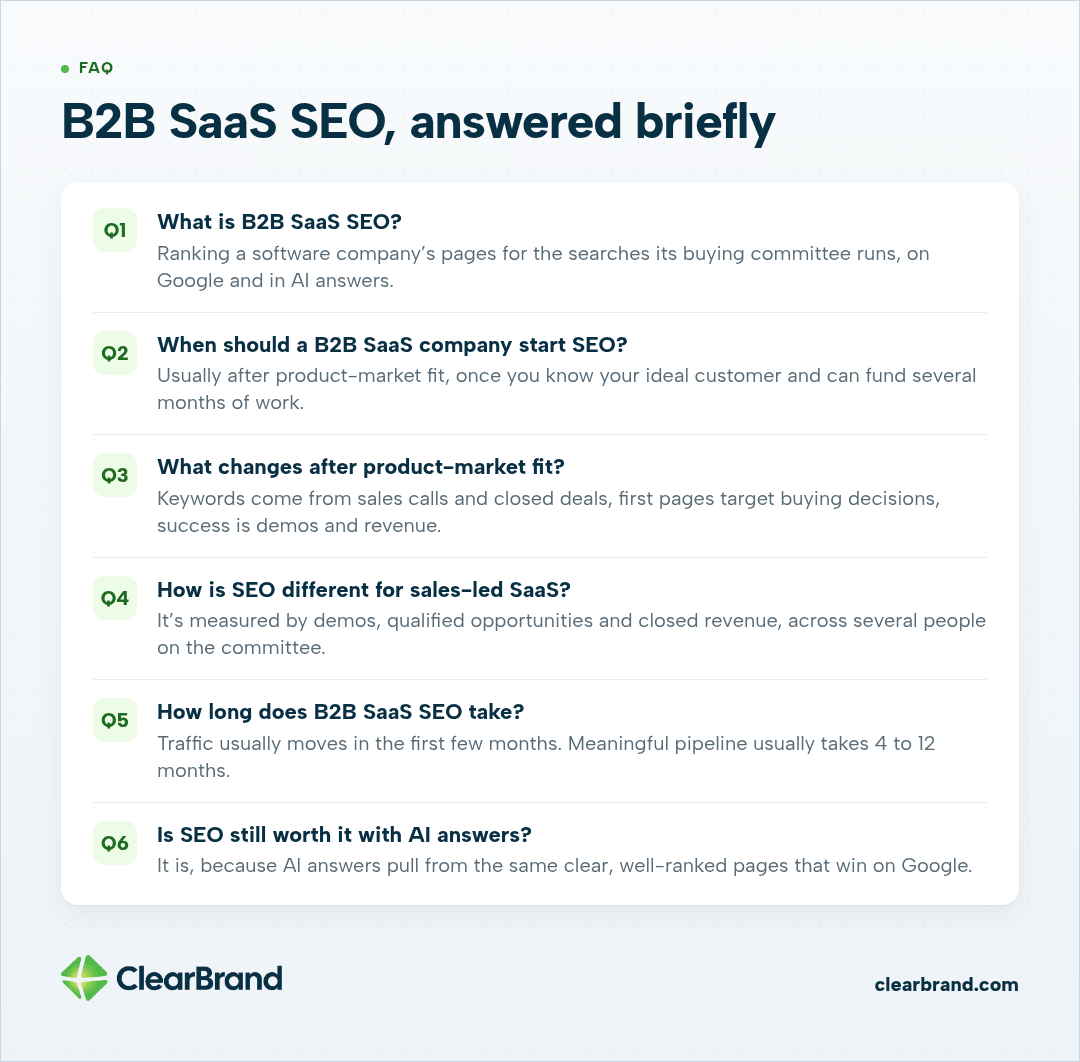
What is B2B SaaS SEO?
B2B SaaS SEO is ranking a software company’s pages for the searches its buying committee runs, on Google and in AI answers, so those visits turn into demos, pipeline and recurring revenue. After product-market fit, it’s built from your ICP, sales calls and closed deals.
When should a B2B SaaS company start SEO?
Most B2B SaaS companies get the best return from SEO after product-market fit, once they know their ideal customer and can fund several months of work. Before that, direct outreach and product work usually teach you more about the buyer.
What changes in SEO after product-market fit?
After product-market fit, the keyword list comes from sales calls and closed deals, the first pages built target buying decisions, and success is measured in demos and revenue. You’re working from evidence about real buyers instead of guesses.
How is SEO different for sales-led B2B SaaS?
Sales-led B2B SaaS measures SEO by demos, qualified opportunities and closed revenue, and it often has to serve several people on the buying committee. Long cycles mean the first page a buyer read can matter as much as the last.
How long does B2B SaaS SEO take?
When SEO is working, clicks and traffic usually move in the first few months, and meaningful pipeline usually takes 4 to 12 months. Results vary by site, so if traffic grows but demos don’t follow, look closely at the path from page to demo.
Is SEO still worth it with AI answers?
SEO is still worth it for B2B SaaS, because AI answers pull from the same clear, well-ranked pages that win on Google. The pages you build for buyers on Google are often the pages ChatGPT, Perplexity and AI Overviews draw on when buyers ask for tools.
Build on what your buyers already told you
After product-market fit, you already hold some of the best keyword research you’ll ever get: your sales calls and your closed deals. B2B SaaS SEO turns that into pages each person on the buying committee can find.
We’d love to help you see where your site stands today. Get your free SEO audit, and we’ll share a full review of your site and an initial 90-day strategy you can keep either way.