
SaaS Lead Generation: Build an Inbound Engine From Search and AI Answers
B2B SaaS lead generation compared: outbound, paid ads, agencies and search. How to build an inbound engine that brings in demos from Google and AI answers.
Originally published: October 20, 2026 Last updated: October 20, 2026
SaaS lead generation is how a software company gets qualified buyers to raise their hand with a demo request, trial or signup. The main sources are outbound (cold email, calls and LinkedIn), paid ads, lead-gen agencies, and inbound from search and AI answers.
New leads from the first three slow or stop when the spending stops. Search and AI answers take longer to build, then can keep bringing in buyers who are already looking.
For the wider marketing mix, start with our guide to SaaS marketing strategies.
Key takeaways
- Outbound and paid ads reach a first lead fastest. Search and AI answers can keep working after the spending stops.
- Buyers who find you in search or an AI answer are often already looking for a tool like yours.
- In my work, comparison, alternative, integration and use-case pages are often where search turns into demos.
- AI tools like ChatGPT and Google AI Overviews now help buyers build shortlists, so being named there can be a lead source.
- Judge the channel on demos, trials and closed revenue. Clicks and impressions are early signals.
- When SEO is working, traffic moves in the first few months, and leads, demos and sales generally follow by about month 6.
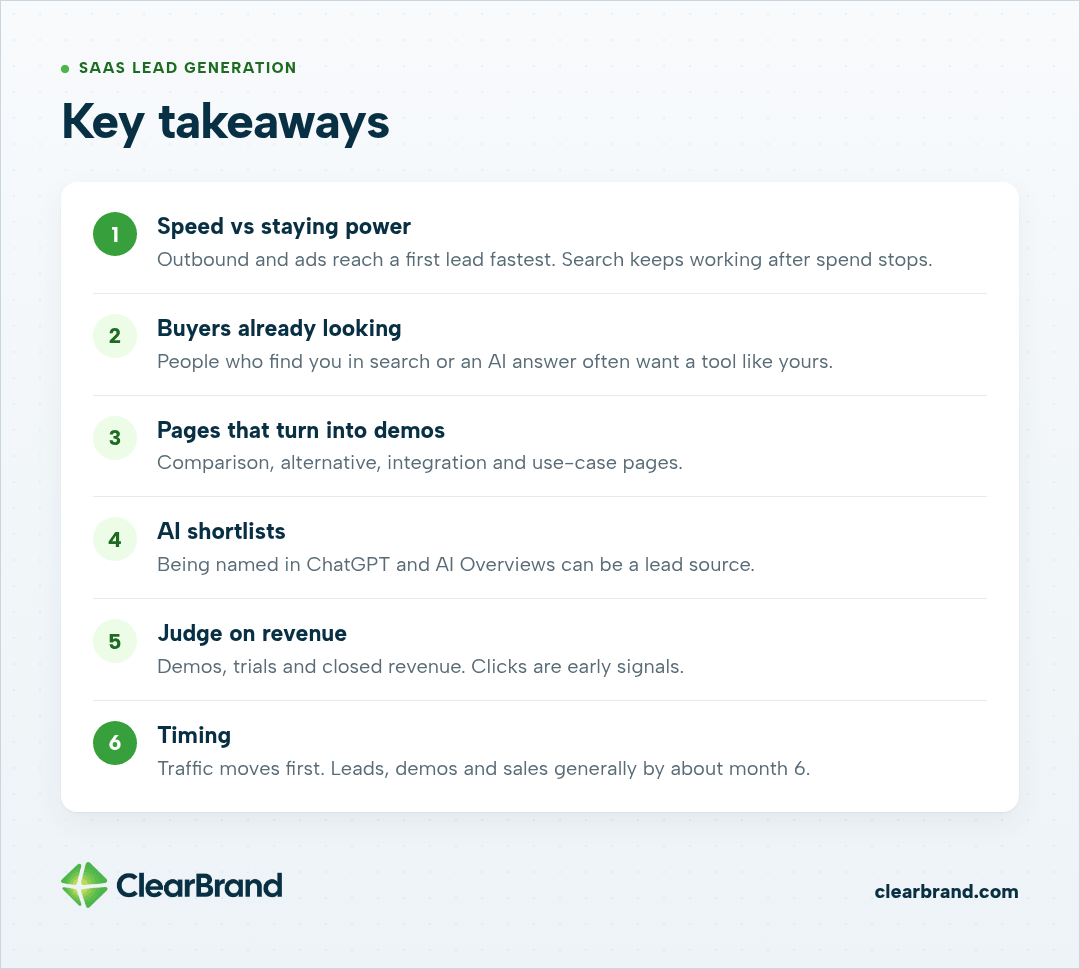
SaaS lead sources compared: outbound, paid ads, agencies and search
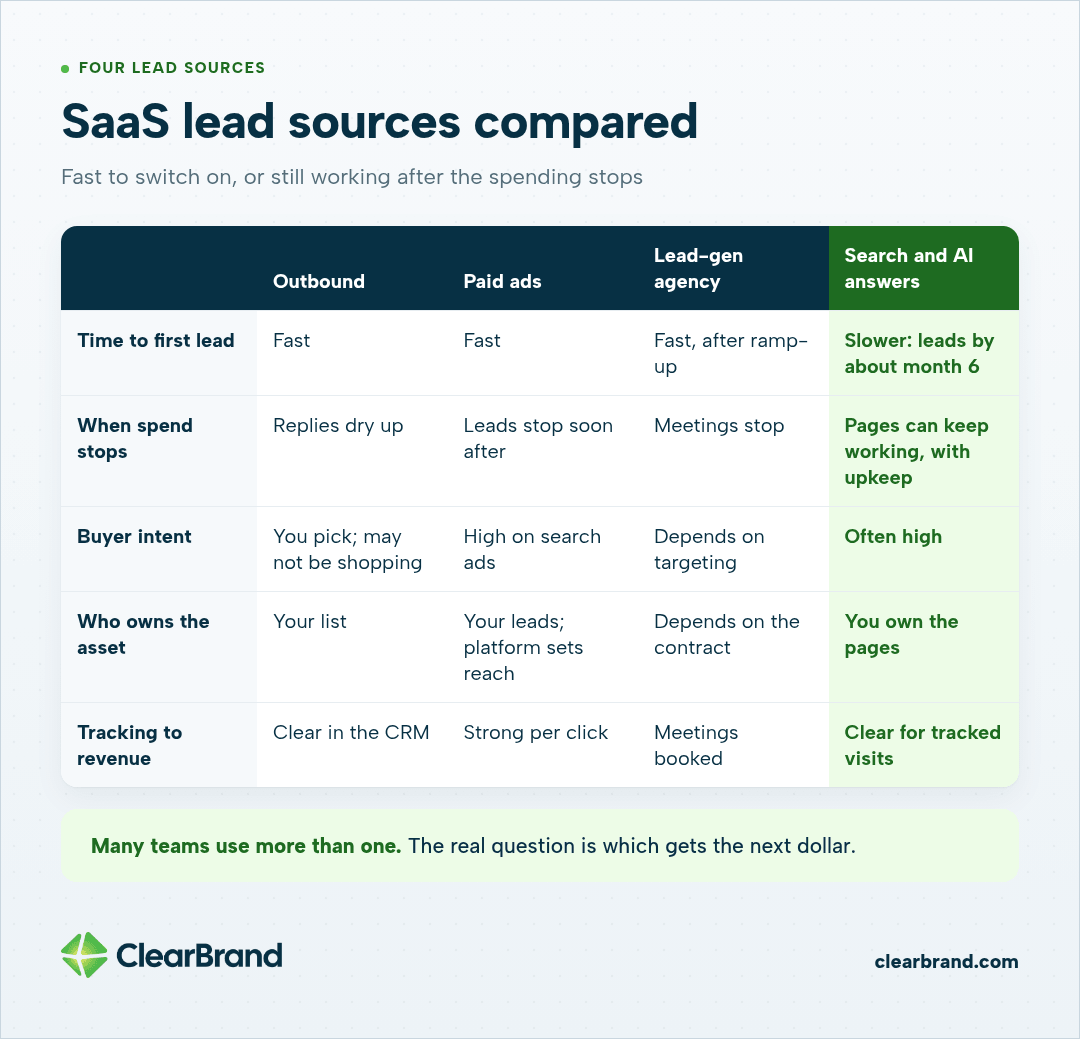
Outbound and paid ads are faster to switch on and easier to turn up or down, and agencies sell that speed without hiring. Search and AI answers take months to build, but you own the pages, and buyers often arrive already looking.
| Outbound (cold email, calls, LinkedIn) | Paid ads | Lead-gen agency | Search and AI answers | |
|---|---|---|---|---|
| Time to first lead | Fast, once the message lands, and you control the volume | Fast, once campaigns run, and you set the budget | Fast, after the agency ramps up | Slower: traffic in the first few months, leads and demos generally by about month 6 |
| When spend stops | New replies dry up when sending stops | New ad leads stop soon after the budget stops | New meetings stop when the contract ends | Pages can keep ranking and getting cited, though they need upkeep to hold their place |
| Buyer intent | You pick the buyer, who may not be shopping yet | High on search ads; social reaches buyers earlier, with precise targeting | Depends on the agency’s targeting | Often high, especially on comparison and alternative searches; lower on purely educational ones |
| Who owns the asset | You keep the list and what you learn | You keep the leads and what you learn; the platform controls reach and price | Depends on the contract | You own the pages; rankings and citations are earned, not owned |
| Tracking to revenue | Clear in the CRM | Strong per click; needs the CRM for revenue | Often reported as meetings booked | Clear for tracked visits when demo events reach the CRM; AI answers can send buyers who never click a tracked link |
Plenty of SaaS teams use more than one, with a free trial or freemium plan as the place many of those leads turn into signups. The real question is which one gets the next dollar, and which one you want carrying your lead flow two years from now. That second question is where SaaS inbound marketing earns its place, because every page you publish is still there next quarter.
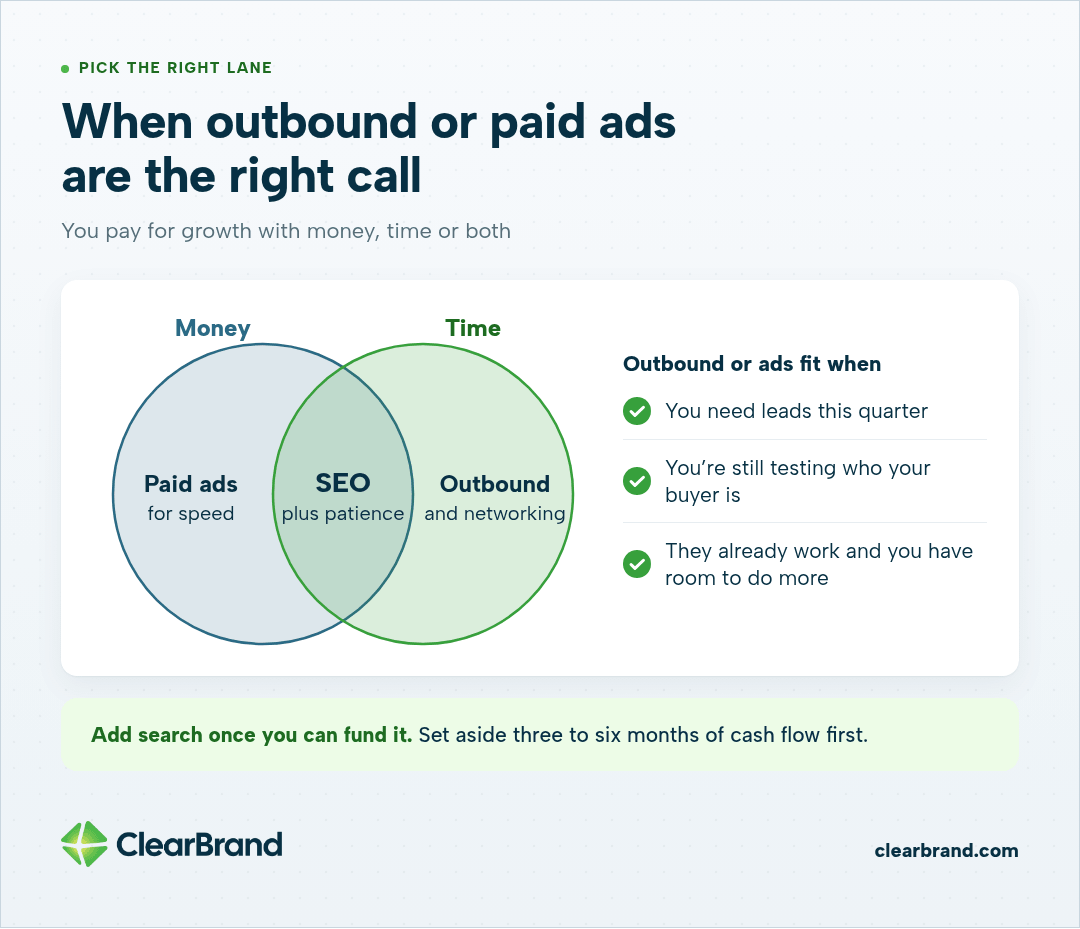
When outbound or paid ads are the right call
Outbound and paid ads are the better call when you need leads this quarter, when you’re still testing who your buyer is, or when they’re already working and you have room to do more of them.
You pay for growth with money, time or both. Ads trade money for speed, while cold calling, cold email and networking trade time. SEO asks for both, plus some patience.
If ads or outbound are working and you’re growing, keep doing them.
Outbound and ads also teach you fast. Ads in particular show you a lot about creative and cost per conversion, and what you learn about your message can make the pages you write later sharper.
Search makes sense once you can fund it without stress. I look for three to six months of cash flow set aside, because the first stretch goes into building pages. Our guide to SaaS SEO strategy shows how to plan and order that first stretch.
A few signals that search is the next lane to add:
- People already search for your category, your competitors or the problem you solve.
- Your cost per lead from ads keeps rising.
- You want a lead source that doesn’t reset to zero each month.
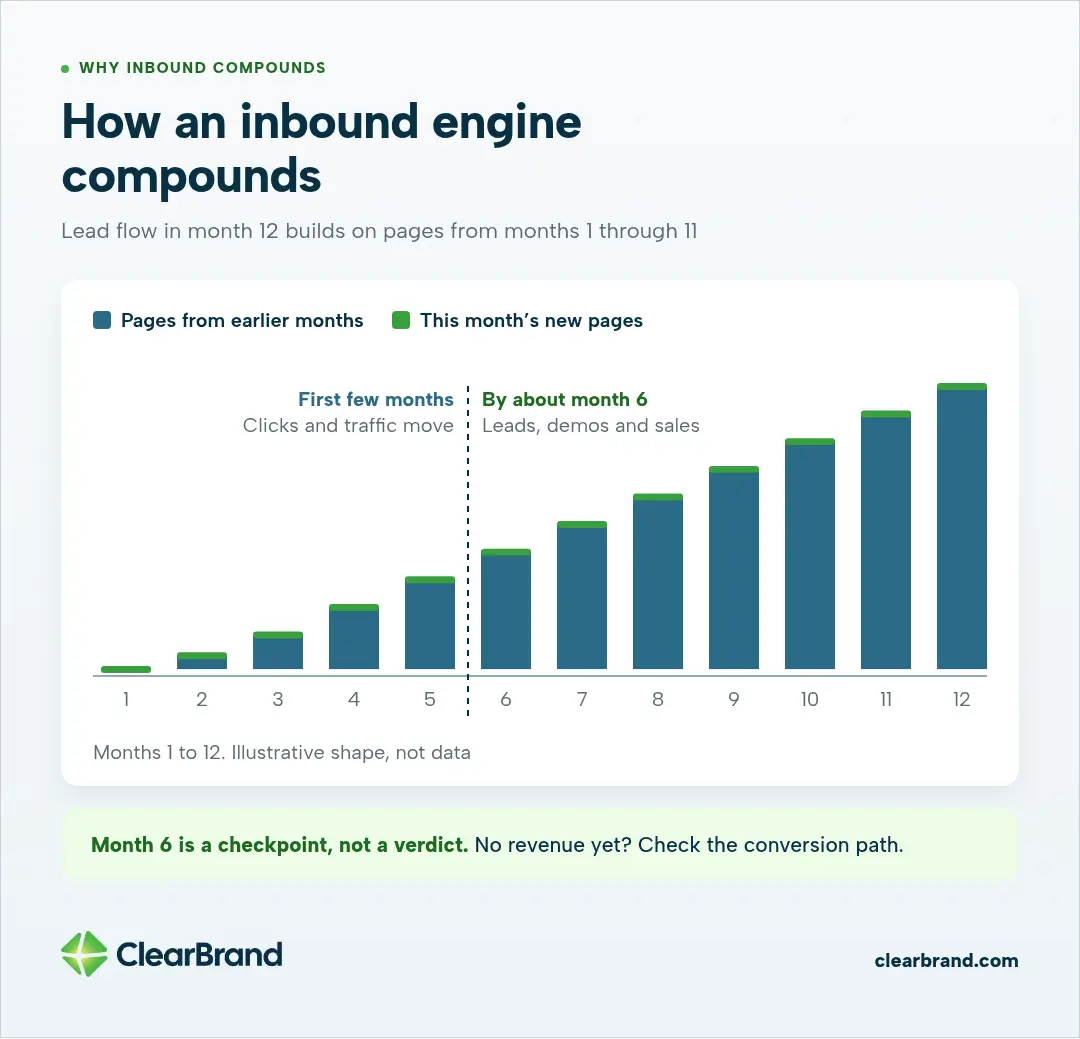
How an inbound engine from search and AI answers compounds
Inbound compounds because each page that ranks or gets cited can keep bringing in buyers without paying for each visit, so the lead flow in month 12 can build on everything published in months 1 through 11.
A comparison page that ranks keeps answering the same buyer question every week, and the next page adds to it. The buyers are different, too. Someone searching “[competitor] alternatives” or asking an AI tool for the best option for their team is usually already choosing.
In my experience, AI search rests on the same foundations as Google: first-hand content, a sound site, and authority from links and mentions. Google says standard SEO best practices still apply to its AI Overviews and AI Mode. So one body of work feeds both.
How long SaaS lead generation strategies built on search take
- First few months: if SEO is working, clicks and traffic start to move.
- By about month 6: leads, demos and sales generally come in. That’s the pattern I see when the work is on track, though it isn’t a guarantee, since every site starts from a different place.
- If month 6 arrives without revenue: that’s the moment to check the conversion path.
Where demand generation fits
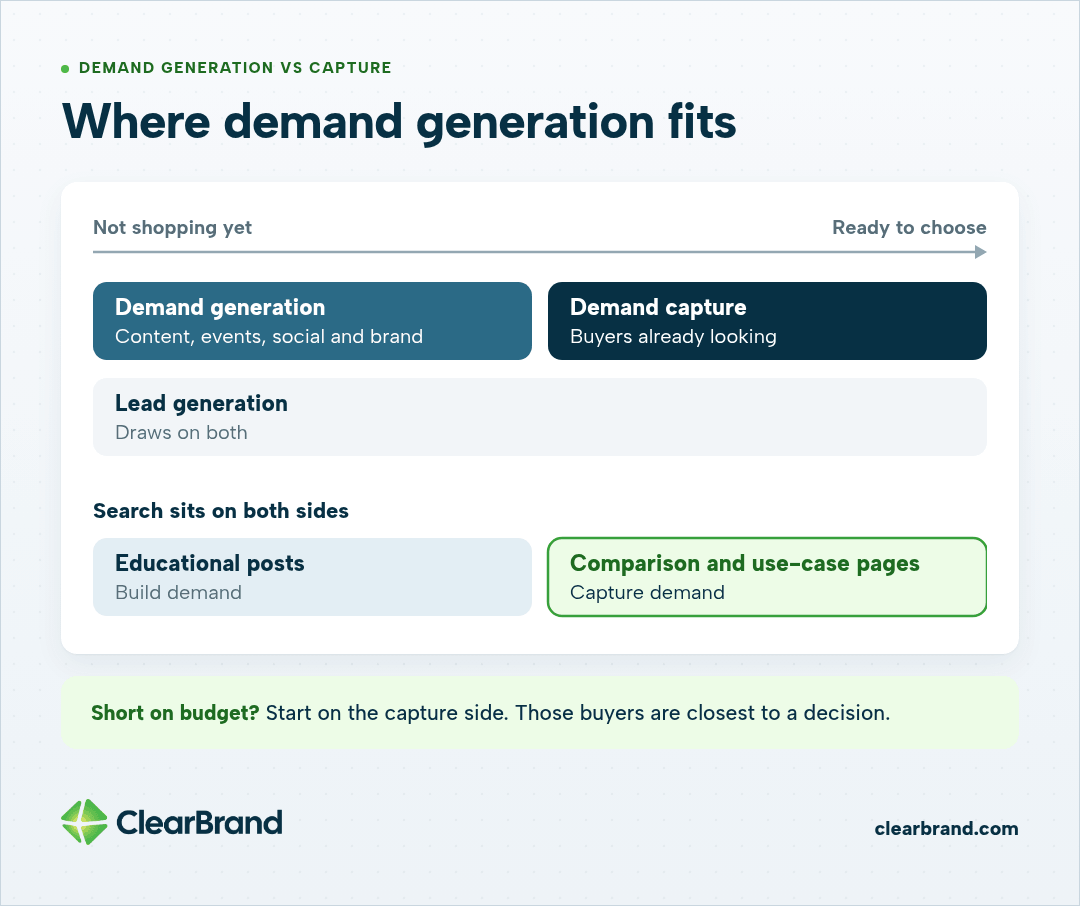
SaaS demand generation builds interest among buyers who aren’t shopping yet, through content, events, social and brand. Demand capture reaches buyers who are already looking and turns them into leads. Lead generation draws on both.
Search sits on both sides: educational posts build demand, while comparison and use-case pages capture it. For a SaaS team short on budget, the capture side is usually the place to start, because those buyers are closest to a decision.
The pages that bring in SaaS demos
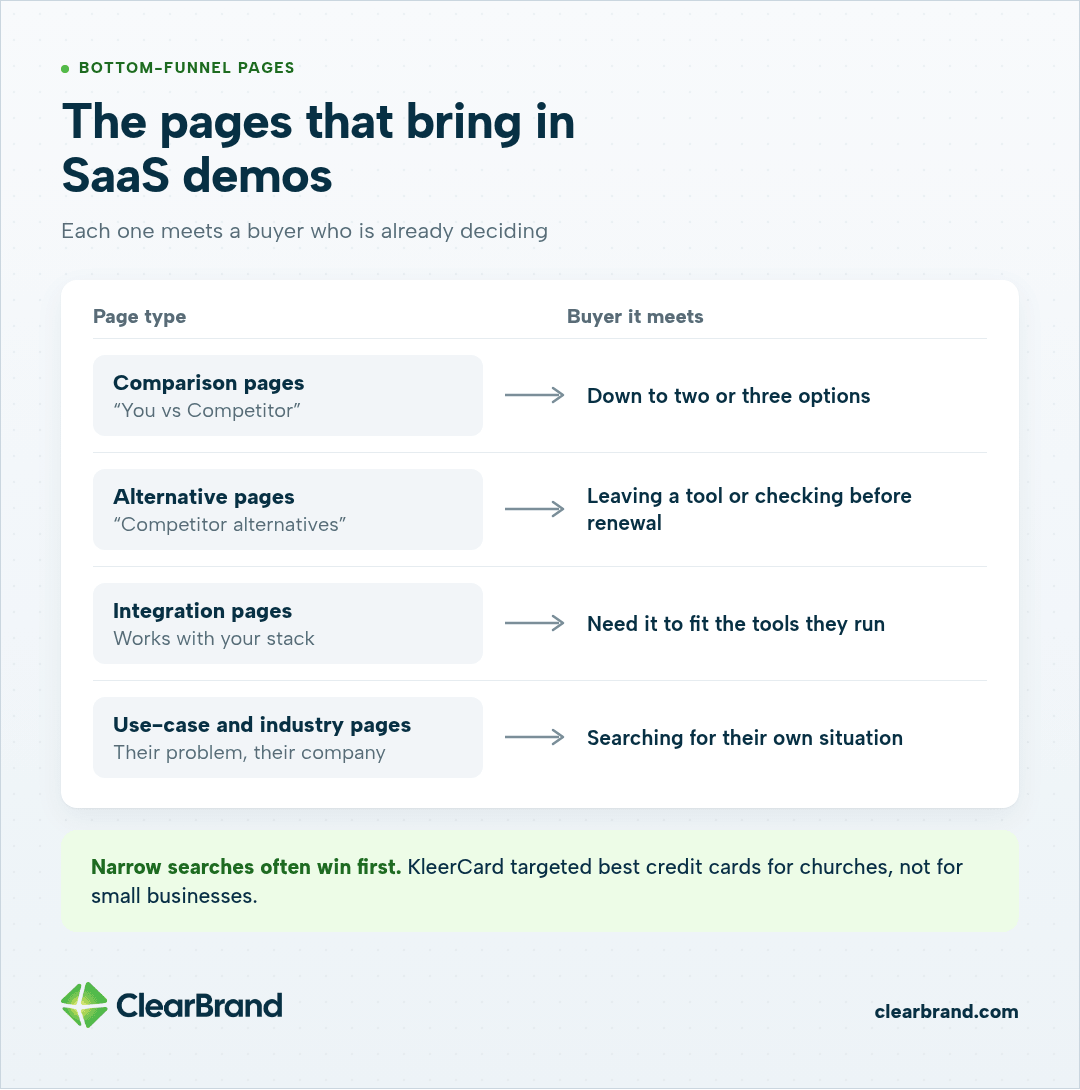
Comparison, alternative, integration and use-case pages are often where search turns into demos, because they meet buyers who are already deciding which tool to pick.
- Comparison pages (“You vs Competitor”): for buyers down to two or three options, and best when fair.
- Alternative pages (“Competitor alternatives”): for buyers leaving a tool or checking options before renewal.
- Integration pages: for buyers who need you to work with the stack they already run.
- Use-case and industry pages: for buyers searching for their own problem or their own kind of company.
Narrow, specific searches often win first. With KleerCard, a fintech card for churches and nonprofits, we skipped broad terms like best credit cards for small businesses and went after best credit cards for churches, nonprofits and school districts. Less volume. More winnable, and closer to the buyers they serve.
Our SaaS SEO guide breaks down each page type and the technical side, and our guide to SaaS comparison and alternative pages covers building them fairly.
AI answers as a SaaS lead source
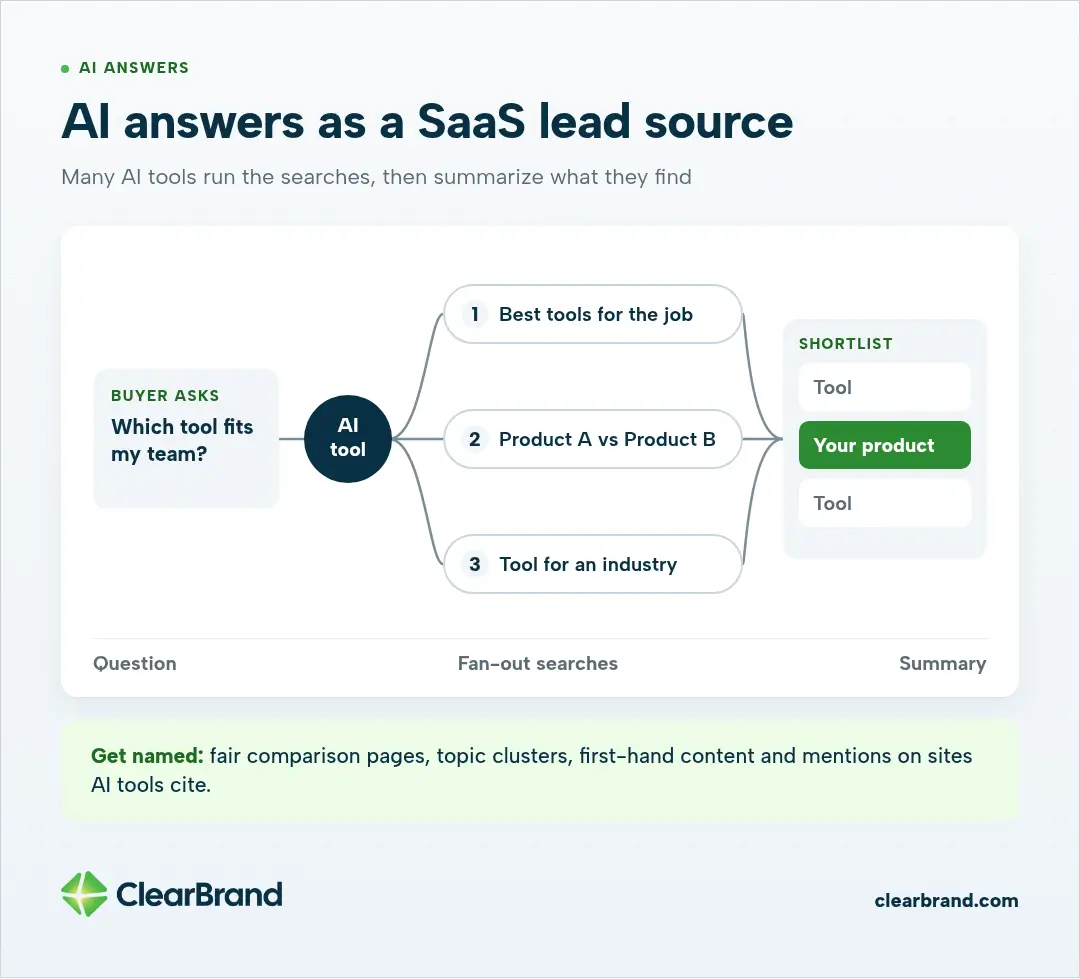
AI answers became a lead source when buyers started asking ChatGPT, Gemini and Google AI Overviews to recommend tools. The SaaS products named in those answers can make the shortlist before the buyer visits a single website.
How buyers use AI tools to build a shortlist
Search hasn’t gone away. Many AI tools run the searches for the buyer, then summarize what they find. Google says AI Overviews and AI Mode may issue multiple related searches (query fan-out), and ChatGPT search typically rewrites a question into one or more searches.
How to earn a place in AI answers
- Answer the questions buyers ask AI tools: best tools for a job, one product vs another, the right tool for an industry.
- Publish best-of lists and comparison pages that are fair and specific. In my work, they’re some of the strongest pages for AI visibility.
- Build topic clusters around each use case, to raise the odds your pages get picked up in those fan-out searches.
- Write from first-hand experience. Expert interviews with your own team give pages details competitors can’t easily copy.
- Earn mentions on the sites AI tools cite, alongside links on the sites Google trusts.
How to see whether you’re named
ChatGPT has no equivalent of Google Search Console, so I track AI visibility with an AI visibility tracker. It asks the AI platforms the prompts your buyers would use on a regular schedule, then records whether your product appears, how it’s described and who sits alongside it. More in our guide to AI visibility metrics for SaaS.
How to track SaaS demos through to revenue
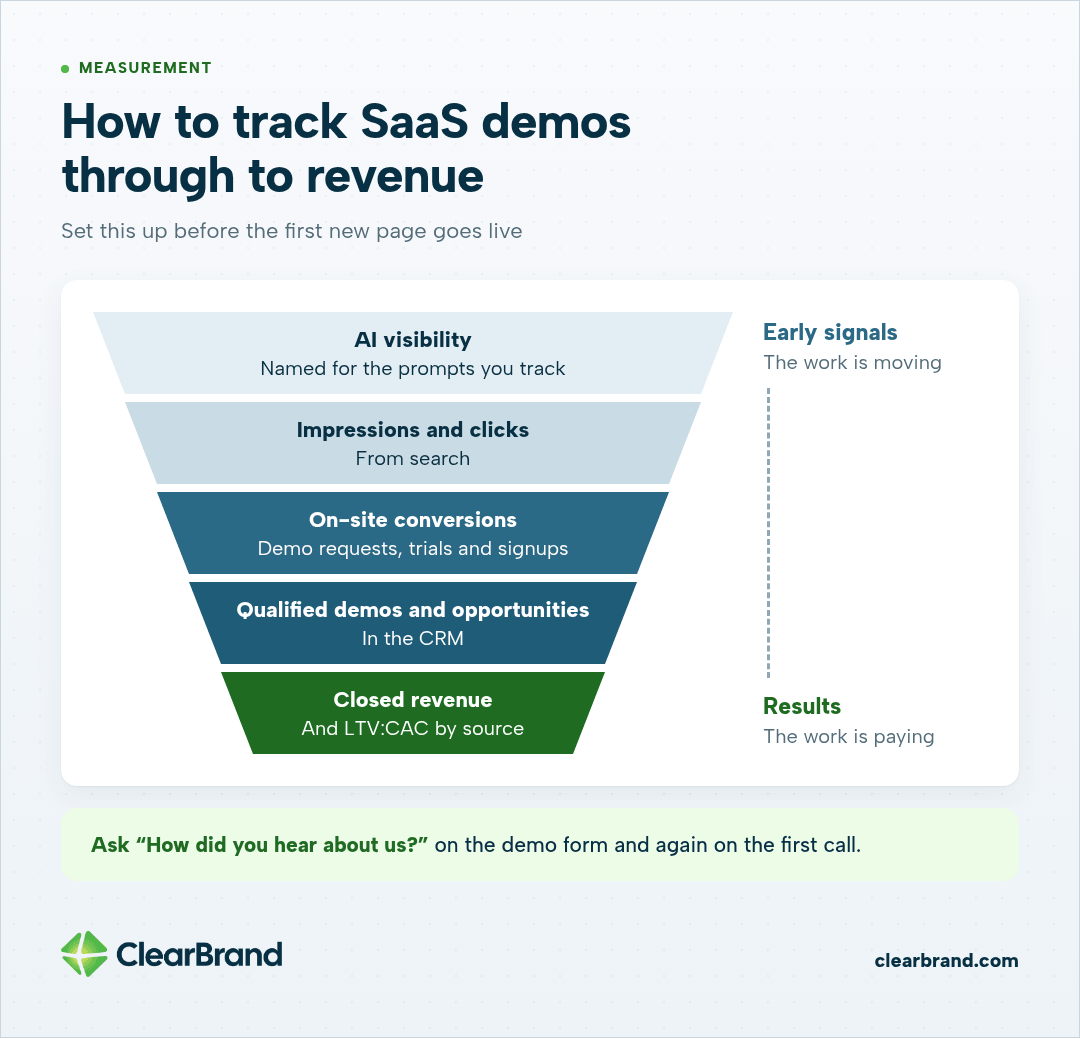
Track every demo, trial and signup from organic search and AI referrals into your CRM with the landing page attached, then follow it to closed revenue. Clicks show the work is moving, and demos and sales show it’s paying.
What to measure, from early signals to results:
- AI visibility: whether you’re named for the prompts you track.
- Impressions and clicks from search.
- On-site conversions: demo requests, trial starts and signups.
- Qualified demos and opportunities in the CRM.
- Closed revenue and LTV:CAC by source.
Set this up before the first new page goes live.
Add a “How did you hear about us?” field to the demo form, and ask again on the first call. Some of our clients ask it at every consultation, because AI answers can send buyers who never click a tracked link.
One week where impressions rise and clicks fall isn’t a trend. Months of falling leads are worth a closer look.
When traffic grows but demos don’t
If traffic is growing and demos aren’t, the next job is conversion work: making it easier to get from the page to a demo or signup.
Look at what the call to action asks for, where it sits and whether it matches what the visitor came to do.
When month 6 arrives with traffic but no revenue yet, I check the conversion path first, then whether the pages reach buyers ready to choose and the CRM is catching every lead.
I treat month 6 as a checkpoint for the plan, not a verdict.
How KleerCard built an inbound lane against billion-dollar competitors
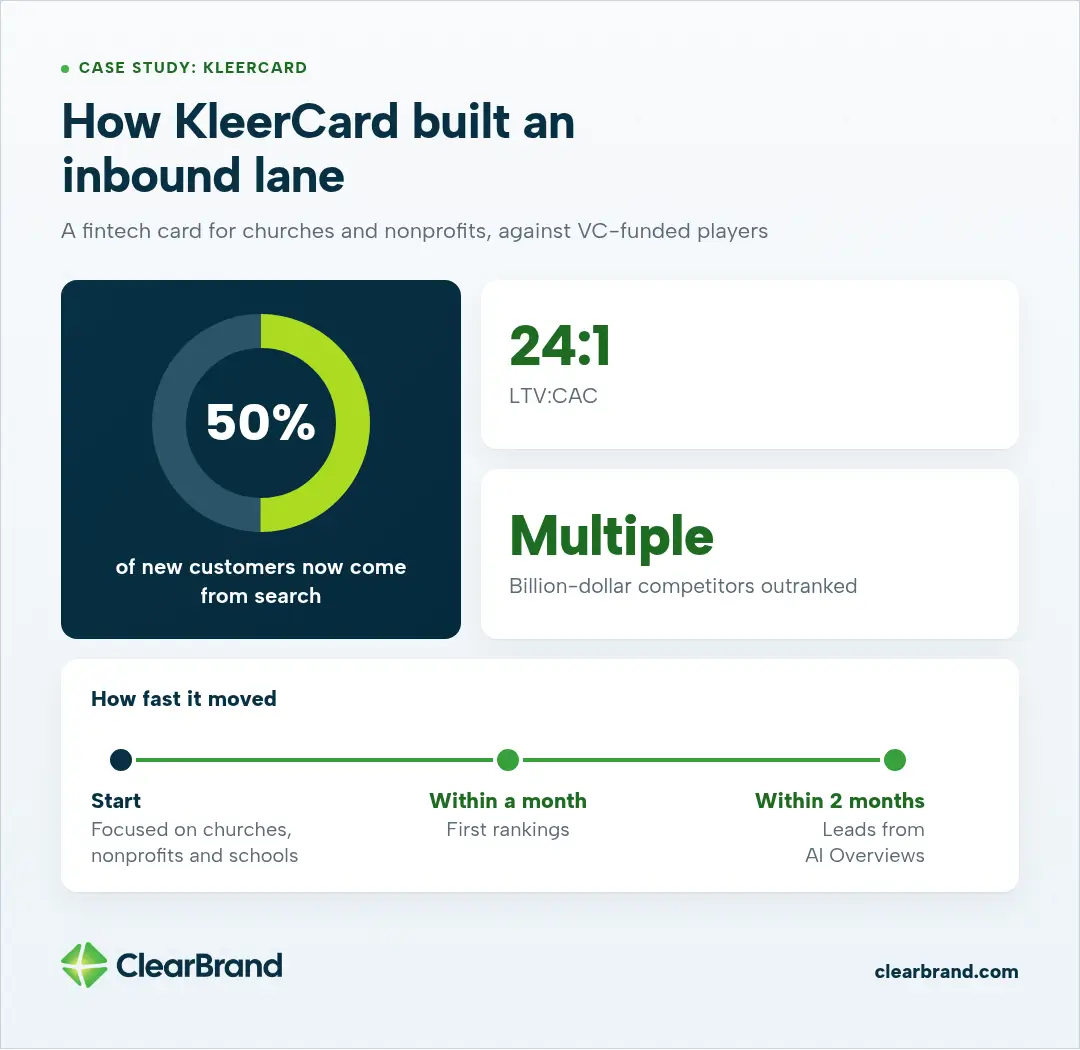
KleerCard, a fintech card for churches and nonprofits, now gets 50% of its new customers from search and runs at a 24:1 LTV:CAC, while outranking multiple billion-dollar competitors.
KleerCard competes with big, VC-funded players, so we focused on the churches, nonprofits and schools KleerCard serves and built the content around the exact searches those decision-makers use, with best-of lists and expertise-driven articles written through our interview process. How fast it moved:
- First rankings within a month.
- Leads from AI Overviews within 2 months.
Read the full KleerCard case study.
Want to know which pages could bring in demos for your product? Get your free SEO audit.
When to bring in a SaaS SEO partner
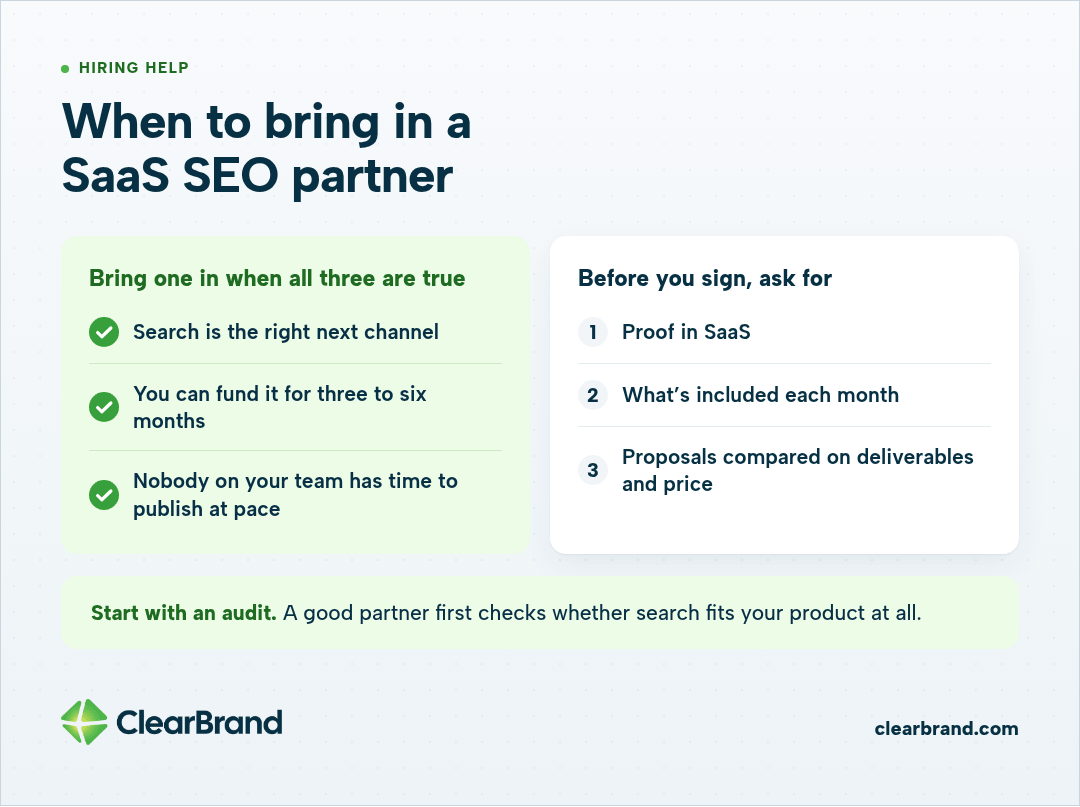
Bring in a partner when search is the right next channel, you can fund it for three to six months, and nobody on your team has time to publish at the pace it takes.
A good partner starts with an audit that tells you whether search is a good channel for your product at all.
Ask for proof in SaaS, look at what’s actually included each month, and compare a few proposals on deliverables as well as price. See what a SaaS SEO retainer includes.
This is the work we do every day as a SaaS SEO agency: pages buyers use to choose a tool, built for Google and AI answers, with reporting that gets as close to leads and revenue as your data allows.
SaaS lead generation FAQ
What is SaaS lead generation?
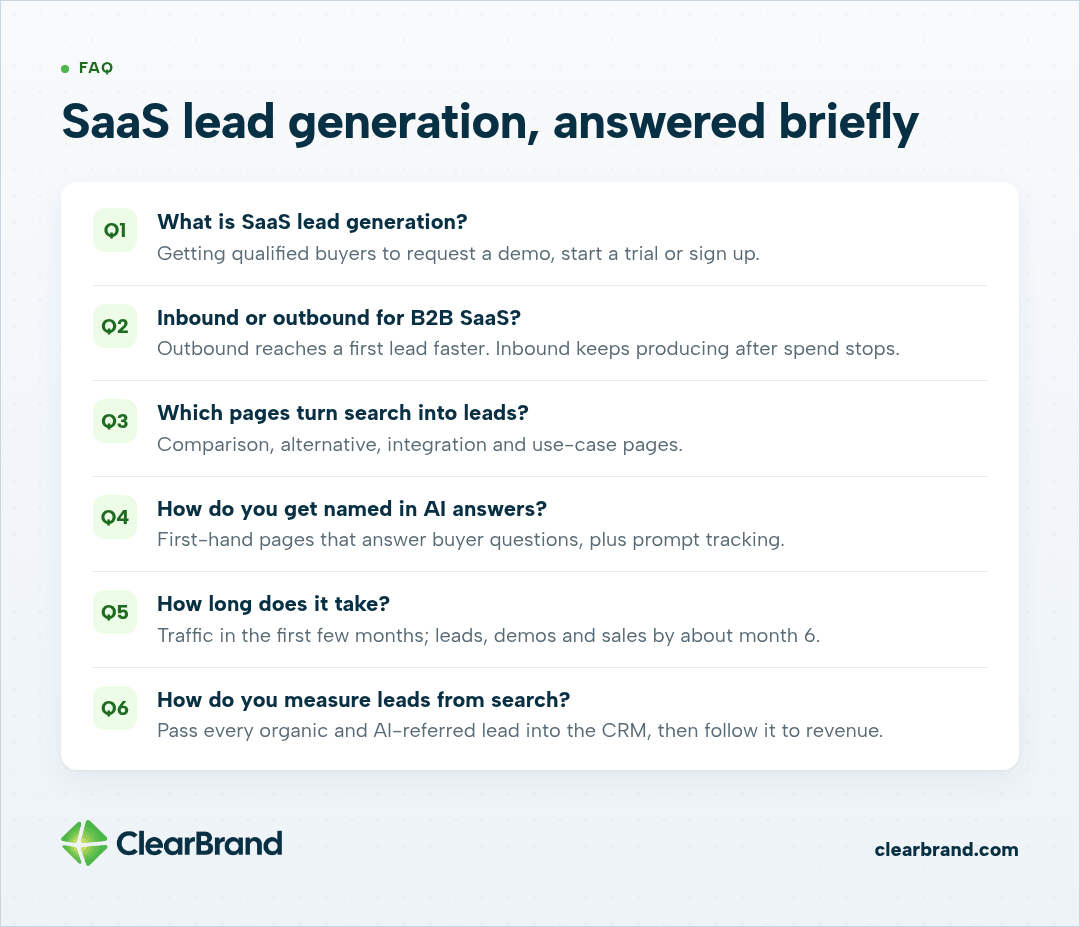
SaaS lead generation is how a software company gets qualified buyers to request a demo, start a trial or sign up. The main sources are outbound, paid ads, lead-gen agencies, and inbound from search and AI answers.
Is inbound or outbound better for B2B SaaS lead generation?
Both have a place in B2B SaaS lead generation: outbound reaches a first lead faster, and inbound from search and AI answers can keep producing leads after the spending stops.
Which pages turn search into SaaS leads?
Comparison, alternative, integration and use-case pages are often where search turns into SaaS leads, because they reach buyers who are already choosing a tool.
How do you get your SaaS recommended in ChatGPT and AI Overviews?
You earn a place in ChatGPT and AI Overviews with clear, first-hand pages that answer the questions buyers ask AI tools, then track the prompts that matter to see whether you’re named.
How long does SaaS lead generation from SEO take?
When SEO is working, clicks and traffic move in the first few months, and leads, demos and sales generally come by about month 6. It’s a typical pattern rather than a promise.
How do you measure SaaS leads from search?
The clearest way to measure SaaS leads from search is to pass every organic and AI-referred demo, trial and signup into your CRM with its landing page, then follow it to revenue.
Let’s find your next demo
If you’d like a second set of eyes on where your next demos could come from, I’d love to take a look. Your free SEO audit is a full review of your site and an initial 90-day strategy, and you keep it whether you work with us or not.