
How to Build a SaaS SEO Strategy: A Planning Framework for Your Team
Build a SaaS SEO strategy around your sales motion: prioritize opportunities, plan phases, name owners, and report what you can track.
Originally published: October 20, 2026 Last updated: October 20, 2026
A SaaS SEO strategy is a ranked, phased plan that decides which searches to win first, which pages to build for them, who owns the work, and how you’ll report results as pipeline. It starts from your sales motion and stage, and it gets revisited every quarter.
If you already know the tactics, the harder part of any SEO strategy for SaaS is the order. Which pages come first? Who owns the work? And what do you show leadership in month two, when sales may not have moved yet?
If you’d like the basics first, like what SaaS SEO is, the page types that convert and the technical fixes that matter, start with our SaaS SEO guide.
Key Takeaways
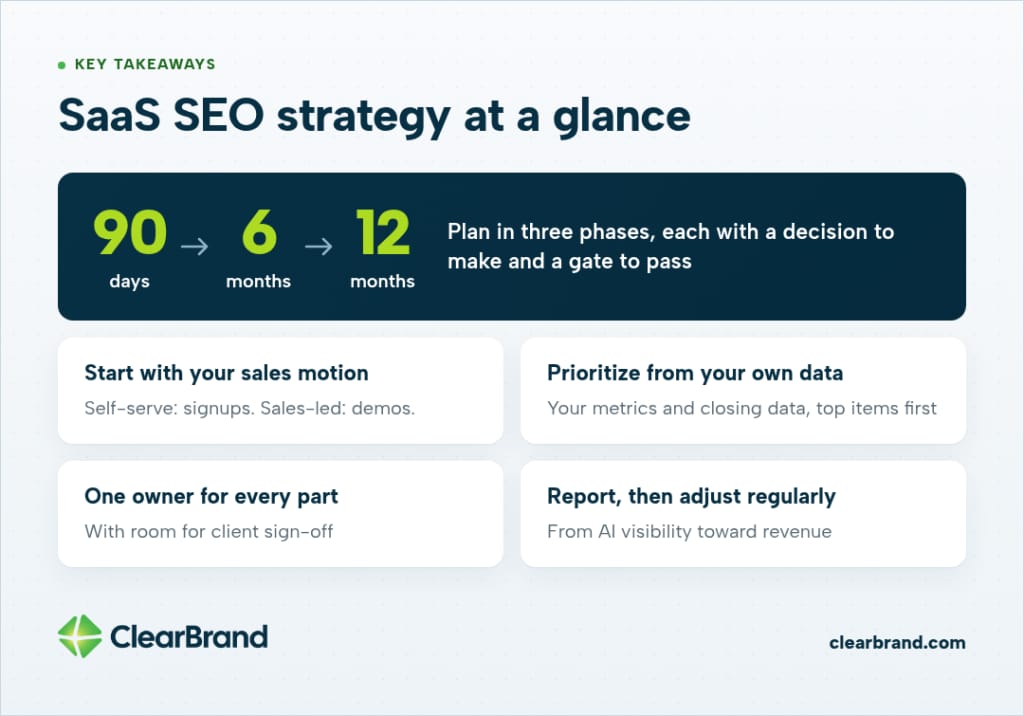
- Pick your strategy by sales motion first. Self-serve products chase signups, and sales-led products chase demos and pipeline.
- Prioritize opportunities from your own metrics and closing data, then build the highest-priority items first.
- Plan in three phases (90 days, 6 months, 12 months), each with a decision to make and a gate to pass.
- Give every part of the plan one owner, and leave room for client sign-off where your team needs it.
- Report what you can track for your industry, from AI visibility and clicks through to conversions, and get as close to revenue as the data allows.
- Adjust regularly from Search Console and AI visibility data. Rewrite when something clearly isn’t working, or when you launch a new product or service.
What a SaaS SEO strategy decides
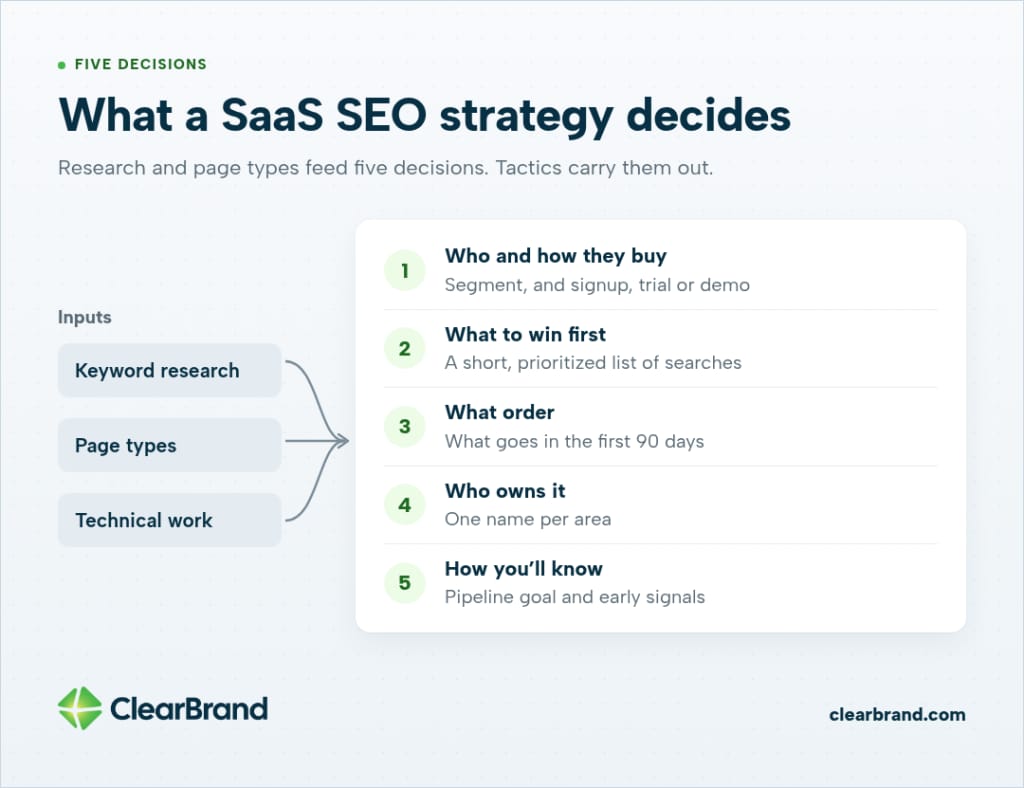
A SaaS SEO strategy makes five decisions: which buyers and sales motion you’re serving, which searches to win first, the order you’ll build in, who owns each piece, and how you’ll measure it. Tactics carry those decisions out.
- Who and how they buy: the segment you’re targeting and whether they sign up, start a trial or book a demo.
- What to win first: a short, prioritized list of searches and the page that answers each one.
- What order: which items go in the first 90 days and which wait.
- Who owns it: one name per area, with room for client sign-off when your process needs it.
- How you’ll know: the pipeline goal for each phase and the early signals you’ll watch.
Keyword research, page types and technical work are the inputs to these decisions. Our SaaS SEO guide covers how to research SaaS keywords from the bottom of the funnel and how each of the other inputs works.
Plenty of good SaaS SEO strategies look different on paper. The ones that work tend to share a written order of work that the whole team agreed to.
Match the strategy to your sales motion and stage
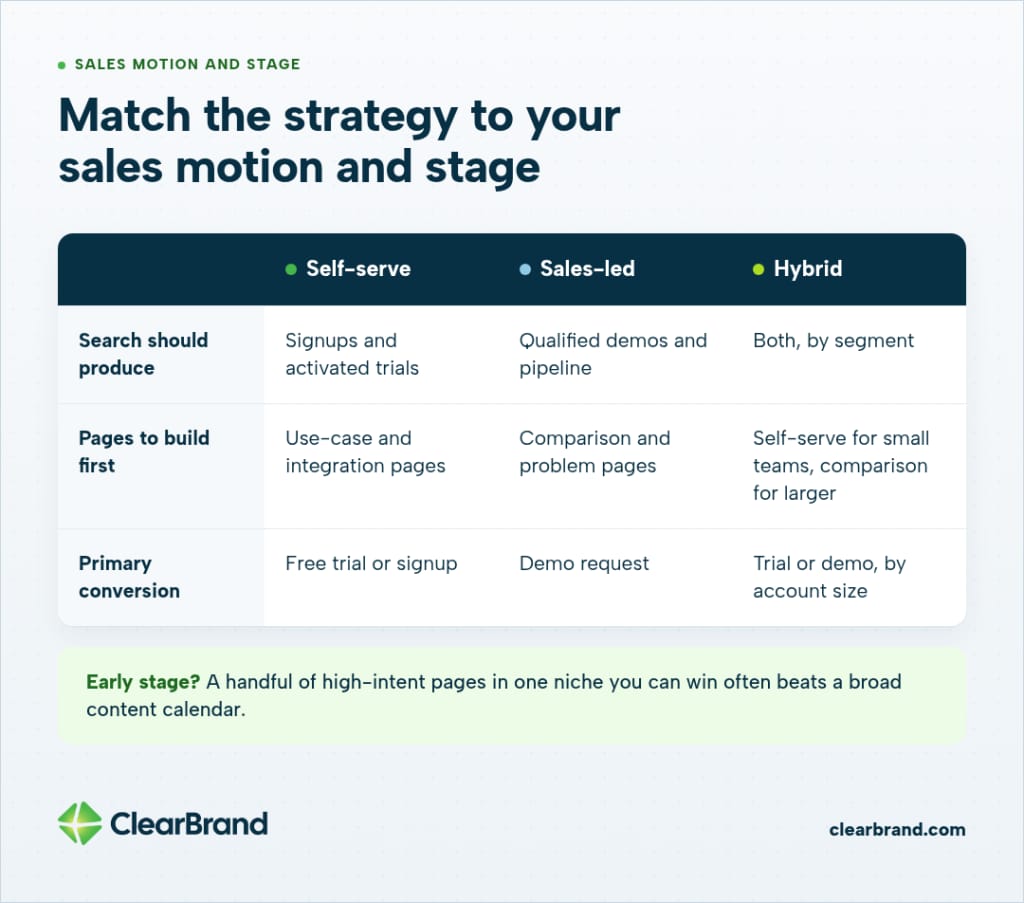
Self-serve (product-led, or PLG) SaaS should prioritize searches that lead to a signup or free trial, like use-case and integration queries. Sales-led SaaS should prioritize comparison and problem searches that lead to a demo, and judge them by pipeline. Hybrid companies split the plan by segment.
| Motion | What search should produce | Pages to prioritize first | Primary conversion |
|---|---|---|---|
| Self-serve (product-led) | Signups and activated trials | Use-case, integration and “how to [job] in [tool]” pages | Free trial or signup |
| Sales-led | Qualified demos and pipeline | Comparison, alternatives and problem-aware pages | Demo request |
| Hybrid | Both, by segment | Self-serve pages for smaller teams, comparison pages for larger accounts | Trial for small teams, demo for larger accounts |
If comparison searches sit near the top of your list, our guide to comparison and alternatives pages covers how to build them well.
How company stage changes the plan
- Early stage: a short list and a narrow segment. A handful of high-intent pages in one niche you can win often beats a broad content calendar.
- Scaling: more segments and more pages, so the priority list and the owner list matter more than the page count.
- Multiple products or markets: one plan per segment, each with its own goal, so wins in one market don’t hide a stall in another.
A B2B SaaS SEO strategy with a longer buying committee follows the same plan, just with more people involved in reviews. It also helps to understand how B2B buyers research before they’re ready to talk.
How to prioritize SaaS SEO opportunities
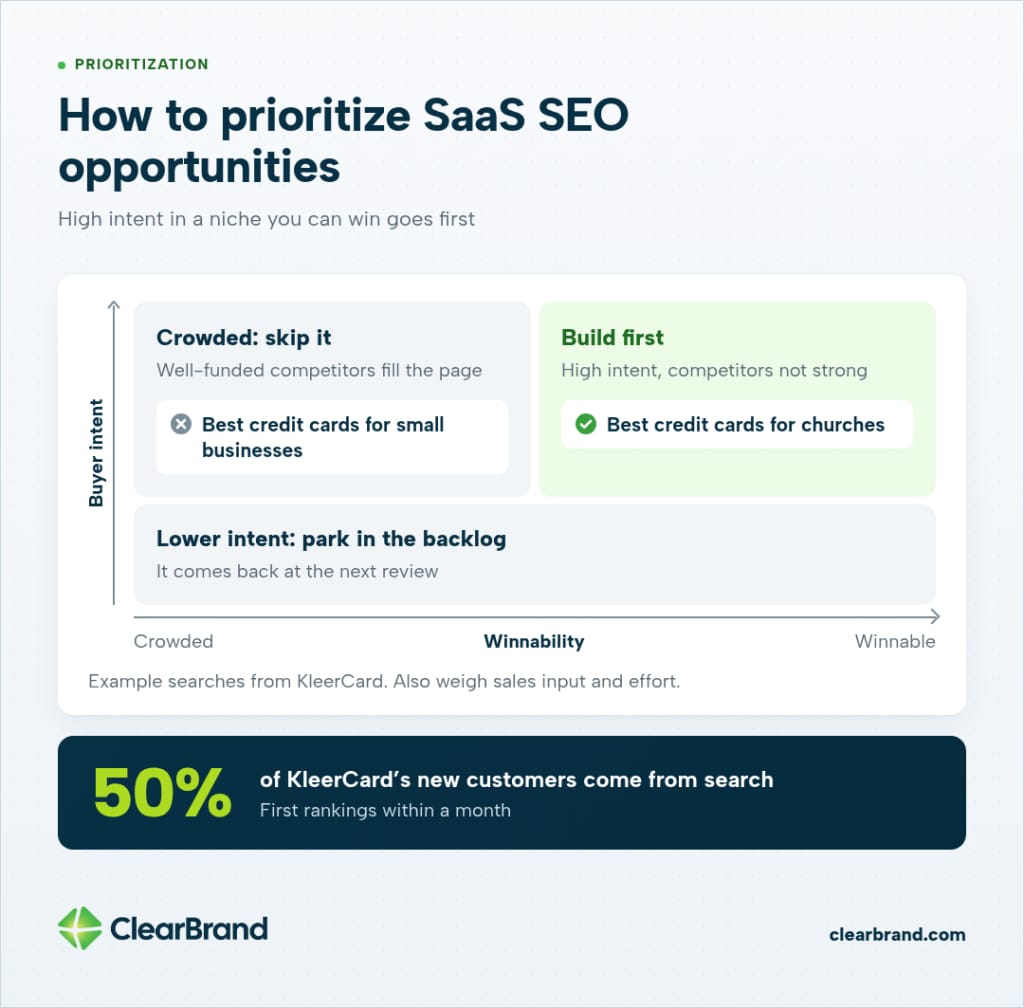
We rely on our clients to prioritize opportunities from their own internal metrics and closing data. The highest-priority items are usually high-intent, bottom-of-the-funnel searches in a niche where competitors aren’t already strong.
When you rank your own list, weigh a few factors against the numbers you already have:
- Buyer intent: is the searcher comparing tools or looking for something to buy, or do they just want a definition?
- Sales input: does sales hear this question or objection on most calls?
- Effort: can you ship it with what you already know, or does it need new data, design or engineering?
- Winnability: are the results thin, or do large, well-funded competitors fill every result?
Search volume belongs in the mix too, but only alongside revenue potential. I look at how many people search a term and what one customer is worth, because a smaller, valuable search often pays back faster than a big generic one.
Sales input is the easiest factor to skip. Call recordings, demo notes and support tickets show the exact words buyers use, so pull a few from tools like Gong, Fathom or Fireflies before you decide.
Pick a category you can win: the KleerCard example
KleerCard is a fintech company that offers credit cards with built-in expense management for churches, nonprofits and schools. Its competitors target nearly every business.
So we skipped the broad searches, like best credit cards for small businesses, where well-funded competitors already fill the page. We went after best credit cards for churches, for nonprofits and for school districts instead.
Those searches have less volume. But they were winnable. KleerCard saw its first rankings within a month, now outranks multiple billion-dollar competitors, and gets 50% of its new customers from search. You can read how KleerCard got 50% of new customers from search in the full case study.
Put the priority list in order
- Build the top priorities first, then group related pages so each one supports the others.
- Keep one or two quick wins in the first batch, like improving commercial pages you already have, so the team sees movement early.
- Park lower priorities in a backlog. They come back at the next review.
A SaaS SEO roadmap: 90 days, 6 months and 12 months
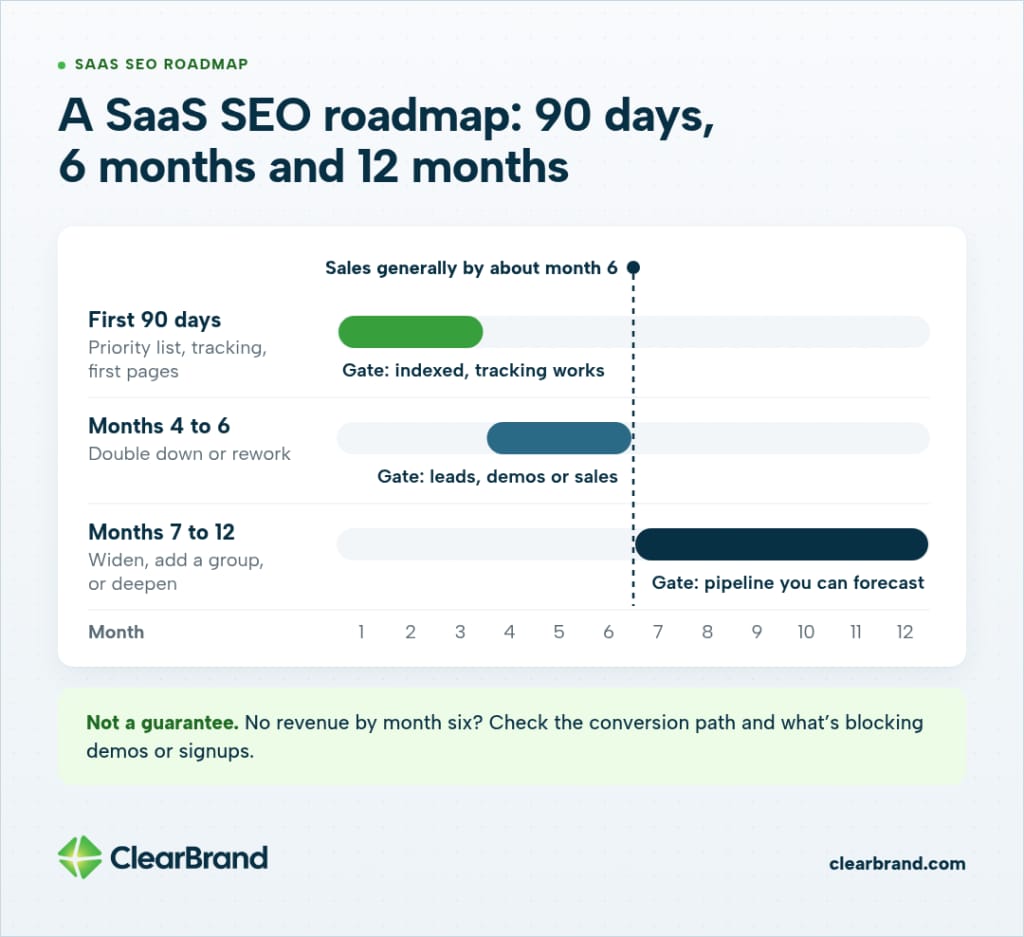
A SaaS SEO roadmap splits the plan into three phases, each with a decision to make and a gate to pass before the next one. The first 90 days fix anything blocking indexing, set up conversion tracking and ship the highest-priority commercial pages.
For what results usually look like at each stage and what the work costs, our SaaS SEO guide covers how long SaaS SEO takes.
| Phase | Decisions to make | Gate to move on |
|---|---|---|
| First 90 days | Final priority list, the first batch of pages, conversion tracking for signups or demos, and anything blocking indexing | Pages are indexed and earning impressions, and tracking records every signup or demo from search |
| Months 4 to 6 | Which pages to double down on, which to rework, and where the next segment or page group goes | Leads, demos or sales are showing up, or you know why they aren’t and have a fix underway |
| Months 7 to 12 | Whether to widen the segment, add a page group, or deepen the niche you’re winning | Search is a repeatable source of pipeline you can forecast in the quarterly plan |
If SEO is working, I look for movement in clicks and traffic in the first few months, then leads, demos and sales soon after. Generally sales come by about month 6. That’s not a guarantee, because conversion issues and other blockers can slow it down. If there’s no revenue by month six, check the conversion path and what’s blocking demos or signups.
A gate you miss is useful information. It tells you whether the issue is the page, the search you picked, or the path to sign up.
Who owns each part of your SaaS SEO plan
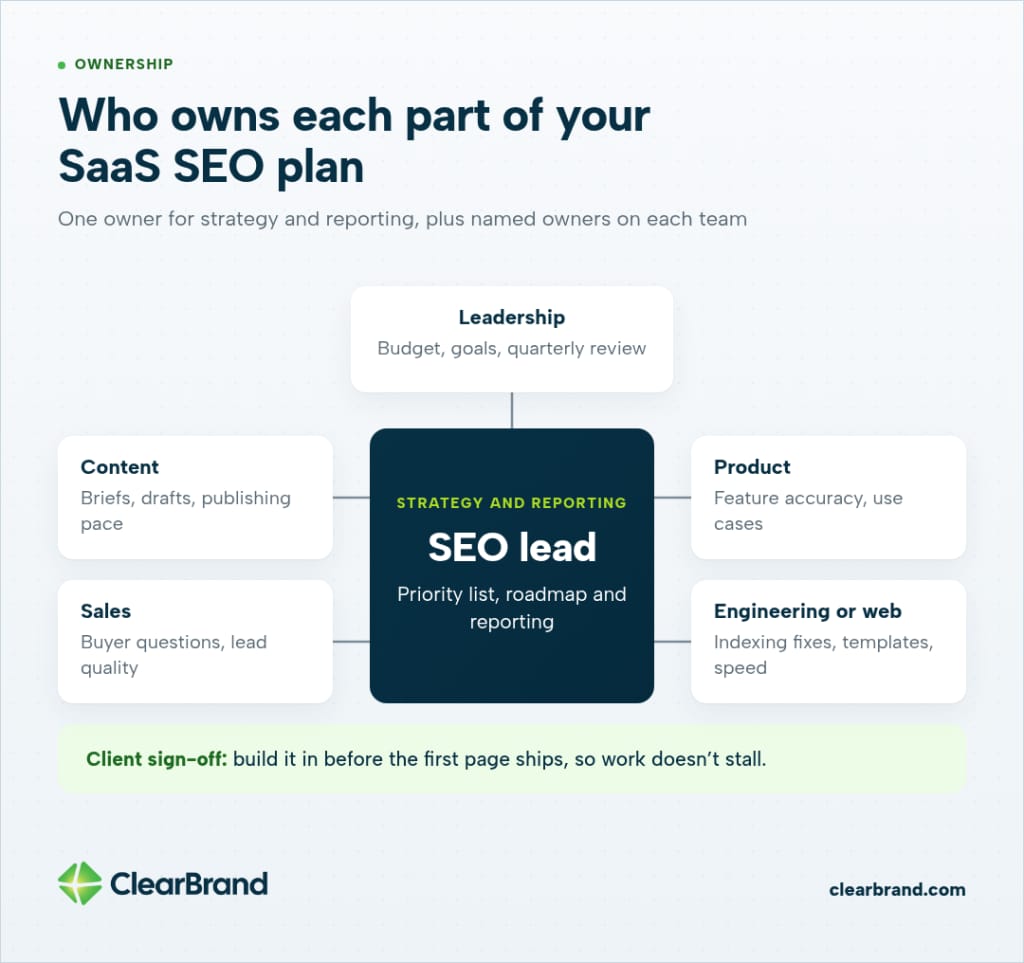
A SaaS SEO plan needs one owner for strategy and reporting, plus named owners in content, product, sales and engineering. We allow for client sign-off, and how it works varies from client to client. Build it into the plan before the first page ships, so work doesn’t stall waiting on a review.
| Role | Owns | Contributes |
|---|---|---|
| SEO lead | The priority list, roadmap and reporting | Priorities and phase gates |
| Content | Briefs, drafts, publishing pace | Readability and brand voice |
| Product | Feature accuracy, screenshots, use cases | Product claims |
| Sales | Buyer questions, objections, lead quality feedback | Whether search leads are qualified |
| Engineering or web | Indexing fixes, templates, site speed | Technical changes |
| Leadership | Budget, goals, the quarterly review | Whether the plan moves to the next phase |
How to get buy-in from product, sales and engineering
- Tie each ask to a goal that team already owns: pipeline for sales, activation for product, fewer support tickets for customer success.
- Ask sales for a short monthly list of the buyer questions and objections they heard. It feeds prioritization directly.
- Give engineering a short, ranked list of fixes with the pages each one affects.
- Share the priority list early, so people see their input in the order of work.
Some teams fill these roles in-house, and others bring in a SaaS SEO agency for strategy, content and reporting. If you’re weighing the two, our guide to SaaS SEO agency vs in-house walks through the tradeoffs.
How to set SaaS SEO goals and report to leadership
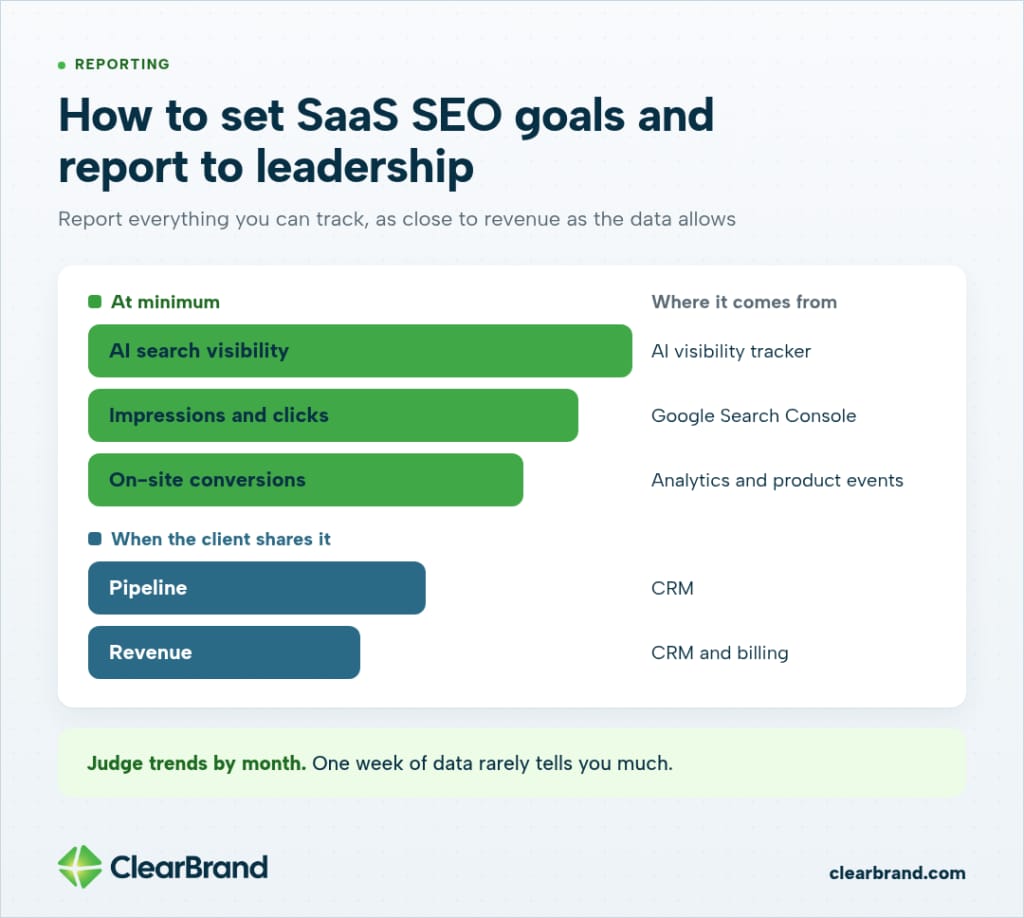
We report everything we can track, and what we can track depends on the industry. We get as close to revenue as the client allows, though it doesn’t always reach that far.
In regulated industries like health and fintech, we often don’t get lead-level data. At minimum, the report should cover AI search visibility, impressions, clicks, and on-site conversions such as button clicks or form fills. Judge trends by month, because one week of data rarely tells you much.
| Stage | What to report | Where it comes from |
|---|---|---|
| Early signal | Impressions, clicks, pages indexed | Google Search Console |
| On-site conversion | Button clicks or form fills from search | Analytics and product events |
| Pipeline (when shared) | Signups, demos or qualified opportunities from organic | CRM |
| Revenue (when shared) | Closed deals, MRR or ARR from organic | CRM and billing |
| AI visibility | How often you’re mentioned or cited in AI answers for tracked searches | An AI visibility tracker such as Rankability |
I think the numbers that matter most are leads and sales when you can see them. For most SaaS companies, that means demos or signups. Impressions and clicks still tell you the work is moving in the right direction before revenue shows up.
If leadership asks why impressions rose while clicks fell, put the conversion numbers right beside them. An AI Overview may now answer the query, and if conversions hold steady or rise, revenue likely isn’t hurt yet. It’s still worth working to win back clicks and earn the citation, and our post on AI visibility metrics for SaaS covers what to track there.
Keep the report to one page: a few SaaS SEO KPIs, what shipped, what’s next, and any gate that moved.
When to revisit your SaaS SEO strategy
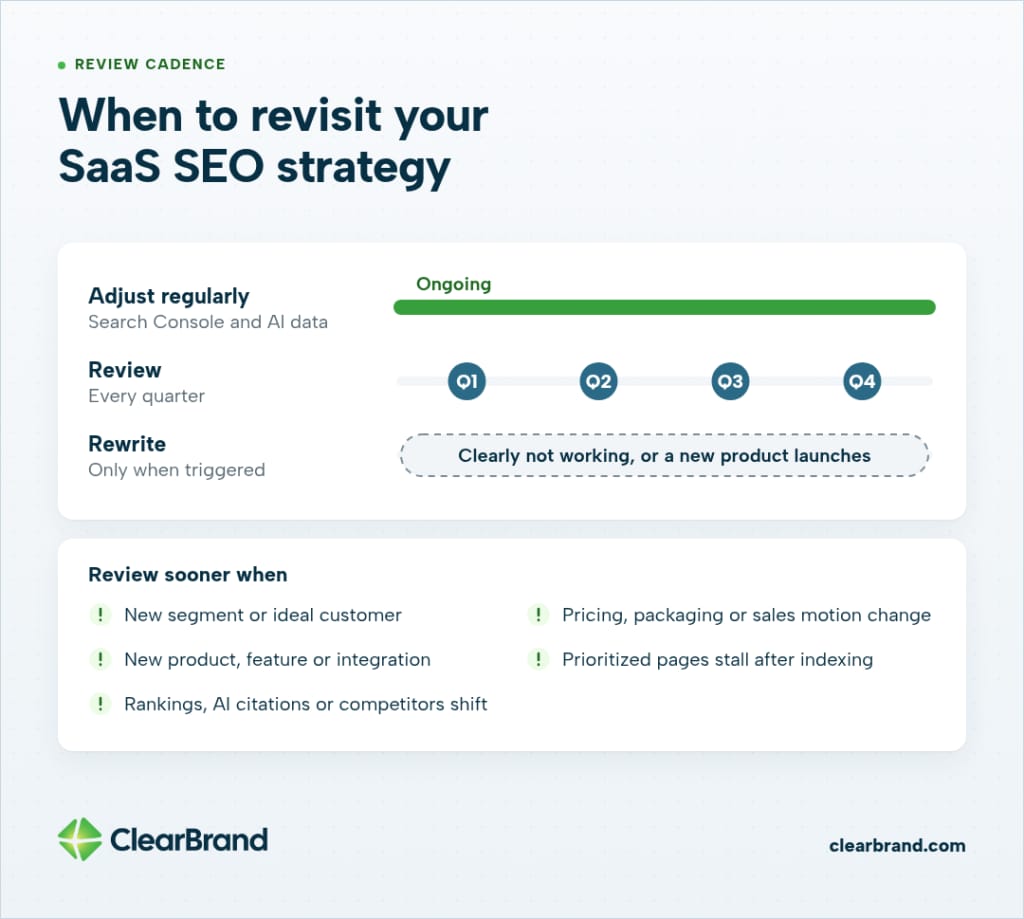
We regularly adjust the plan based on Google Search Console and AI visibility data. A full rewrite is for when something clearly isn’t working, or when you launch a new product or service.
Review your SaaS SEO strategy every quarter, and sooner when your ideal customer profile (ICP), pricing, sales motion or product changes, or when the pages you prioritized stall.
- You add a new segment or change your ideal customer.
- You change pricing, packaging or the sales motion, such as adding a free trial or moving upmarket.
- You launch a product, a major feature or a new integration.
- Pages you prioritized stall after they’re indexed.
- Rankings or AI citations shift, or a new competitor starts showing up for your core searches.
A quarterly review is a short meeting. Reprioritize the backlog, check each phase gate, and change the order of work if the data changed.
SaaS SEO strategy FAQ
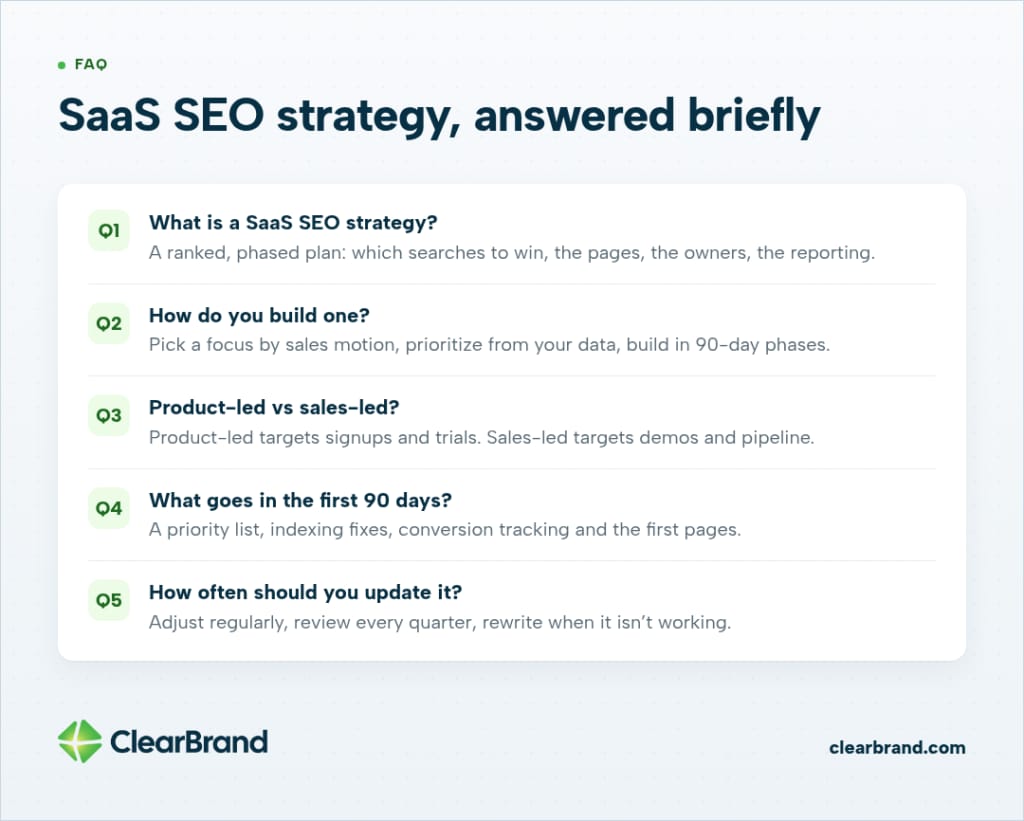
What is a SaaS SEO strategy?
A SaaS SEO strategy is a ranked, phased plan for which searches to win first, which pages to build for them, who owns the work, and how you’ll report results as pipeline. It’s built around your sales motion and stage.
How do you build a SaaS SEO strategy?
You build a SaaS SEO strategy by choosing a focus based on your sales motion, prioritizing opportunities from your metrics and closing data, and building the top items in 90-day phases. Each phase gets a named owner and a pipeline goal.
How is SEO strategy different for product-led and sales-led SaaS?
Product-led SaaS focuses on searches that lead to a signup or free trial, such as use-case and integration queries. Sales-led SaaS focuses on comparison and problem searches that lead to a demo, measured by pipeline.
What should a SaaS SEO roadmap include in the first 90 days?
The first 90 days should include a prioritized list, fixes for anything blocking indexing, conversion tracking for signups or demos, and the first batch of high-intent pages. Expect leading indicators like impressions and clicks first.
How often should you update a SaaS SEO strategy?
Plan to adjust your SaaS SEO strategy regularly from Search Console and AI visibility data, and review it every quarter. Rewrite it when something clearly isn’t working, or when you launch a new product or service.
Build your plan with a clear first step
Start with your motion, prioritize a short list from your own metrics, and give the first 90 days one owner and one goal. That’s enough to begin.
If you’d like a second set of eyes, we’d love to look at your plan with you. Talk with us about the searches worth winning first, or get your free SEO audit to see where your site stands today.