

Physician Marketing: Where to Put Scarce Hours First
Physician marketing works best when a busy doctor puts scarce hours into the practice website and local search first, then content, reviews, and referrals.
Written by Alexander Toth Originally published: November 25, 2026 Last updated: November 25, 2026
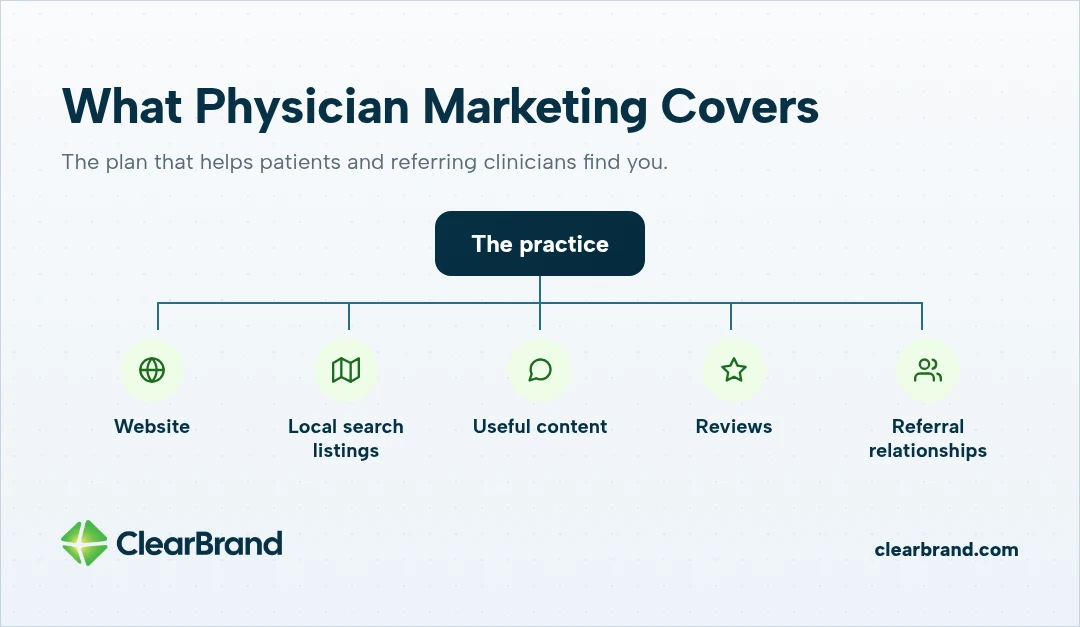
Physician marketing is the work of helping patients and referring clinicians find, trust, and choose a practice. For a doctor with limited time, the highest-yield hours usually go to the website and to local search, then to content drawn from the physician’s own expertise, then to reviews and referrals.
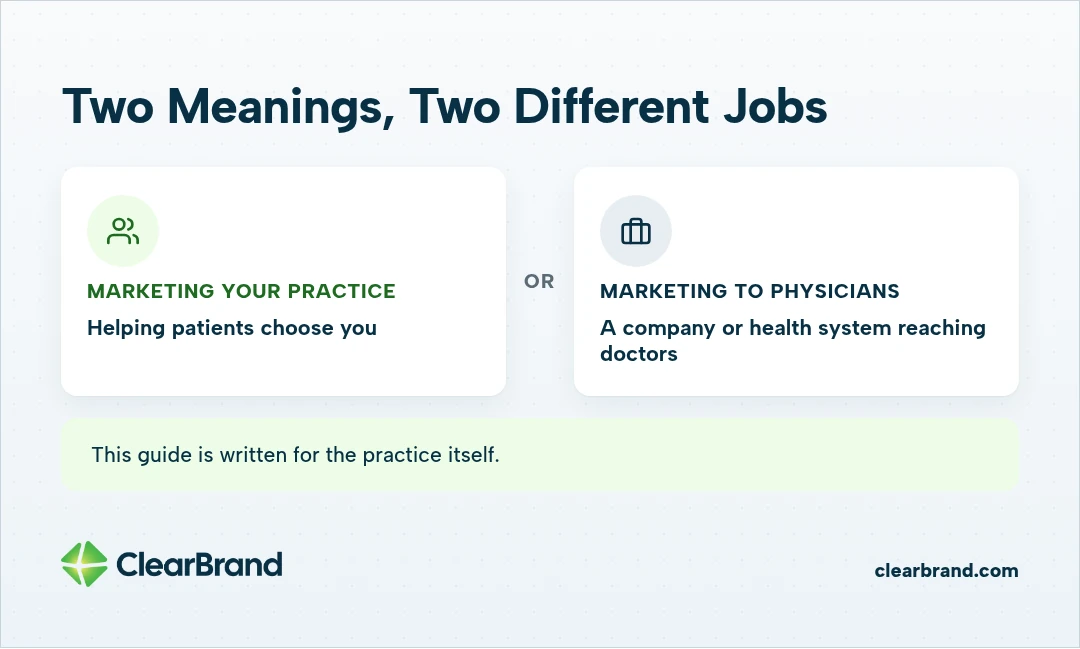
Hospitals, health systems, and life science companies use physician marketing to mean reaching doctors with ads, sponsored content, or platforms such as Doximity. That’s marketing to physicians, and here we’re talking about marketing the practice itself.
You can start without a full marketing department, with a site patients can understand, accurate listings, and a next step that’s easy to take.
Key takeaways
- Physician marketing, in the sense that helps a practice grow, is how patients and referring clinicians find you.
- Put scarce hours into the website and local search first, not into a wide mix of ads and social posts.
- Let the physician’s own knowledge show up on the site, in plain answers to the questions patients already ask.
- Reviews and referral relationships still matter, and they work better once people can find you.
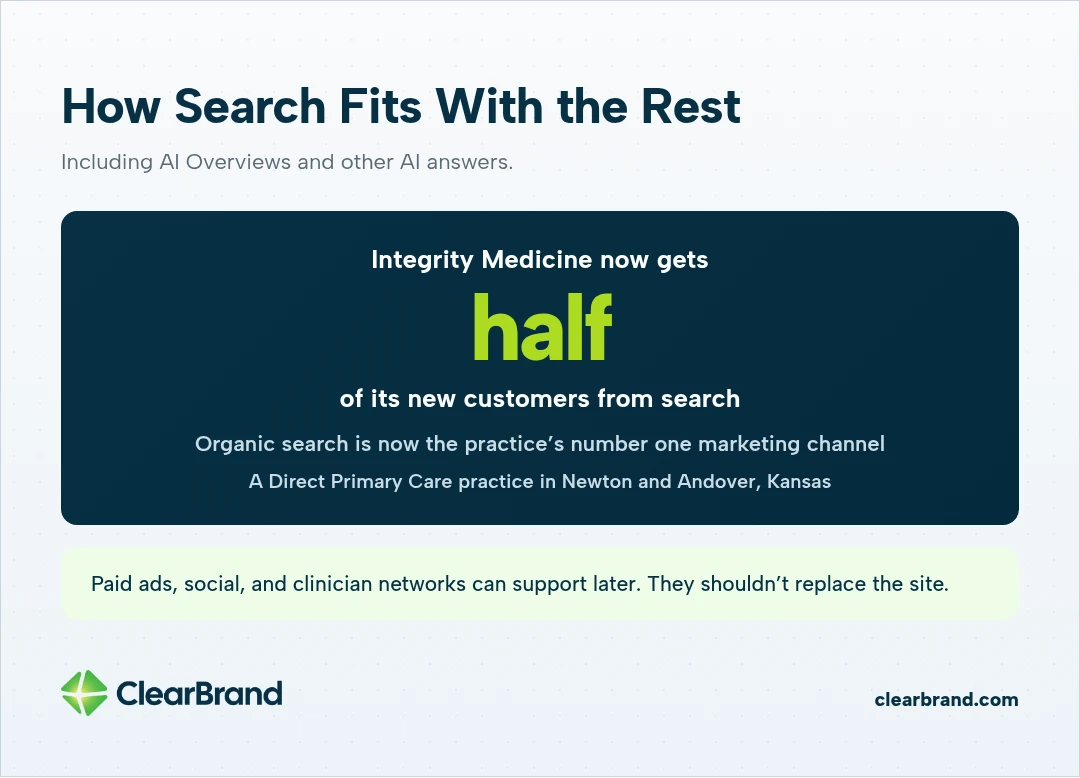
- Integrity Medicine now gets half of its new customers from search, and organic search is its number one marketing channel.
- Paid ads, social, and clinician networks can support the plan later, but they shouldn’t replace the site.
What is physician marketing?
Physician marketing is the plan a practice uses to attract new patients, keep current ones, and stay visible to referring clinicians. It includes the website, local search listings, useful content, reviews, and referral relationships.
In a hospital or industry context, the same words can mean campaigns aimed at doctors as an audience. If you arrived here looking for campaigns aimed at doctors, or for Doximity advertising, that’s a different job. If you arrived here as a physician or practice manager, this guide is written for you.
Marketing your practice, or marketing to physicians
Marketing your practice means helping patients choose you. Marketing to physicians means a company or health system trying to get in front of doctors.
Both meanings show up for this search, which is why the results can feel scattered. A private practice needs a clear digital presence and a way for the right people to book a visit or a first conversation, rather than a pharmaceutical playbook.
Where a physician should put scarce marketing hours
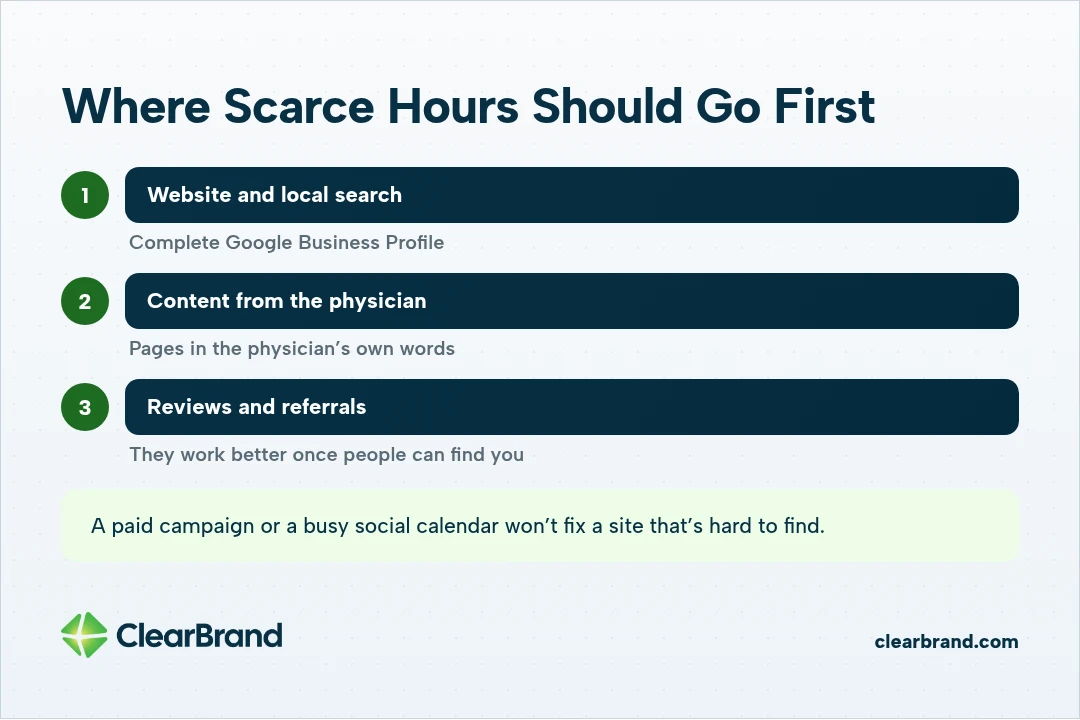
Put the first hours into the practice website and into local search, including a complete Google Business Profile. Then add pages and short articles that answer real patient questions in the physician’s own words. Then spend time on reviews and on referral relationships.
A paid campaign or a busy social calendar won’t fix a site that’s hard to find, out of date, or unclear about what happens next.
Start with the website and local search
Most new patients look the practice up before they call. The site should say who you help, what you offer, where you practice, and what to do next, in language a first-time visitor can follow.
Keep hours, addresses, and provider names consistent on the site and on Google Business Profile. Local search and Maps are often how nearby patients compare options. A complete profile, current photos, and accurate categories are unglamorous work that saves you hours later.
If the practice has more than one service line or location, each important service and office should have a clear page, without a swarm of thin pages that all say the same thing. For the details of service-line structure, see our guide to medical clinic SEO.
Let the physician’s knowledge show up on the site
The content that helps most is the kind only the practice could write: how you think about a common condition, what a first visit looks like, how pricing or insurance works in your model, and what patients should do when they’re unsure.
You don’t have to become a full-time writer to get that on the site. Regular conversations with the physician, captured and turned into pages, can be enough. Patients can often tell the difference between a generic health article and an answer that sounds like the doctor they might actually see.
For a fuller system, including who should review clinical content before it goes live, see our healthcare content marketing guide.
Then reviews and referrals
Reviews and referring clinicians still bring patients. They work harder when the person who hears your name can find a trustworthy site and take a next step.
Make it easy to leave a review, respond to the ones you have, and give referring offices a simple page they can send. If a colleague recommends you, the next thing that person will do is search.
How search and AI answers fit with the rest of the mix
Search, including AI Overviews and other AI answers, is often the first place a patient checks after a referral, a conversation, or a symptom. Paid ads, social posts, and clinician networks can support awareness, but they’re a poor substitute for a site that already ranks and explains the practice clearly.
If you want the fuller practice-marketing system, including conversion pages and measurement with privacy in mind, see our medical practice marketing guide.
Integrity Medicine, a Direct Primary Care practice in Newton and Andover, Kansas, is an example of a search-led approach.
The program was built around the questions patients actually ask, with answers that come from conversations with the physician, and a single easy next step: a free meet-and-greet. Organic search is now the practice’s number one marketing channel, and half of new customers come from search. You can read the Integrity Medicine case study for how that program was built.
Physician marketing FAQ
What is physician marketing for a private practice?
Physician marketing for a private practice is the work of helping patients and referring clinicians find the practice, understand what it offers, and take a first step, usually through the website, local search, content, reviews, and referrals.
Where should a busy physician start with marketing?
Start with the practice website and a complete, accurate Google Business Profile, then add a few pages that answer the questions patients already ask. Ads and social can wait until those basics are solid.
Is physician marketing the same as marketing to physicians?
Physician marketing and marketing to physicians are different jobs. Marketing to physicians is how hospitals, health systems, and industry teams reach doctors. Marketing a physician’s practice is how that practice reaches patients and referral sources.
Can search really bring new patients to a practice?
Search can become a leading source of new patients when the site answers real questions and the listings are accurate. Integrity Medicine now gets half of its new customers from search, and organic search is its number one marketing channel.
Do reviews and referrals still matter if we invest in SEO?
Reviews and referrals remain a major way patients choose a doctor. They work better when the person who hears your name can find a clear site and book a next step.
Should we hire a healthcare SEO partner?
If the practice is ready to improve the site, publish useful pages, and keep the facts accurate, a specialist partner can do that work with you. If you only need a logo or a social calendar, you may not need that kind of help yet. You can see how we work with clinics on our healthcare SEO page.
A calm next step
If you want help turning the practice website into a reliable source of new patients, we’d like to look at the site with you. Your free SEO audit includes an initial 90-day plan, and you keep it whether you work with us or not. We reply within two business days.