

Medical Practice SEO: Who Owns Search Inside the Practice
Medical practice SEO is the search work a clinic owns: Google Business Profile, service pages, clinician-reviewed content, and measurement on your site.
Originally published: November 18, 2026 Last updated: November 18, 2026
Medical practice SEO is the search work that helps a clinic show up when a nearby patient looks for a doctor, a service, or a symptom, then makes it easy to take the next step. It covers the Google Business Profile, the service and location pages on the website, clinician-reviewed content, technical access, and measurement that stays on your site.
It isn’t the whole of medical practice marketing. Ads, social, email, and the website itself still matter. SEO is the part of that work that owns search, including Google and AI answers.
Key Takeaways
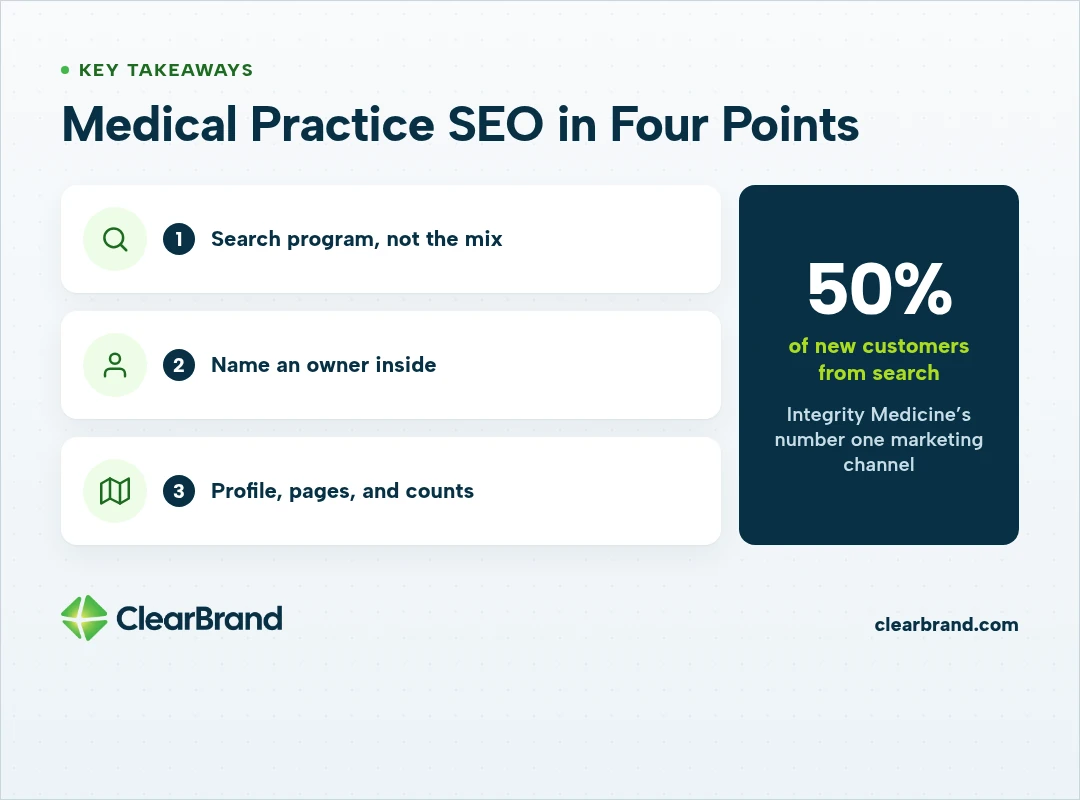
- Medical practice SEO is the search program a clinic owns, not the entire marketing mix.
- Someone inside the practice has to own the Google Business Profile, review replies, and clinician interviews. A partner can run the research, writing, technical work, and reporting.
- Start with the profile, the pages that convert, and a way to count calls, bookings, or meet-and-greets without handling patient records.
- Integrity Medicine, a direct primary care practice in Newton and Andover, Kansas, now gets 50% of its new customers from search, and organic search is its number one marketing channel.
- We focus on helping 7- and 8-figure companies. A free SEO audit is the first step.
How medical practice SEO differs from the rest of your marketing
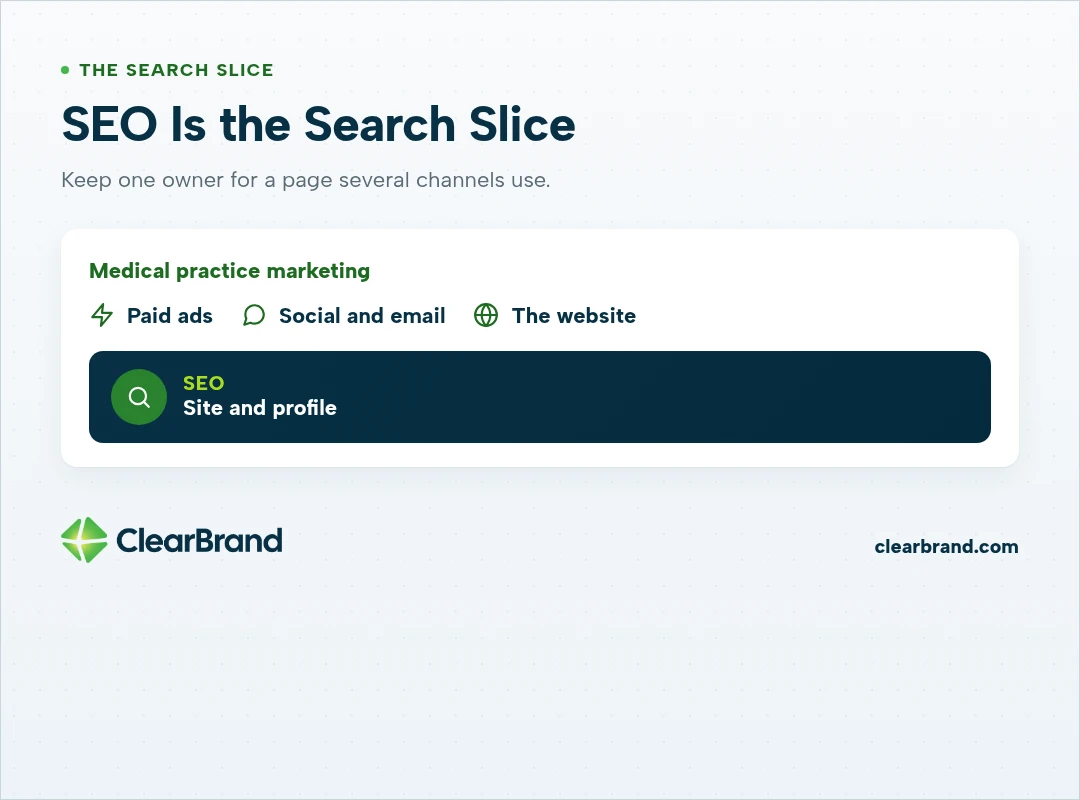
Medical practice marketing is how you get found and chosen. SEO is the search slice of that work.
Paid ads can fill the calendar this week, and social and email help you stay in touch. The website is the place those channels send people. SEO is what makes the site and the Google Business Profile show up when someone is already looking for care.
The same landing pages often serve more than one channel. A service page that ranks can also be the page behind an ad. That is a reason to keep one owner for the page, even when several channels use it.
For the deeper local, trust, and AI mechanics, see healthcare SEO for clinics.
Who owns medical practice SEO inside the practice
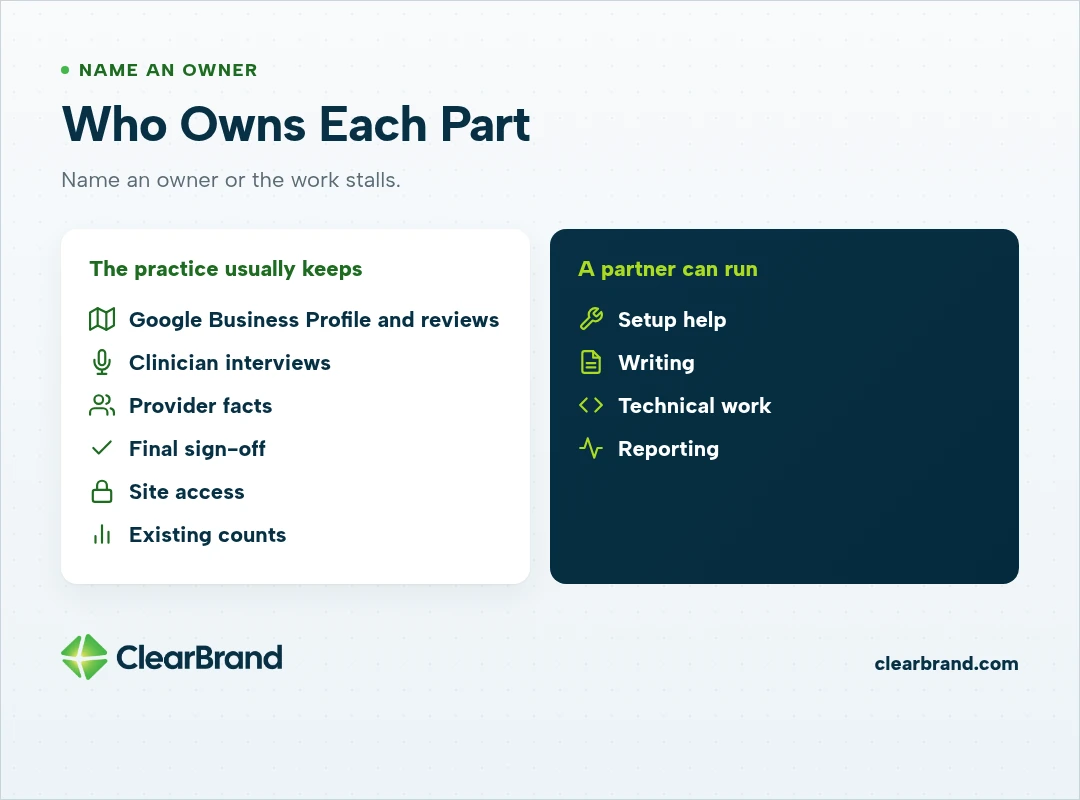
SEO stalls in a practice when everyone shares it and no one has time set aside for it. The work splits cleanly if you name an owner for the parts only the practice can do, and an owner for the parts a specialist can run every week.
| Work | The practice usually keeps | A partner can run |
|---|---|---|
| Google Business Profile hours, photos, categories, and review replies | Practice manager or front desk, in an account the practice controls | Setup help and a monthly checklist |
| Clinician interviews and medical review of clinical pages | Doctors and clinical leadership | Scheduling the interviews and writing from them |
| Provider bios, credentials, and photos | The practice, because the facts have to stay accurate | Drafting and on-page setup |
| Service, location, and condition pages | Final sign-off | Keyword research, writing, internal links, and technical setup |
| Technical SEO, schema, and indexation | Access to the site and hosting | The work itself |
| Reporting on calls, bookings, or meet-and-greets | The practice already has these counts | Tying those counts to landing pages, without collecting patient records |
If one person in the office can’t protect a monthly block of time for the profile, the interviews, and sign-off, the work will stall even with a good partner.
What to do first for medical practice SEO
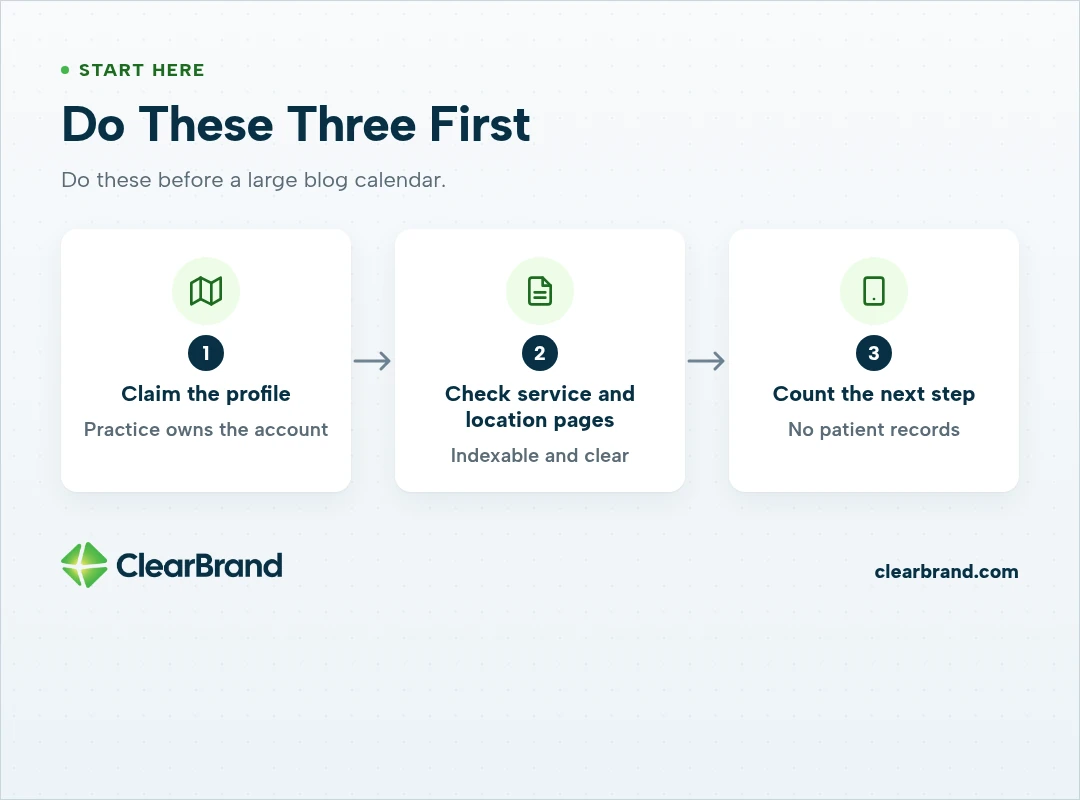
Start by claiming and completing the Google Business Profile in an account the practice owns. Make sure the service and location pages a patient would use to book are indexable and clear. Then confirm you can count the next step on your own website: a click to call, a booking request, or a meet-and-greet form, without sending patient records to a marketing tool.
A complete profile includes the correct category, hours, services, phone number, and photos of the office and team. If a former vendor still holds the login, get that access back before you change anything else. The listing should match the name, address, and phone number on your site.
On the website, open the main service and office pages in an incognito window and on a phone. Confirm the page loads, the next step is obvious, and the content is in the text, not only in an image. Then look in Google Search Console to see whether those URLs are indexed.
Do those before you plan a large blog calendar. A new article won’t repair a missing service page or a profile that still has last year’s hours.
Local search and the Google Business Profile
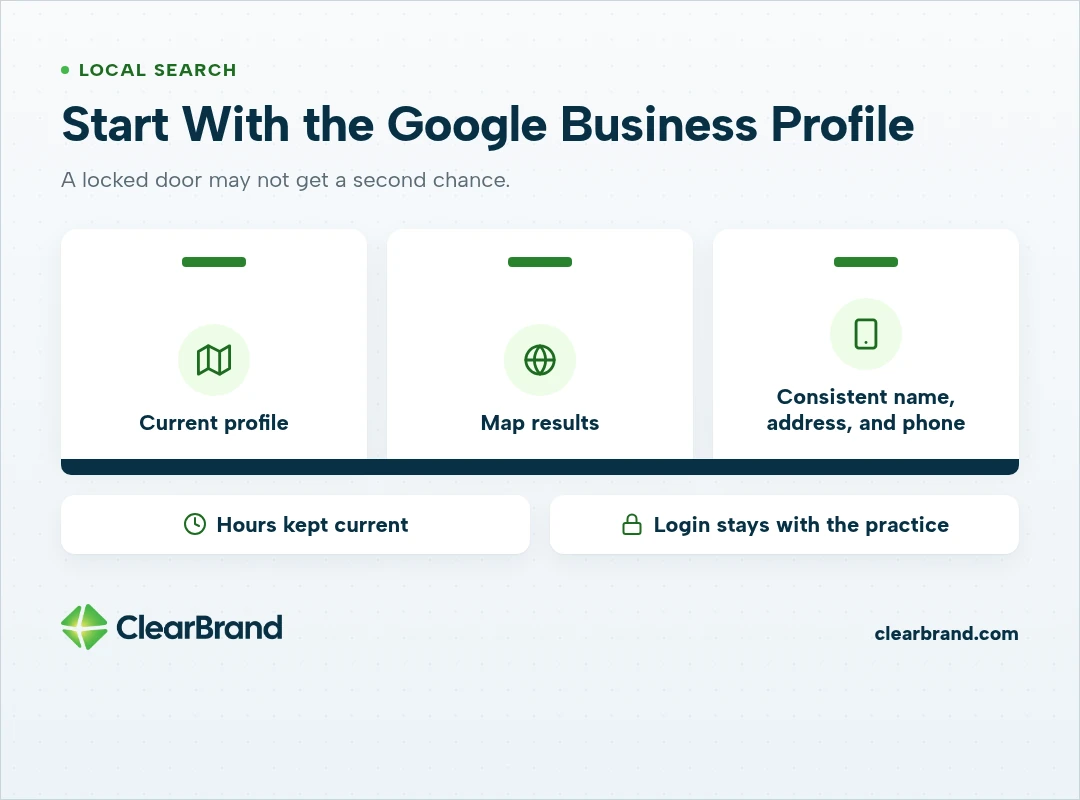
Many new patients live nearby. The profile, the map results, and consistent name, address, and phone information across the site and major directories are the local foundation.
Keep hours, services, categories, and photos current. If you close early on a Wednesday, the profile should say so. A patient who drives to a locked door may not give you a second chance.
Reply to reviews from the practice, kindly, and without discussing a patient’s case. Thank the person, invite a conversation offline if something went wrong, and leave clinical details out of the reply. The login should stay with the practice, even when a partner helps with the setup.
Directory listings on major healthcare and local sites should match the same name, address, and phone number on your site. A short, accurate set of those listings is enough. Deeper local and multi-office questions belong in healthcare SEO and SEO for multi-location clinics.
The pages medical practice SEO should cover
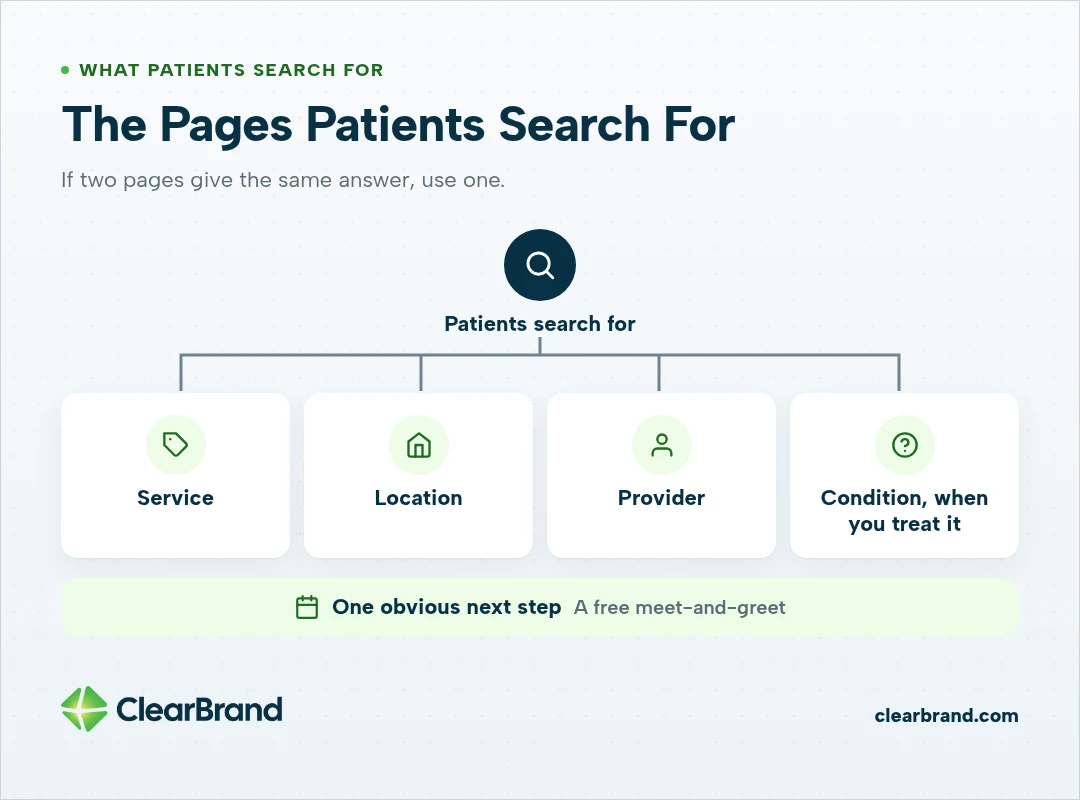
Patients search for a service, a location, a doctor, or a symptom. The site needs a clear page for the services you want to be found for, a page for each office, and provider pages with real credentials and photos. Symptom or condition pages help when your clinicians actually treat that problem and the page can say so honestly.
A useful service page tells a patient what the service is, who it is for, what happens at the first visit, and how to start. A location page should speak to the people that office actually serves, including nearby communities you welcome, without spinning out a thin page for every town name.
A provider page should look like the doctor a patient will meet, with a photo, training, and the services that person offers.
If two pages would give a patient the same answer, they should be one page. The details of when a service earns its own URL, and how to avoid doorway pages, are in medical clinic SEO.
Every one of those pages needs one obvious next step, such as a free meet-and-greet, a booking request, or a click to call. Integrity Medicine made that first step a free meet-and-greet, so every page could point to the same, low-pressure conversation.
Content that comes from the clinicians
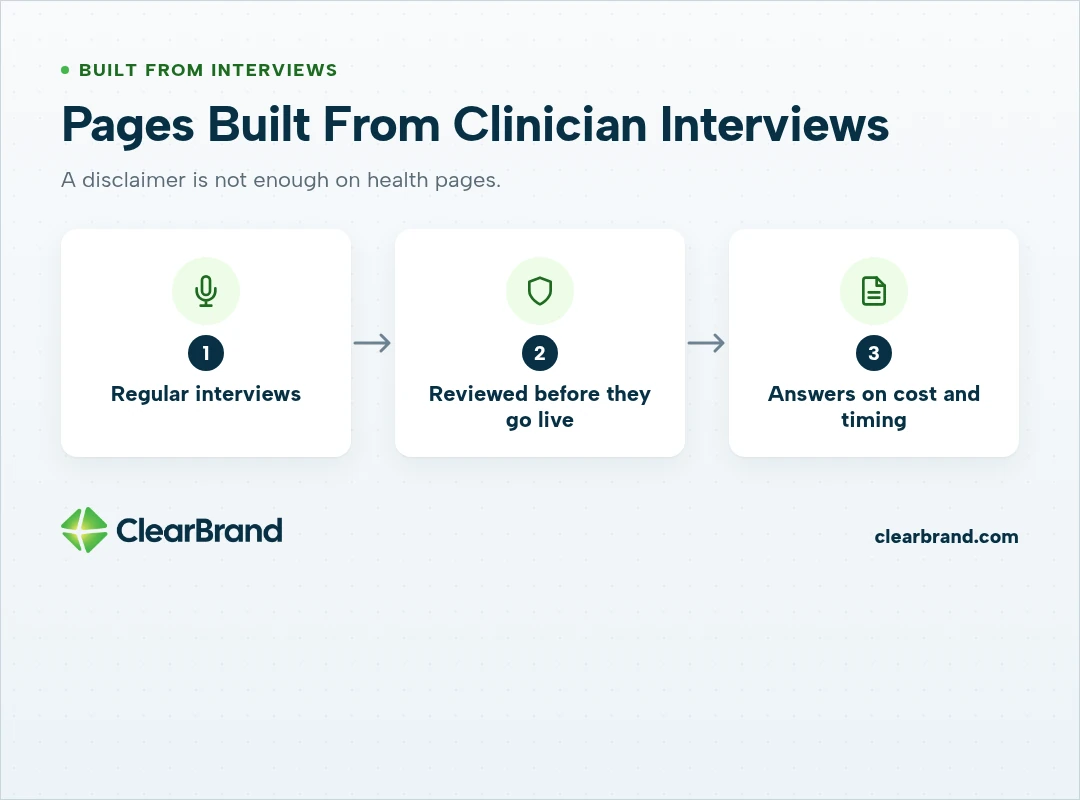
The content on this program should come from regular interviews with the doctors and clinical team, then be reviewed before it goes live. That is how you get specific answers about cost, timing, and what a first visit looks like, and how you meet the trust standard patients and search engines expect on health pages.
Health pages sit in a category Google treats with extra care, often called Your Money or Your Life. A disclaimer at the bottom of every page won’t carry that standard on its own. Accurate writing, a clinician who will stand behind it, and bios that make it clear who provided the care and the review will.
That is the content we write at ClearBrand: high-quality pages built from those conversations, on top of sound technical SEO, and supported by authority from brand mentions and backlinks. At Integrity Medicine, those conversations are regular check-ins with founder Robert Roeser, and his answers on prices, insurance timing, and same-day access go into the pages patients read before they book.
You can write useful pages without using a patient’s name or record. If you want to share a story or a review that includes personal health details, you need the patient’s written permission.
A blog calendar is useful after the service and location pages are in place. Seasonal or educational posts can support those URLs, which we cover in more detail in healthcare content marketing. A post that never sends a reader to a page where they can book is usually still missing a step.
Technical access, trust, and AI search
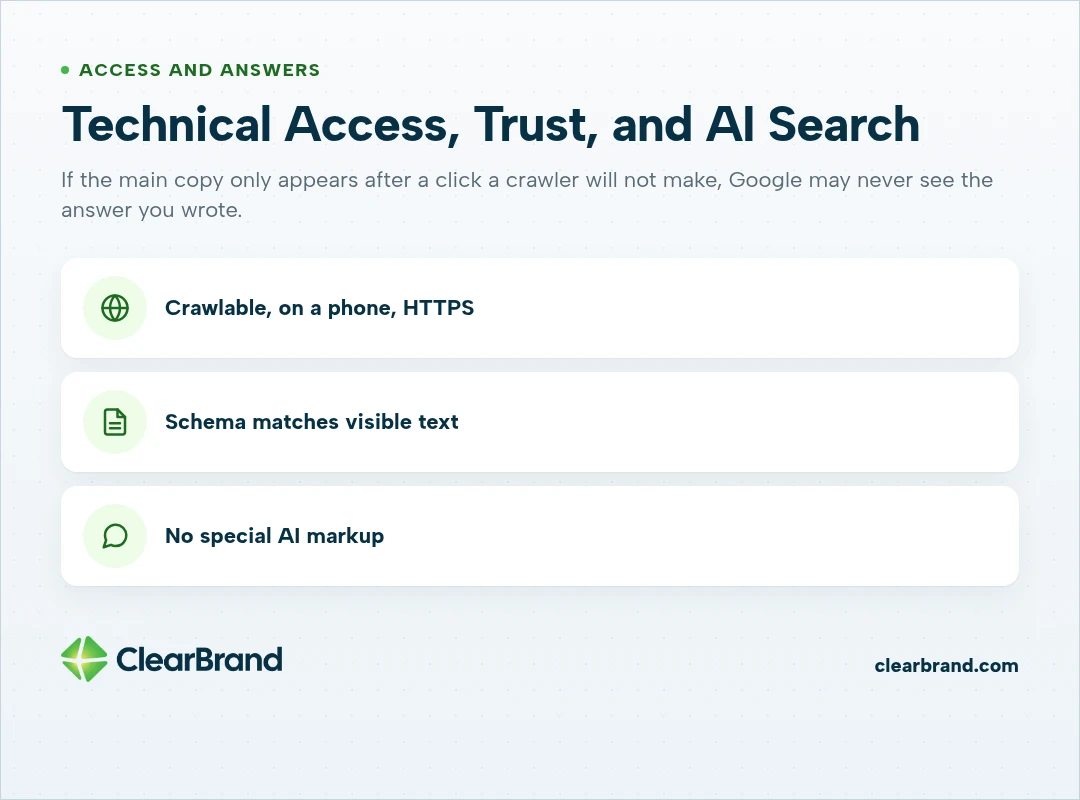
Those pages have to be crawlable, usable on a phone, and served over HTTPS. If a service page requires a login, or the main copy only appears after a click a crawler won’t make, Google may never see the answer you wrote.
Schema should match the visible text, including medical clinic or physician information when you actually show it. Don’t mark up a FAQ, a review, or a credential that is not on the page. Trust also lives in accurate provider bios, consistent facts, and reviews the practice can stand behind.
Patients also ask ChatGPT, Perplexity, Gemini, and Google AI Overviews who to see. The same clear, reviewed pages are the ones those tools can cite. Put a direct answer in the first sentence under a heading, and keep the clinical facts in text a crawler can read.
You don’t need special markup for Google’s AI features. We cover that work in more depth in healthcare SEO.
How to measure medical practice SEO
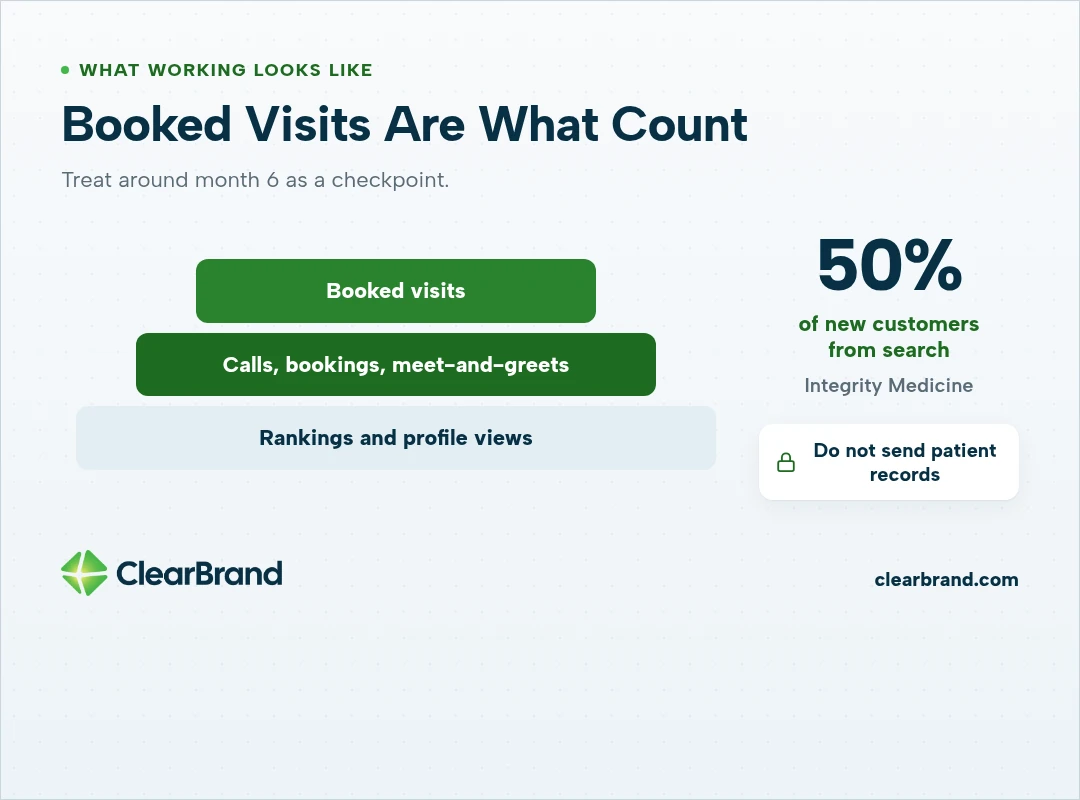
Measure the actions on your website and in the practice’s own calendar: calls, booking requests, meet-and-greets, and new patients the practice already counts. Don’t send patient records to a marketing dashboard. Rankings and profile views are early signals, and booked visits are what count.
Set that reporting up before you publish a batch of new pages, so a booking request still carries the landing page with it. Six months of traffic with no way to see which URLs led to a meet-and-greet is hard to defend in a partner meeting, and it is harder to fix later.
Integrity Medicine, a direct primary care practice with offices in Newton and Andover, Kansas, now gets 50% of its new customers from search. Organic search is its number one marketing channel.
We measure free meet-and-greets and the new patients added to each doctor’s panel, the same numbers the practice uses to run the business. The pages are written from regular check-ins with founder Robert Roeser. Read the Integrity Medicine story.
Treat around month 6 as a checkpoint for a repeating flow of inquiries, knowing every practice moves at its own pace. First movement on the right local and service terms can come sooner.
When to run this work with a partner
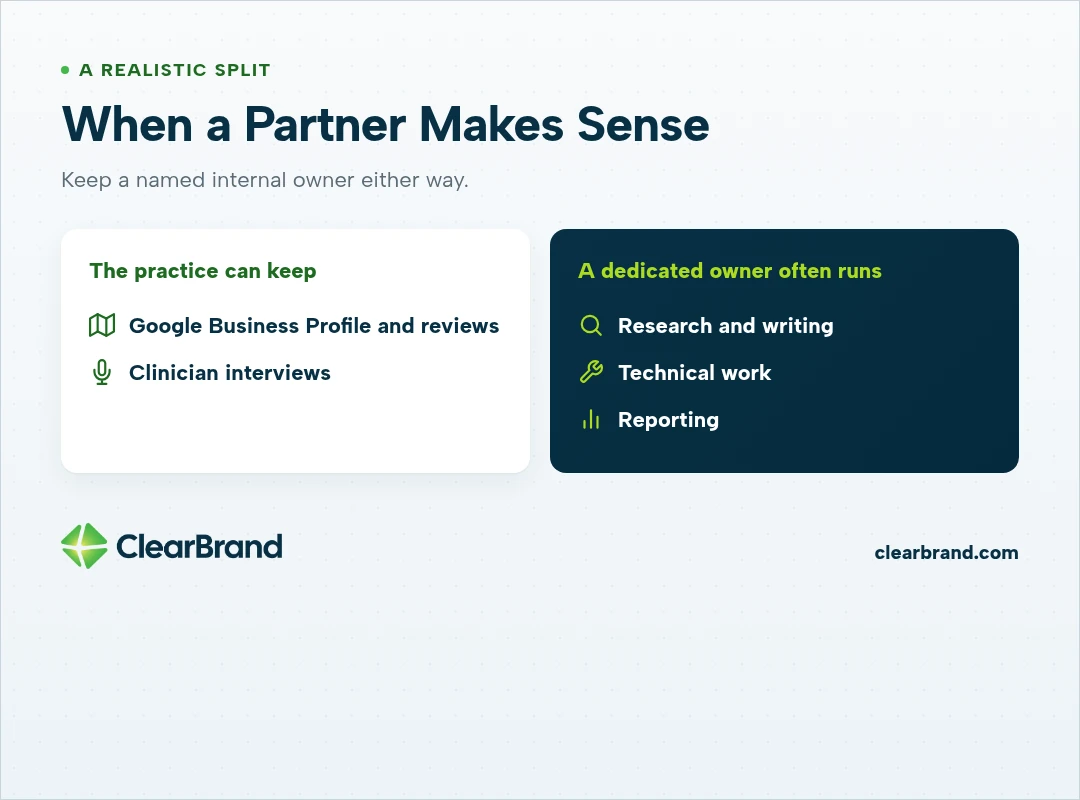
An office manager can keep the Google Business Profile and review replies current, and a clinician can sit for interviews, without a full in-house SEO team. The research, writing, technical work, and reporting often need a dedicated owner.
That split is usually more realistic than hiring a full-time SEO in a small practice, or handing the Google login to a vendor and hoping the pages stay accurate. The practice still needs a named internal owner, even when a partner does the weekly work.
We focus on helping 7- and 8-figure companies. If you want a team that already does this in healthcare, see our healthcare SEO services, or start with a free SEO audit. For a broader buying process, see how to choose an SEO agency.
Medical practice SEO FAQ
What is medical practice SEO?
Medical practice SEO is the search work that helps a clinic show up when a nearby patient looks for a doctor, a service, or a symptom, then makes it easy to book or request a visit. It includes the Google Business Profile, service and location pages, clinician-reviewed content, technical access, and measurement that stays on your site.
How is medical practice SEO different from medical practice marketing?
Medical practice marketing is the full effort to get found and chosen, including ads, social, email, and the website. Medical practice SEO is the search part of that work: showing up in Google, maps, and AI answers, then sending those visits to a page where a patient can take the next step.
Is SEO worth it for doctors?
SEO is worth it when the practice can show up for the searches its patients already run and turn those visits into booked conversations. Integrity Medicine now gets 50% of its new customers from search, and organic search is its number one marketing channel.
Is SEO still working for medical practices in 2026?
SEO is still working for medical practices in 2026. Patients still search, and AI Overviews change how some of those answers appear, but they still rest on the same local profile, service pages, and clinician-reviewed content. A drop in clicks on some queries doesn’t make the channel less useful if bookings hold.
How much does medical SEO cost?
The right scope depends on how many locations and service lines need pages, and on whether the site and Google Business Profile are already in good shape. A useful conversation starts with those facts, not a generic package. If you would like a look at your site, start with a free SEO audit.
How do you measure medical practice SEO without patient records?
Measure the actions on your website and the counts the practice already keeps: clicks to call, booking requests, meet-and-greets, and new patients added to a panel. Keep patient records inside the practice. Rankings and profile views can show early movement, but booked visits are the number that matters.
How do you choose a medical practice SEO partner?
Choose a partner that can show healthcare or similar local-practice results, writes from the clinicians’ knowledge, and measures booked visits rather than traffic alone. We focus on helping 7- and 8-figure companies. Our healthcare SEO services page shows how we run that work.
Get a clear owner for search in your practice
If search is going to bring in patients, someone inside the practice has to own the profile, the interviews, and the numbers you already trust. We can run the rest of the work with you.
Get your free SEO audit. Your free SEO audit is a full review of your site and an initial 90-day strategy. You keep it whether you work with us or not.