
If you’re searching for questions to ask an SEO agency before hiring one, this guide shares the checklist we recommend at ClearBrand.
Hiring the wrong partner ranks among the higher-risk marketing decisions a business owner faces. The work stays invisible for months. The wrong fit can erase 6 to 12 months of runway before you even notice.
I founded ClearBrand in 2017. I have led the company for over eight years. I speak with prospects every week who are vetting agencies.
I have watched dozens of clients arrive from broken agency relationships. The problems are almost always the same.
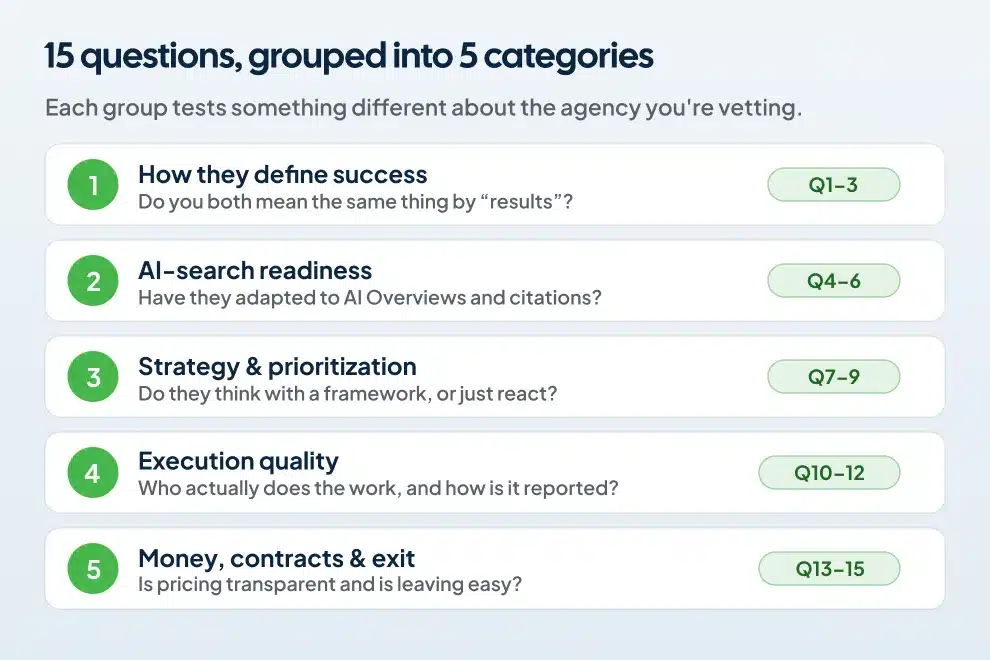
The 15 questions below are grouped by what each one reveals about the agency. Some questions will matter more for your situation than others. Bring the relevant ones to your next sales call. Skip the rest.
We use this same checklist to help guide prospects in making a good decision for their company.
Quick Checklist
Use this list in your next agency conversation. Copy it into your notes or print it out.
- How do you define a successful engagement?
- What problem do you think SEO solves for our business?
- How does SEO connect to revenue in our specific case?
- How do AI search engines understand our brand today?
- What is your approach to AI Overview citations specifically?
- How are you tracking AI visibility for clients today?
- How do you decide what to work on first?
- What would you intentionally not recommend we do?
- How does your work change based on industry?
- What platform do you build on, and how does that affect SEO?
- Who specifically will do the work?
- What does your reporting show?
- What does pricing look like, and what shapes the range?
- What is the contract structure, and what happens if we want to leave?
- What guarantees, if any, do you make?
Questions That Reveal How They Define Success
The biggest agency mistakes happen here. Business owners and agencies use the same words yet mean different things. “Results” can mean rankings for one party and revenue for the other.
1. How do you define a successful engagement?
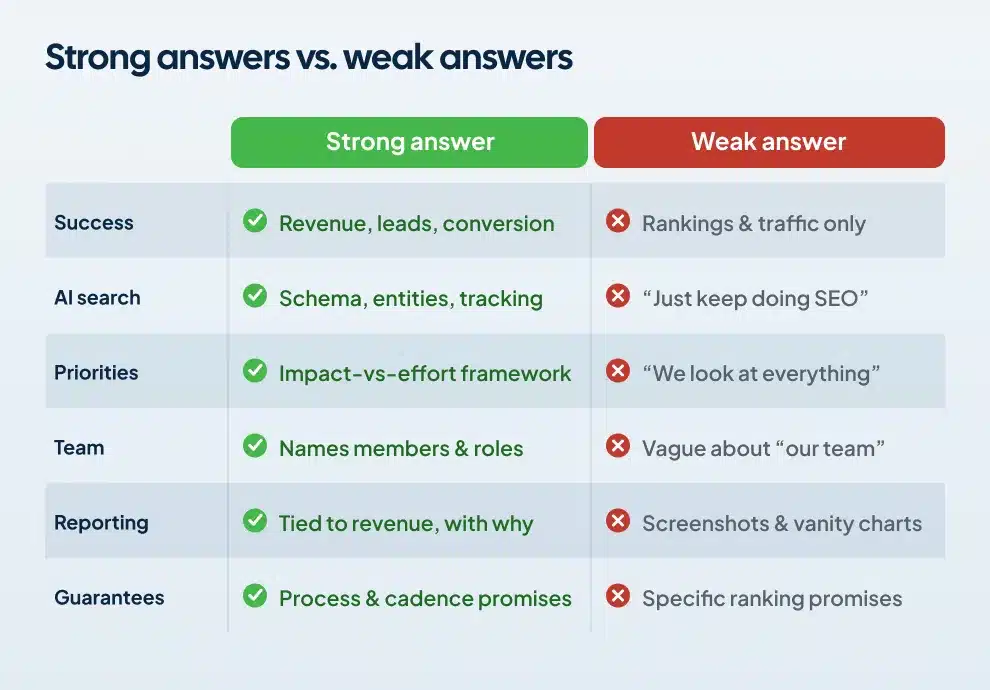
A strong answer names revenue influenced, qualified leads generated, conversion efficiency improved, or brand visibility in competitive queries. A weak answer stops at rankings and traffic alone.
Rankings without conversion represent the most common cause of agency churn we have seen at ClearBrand. Pew Research Center data from July 2025 showed click-through rate dropping from 15 percent to 8 percent when an AI Overview appears on a query. Rankings without click value have become more common in 2026.
2. What problem do you think SEO solves for our business?
This question functions as a diagnostic test. Strong agencies slow down and ask clarifying questions. Weak agencies skip straight to “we will write content and build links.”
We have seen this pattern dozens of times at ClearBrand. The agencies that diagnose first produce work that helps the business grow. Those that pitch tactics before understanding the business often fall short on lasting results. See examples of how the diagnosis shaped the work.
3. How does SEO connect to revenue in our specific case?
A serviceable answer ties SEO to demand capture, brand search growth, conversion improvement, or sales cycle compression. Watch for any description of SEO as a standalone channel that exists apart from the rest of the business.
Success definitions matter. The next questions test whether an agency has kept up with how search itself has changed.
Questions That Test AI-Search Readiness
This section separates agencies that have adapted from those still operating on older playbooks. Most competitors cover AI search in a single paragraph. The work has changed.
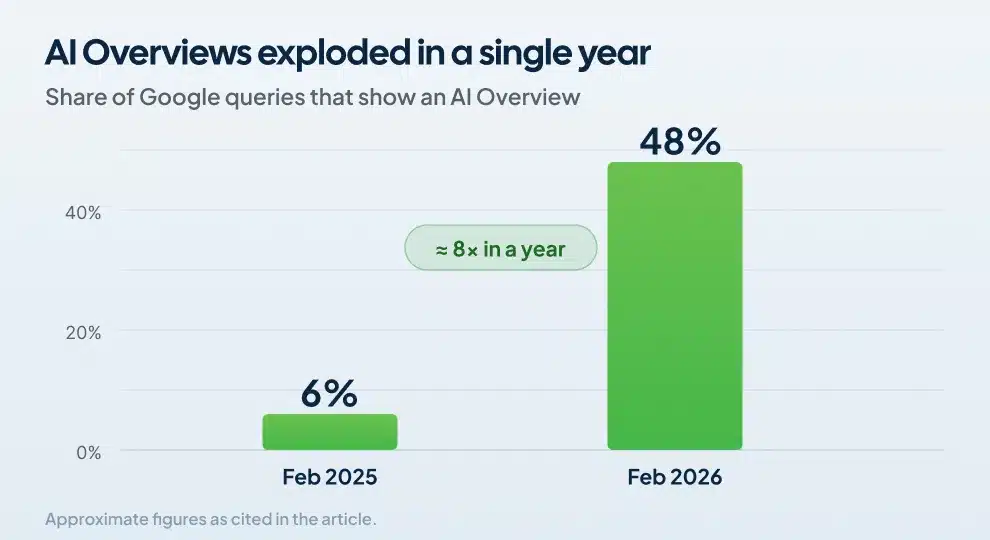
Google’s AI Overviews appeared on roughly 48 percent of queries by February 2026, up from about 6 percent one year earlier. That shift changes what counts as competent SEO work.
4. How do AI search engines understand our brand today?
Strong answers reference entity understanding, topical authority, knowledge graph presence, and how content reinforces brand meaning. Weak answers focus only on keywords.
5. What is your approach to AI Overview citations specifically?
Strong answers mention schema markup implementation, comprehensive answers in self-contained sections, listicle and comparison content formats, and entity density. Schema markup correlates with a 30 percent improvement in AI citation rates according to Exposure Ninja analysis of February 2026 research. AirOps research from April 2026 found comparison pages with three or more tables earn 25.7 percent more ChatGPT citations than pages without.
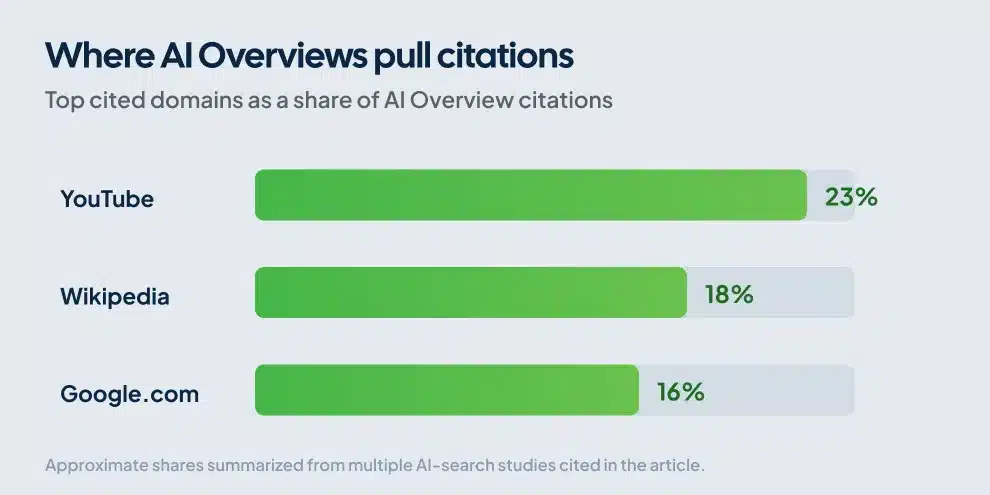
YouTube accounts for roughly 23 percent of AI Overview citations, Wikipedia about 18 percent, and Google.com about 16 percent based on multiple AI search studies summarized in early 2026 reports.
Watch for agencies that treat AI search as “just keep doing SEO.”
6. How are you tracking AI visibility for clients today?
Listen for specific tool names such as Rankability, Brand Radar, Profound, Otterly, AthenaHQ, or Peec AI. Listen for specific metrics such as visibility percentage, citation rate, share of voice, or prompt coverage. Vague answers like “we are keeping an eye on it” with no specifics signal a gap.
We use Rankability internally at ClearBrand to monitor how AI systems surface client brands. The agencies that track this today will be the ones still relevant in 2027.
Questions That Test Strategy and Prioritization
Any honest agency will say “it depends.” The real agencies follow that phrase with a framework. This section reveals whether an agency thinks or simply reacts.
7. How do you decide what to work on first?
Strong answers name an explicit framework for impact versus effort, risk versus reward, and technical-before-content dependencies. Weak answers say “we look at the whole picture.”
Greenlane Marketing’s February 2026 article by Bill Sebald makes this point clearly. We agree with the framework. We have seen it help agencies focus effort where it matters most.
8. What would you intentionally not recommend we do?
This question discriminates. Agencies that try to sell everything they offer struggle here. A strong answer contains a clear list of work the agency considers low-leverage for your specific business.
9. How does your work change based on industry?
Strong answers show the agency knows which SERP features dominate your vertical, which ranking factors weigh heavier, and what the local competitive landscape looks like.
For example, we’ve seen clear differences between SaaS SEO, construction SEO, and law firm SEO. If you operate in one of those spaces, the right agency will speak to those specifics rather than offer generic advice.
Questions That Reveal Execution Quality
This section moves from philosophy to concrete delivery. Buyers want answers they can verify.
10. What platform do you build on, and how does that affect SEO?
Agencies that say they work with any platform without qualification may fall short on technical SEO. Platform choice constrains what is possible.
For example, we build every site on Webflow. That choice is deliberate. Webflow gives us page-speed control, structured-data precision, CMS controls, and clean code that AI crawlers handle well.
If you’re evaluating Webflow agencies specifically, our approach to Webflow SEO explains why we chose this platform exclusively.
11. Who specifically will do the work?
This is the bait-and-switch question. Senior teams pitch. Junior teams deliver. That pattern is the most common complaint we hear from clients who leave other agencies.
Strong answers name team members, clarify account manager versus strategist roles, and describe escalation paths. Weak answers stay vague about “our team.”
12. What does your reporting show?
Strong reporting ties metrics to revenue, includes leading indicators, tracks business KPIs alongside SEO metrics, and explains why numbers moved. Weak reporting shows ranking screenshots, vanity traffic charts, and GA4 exports with no commentary.
Questions About Money, Contracts, and Exit
This section earns trust through transparency. Most competitor articles tiptoe around pricing. Honest agencies name ranges and variables.
13. What does pricing look like, and what shapes the range?
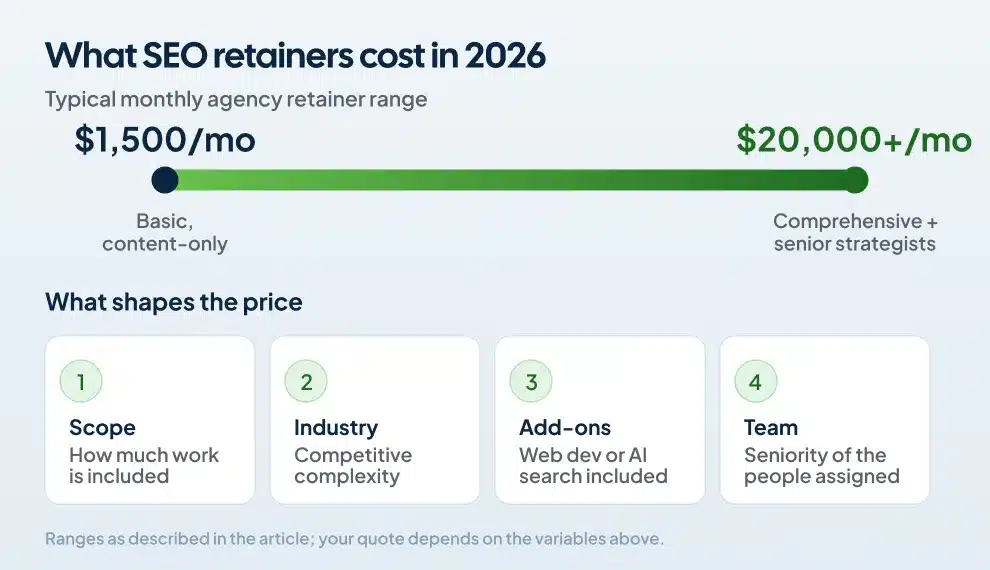
SEO agency retainers in 2026 typically range from $1,500 per month on the low end for basic content-only work up to $20,000 per month or more for comprehensive strategy with senior strategists. The variables that drive price include scope, industry complexity, whether the engagement includes web development or AI search optimization, and the seniority of the team assigned.
Watch for opaque “custom pricing” with no anchoring or context.
14. What is the contract structure, and what happens if we want to leave?
Strong structures offer month-to-month terms after an initial period, clear data and asset handoff, no penalty clauses, and transition help. Weak structures lock clients into long terms with penalty fees and vague handoff language.
We deliver everything in a clean handoff package so clients can leave without friction if the fit stops working.
15. What guarantees, if any, do you make?
Ranking guarantees represent the single hardest red flag in the industry. No honest agency can guarantee specific rankings. Google’s own SEO starter guide states that any agency promising specific rankings is making a claim they cannot keep.
Strong answers offer process guarantees such as deliverable counts, response times, and reporting cadence. They never offer specific outcome guarantees, like rankings, revenue, or leads.
Red Flags to Watch For During the Sales Process
These signals appear early. In the dozens of client transitions we have managed at ClearBrand, most agencies that are not the right fit show it early.
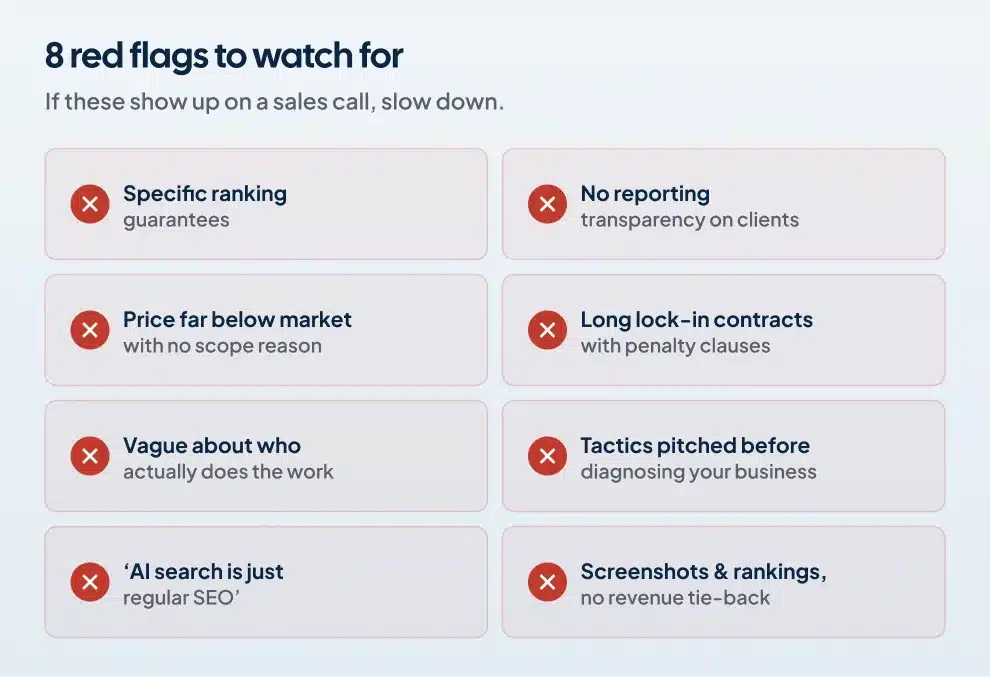
- Specific ranking guarantees
- Pricing dramatically below market with no clear scope reason
- Vague answers about who does the work
- AI search dismissed as “the same as regular SEO”
- No reporting transparency on past clients beyond a single representative engagement
- Long lock-in contracts with penalty clauses
- Selling tactics before diagnosing your business
- Reliance on screenshots and rankings without revenue tie-back
What Happens After You Ask These Questions
Score answers as you go. Strong, mixed, or weak. The overall pattern matters more than any single answer.
Take the top two or three agencies into a paid pilot or short discovery engagement if possible. A 2-3 month pilot before a six-figure retainer is one of the cheapest forms of insurance available. Both Greenlane and DesignRush reference paid pilots as a vetting tool. We see value in that approach too.
Trust your gut on communication. If an agency is slow or vague before they have your money, they will be slow and vague after.
FAQ
How much does it cost to hire an SEO agency in 2026?
SEO agency retainers in 2026 typically range from $1,500 per month on the low end for basic content-only work up to $20,000 or more for comprehensive strategy with senior strategists. Price depends on scope, industry complexity, and whether the engagement includes web development or AI search optimization. Agencies that quote a single number without explaining variables usually lack transparency.
How long should it take to see results from an SEO agency?
Expect 4 to 6 months before meaningful ranking movement on competitive terms. Leading indicators such as improved crawl efficiency, higher-quality backlinks, and early traffic from long-tail queries often appear in the first 60 to 90 days. Agencies that promise faster results on competitive terms usually cut corners or rely on short-term tactics that do not last.
Should I hire an SEO agency or build an in-house team?
Hire an agency when your revenue sits between $3 million and $50 million and you lack internal SEO expertise or capacity. Build in-house once you exceed roughly $25 million in revenue and can justify a full-time strategist plus content team. Hiring is not only about the person who’s doing the work, it’s also having a manager who can oversee the work and make sure they’re doing it well. Most companies in the $3 million to $25 million range (or higher, depending on your appetite for managing your marketing team) get better results and lower risk by partnering with a specialized agency rather than making their first SEO hire.
What is the difference between an SEO agency and an SEO consultant?
An agency brings a team with defined roles, processes, and capacity for ongoing work. A consultant usually works solo and excels at strategy or audits but often lacks bandwidth for consistent execution month after month. Choose the model that matches the scope and duration of your need.
How do I know if my current SEO agency is doing good work?
Look at three things in their reporting. First, do the metrics tie to revenue or qualified leads rather than just rankings and traffic? Second, does the narrative explain why numbers moved or simply show screenshots? Third, are leading indicators such as technical improvements and content quality trends moving in the right direction even when rankings lag? Agencies that cannot answer these questions clearly are not delivering.
What red flags should I watch for in an SEO agency proposal?
The same signals that appear in sales calls show up in proposals. Watch for ranking guarantees, vague team descriptions, no pricing transparency, long lock-in terms, and heavy emphasis on tactics before any diagnosis of your business. A strong proposal diagnoses first and recommends second.
Conclusion
The right SEO agency answers these questions clearly, owns its tradeoffs, ties work to revenue, and adapts as search changes. Most agencies that are not the right fit show it early.
If you are vetting agencies for a Webflow site, or if you want to talk through your situation with someone who has been on the other side of these calls for eight years, the right-fit conversation is here.
Alexander Toth founded ClearBrand in 2017 and has led the company for over eight years. ClearBrand builds websites on Webflow and delivers SEO and AI search work for SaaS, service, and B2B companies generating $3 million to $50 million in annual revenue. His YouTube content and ClearBrand Marketing Podcast have been viewed hundreds of thousands of times.