

If you’ve asked ChatGPT, Perplexity, or Google AI Mode for the best project management tool lately, you know exactly what happens.
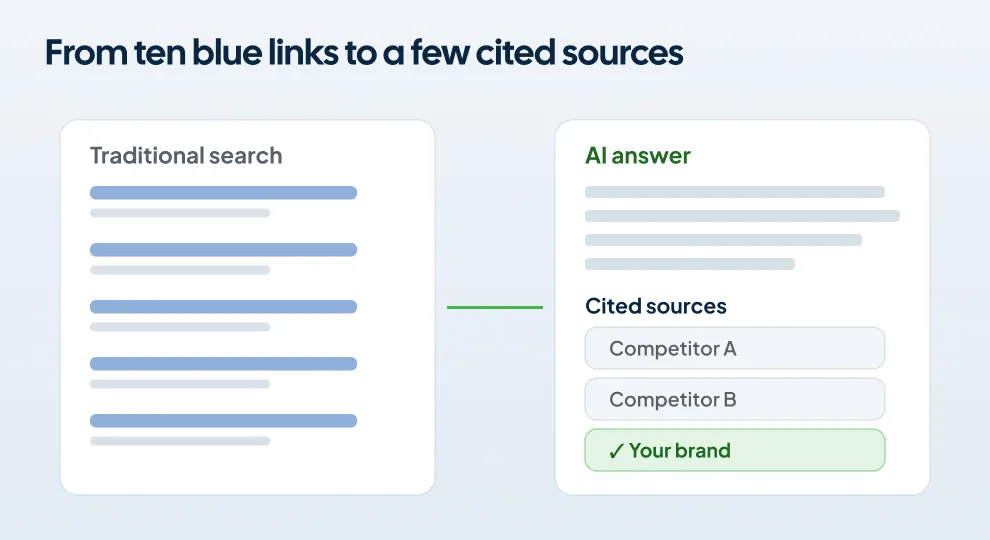
You get a short, confident answer that names two or three brands — and nothing else. No ten blue links. No chance to browse. If your brand isn’t in that answer, the buyer never sees you.
That is the new reality every marketer faces in 2026.ChatGPT alone reached 700 million weekly users by August 2025, with continued growth since. Google’s AI Overviews now appear in roughly 48% of searches and climbing.
People are getting answers without clicking, and those answers cite just a handful of sources.
Generative engine optimization (GEO) is how you become one of those sources.
What Is Generative Engine Optimization?
Generative engine optimization (GEO) is the practice of structuring your content and brand presence so AI systems cite, quote, or recommend you when they generate an answer. It applies to ChatGPT, Perplexity, Gemini, Claude, Google’s AI Overviews, and the newer AI Mode.
The term was coined in a2024 research paper from Princeton (Aggarwal et al., presented at KDD 2024). The authors created a benchmark of 10,000 queries to test exactly what makes an AI system pull a source into its response.
GEO builds directly on traditional SEO. You still need crawlable pages, topical authority, and content people trust. What GEO adds is a second layer: when an AI writes an answer, can it find a clean, self-contained passage on your page and confidently attribute it to you?
In our work at ClearBrand buildingWebflow sites and content strategies for clients, the pages that tend to perform well in AI answers are the ones structured around the exact questions buyers ask — not vague keyword-stuffed blocks.
GEO vs AEO vs SEO: How They Differ
The industry still uses these terms loosely, so here is a practical breakdown:
Approach What It Targets What You Optimize For How You Measure It
SEO Ranking on a search results page Keywords, links, crawlability, intent Rankings, organic traffic, clicks
AEO Direct answer in a featured snippet or AI box Question-led structure, concise answers, schema Snippet wins, citations, zero-click visibility
GEO Mention inside an AI-generated response Extractable content, brand presence, credible sources AI mentions, citations, share of voice
SEO earns the click. AEO earns the answer box. GEO earns the mention inside the model’s response. Most teams need all three — the signals that win one usually strengthen the others.
We treat them as one integrated system. The same clear structure that helps Google understand a page also makes it easy for AI systems to extract and cite.
Why Generative Engine Optimization Matters in 2026
AI answers typically mention only two to seven sources. That narrow window makes every page more important.
The traffic that does arrive converts better.HubSpot’s 2026 State of Marketing Report found 49% of marketers saw search traffic drop due to AI answers, yet 58% reported that AI referral traffic carries higher purchase intent. Fewer visitors, but more of them ready to buy.
The growth numbers tell a clear story.Frase research recorded a 527% increase in AI-referred sessions between January and May 2025.Webflow’s own SEO lead noted AI-referred signups rising from 2% of new customers in October 2024 to 8% by June 2025.
Citation authority compounds like SEO authority. Once an AI system cites you across related queries, it builds a trust pattern that becomes harder to displace later. Brands that start now gain the compounding advantage.
In our work at ClearBrand, we’ve seen this shift with the clients we serve. The sites and content that tend to earn citations are the ones that answer buyer questions directly, back every claim with data or sources, and use clean structure AI systems can lift without extra context.
How Does Generative Engine Optimization Work?
AI systems do not read your page like a human. They retrieve specific passages, convert them into vectors, and assemble the most relevant ones into a response.
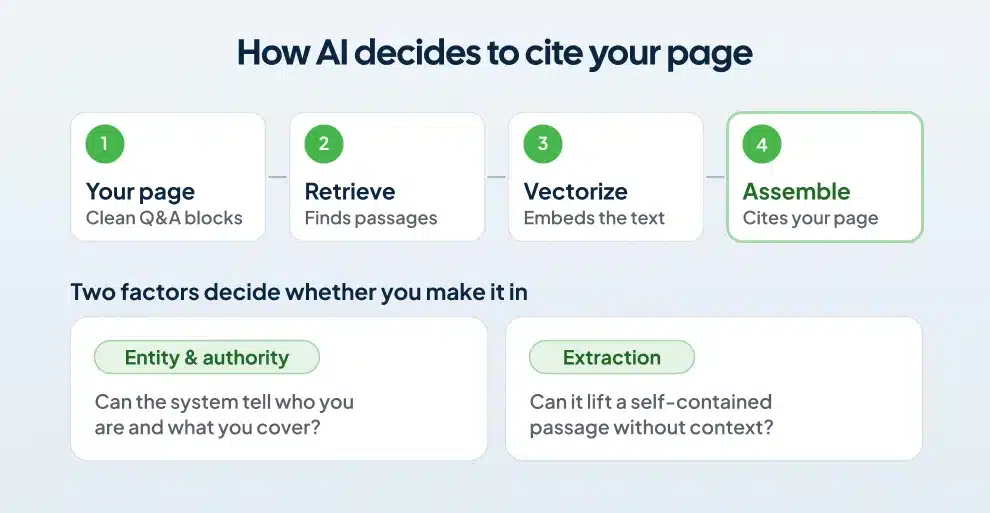
Two factors determine whether your content makes it in:
-
Can the system understand who you are and what you cover? (Entity and authority)
-
Can it pull a self-contained, quotable passage from your page without needing the surrounding paragraphs? (Extraction)
This is why structure matters so much for GEO. A clear heading followed by a direct, complete answer gives the system something it can use cleanly. A long, buried paragraph gives it nothing.
In our work at ClearBrand, we have seen the same patterns that make content easy for humans to scan also make it easy for AI to extract. Leading with the exact question the buyer is asking — and answering it plainly before adding context — is one of the most effective changes we make for clients.
What the Research Says Actually Works
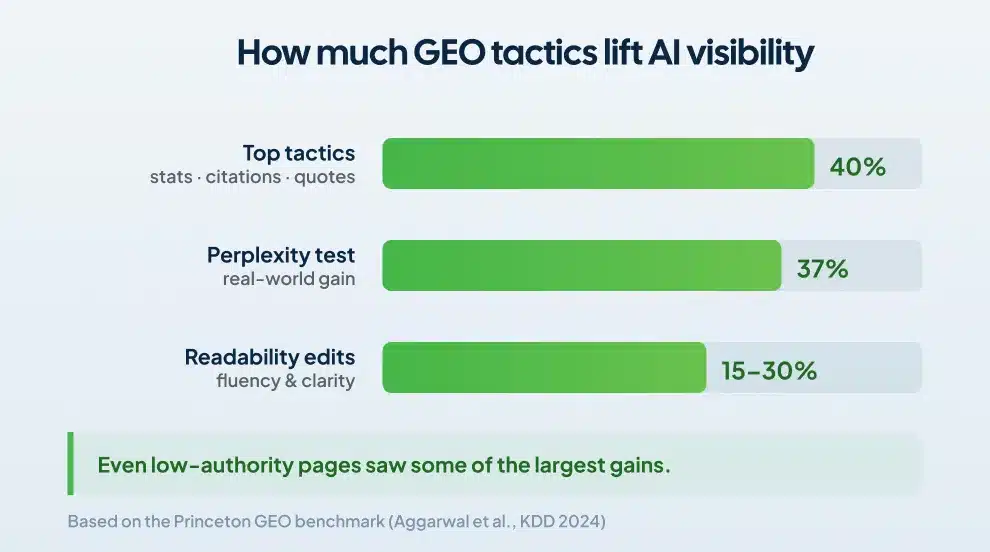
The original Princeton study tested nine optimization methods. Some moved the needle far more than others. The top tactics lifted source visibility by up to 40% in AI responses.
The Three Tactics with the Biggest Impact
-
Adding specific statistics. Concrete numbers beat vague claims every time. A sentence with a real figure gets pulled into answers more often than a general statement.
-
Citing credible sources. Referencing research papers, government data, or industry reports signals rigor — and makes your own content more citable in return.
-
Adding direct quotations. Attributable quotes from named experts give AI systems clean, trustworthy evidence to extract.
The study also found that basic readability improvements (fluency and clarity edits) raised visibility by 15–30%. When the researchers tested these methods on Perplexity, they saw real-world gains up to 37%.
One finding stands out for smaller sites: the gains were not limited to high-authority domains. Lower-DR pages saw some of the largest improvements when they applied clean structure and credible sourcing.
How to Do Generative Engine Optimization: A 7-Step Starting Sequence
You do not need to rebuild your entire site. Start with this practical sequence.
-
Audit where you currently stand. Run real buyer questions through ChatGPT, Perplexity, and Google AI Mode. Note whether you appear, who beats you, and what the AI says about your category.
-
Rewrite your most important headings as questions. Match the exact phrasing buyers type into AI tools. Open every section with a direct, complete answer before adding supporting detail. This one change tends to make a big difference for clients.
-
Add the three research-backed elements. Work in a relevant statistic, a credible citation, and an expert quote wherever they fit naturally.
-
Add structured data. Implement Organization schema site-wide andFAQPage schema in Webflow on any page that answers questions. Schema is one of the most direct technical signals for AI visibility.
-
Make key content machine-readable. Confirm that important text renders server-side. AI crawlers still struggle with content that only loads through heavy client-side JavaScript.
-
Earn mentions off your own site. Unlinked brand mentions, an accurate Wikipedia presence, and consistent activity on Reddit and YouTube all feed AI understanding of your brand.
-
Set a measurable baseline before you change anything. Enable AI referral tracking in GA4 so you can see what actually moved the needle.
This sequence has worked well for clients who publish service pages and thought leadership content. The pages that start with the questions their buyers actually ask, then answer them cleanly with data and quotes, make it easier for AI systems to cite them.
GEO Across Different AI Platforms
Each surface has its own preferences, so no single tactic wins everywhere.
-
ChatGPT favors comprehensive, well-sourced content with clear expertise signals.
-
Perplexity leans heavily on citations and source credibility.
-
Google AI Overviews still blend traditional ranking signals with AI synthesis.
-
Google AI Mode pulls from a wider set of sources than standard Overviews and rewards conversational clarity.
-
Gemini and Claude both reward clean structure and consistent brand presence across the web.
The common thread is structure plus credibility. Win those two and you can compete on every surface.
How to Measure Your GEO Performance
GEO breaks traditional reporting. Rankings and click-through rate do not tell you whether an AI quoted you.
Track these instead:
-
How often you are mentioned across AI engines
-
Which specific pages get cited
-
Your share of voice versus competitors
Google Search Console will not give you a clean AI Overview report. What it can show is impression and click movement on pages you restructure or add schema to — useful directional data.
For the full picture, use dedicated tools such as Rankability (which is what we use), Semrush AI Visibility Toolkit, Ahrefs Brand Radar, or Profound. Set a baseline and check on a regular cadence.
What GEO Will Not Do (And What Is Still Unproven)
GEO is still new. A few honest realities keep you from chasing the wrong things.
AI visibility fluctuates. The same prompt can return different sources on different days. Treat trends, not single-day snapshots, as your signal.
llms.txt is not a confirmed ranking factor. Major AI providers have not publicly verified using it in live systems, so treat it as a nice-to-have, not a priority.
Optimizing for machines at the expense of real readers backfires. Content stuffed with quotes and statistics but light on genuine value does not hold attention or earn lasting trust. The safest GEO strategy is accurate, genuinely useful content with clean structure.
Frequently Asked Questions
Will GEO replace SEO?
No. GEO sits on top of SEO rather than replacing it. AI systems pull from the same web your SEO fundamentals live on. Strong crawlability, authority, and useful content are what make you citable in the first place. Most brands need both.
How is generative engine optimization different from SEO?
SEO optimizes for ranking on a search results page. GEO optimizes for being cited inside an AI-generated answer. The underlying work overlaps heavily, but GEO adds a specific focus on extractable structure, credible sourcing, and brand presence across the web.
Is generative engine optimization the same as AEO?
They overlap and the industry uses the terms loosely. Answer engine optimization (AEO) focuses on winning direct answers like featured snippets and answer boxes. GEO focuses on appearing inside the longer responses generative AI tools produce. The tactics are close cousins.
How do you measure GEO?
Track AI mentions, citations, and share of voice rather than rankings alone. Google Search Console shows directional movement on optimized pages. Tools like Semrush AI Visibility Toolkit, Ahrefs Brand Radar, and Profound track citations across the major AI engines.
Why is generative engine optimization important now?
AI answers cite only a few sources. The brands cited early build trust patterns that compound over time. With AI referral traffic converting at higher rates, the cost of being absent from those answers grows every month.
Can a small or low-authority site win at GEO?
Yes. The Princeton research found that lower-ranked sites saw some of the largest visibility gains from GEO tactics. Clean structure and credible sourcing can earn a citation even when a page does not rank at the top.
Where to Go from Here
Generative engine optimization rewards the same fundamentals good marketing has always required: clear answers to real questions, credible sources, and content built for the person asking. The difference now is that an AI system reads it first and decides whether to pass it along.
Start with the seven-step sequence above. Set your baseline. Focus on the buyer questions that matter most to your business.
If you want a team that builds Webflow sites and content specifically designed to get cited in AI answers,that is what we do at ClearBrand. Book a call and we will tell you where your site stands today.