
To earn a citation in Google’s AI Overviews (AIOs), your page needs to show up somewhere in the search results. Either for the query itself, or for one of the sub-queries Gemini fans out to. It also needs a passage Gemini can extract and quote.
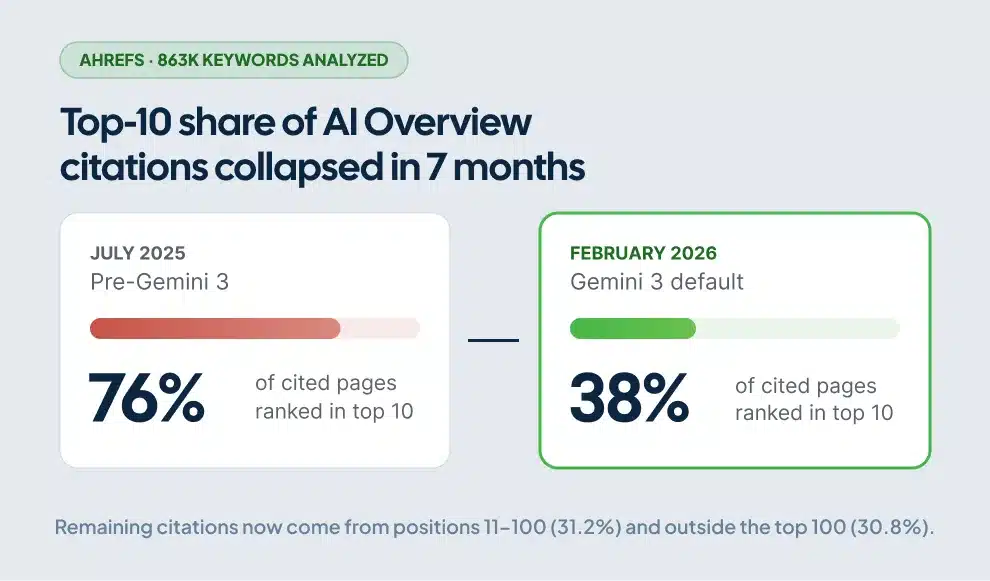
Ahrefs’ February 2026 analysis covered 863,000 keywords and 4 million AI Overview URLs. Only 38% of cited pages also rank in the top 10 for the same query. The rest come from positions 11-100 (31.2%) or don’t rank in the top 100 at all (31%).
That’s a fast shift. The same study in July 2025 put the top-10 number at 76%. Google made Gemini 3 the default AI Overview model in January 2026. The timing suggests this update was the cause for the change.
Earning citations under the new model still works, but the playbook for getting there is different than it was a year ago.
I run an SEO agency. We’ve earned AI Overview citations for clients across very different verticals in 2025 and 2026.
Two examples: KleerCard’s “best of” articles appear as top recommendation in AI Overviews for their target queries. Integrity Medicine’s location pages do the same in their market.
I’ll walk through the playbook we used.
(Note: this article includes affiliate links, so we may make a commission if you purchase through these links. We only recommend platforms and tools we’ve personally tried and vetted.)
Why AI Overview Citations Matter More Than They Did Last Year
Three studies from 2025 measured what AI Overviews do to organic traffic.
Pew Research analyzed 68,879 Google searches across 900 U.S. adults. When an AI Overview appeared, users clicked a traditional result 8% of the time. Without one, they clicked 15% of the time. That’s a 47% relative drop in clicks for pages on the same SERP.
Ahrefs’ December 2025 analysis covered 300,000 keywords. Position-one click-through rate dropped 58% when an AI Overview appears, up from 34.5% in April 2025. The decline accelerated through the year.
A Seer Interactive study looked at what citations do for the brands that earn them. Brands cited inside the AI Overview earned 35% more organic clicks than uncited brands on the same query. Being inside the citation set partially recovers the loss in CTR.
Our client work shows the same divide. Pages cited inside the AI Overview keep generating qualified pipeline. Pages that rank in positions 3-10 but don’t get cited see traffic erode month over month.
What AI Overviews Are
AI Overviews are Google’s AI-generated summaries. They appear at the top of certain search results, above the traditional blue links. The Gemini model writes them. It pulls from pages in Google’s search index, then cites the sources it used.
Google’s May 2026 AI optimization guide describes the underlying mechanic this way. AI features are “rooted in our core Search ranking and quality systems.” Google says there is no separate “AI index.” The content that earns organic visibility is the same content that gets cited.
Two technical concepts shape how this works.
Retrieval Augmented Generation (RAG). Google’s AI doesn’t answer from training data alone. For each query, it pulls live results from the search index and summarizes them. If your page isn’t in the index for that query, it can’t be cited.
Query fan-out. A user types one query. Google’s AI generates several related sub-queries behind the scenes and pulls candidates for each. A page that ranks for the main query plus two of its fan-out variants gets more chances to be cited. Surfer SEO’s research found a page’s citation chances increase by 161% when it ranks for at least one fan-out in addition to the main query.
Fan-out got more aggressive in early 2026, when Google made Gemini 3 the default AI Overview model. SE Ranking’s post-upgrade analysis found two changes. Gemini 3 returns about 32% more source URLs per response. It also replaced roughly 42% of the domains the previous model had favored.
That wider source pool is part of why the top-10 citation share dropped from 76% to 38% in seven months. Gemini 3 reaches further down the index for each sub-query. A page ranking at position 30 for the main query can still get cited if it ranks well for a fan-out variant.
How Common Are AI Overviews? Quick SERP Math
Wider fan-out doesn’t mean AI Overviews show up everywhere. The prevalence varies by query type, which affects where it’s worth investing.
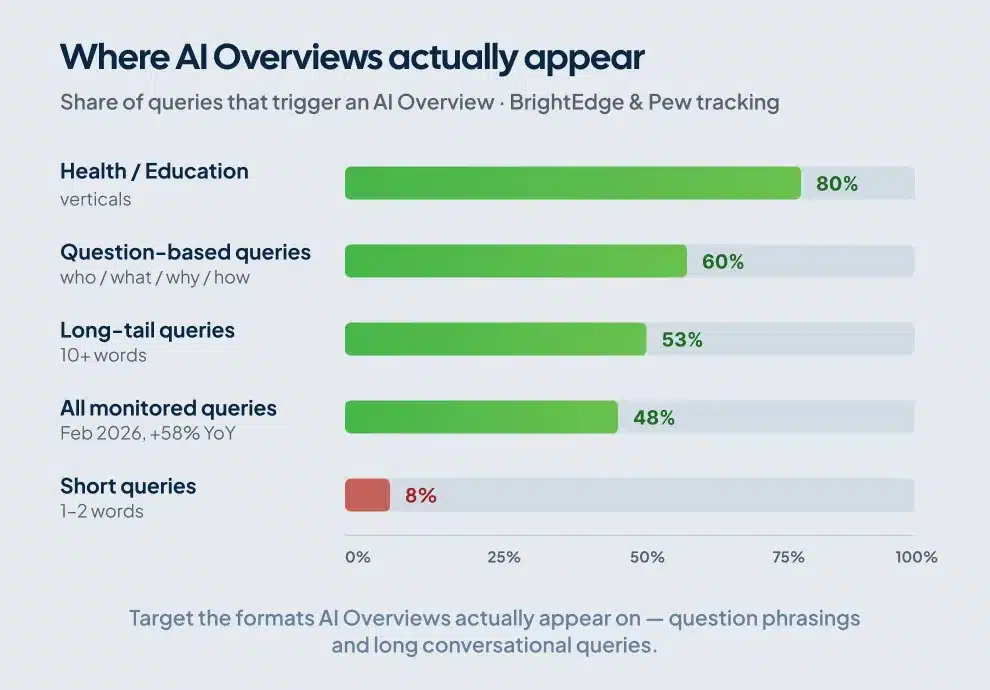
BrightEdge tracking through February 2026 showed AI Overviews appearing on 48% of monitored queries, up 58% year over year. Health, education, and research verticals trigger them on roughly 80% of queries. Pew’s earlier study from March 2025 showed 18% across all queries.
Two patterns drive that volume:
- Question-based searches (queries with “who,” “what,” “why,” “how”) trigger an AI Overview around 60% of the time.
- Long-tail queries (10+ words) trigger them 53% of the time. Short queries (one to two words) trigger them only 8% of the time.
For content planning, this means targeting the question formats and longer conversational queries where AI Overviews appear most often.
The 7-Step Playbook
Seven steps that move citation rates, in rough priority order. They build on each other. The failure mode we most often see in client audits is teams investing in one layer (rankings or on-page structure) and ignoring the other.
Step 1: Rank Well Organically (Especially the Top 5)
Pages at position 1 still get cited far more than pages at position 10. A page at position 17 can also get cited now, which wasn’t true a year ago.
The Ahrefs February 2026 analysis covers the current picture. 38% of cited URLs rank in the top 10. Another 31% rank between positions 11 and 100. The remaining 31% don’t rank in the top 100 at all.
GetPassionFruit measured the citation probability by position. A page at position 1 gets cited 33.07% of the time; a page at position 10, 13.04%. Higher rankings give you better odds, though the odds at any single position are far from a sure thing.
The location pages we built for Integrity Medicine didn’t get cited the day they shipped. They got cited after they reached the top 5 organically, matching what the GetPassionFruit numbers above predict.
To find your closest wins, open Search Console, find queries that are likely to trigger an AI Overview. Improve those before writing anything new.
There is no native way to filter for “AI Overview” so here are three ways to get close:
- Long-Tail Regex Filter: Use a custom regex filter on the “Query” dimension to find long, conversational queries often associated with AI. Paste ^(?:\S+\s+){9,}\S+$ to show queries with at least 9 words, or change 9 to 20 for longer queries.
- Question & Comparison Regex: Use (?i)^(who|what|where|when|why|how|which|is|are|can|does|should)|\b(vs|versus|compare|difference|pros and cons|guide|tutorial|best|top|list)\b to capture question-based and comparison queries that frequently trigger AI Overviews.
- CTR and Position Analysis: Filter queries by Average Position > 2 and sort by CTR to find low-click-through-rate queries. A significant drop in CTR alongside an increase in average position often indicates the query is now being answered by an AI Overview.
For direct tracking of AI Overview performance, you can use third-party tools (such as Semrush, Ahrefs, or SerpApi) that monitor SERP features.
What “improve” means here hasn’t changed. Search intent match, internal linking, page experience, backlinks, and content depth still determine whether you climb the SERP.
Step 2: Target Question-Based, Long-Tail Queries
AI Overviews are calibrated for informational intent. Ahrefs found that 99.2% of keywords triggering AI Overviews have informational intent.
Commercial intent triggers AIOs around 5.5% of the time. Transactional sits at 1.2%. Navigational is essentially zero.
That narrows where it makes sense to invest. Pure product pages and commercial comparison pages don’t get many AI Overview citations on their own.
Two formats consistently earn citations in our client work:
- “Best of” articles. KleerCard’s “best of” articles are how we earned the first-recommendation citation slot in their target AI Overviews. The format matches what Google’s AI is looking for. A structured list, named entities, direct comparison criteria, and a single recommendation supported by evidence. These read as commercial to humans but trigger informational AIOs because the user query underneath is “what’s the best X.”
- Location pages with informational structure. Integrity Medicine’s location pages don’t read like generic “Town Name + Service” pages. Each one answers the underlying informational questions a patient has about that service in that location, then offers the local option.
When mapping topics, focus on:
- Questions starting with “how,” “what,” “why,” “when,” and “which”
- Queries four to seven words or longer
- Phrases that match natural spoken language
- “Best of” formats for commercial queries with informational underpinnings
People Also Ask and Google’s autocomplete are the most reliable sources for these phrasings. Pull the questions, group them by topic, and write pages that answer them directly.
Step 3: Lead Every Section With a Direct, Standalone Answer
In our client audits, restructuring sections to lead with the answer is the step that tends to produce the fastest visible change in citations.
The reason is mechanical: the model extracts passages, not pages. Search Engine Land’s analysis describes passage indexing, where Gemini pulls specific sections rather than whole pages to fill out a response.
If your answer requires a reader to scroll, read context, and assemble meaning across three sections, the model won’t extract it.
How to fix it:
- Begin each section with a one to three sentence direct answer
- Follow with context, evidence, and detail
- Keep the answer self-contained so it makes sense lifted out of the page
A useful rule of thumb is the 50-to-70-word opening summary. Treat each H2 as a standalone question. The first 50-70 words should answer it completely. Everything after that adds depth for readers who want it.
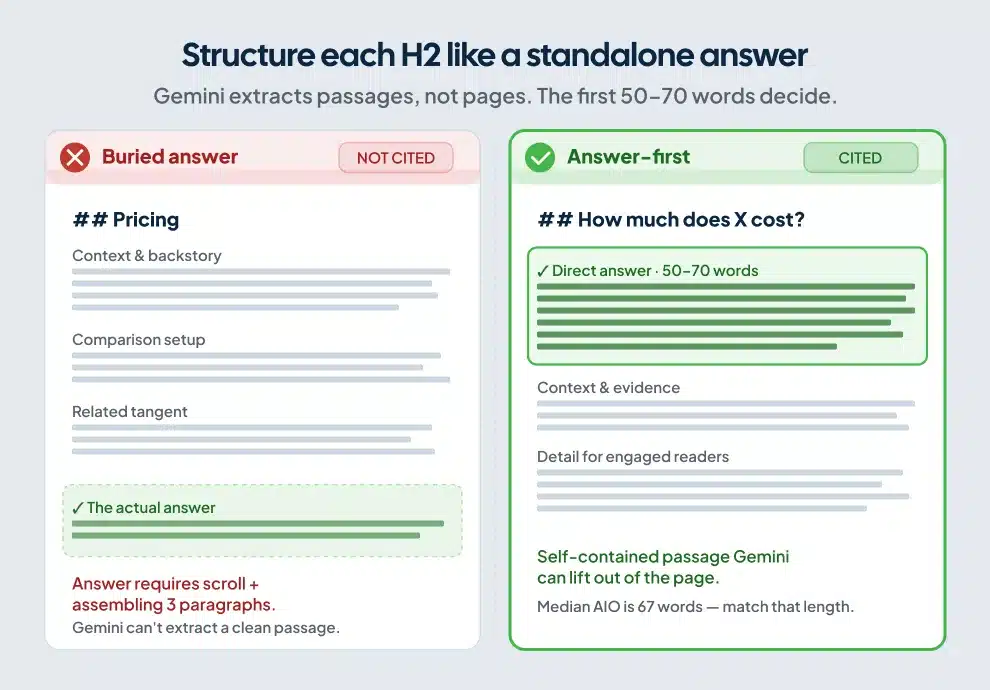
In our KleerCard “best of” rewrites, the citation often pulls from the first 60 words of a section. The rest of the section serves the reader who clicks through. Both audiences get what they need from the same content.
Pages restructured this way often pick up featured snippets too. Both formats favor the same kind of self-contained, extractable answer.
Step 4: Use Question-Format Headings That Mirror How People Search
Google’s AI matches user queries to content using semantic similarity. Headings that sound like the natural-language question a person would type give the model a cleaner match.
Stop using one-word headings like “Pricing” or “Implementation.” Start using headings like “How much does Webflow cost for a small business?” or “What does Webflow implementation look like for a 10-page site?” The longer headings carry the phrasing the model is looking for.
We recommend structuring an article around four to eight question-style H2s, each answering a sub-query in the topic cluster. The Big Human team calls these “structural cues” of the “What is X,” “How to X,” “Why X Matters” form. Combined with the direct-answer-first rule from step 3, your page reads as a stack of self-contained answers tied together with a narrative.
Step 5: Build Topical Authority Through Content Clusters, Not Standalone Posts
One comprehensive page rarely earns citations across a wide query set. The breadth required is more than a single page can cover.
The pattern works like this. Pick a topic. Write one main “pillar” page that gives the comprehensive answer.
Then write supporting pages for each sub-question, each fan-out variant, and each adjacent angle. Internally link them. Update them as a group.
Ahrefs analyzed 540,000 query pairs and found that Google’s AI Overviews and AI Mode cite the same URLs only 13.7% of the time. The citation set runs wide, especially under Gemini 3’s expanded fan-out. A cluster gives you exposure across more of those sub-queries than any single page can.
For Integrity Medicine, we built a cluster: the service pillar page, multiple location pages, supporting condition pages, and FAQ pages that answered every adjacent question. We started seeing citations before the cluster was in place, but it improved with each piece of content we added.
Two things to do at the topic level:
- Map every question in the cluster using People Also Ask, AlsoAsked, and AnswerThePublic
- Write a dedicated page for the high-volume ones; address the low-volume ones inside the relevant pillar
Step 6: Earn Brand Mentions Across the Web
Most B2B teams put a lot of weight on backlinks and almost none on unlinked brand mentions. The Ahrefs citation data suggests this is the wrong ranking.
Ahrefs analyzed 75,000 brands to measure which factors correlate with AI Overview visibility. The study found that brand web mentions correlate at 0.664, compared to 0.218 for backlinks. Brand mentions outpace backlinks by roughly 3x on this metric.
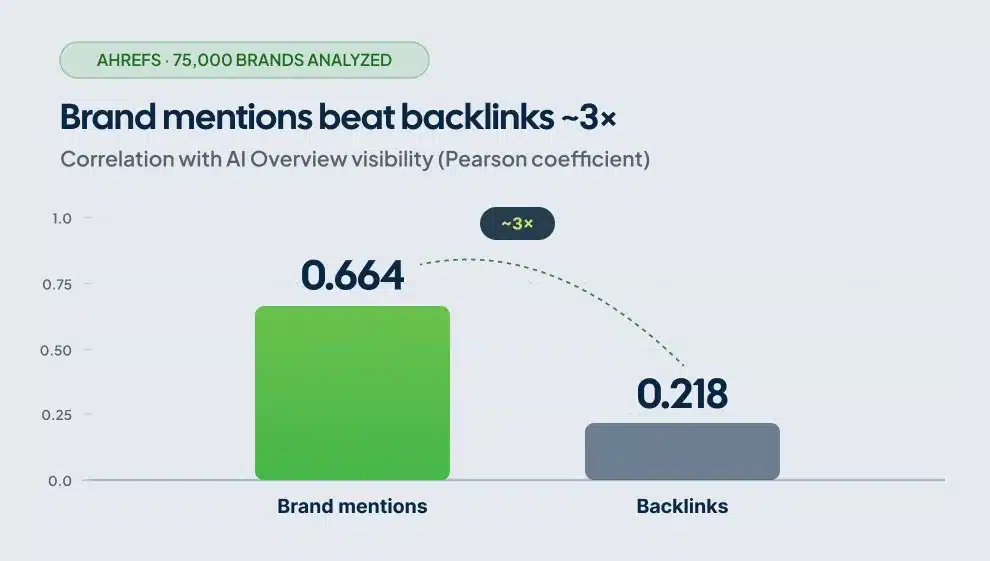
When Gemini decides which sources to cite, it weighs how often your brand shows up in trusted contexts across the web. Both backlinks and unlinked mentions contribute, with mentions carrying the heavier weight.
Five places to invest in earning those mentions:
- Get cited in industry roundups, news articles, and reports
- Pitch original research to journalists covering your space
- Show up on podcasts, panels, and conference stages where your brand gets named
- Build a presence on Reddit, Quora, and other platforms where conversations about your category happen
- Encourage and respond to reviews on Trustpilot, G2, Capterra, and Google
PR work needs to shift weight from backlinks to named mentions in credible sources. Mentions take time to compound, often longer than any other step in this article.
Step 7: Implement Schema and Get Your Technical Foundation Right
Schema markup helps Google understand your content’s structure. It doesn’t guarantee citations, but it removes the technical friction that would otherwise hold them back.
Schema types worth prioritizing for AI Overview eligibility:
- Article schema with author, date, and organization fields for editorial content
- FAQPage schema for question-and-answer content
- HowTo schema for step-by-step instructional content
- Organization schema for brand identity
- Product and Review schema where applicable
Validate your schema in Google’s Rich Results Test. Errors or partial schema reduce eligibility. Beyond schema, the technical baseline matters: clean crawlability, no robots.txt blocks on Googlebot or Google-Extended, fast Core Web Vitals, mobile responsiveness, and clear URL structure.
A quick robots.txt check is worth doing separately. If you’re blocking crawlers like GPTBot or ClaudeBot, you’re cutting yourself out of other AI search surfaces (ChatGPT, Claude, Perplexity). Google’s AI Overviews use Googlebot’s crawl, so they’re unaffected by GPTBot rules. A broader AI search strategy needs the other crawlers allowed too.
What Most “AI Overview Optimization” Advice Gets Wrong
Five claims from competitor guides that we’ve seen fail in practice or contradict the published data:
“Write longer content.” Length doesn’t change citation chances much. Pew found the median AI Overview is 67 words long. Gemini typically extracts a 50-to-100-word passage. A 4,000-word article and a 1,500-word article have the same chance of being cited from any given section. What matters is whether the section answers the question. Our KleerCard rewrites kept word counts roughly the same as the originals.
“Use lots of bullet points.” Bullets work when the underlying content is a list. When used to fragment prose into a fake checklist, they don’t help. The model looks for direct answers, not visual scannability.
“Optimize for the AI Overview specifically.” Google’s May 2026 guidance pushes against this. The official position from Search Central is that “optimizing for generative AI search is optimizing for the search experience, and thus still SEO.” The guide says there is no separate AI index and no AI-specific rewriting needed. The same advice that ranks pages for traditional search also earns AI Overview citations.
“You need new tools to rank.” Search Console, the SERP, and a content audit get you 90% of the way there. AI visibility tracking tools are useful for measurement, but they don’t change the underlying work.
“AI Overview optimization is fast.” Speed isn’t guaranteed. In our client engagements, citations have taken anywhere from 2 to 10 weeks after a content rewrite when the page is already in the top 10. Pages ranking between 11 and 100 take longer, typically 3 to 5 months, but they do get cited.
To be clear: it’s not that it needs that much time to rank. The difference in time is based on the full strategy. What other pages are being written? Backlinks? Brand mentions? Etc. It all adds up and contributes to the pages you want to get cited actually getting cited.
How to Track Whether You’re Showing Up in AI Overviews
Three approaches that work for AI Overview citation tracking:
- Rankability. They offer a dedicated AI Overviews tracker. We use this platform to track all our clients’ AI performance.
- Ahrefs Site Explorer. Filter Organic Keywords by the AI Overview SERP feature. You’ll see which queries trigger an AIO and whether you’re cited.
- Semrush Position Tracking. When your domain appears in an AI Overview, the tool marks you as ranking for that SERP feature.
- Manual SERP checks. Take your top 20 informational queries, run them in Google, and see who’s cited. Compare your URL to the cited ones. The comparison usually shows you what’s missing.
Don’t track every query. Track the ones with commercial impact for your business. A page cited for “Webflow SEO agencies” has measurable downstream value. Citations on queries that don’t bring you buyers are worth less attention.
Do It Yourself or Have It Done For You?
Either option can work. Hiring an Answer Engine Optimization agency makes sense for companies that don’t have a full marketing department with time and energy to stay in-the-loop enough to become experts.
AI search is changing constantly, so if you want to rank you have to be willing to put in the effort.
Running it in-house still comes down to the two things: (1) producing extractable, answer-first content and (2) tracking whether it earns citations. AirOps is a strong option for teams that want both in one place.
On the measurement side, it tracks brand citations, share of voice, and competitor visibility across Google AI Overviews, ChatGPT, Perplexity, and Claude. That replaces the manual SERP checks in the tracking section above.
On the production side, AirOps generates the answer-first, question-heading, schema-ready structure these seven steps prescribe, with human review before anything publishes. It speeds up the measurement and the output. The work itself is still the playbook.
If you’re going to run this playbook in-house, a tool like AirOps is necessary.
Frequently Asked Questions
How long does it take to rank in AI Overviews?
If your page already ranks in the top 10 organically, citations can appear within 6 to 14 weeks. Restructure the content for extractable answers first.
If your page ranks between 11 and 100, you still have a real shot. The Ahrefs February 2026 data shows about a third of citations come from that range. Expect 3 to 5 months once the content is properly structured. Our KleerCard and Integrity Medicine results both followed roughly this timeline.
Do you need backlinks to rank in AI Overviews?
Not necessarily. You need the authority that backlinks contribute to. Backlinks alone are not the strongest signal. Brand mentions across the web correlate with AI Overview visibility roughly three times more strongly than backlinks. The work splits between both: link-building helps organic ranking, mention-building helps citation likelihood.
Can AI-written content rank in AI Overviews?
Google’s official position is that AI-assisted content is allowed if it meets the quality bar of original, useful, people-first content. What matters is whether the content passes E-E-A-T evaluation, not how it was drafted. Commodity AI-generated content fails on quality grounds. We don’t ship AI-drafted content to clients without substantial human rewriting.
Why isn’t my page being cited even though it ranks in the top 10?
The most common reasons your page isn’t being chosen are structural. The page buries its answer below context. Or it uses headings that don’t match question-format queries. Or it covers the topic so broadly that no single section gives Gemini a clean passage to extract.
Rewrite the top three sections to lead with a 50-to-70-word direct answer, then recheck after Google recrawls.
A top-10 ranking gives you a strong shot at citation, not a guarantee.
Do AI Overviews work the same way on mobile and desktop?
Yes. The Gemini model and the citation logic are identical across devices.
The display differs slightly. On desktop, the top-cited URL is visible without interaction. On mobile, the citation expansion requires a tap. The underlying ranking and citation behavior is the same on both.
How do you measure ROI from AI Overview citations if clicks are down?
Track three things in parallel. First, brand-name search volume in Search Console. Second, direct traffic from queries that trigger AI Overviews. Third, assisted conversions where the first touch was an organic session that ended in an AI Overview view.
Seer’s data shows cited brands earn 91% higher paid click-through rates and 35% higher organic click-through rates on the same queries. AI Overview visibility lifts the rest of the funnel even when direct clicks fall.
Can “best of” articles rank in AI Overviews if they look commercial?
The best approach is to target the “best of” article at the research phase buyer. The KleerCard work taught us this directly. The user is asking “what’s the best X” and Google’s AI will cite a well-structured comparison piece that answers it.
The structure has to stay informational: clear criteria, named options, direct comparison, and a single recommendation supported by evidence. A page that reads as a sales pitch tends not to get cited at all.
Do location pages get cited in AI Overviews?
Yes, if they’re structured as informational content rather than thin local landing pages. The Integrity Medicine pages we built each answer the underlying patient questions about the service in that location, then offer the local option. Pages built as “City Name + Service” templates without that informational layer give Gemini little to extract.
What to Do This Week
If you have an hour, open Search Console for the last 90 days. Filter for question-based queries. Identify the five pages closest to the top 10 that aren’t there yet. Those are your first targets.
If you have an afternoon, pick your top-performing informational page. Rewrite the opening of each H2 so it leads with a 50-to-70-word standalone answer. Recheck the page after Google recrawls.
If you have a quarter, build out one content cluster around a topic where you already have partial coverage. Pillar page, five supporting pages, internal links between them, schema validated. Then track citation appearance month over month for the cluster’s target queries.
If you want help applying this to your own site, we do this work for clients at ClearBrand. If you’d rather run it in-house, this article is everything we’d do.
About the Author
Alexander Toth is the Founder & CEO of ClearBrand, an AI SEO and Webflow agency. He has led AI Overview citation work for clients across SaaS (KleerCard), B2B, and healthcare (Integrity Medicine), earning first-recommendation citation slots in every vertical we’ve worked in.