

SEO is worth it when you sell nationally and can fund a slow payback. Your cost to acquire a customer also has to stay well under their lifetime gross margin. For most single-location local businesses and early-stage startups, faster channels pay off first.
I run a Webflow SEO agency, and I turn down prospects when SEO is the wrong call for them. An honest answer has to include the cases where it does not pay off. I will cover both: when SEO earns its keep, and when it wastes money you could spend elsewhere. You can decide before you commit a dollar.
SEO is worth it when three conditions hold
Three conditions decide whether SEO makes sense for you, before any keyword research or content plan.
-
You sell nationally, or at least beyond one local service area. National reach gives organic search enough demand to move your revenue.
-
You have the cash flow to fund the wait. SEO pays back over months, not weeks, and you carry that gap yourself.
-
Your cost to acquire a customer stays well under their lifetime gross margin. The room between those two numbers is your profit.
With all three in place, execution is the rest of the job. If one fails, better tactics will not change the outcome.
Signal SEO is likely worth it Reconsider SEO first
Reach You sell nationally or have multiple locations Single location, local service area
Cash flow You can fund a multi-month payback You would fund it on credit
Margin Acquisition cost well under gross margin Acquisition cost near or above gross margin
Channel fit Lead gen and considered purchases Ecommerce chasing this week’s sale
Cases where SEO is not worth it
These are the cases where I tell prospects to spend their money somewhere else.
You would fund it on a credit card
You pay to grow, in money or in time. That part is true for every business. The mistake I see most often is treating SEO like a bet you can put on credit and cover by closing deals fast enough.
A lot of founders believe that if they build it, customers will come. Start marketing, close deals quickly, let the spend pay for itself. For maybe one in a hundred, that works. For everyone else, the bill arrives before the revenue does.
The early phase of a business is for the grind: direct outreach and the search for product-market fit. Paid marketing comes after.
I want cash flow in place before a client spends on SEO or ads. Never take a business risk that can put you out of business. You want to know that if the marketing returns nothing, you are still standing.
You run a single-location local business
With one location, your first dollars belong in your Google Business Profile.
Earn reviews and fill out the profile so you show up in the local map pack. That map pack carries a large share of local-intent clicks. Backlinko’s local search data puts it around 42 percent. The cost (nearly free) makes this the ideal starting point for these types of businesses.
People pull up Google Maps or glance at the pack on a search, and many never scroll past it.
A full SEO program for one location makes sense when you have cash flow, and you want to own the market rather than chase a few extra leads.
You sell mostly through ecommerce
For an ecommerce store, paid social is usually a shorter path to revenue than SEO. Meta ads can put your product in front of buyers this week.
I would run paid first, then add SEO once you are chasing category dominance instead of your next sale.
You are betting the plan on AI search
AI search gets a lot of attention right now, and some of that excitement is earned. It still makes up a small slice of total search.
In our client data, AI sits at roughly 5 to 10 percent of what Google brings in on clicks and customers. External numbers point the same direction. Ahrefs found that Google sends 190 times more traffic to websites than ChatGPT. ChatGPT itself runs at about 12 percent of Google’s search volume.
Build for where the clicks are today, which is still Google, while you position for AI visibility as it grows.
Run the numbers before you spend
Once cash flow is settled, the rest is math you can do on a napkin.
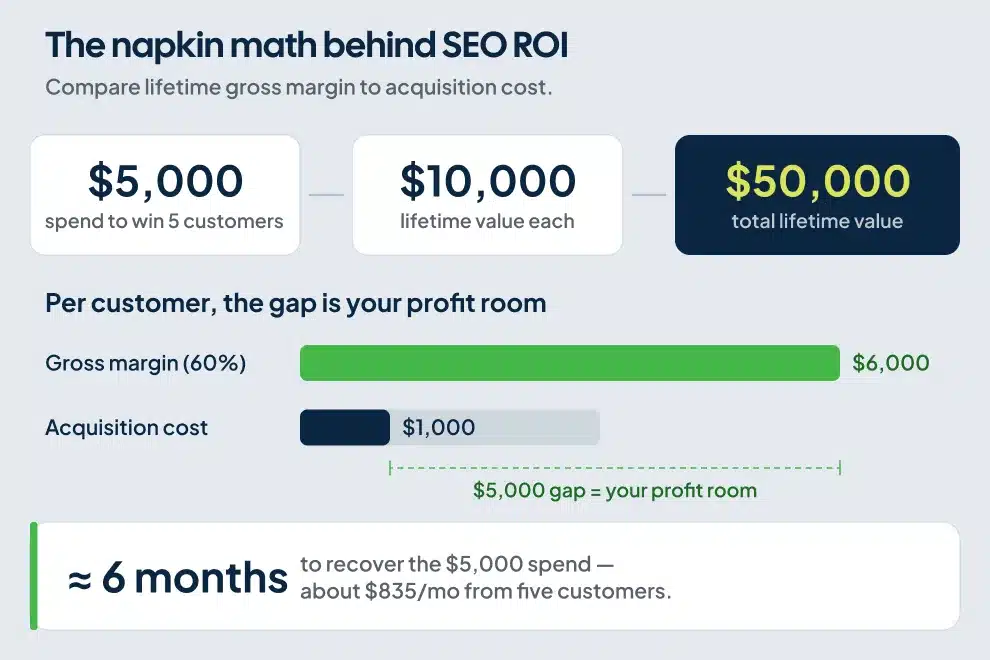
Start with lifetime value. Spend $5,000 to bring on five customers, each worth $10,000 over their time with you, and you turned $5,000 into $50,000. That is a strong trade when you can fund it.
Lifetime value alone overstates the case. The better number is lifetime gross margin, because cost of goods can eat a large share of revenue. You want your cost to acquire a customer well under that margin.
Say your gross margin runs 60 percent. Each $10,000 customer is worth $6,000 in gross margin over their lifetime. You paid $1,000 to acquire each one. That gap is healthy, and the trade works.
Then there is timing. How long will it take you to make your investment back? If your customers pay you up front, that’s fast. If they pay you monthly, it might take a while. Do the math so you know beforehand.
The reverse shows you when to walk away. A customer worth $6,000 in gross margin who costs $5,000 to win barely clears. Add a slow payback, and a couple of weak months erase the gain.
That payback timing is why cash flow comes first. With it, you can accept a slow return and let revenue compound. Without it, the same trade can sink you.
The figures below are an illustration, not a quote for any one business.
Step in the calculation Example figure
Spend to acquire 5 customers $5,000
Lifetime value per customer $10,000
Gross margin per customer (60%) $6,000
Acquisition cost per customer $1,000
Monthly revenue from 5 customers ~$835
Time to recover the $5,000 ~6 months
SEO costs and who should run it
You pay for SEO with your time or with money. Some businesses start by learning the basics and running them in-house. That can be the right move for some, but it takes a long time.
Paying with money splits two ways. An in-house hire makes sense when you have the cash flow and feel confident that you can manage that person, their inputs and outputs, and know what they should be reporting. If managing the role feels like a big job (which, it is), then an agency may be a better fit.
An agency earns its fee when your search activity is high enough to turn the work into outcomes. Weigh any number against your gross margin and payback, not against another agency’s sticker price.
One honest caveat. If you do not have enough search demand to act on, no provider changes that.
How long until SEO pays off?
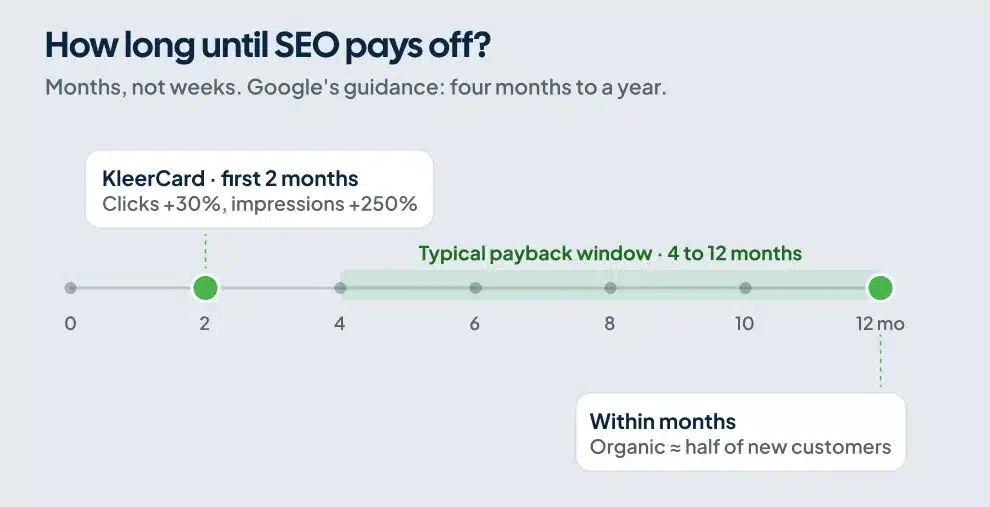
Most SEO programs take months, not weeks, to produce meaningful organic revenue. Google’s own guidance says the same. In its “How to Hire an SEO” video, Google puts the window at four months to a year. Plan around that, and the slow start stops being a surprise.
The wait is the cost, and cash flow is what carries you through it. This is the same reason I gate the whole decision on your runway.
Faster movement does happen. We took on KleerCard, a fintech client. Clicks rose more than 30 percent and impressions more than 250 percent inside the first two months.
Leads started arriving from AI overviews in that same window. Within months, organic search was bringing in half of their new customers. You can read the fullKleerCard case study for the details.
Even with early wins like that, I set expectations around a multi-month payback. It keeps the decision honest.
The return when SEO is worth it
When SEO makes sense for a business, it is an incredible marketing channel. The return compounds in a way paid channels do not. Often beating other channels on ROI.
You earn traffic from people already searching for what you sell. That demand is qualified, because you show up at the moment of intent instead of interrupting a feed.
The visibility lasts. Good content keeps pulling visitors between active investment cycles, which lowers your effective cost over time. Paid traffic stops the day you stop paying. Content you ranked last year can still bring in leads next year.
AI visibility rides along with it. The pages that rank in organic search are the same ones AI tools cite. KleerCard now shows up in Google AI Overviews and in ChatGPT for its target terms, off the back of the same SEO work.
SEO or paid ads first?
Paid ads buy speed, and SEO builds an asset you keep. Your phase and your margins decide which comes first.
Paid ads SEO
Speed to first results Days to weeks Months
When you stop paying Traffic stops Rankings keep working
Cost over time Steady or rising Drops as content ages
Best early fit Ecommerce, urgent revenue National lead gen
AI visibility Limited Same pages get cited by AI
If you need revenue this quarter and sell through ecommerce, start with paid social. If you are local, start with your Google Business Profile. Both put you in front of buyers faster than organic content can.
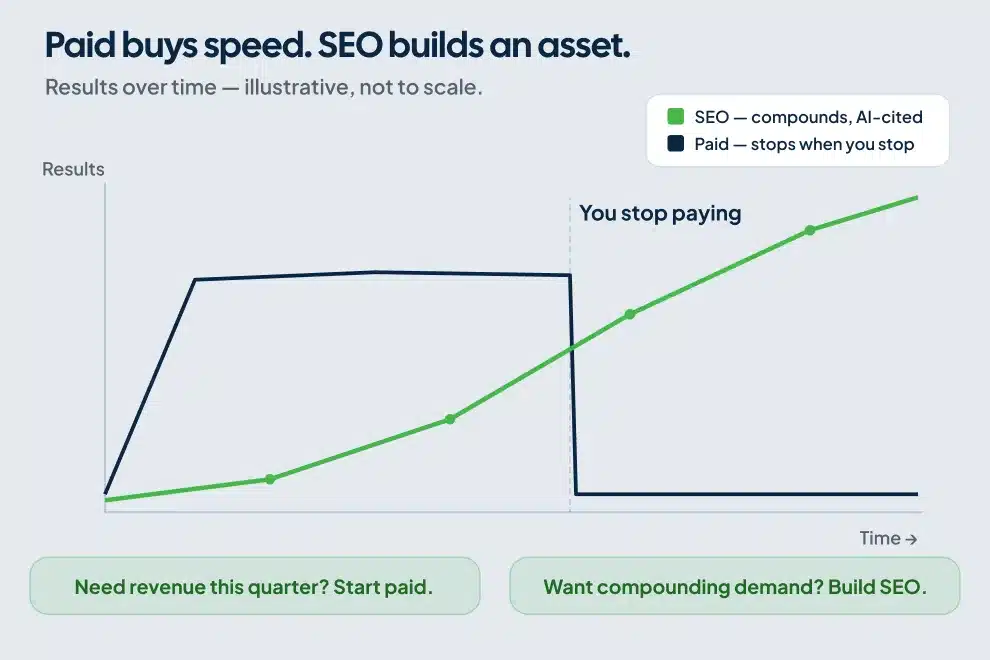
SEO comes in when you want demand that compounds and a cost per lead that drops over time. Most mature programs run both, with paid covering the near term while organic builds the asset underneath.
“SEO is dead” and other objections
I hear a handful of reasons people give for skipping SEO. Some are wrong. Some are right for the business saying them.
“SEO is dead.” It is not, but it changed. Google still drives most search clicks, and businesses that publish useful content still rank. Thin content built to game the algorithm does worse than it used to.
“It takes too long.” This one can be fair. If you need revenue this month with no runway, the multi-month payback is a real problem. That is a cash-flow answer, not an SEO answer.
“AI killed it.” AI changed how results look, not whether people search. The same content that ranks organically is what AI engines cite, so the work feeds both.
“It is too expensive.” It can be, if your margins or search demand are thin. Run the numbers from the section above before you decide. The price only means something next to your gross margin.
Is SEO still worth it with AI Overviews and ChatGPT?
AI changed how results look, not whether people search. Google still drives most of the clicks and most of the customers.
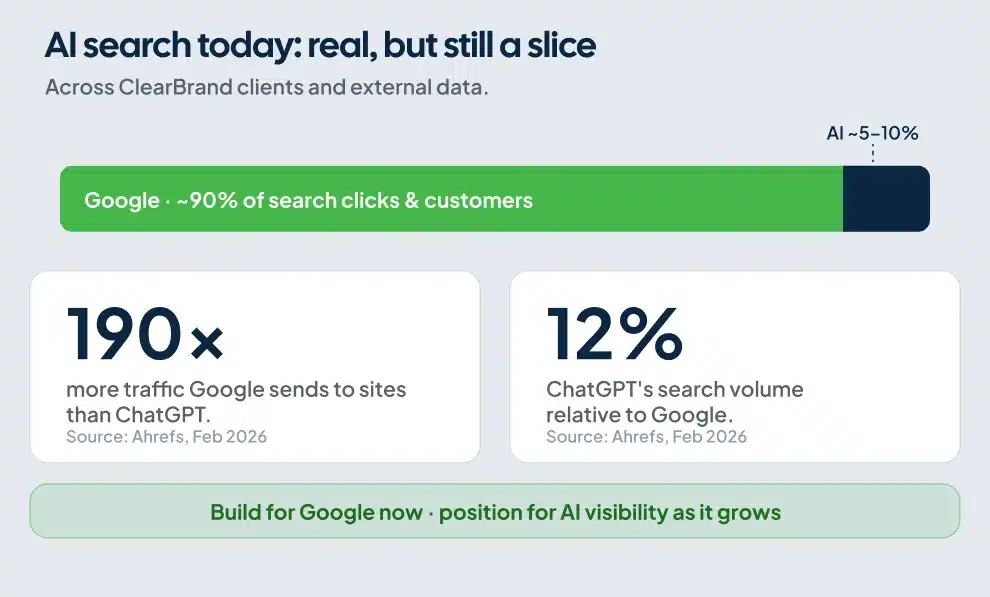
AI answers are a fraction of total search today, closer to 5 to 10 percent in what we see across clients. That share will grow, and it is worth planning for. It is not the main event yet.
The two reinforce each other. The content that ranks organically is what AI engines pull from, so strong SEO feeds your AI visibility instead of competing with it. For the difference between optimizing for search and for AI answers, our guide toSEO, AEO, and GEO breaks it down. For how Google evaluates pages, seehow modern SEO works.
Is SEO worth it for you?
Run it back through the three conditions. You sell nationally. You can fund a slow payback. Your cost per customer sits well under lifetime gross margin.
If those hold, SEO returns compound steadily over years, and I would be glad to help you build it.
If they do not, the better first move is usually your Google Business Profile or direct outreach. Build the cash flow first, then come back to SEO when the numbers line up. Not sure which side you fall on? Ourright-fit page walks through it with you.
Frequently asked questions
Is SEO worth it for a small business?
It depends on whether you sell locally or nationally. A national small business with cash flow and healthy margins is often a strong fit. A single-location local business should put its first effort into its Google Business Profile and the local map pack. That is where most local searchers look before they scroll.
How long does SEO take to pay off?
Most programs take several months, not weeks, to produce meaningful organic revenue. Google’s guidance puts the window at four months to a year. Some clients see early movement sooner, and KleerCard saw clicks and impressions climb within two months. Plan your budget around a multi-month payback.
How do you measure SEO ROI?
Compare your cost to acquire a customer against that customer’s lifetime gross margin, not raw lifetime value. Then track time to payback month by month. The return holds up once your acquisition cost sits well under gross margin and you can fund the wait.
Is it worth paying someone to do SEO?
It is worth paying when your search demand is high enough to turn the work into outcomes. It also makes sense when you would rather not build the skills and tooling in-house. If there is little search volume for what you offer, no agency or hire fixes that, and the spend is hard to justify.
Is SEO still worth it in 2026 with AI?
Yes, for most national businesses with the cash flow to invest. AI changed how search results look, but Google still drives the majority of clicks and customers. The same content that ranks organically is what AI tools cite, so SEO and AI visibility build on each other.
About the author: Alexander Toth is the Founder and CEO of ClearBrand, a Webflow web design and SEO agency. He is featured in a Wall Street Journal bestselling marketing book and writes about SEO, AEO, and conversion-focused web design.
Sources: Google, “How to Hire an SEO” (Maile Ohye), Google Search Central. Patrick Stox, “ChatGPT Has 12% of Google’s Search Volume but Google Sends 190x More Traffic to Websites,” Ahrefs, February 2026. “Local SEO Statistics,” Backlinko, updated December 2025.