
SEO for Construction Companies: A 2026 Playbook for Residential and Commercial Firms
SEO for construction companies is really two games. Get the 2026 playbook for residential local-pack rankings and commercial pre-RFP authority.
Originally published: May 28, 2026 Last updated: May 28, 2026
SEO for construction companies is two different problems wearing the same name. Search “seo for construction companies,” “construction seo,” or “seo for contractors” and you see the same split.
Residential construction SEO is a local visibility problem. Buyers search “kitchen remodeler near me.” They click three Google Business Profiles. They get three quotes. They pick one within a week. The game is local pack ranking plus a website that converts on the first visit.
Commercial construction SEO is a trust and authority problem. Buyers are owners, developers, architects, and facilities directors. They research firms three to eighteen months before any RFP. They read case studies. They study project portfolios. They ask around in industry circles. The game is showing up in that pre-RFP research window and earning trust before anyone makes contact.
Most guides mix both games into one checklist. We split them here so you can focus on what actually applies to you.
We serve construction firms atClearBrand. We build websites on Webflow. We run SEO and AEO programs for construction companies. We rank clients at the top of Google, AI Overviews, and AI (ChatGPT, Perplexity, etc.). The advice below comes from that work.
Which Type of Construction SEO Are You Running?
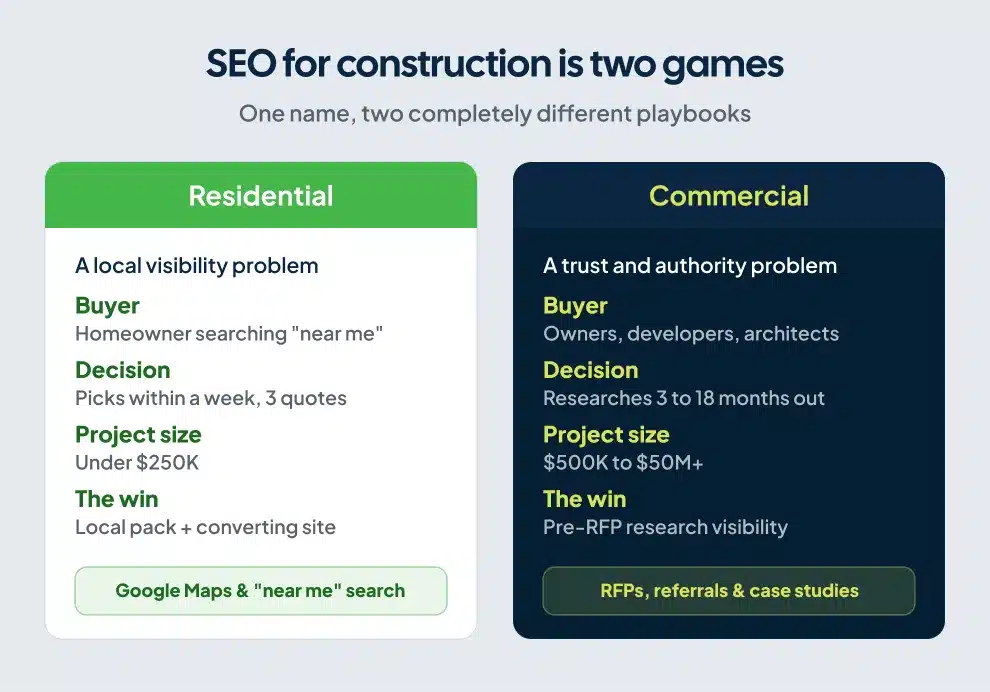
Residential signals (local pack focus)
-
Average project under $250K
-
Sales cycle under 30 days
-
Most leads from Google Maps and “near me” searches
-
Services include kitchen remodels, bathroom remodels, decks, roofing, additions, or custom homes
Commercial signals (authority and research focus)
-
Average project $500K to $50M+
-
Sales cycle 60 days to 18 months
-
Leads from RFPs, bid invitations, architect referrals, and repeat business
-
Projects include offices, industrial facilities, multifamily, healthcare, education, or government work
Hybrid firms (both tracks needed)
You do both. Residential work pays the bills today. Commercial work builds the future. You run two SEO programs from one website. Residential SEO lives in the local pack. Commercial SEO lives on a separate content track. We cover both below.
Quick three-question diagnostic
-
What is your average project value?
-
How long from first contact to signed contract?
-
Does most of your work come from local search, referrals, or RFPs?
Start with the section that aligns best.
What Changed in Construction SEO Since 2024
Three real shifts matter in 2026. Everything else is noise. We pulled this data fromAhrefs in May 2026 andBrightLocal’s 2026 Local Search Ranking Factors survey.

AI Overviews now appear on most construction-related searches. Construction firms must now think about getting cited in Google’s AI answer, not only ranking organically. BrightLocal tracked AI search visibility as a ranking factor category for the first time in 2026.
Primary GBP category remains the number one local pack ranking factor. Choosing the wrong primary category is the single most damaging signal in the entire survey. Many contractors still default to “General Contractor” when “Custom Home Builder,” “Roofing Contractor,” or “Bathroom Remodeler” would match buyer intent more precisely.
Reviews matter more than they did three years ago. Review importance jumped from 16 percent in 2023 to 20 percent in 2026. A contractor with 12 reviews now competes against one with 80. The gap is harder to close with on-page work alone.
Link signals dropped for local pack rankings. Local backlinks still help, but the rate of return narrowed. This favors firms that focus on GBP, reviews, and service pages instead of chasing big link budgets.
Reddit and forum content ranks more often. Google now treats authentic practitioner discussion as a credibility signal. Construction firms should show up in r/Construction, contractor Facebook groups, and Trade Hounds to boost their SEO (and also to get leads from those discussions).
Local SEO for Contractors: The Residential Playbook
Get Your Google Business Profile Right First
Choose the most specific primary category. Not “General Contractor” unless that is the most accurate match. Consider Custom Home Builder, Home Builder, Bathroom Remodeler, Kitchen Remodeler, Roofing Contractor, Concrete Contractor, Excavating Contractor, Deck Builder, Siding Contractor, or Window Installation Service. Each has different competitive dynamics in the local pack.
Keep NAP (Name, Address, Phone) consistent across every directory. Name, address, and phone must match exactly on Google, Bing Places, Yelp, Houzz, Angi, BBB, Yellow Pages, and state contractor license databases. One typo on one directory costs map pack visibility.
Set your service area correctly. Residential firms get this wrong constantly. Either set your service area to the cities and ZIP codes you serve and hide your physical address, or show your physical address and rank in that exact location. Do not try both. Google penalizes service area abuse aggressively.
Typically, we see businesses with an address listed ranking above those using service areas. If you can display an address, you generally should.
Upload photos on a monthly cadence. Recency in your photo library is a measurable ranking factor. Upload progress shots, completed projects, team photos, equipment, and jobsite safety setups. One upload per week or one batch per month.
Post weekly on GBP. Project updates, before-and-afters, and seasonal offers keep the profile in active business status. Most contractors stop after the first month and lose ground.
Pre-answer questions in the Q&A section. Are you licensed and insured? Do you do permitting? What is your minimum project size? Do you handle financing? These are the questions you get on the phone every day.
Build Service Pages That Match Local Search Intent
Create one page per primary service + location. Not a single Services page with a list.
Structure each page like this.
-
H1 with service plus city where you have a physical location.
-
Problem the homeowner has.
-
Your process for solving it.
-
Photo gallery of completed projects in that service area.
-
P
-
FAQs.
-
Internal links to related services.
Service area pages versus service pages matter more than ever after the March 2026 Core Update. A bathroom-remodeling page targets the service. A bathroom-remodeling-colorado-springs page targets the service plus location.
Both can exist if the content is genuinely different. Swapping only the city name creates thin, templated content that Google now treats as low-value doorway pages and demotes. The pages that hold or gain rankings include real local photos, specific community references, and details from actual jobs in that area.
Google’s March 2026 punished weak Service area pages (SAPs). These pages still remain valuable for multi-location or service-area businesses, but they must now demonstrate real differentiation:
-
Make them genuinely unique. Include location-specific details (local projects, community references, photos from that exact area, unique challenges in that ZIP/city). Swapping only the city name creates doorway-page risk and is now actively penalized.
-
Tie to real operations. Reference actual jobs completed in the area, team members who work there, or local partnerships. This signals “Information Gain” and E-E-A-T.
-
Structure for both users and Google. Use clear H1/H2s with the service + location, add unique FAQs, testimonials from that area, and schema (Service + LocalBusiness).
-
Avoid abuse. Do not create dozens of near-identical pages or hide your physical address while claiming unrealistic service radii. Google continues to penalize aggressive service-area manipulation (consistent with pre-update guidance).
-
Pair with strong GBP. Primary category accuracy, recent photos, weekly posts, and review responses remain critical (primary category is still the #1 local pack factor per 2026 data).
Use schema markup. Use GeneralContractor or the more specific subtype such as RoofingContractor or HousePainter under HomeAndConstructionBusiness. Pair with Service schema on individual service pages and Review schema where you have genuine testimonials.
Reviews as a Ranking and Conversion Lever
Aim for at least twice the review count of the next competitor in your local pack. If competitors have 30 reviews, target 60 plus.
Ask every customer for a review at project completion, in person. Email follow-up requests convert at low single-digit rates. In-person asks at project handoff hit much higher rates.
Respond to every review, positive and negative. Response rate is now a signal Google reads. Negative review responses matter most. Stay calm. Be specific. Take ownership. Never argue. Never apologize for things outside your control.
Ask happy customers to upload one photo with their review. Photo-rich reviews carry more weight in local pack scoring based on practitioner reports we have seen. Whitespark data does not split this out yet, so treat it as observed pattern rather than proven factor.
On-Page Basics That Still Earn Ranking
Title tags follow a boring, repeatable winner. Service plus city followed by company name. Bathroom Remodeling in Colorado Springs | ClearBrand beats Beautiful Bathrooms for Your Family by Our Award-Winning Team.
Headings follow buyer questions. H1 includes the primary keyword. H2s cover the questions a buyer would ask before signing a contract.
Images follow three rules. WebP format. Compressed under 200 KB. Alt text and file names describes the project, not image1.jpg. File names use hyphens, not underscores.
Page speed targets are non-negotiable. Largest Contentful Paint under 2.5 seconds. Cumulative Layout Shift under 0.1. We published a detailed walk-through of these targets on our Webflow SEO service page. Mobile responsiveness matters because more than half of construction searches happen on mobile. If the contact form is hard to tap, you lose leads regardless of ranking.
SEO for General Contractors and Commercial Construction Firms
Why Commercial Construction Buyers Research Months Before Contacting You
The Construction Marketing Association states 82 percent of construction buyers research firms online before making contact. Decision committees average six or more stakeholders. Owner. GC. Architect. Engineer. Facilities director. Sometimes a third-party project manager. Each researches independently.
The window where SEO matters is the pre-RFP research phase. By the time the RFP arrives, the shortlist is already set. Your website must be discoverable for the questions a committee asks six months before an RFP, not the keywords they type the day they sign a contract.
IBISWorld’s 2026 Commercial Building Construction report puts the U.S. market at $315.5 billion with a 2.2 percent five-year CAGR. Office vacancies sit at 17.8 percent as of March 2026. These numbers show why trust signals and case studies matter more than ever.
Content Commercial Construction Buyers Want
Write case studies with named projects, named clients where you have permission, and specific numbers. Square footage. Project value. Timeline. Challenges solved. Avoid “we delivered an amazing experience.” State what you built and what it cost.
Create capability sheets and project portfolios formatted for download. PDFs that procurement teams can share internally.
Build project type pages. Healthcare construction. Education construction. Industrial fit-outs. Each needs a separate URL with deep content about how you handle that vertical’s specific challenges. Clean rooms. ADA compliance. MEP coordination. Occupied-building work.
Write process content. How you scope a job. How you handle change orders. How you communicate with owner’s reps. Procurement people read this before sending an invitation to bid.
Schema and Structured Data for Commercial Firms
Use GeneralContractor schema at the organization level. Add Project markup or CreativeWork markup to case study pages. Use FAQPage schema on bid-process and how-we-work pages. Add Organization schema with sameAs properties linking to your verified profiles on AGC, ENR, industry-specific platforms, and your LinkedIn company page.
AI Search Visibility for the Long Sales Cycle
ChatGPT, Perplexity, and Google AI Overviews are now the first stop in pre-RFP research. A facilities director looking for “best healthcare construction firms in Denver” sees AI-generated answers that cite specific firms.
Three things correlate with getting cited.
-
Authoritative third-party mentions in ENR, Construction Executive, local business journals, and AGC chapter coverage.
-
Structured, fact-dense content on your own site. Project portfolios with project value, timeline, and square footage are easier to cite than marketing prose.
-
Schema markup that explicitly identifies your firm’s specialties.
We runAEO work at ClearBrand for exactly this reason. The service focuses on getting clients cited in AI answers.
Digital PR for Commercial Visibility
Submit completed projects to ENR, regional business journals, and AGC chapter newsletters. Pursue speaking slots at CONEXPO, World of Concrete, and AIA local chapters for design-build firms.
Get team members published as authors in trade publications such as Construction Executive and Building Design+Construction. These efforts move the needle on AI citations and authority signals more than another thirty blog posts on kitchen remodeling tips.
Keyword Research for Construction (Without Wasting Six Months)
You do not need six months or enterprise tools.
Start with three seed terms. Your service plus your city. Your service plus near me. Your service alone. Use Ahrefs Keywords Explorer or Google Keyword Planner, free with an active Google Ads account, to expand.
Map keywords to the buyer’s decision stage.
-
Top of funnel: how to remodel a bathroom or cost to build a custom home in Colorado Springs.
-
Middle of funnel: bathroom remodeling contractor Colorado Springs or custom home builder near me.
-
Bottom of funnel: competitor name plus reviews or your own company name.
Bottom-of-funnel keywords matter more than most contractors realize. Brand searches on you and your competitors happen whether you optimize for them or not.
Keywords Most Construction Firms Ignore but Should Not
If you were running ads, terms like “cost for [service] in [city]” carry high intent and high cost. Worth a content page that gives honest ranges plus the variables that drive cost.
“[service] vs [alternative service]” catches buyers comparing options. “Drywall vs plaster” for finishing contractors. “Deck vs patio” for outdoor builders.
“Best [service] companies in [city]” is a listicle-style query where you want to rank on your own listicle or earn placement on someone else’s.
“How long does [project] take” answers process and timeline questions buyers ask before signing.
The Website Itself: Where Construction Firms Lose Deals SEO Worked Hard to Earn
Most construction sites are visually fine and conversion-disastrous. SEO brings the traffic. The website either turns it into leads or leaks it.
Speed is not optional. Slow sites lose paid ad spend and organic traffic at the same rate. Target sub-2.5-second Largest Contentful Paint. The most common culprit on construction sites is an uncompressed hero image of a finished project.
Trust signals belong above the fold. License numbers. Insurance status. Years in business. BBB rating. Association memberships such as AGC, NAHB, NARI. A homeowner about to commit $80,000 to a remodel needs these in the first scroll.
Project portfolios need filters that work. A gallery of 200 projects with no filtering is unreadable. A gallery filterable by project type, location, and budget range is a sales tool.
Forms must match the buyer’s stage. A commercial firm should not have a 25-field RFP form on the homepage. A residential remodeler should not have a 3-field form that does not capture budget. The right form depth depends on lead value.
The general rule of thumb is to limit form fields to no more than 5, unless absolutely necessary.
We build construction websites on Webflow at ClearBrand. We chose Webflow because the CMS handles project portfolios cleanly, the platform’s page speed defaults outperform most WordPress setups, and the visual design flexibility matches what construction buyers expect from a modern firm.
If you run heavy field operations and need tight integration with ServiceTitan or JobNimbus, a WordPress build with those integrations may serve you better. If your priority is design quality and the website itself being a sales asset, Webflow is what we recommend.
What to Build vs What to Fix on Your Existing Site
If your site is more than 4 years old, probably rebuild. Mobile design standards, page speed, and search expectations have all shifted.
If your site is 1 to 3 years old and on a modern platform such as Webflow, modern WordPress, or Squarespace 7.1, probably fix. Focus on GBP, schema, and page speed wins first.
If your site is on a builder you cannot modify such as Wix, GoDaddy site builder, or an old custom CMS, rebuild on a better platform.
How Long Until SEO Pays Off for Construction Firms?
Local pack rankings move in 30 to 90 days for properly optimized GBP plus service pages in low-to-medium competition markets. Big metros such as New York, Los Angeles, Chicago, Houston, and Atlanta take longer.

Organic rankings for “service plus city” terms take 3 to 6 months on a new site and 1 to 3 months on an existing site with domain history.
National commercial visibility takes 6 to 18 months. Authority for commercial construction terms compounds slowly because the competition includes firms that have been publishing for a decade.
AI citation visibility is still being measured. The working hypothesis is that you need great content with solid structure as the foundation, but authoritative third-party coverage matters more than on-site optimization for AI Overviews, ChatGPT, and Perplexity citations. Anyone telling you they can guarantee AI search visibility in 30 days is selling something that does not exist yet.
Doing It Yourself vs Hiring a Specialist
DIY makes sense if you have time for a few hours per week, your competition in the local pack is light, your project size is small, and you enjoy the work.
A freelancer or small specialist makes sense if you are a single-location residential contractor in a competitive market and need GBP, on-page, and content help on a budget under $1,500 per month.
A specialized agency makes sense if you operate in multiple markets, you need a website rebuild, you are going after commercial work where authority and AI search visibility matter, or your time is more valuable spent running the business.
Frequently Asked Questions
What is SEO in construction?
SEO for construction means optimizing your website and online presence so search engines surface your company when buyers search for construction services. For residential firms, that is primarily about ranking in Google Maps and local search results. For commercial firms, it is about showing up in research queries before any RFP gets sent.
How much does SEO cost for a construction company?
Specialist construction SEO ranges from about 1,500 dollars per month at the entry level to 15,000 dollars plus per month for enterprise commercial firms. Most mid-market residential contractors land in the 2,500 to 6,000 dollar per month range.
How long does SEO take to work for construction companies?
Local pack visibility can move within 30 to 90 days for properly optimized GBP setups. Organic rankings for service plus city terms typically take 3 to 6 months. National commercial authority builds over 6 to 18 months. Anyone promising 30-day national rankings should be treated with skepticism.
Is SEO worth it for construction companies in 2026?
For residential contractors competing against firms that show up in the map pack, yes. Buyers searching for kitchen remodeler near me pick from the map pack at the top of the page far more often than they scroll to organic results. For commercial firms, SEO matters most as a trust signal during the pre-RFP research window.
What is the difference between SEO for general contractors and specialty trades?
General contractors compete across dozens of keyword categories at once because they offer many services. Specialty trades such as roofers, electricians, plumbers, and concrete contractors compete in a narrower set of high-intent terms. Specialty trades typically see faster local pack results. GCs typically need more content depth to cover their service breadth.
Do construction companies need to worry about AI Overviews?
For residential, AI Overviews appear on informational queries such as how much does a roof cost more than on bottom-funnel local queries such as roofer near me. For commercial, AI Overviews show up across the pre-RFP research path and are now a meaningful visibility channel. Whether to invest in AEO work depends on where in the funnel your buyers do their research.
Where to Start This Week
If you are residential, audit your Google Business Profile. Check whether your primary category is the most specific match. Add five new project photos. Ask three recent customers for a Google review with a photo. That is a one-hour task that moves visibility within a week.
If you are commercial, pick three past projects with the largest budgets or most prestigious clients and write proper case study pages. Add Project schema. Submit each one to your local business journal and your AGC chapter newsletter. That is a one-week task that compounds for months.
If you are doing both, run the residential play this week and the commercial play next week. Do not try both simultaneously unless you have a team.
If you are an established construction company that wants more leads from search, you are the kind of firm we work with at ClearBrand.
We build the website on Webflow, run the SEO, and handle the AEO work for AI search visibility.
If that matches what you are looking for, schedule a call atclearbrand.com/right-fit.
If you are just getting started, a specialist freelancer is probably a better starting point. If you are larger or doing primarily enterprise commercial work, Percepture or a similar enterprise construction marketing firm is probably a closer match.
The goal of this article is for you to make a good decision, not necessarily our decision.
ClearBrand has helped construction firms improve local pack rankings and pre-RFP visibility since 2017. Results vary by market and execution. This playbook reflects what we have seen work consistently across projects.