
By Alexander Toth, Founder and CEO, ClearBrand
KleerCard came to us with a problem you might recognize. They had a real product and paying customers, but zero leads from organic search. Every new lead came from outbound, referrals, or paid spend. The kind of growth that stops the moment you stop spending.
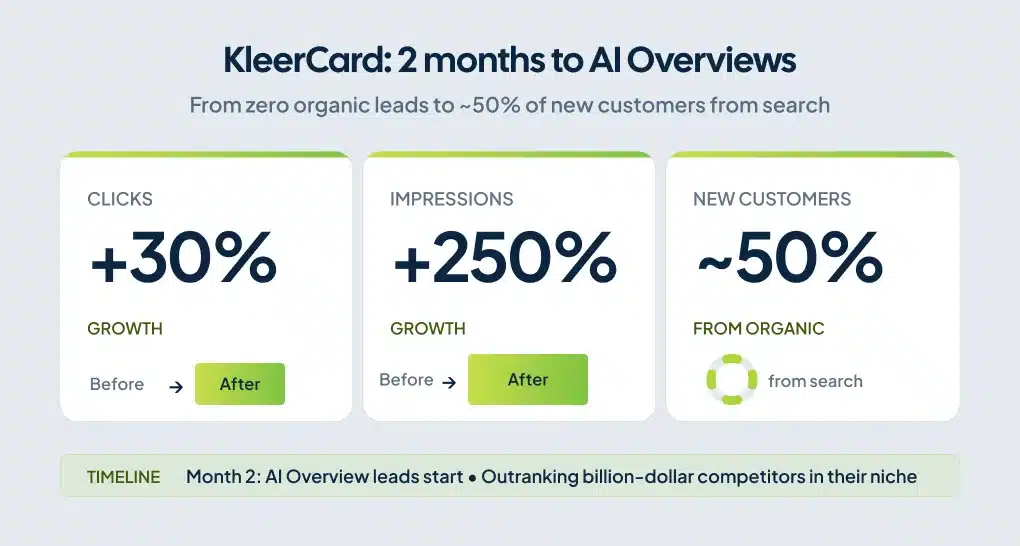
Two months into working with us, KleerCard was showing up in AI Overviews for high intent searches with real buyers. Clicks were up more than 30%, impressions were up more than 250%, and search was bringing in leads.
Today, organic search drives roughly half of all new customers for KleerCard. And they’re outranking multiple billion-dollar competitors for the terms they care about most.
This article is the playbook we used to get there. I’ve been running ClearBrand since 2017, and this kind of work is most of what we do for companies. So what follows is the conversation I’d have with you over coffee if you asked, “should I be doing SEO right now?”
What is SEO for startups?
SEO for startups is the work of helping a company’s website rank in search engines. The goal is for the right buyers to find you without you paying for every click. The “for startups” part matters because your constraints are different from a Fortune 500. You have less time, less budget, and a domain Google barely knows exists.
The work breaks down into three things, in this order. First, fix the technical mistakes that kill new websites before they ever rank. Second, get found for searches your customers are already making. Third, build enough content to compound traffic over 6 to 12 months.
For this article, I’m defining “startup” as any business in its first three years, with a small team and limited marketing spend.
Why SEO matters for startups (and when it doesn’t)
I’ll give you the answer most agencies won’t. SEO is not always right for a startup.
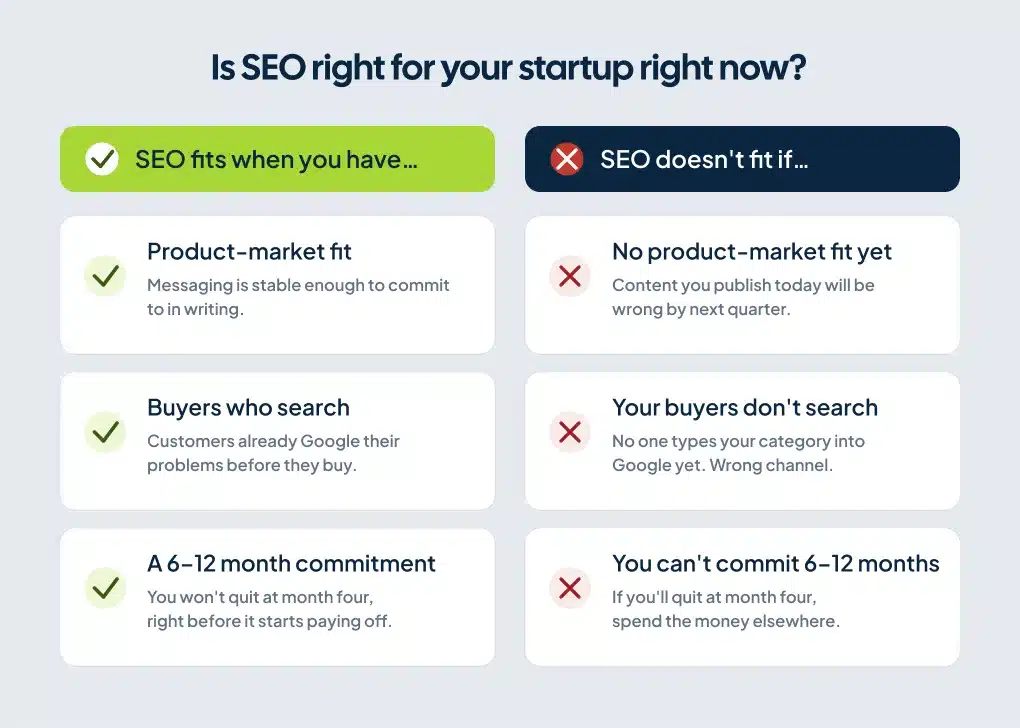
If you don’t have product-market fit yet, SEO will amplify the wrong message and burn the runway you have left. And if your customers don’t search for what you sell, you’ll rank for keywords that bring traffic but no revenue.
When SEO does fit, you get a channel that gets cheaper as it grows. Paid channels charge you per click, per impression, and per lead, every single time. SEO charges you a flat fee that compounds. You write articles, build pages, earn links, and the traffic compounds for years. The longer you do it, the more leads and sales you get (if it’s done right).
Ahrefs is a useful example here. They’ve published that their blog generates around 1.1 million monthly visits from search. They estimate that buying that same traffic with paid ads would cost roughly $2 million per month.
Three reasons SEO is worth it for a startup:
- People search for solutions, then brands. A 2014 Google study with Millward Brown Digital found that 71% of B2B researchers start with a generic search, not a branded one. KleerCard fit this pattern. Their buyers (church administrators, nonprofit operations leads, educators) were searching for category solutions, not the KleerCard brand. We ranked for those category searches, and the leads followed.
- Organic traffic compounds. One article ranked at position three for a 500-search keyword can bring you 50 to 80 qualified visits a month for years. Stack 50 of those and you have a real channel.
- It builds you a moat. Once you rank, your competitors have to outspend, outwrite, and outlast you to take the position. And the longer you do it, the harder it gets for them.
Three reasons SEO is not right for your startup right now:
- You don’t have product-market fit yet. If your messaging shifts every month, the content you publish today will be wrong by next quarter.
- Your buyers don’t search. If you sell something so new that nobody types it into Google, SEO is the wrong channel until search demand exists.
- You can’t commit for 6 to 12 months. SEO does not produce meaningful results in 30 days. If you quit at month four, you’ll leave right before the work starts paying off.
The biggest mistake we see startups make with SEO
After years of working with SaaS and B2B companies on this, one pattern comes up over and over. Founders chase speed instead of quality or consistency.
It looks like this. You read an article (probably one like this) and decide to get serious about SEO. You publish ten posts in a week, redo the homepage, and buy Ahrefs.
Three months later, nothing has happened. You conclude SEO is broken and you stop.
What works is the opposite. One well-researched article published every week for 52 weeks beats ten articles published in one frantic week followed by nothing. SEO is a compounding asset, and compounding assets reward time in the market, not timing the market.
KleerCard’s results didn’t come from a sprint. They came from steady, weekly publishing on the topics their buyers were already searching for, without a missed week.
When should a startup start investing in SEO?
The clearest case study on timing comes from PostHog. They didn’t start serious SEO until January 2022, two years after the company was founded. By that point they had revenue, a clear ideal customer profile, and strong retention.
Their long-term SEO bets paid off because the foundation didn’t shift underneath them. They tripled SEO traffic in 12 months.
What I take from PostHog’s experience: don’t invest heavily until the foundation is stable.
A framework that works:
Start small (1 to 5 hours per week) from day one. Set up Google Search Console. Publish your homepage and core service pages with clear titles and meta descriptions. Write three or four comparison articles against known alternatives.
Go heavy (10+ hours per week or a dedicated hire) once you have:
- Real revenue from a defined customer profile.
- Retention strong enough that you trust the funnel.
- Messaging stable enough that the article you publish today will still be true in 12 months.
If you’re not there yet, focus on product. SEO doesn’t fix a leaky funnel. It magnifies it.
How startup SEO is different from enterprise SEO
A lot of SEO advice was written for sites with 10,000 indexed pages and a Domain Rating of 75. If you’re running a six-month-old website (or a six-year-old website) with two dozen pages and almost no backlinks, that advice will lead you wrong.
Three things change for startups, especially if you have well-funded competitors:
Keyword difficulty matters more. With a low-authority domain, you can’t compete for high-volume head terms. Ahrefs gives every keyword a Keyword Difficulty (KD) score from 0 to 100. For a new site, you want keywords with KD under 20, often under 10. Salesforce can rank for “CRM software.” You can’t yet. Pick topics you can win.
You need to defend your name and category first. Before you chase informational traffic, lock down searches where someone is already partway down the funnel. PostHog calls this “defensive SEO” and recommends startups do it before competitors swoop in. Examples: “your product vs Competitor A,” “alternatives to Competitor B,” “how to migrate from Tool X.”
Topic clusters beat scattered posts. A new site builds authority by going deep on one narrow topic, not wide across fifty. Pick where you have the most expertise. Publish five to ten related articles before you move on. We did this with KleerCard with tight clusters around elements of their product that aligned with their buyers’ actual pain points (and searches), instead of broad fintech content that would never have ranked.
The Compounding 8: ClearBrand’s startup SEO playbook
We’ve built and tested this sequence across small business and startup clients. The order matters more than the individual tactics. Skipping the early steps to chase content is the most common reason startup SEO fails.
Step 1: Decide if SEO is even right for you
Go back to the framework I shared above. Product-market fit, buyers who search, and a 12-month commitment. If you have all three, keep reading. If you don’t, fix that first or pick a different channel.
Step 2: Fix the technical foundation before publishing anything
A lot of startup websites lose to Google before they’ve published a single article. The first thing we do on any new SEO engagement is a technical audit. The same handful of issues come up repeatedly: missing sitemaps, slow mobile load times, broken internal links, headers not sequenced properly, and duplicate title tags across multiple pages.
Before you publish content, your site needs:
- To load in under three seconds on mobile. Check with PageSpeed Insights.
- An XML sitemap submitted to Google Search Console.
- HTTPS site-wide.
- Clean URLs (short, lowercase, hyphen-separated, no stop words).
- No 404 errors on key pages.
- A clear page hierarchy: homepage, then category pages, then individual posts or services.
One note on speed scores. Google’s John Mueller has said many times that perfect Core Web Vitals scores are not a ranking shortcut. PostHog’s Andy Vandervell put it this way: get your scores in a decent place, but spend more time on your content and website UX.
That matches what we see. Decent and stable beats perfect. You can spend 100 hours optimizing your site to make it perfect. Or you can spend 5 to get it above the watermark, then 95 on the next steps.
Step 3: Lock down your defensive keywords first
Before you chase informational traffic, secure the searches where someone is already partway down the buying funnel.
Write these pages in your first month:
- A “Your Product vs [Competitor]” comparison page for each of your top two or three named competitors.
- An “Alternatives to [Competitor]” page for the biggest players in your category.
- A “Best [Product/Category] in [Year]” listicle. People often search for “best vacuum cleaners,” “best credit cards for churches,” “best seo agencies,” etc. As of right now, AI loves to cite these types of articles.
- A clear, keyword-rich landing page for the exact thing you sell, named the way customers search for it.
These pages convert. Someone searching “ClearBrand vs HubSpot” is not browsing. They’re choosing. Ranking for searches like this is often easier than ranking for broad informational keywords, because the volume is lower and the competition is thinner.
Step 4: Do keyword research the right way
Most keyword research advice tells you to brainstorm 200 keywords and dump them in a spreadsheet. If you do that, you’ll never write the content.
A better approach, and the one we used for KleerCard:
- Ask your existing customers what they searched for when they found you. Their language becomes your keyword list.
- Type your seed terms into Google. Read the autocomplete suggestions and the “People Also Ask” boxes. These are real searches, free.
- Check volume and difficulty in Ahrefs, Semrush, or the free Google Keyword Planner. For a new domain, ignore anything with KD over 20 in the first six months.
- Sort by intent, not volume. A keyword with 200 searches and high purchase intent will out-earn a 5,000-search keyword that brings tire-kickers.
For KleerCard, we focused on the exact searches that church administrators, nonprofit operations leads, and educators were running. We avoided high-volume fintech terms that they could not win and would have brought the wrong traffic.
Start with 30 to 50 keywords organized by funnel stage. Awareness keywords are broad and informational. Consideration keywords cover comparisons and tools. Decision keywords show purchase intent: pricing, alternatives, ready-to-buy.
Step 5: Write content that helps a real person
A lot of agencies write for keyword density and word count. Google has gotten much better at distinguishing useful content from content padded to hit a target. So have your buyers.
Andy Vandervell at PostHog framed this well. He asks if your content is “share it with a friend you like and respect” great. Or if it’s “share it on LinkedIn with a hashtag” great.
The bar I’d hold your content to:
- It makes a recommendation. Hedging doesn’t rank, because hedging isn’t useful. (And I personally can’t stand it, so maybe we can make the internet a better place together.)
- It goes beyond explaining the topic. AI can explain things. You need to do something AI can’t, like share lived experience, original data, or a clear point of view.
- It would be useful to someone who already knows the topic, not a beginner.
- It helps the reader make a decision.
A few practical notes on structure. Lead with the answer. Don’t bury it 800 words in.
Use H2s and H3s the way a book uses chapters. Keep paragraphs to one to three sentences. Cite primary sources directly, with a link.
Step 6: Build links the slow, honest way
Link building for startups is not link buying. It’s not commenting on blogs. It’s not directory submissions. Those tactics either fail or actively hurt you.
What does work for startups:
- Original data and research. Pull data nobody else has. Publish it. Reporters and bloggers cite original data because they need it for their own articles.
- Defensive content links. Other sites might link to your “Tool X vs Tool Y” page if it’s the most useful comparison on the internet.
- Partner and integration pages. If you integrate with Stripe, Stripe might link to you. Mutual partner mentions create natural links.
- Founder-led content. A founder on three industry podcasts a quarter will earn more relevant links than any outreach campaign. Guest posts also work for this.
The metric to watch in Ahrefs or Semrush is referring domains, not total backlinks. 30 unique domains linking to you is far better than 300 links from three domains.
Step 7: Optimize for AI search alongside Google
SEO doesn’t mean only Google anymore. People are asking ChatGPT, Perplexity, Gemini, and Google’s AI Overviews the same questions they used to type into a search bar. We call the work of optimizing for these systems Answer Engine Optimization (AEO).
KleerCard is my clearest example of why this matters. Two months into the engagement, they started getting qualified leads from AI Overviews, ChatGPT, and Perplexity. Two months. That’s faster than most traditional SEO results show up on page one of Google.
Specific moves that help in AI search:
- Use clear, direct first sentences in each section. AI tends to pull the cleanest declarative sentences as citations.
- Include explicit definitions and lists. AI models grab structured content first.
- Cite primary sources. AI models prefer pages that cite their facts.
- Get cited in trusted publications. AI models reference what other trusted sources reference.
Google’s AI Overview appears for “seo for startups” and similar informational searches. I confirmed this in the SERP analysis for this article using Ahrefs before writing it. We’ll see if it ranks (though, candidly, we’re competing with some big names).
Step 8: Measure what matters and cut what doesn’t
A lot of startup SEO dashboards measure the wrong things. Pageviews look good in a board deck and tell you nothing about revenue.
The metrics worth watching:
-
- Organic traffic to your top 10 commercial pages. Not total traffic. Traffic to pages that convert.
- Keyword rankings for your top 30 commercial keywords. Track weekly in Google Search Console or a paid tool.
- Referring domain growth. New unique sites linking to you each month.
- Pipeline or revenue attributed to organic search. This is the number that justifies the channel. For KleerCard, this eventually crossed 50% of new customers.
- AI visibility. We use Rankability to track this for ourselves and our clients.
Review monthly. Kill pages that still have near-zero traffic six months after publication. Update pages ranking on page two through five with fresher data and clearer answers. The compounding part of SEO comes from this maintenance loop, not from publishing alone.
How much does SEO cost for a startup?
Real cost ranges, with the honest tradeoffs:
| Approach | Typical cost | What you get | Best for |
| DIY (founder or marketer) | $0 to $200/month for tools | Slow start, full control, every mistake is yours to learn from | Pre-seed and seed-stage with one founder who has time |
| Freelancer | $50 to $150/hour, often $1,000 to $3,000/month retainer | Specialized expertise on demand, but coordination overhead | Seed to Series A, when you know what you need |
| Specialized agency | $2,000 to $10,000+/month | A team executing a strategy, with accountability and reporting | Series A and beyond, or any startup that wants to move fast |
| In-house SEO hire | $70,000 to $130,000/year, plus tools | Full ownership and product-specific knowledge over time | Series B and beyond with a clear long-term SEO bet |
A few source notes. Ahrefs’ SEO pricing survey of 439 SEOs found consultancies average $171/hour, agencies $99/hour, and freelancers $72/hour. The overall average across all SEOs surveyed was $111/hour. The agency monthly retainer and in-house salary ranges in the table above are industry-typical ranges I’ve put together for this article, not surveyed data.
The cheapest option is also the slowest. The fastest option is the most expensive. There’s no shortcut. Most startups should expect to spend at least $5,000 a month on SEO once they’re past product-market fit and serious about the channel.
Common SEO mistakes startups make
These are the patterns I see kill SEO progress for months before founders notice.
Chasing speed instead of consistency. Covered above. The most expensive mistake on this list.
Writing with AI. It’s doable, but the Dunning–Kruger effect is real. Google is getting better at finding and punishing “AI slop.” If you don’t know how to write with AI without it being slop, hire it out.
Writing content that’s not better than your competition. If it’s not better, it won’t rank.
Targeting keywords way above your domain’s weight class. A KD 60 keyword is wishful thinking for a six-month-old site. Aim under 20 until you’ve built authority.
Publishing isolated blog posts instead of topic clusters. One post on a topic rarely ranks. Five to ten interlinked posts on a tight topic often does.
Skipping technical SEO because the platform “handles it.” No platform handles it perfectly. Audit your own site.
Buying links from sketchy vendors. Worse than no links. Google penalizes link networks, and recovery takes months.
Writing for keywords instead of customers. If your content reads like a robot summarizing Wikipedia, Google can tell. So can your customers.
Quitting at month four. Real SEO results show between months six and twelve. If someone tells you to quit at month three, they don’t understand the channel.
Not measuring revenue impact. Pageviews are vanity. Pipeline is sanity.
How long does SEO take for startups?
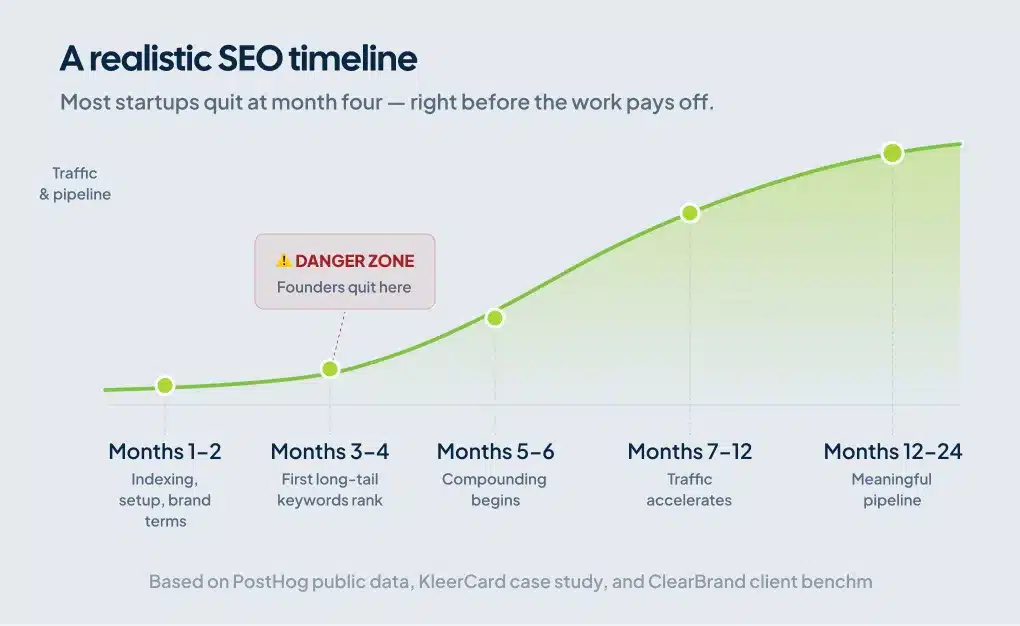
An honest timeline, based on published case studies and what we see across our client base:
- Months 1 to 2: Google indexes your pages, tracking is set up, fix technical issues, and you’ll see a slight boost in traffic from brand terms. (Caveat: AI Overview citations can happen this early. KleerCard started getting AI Overview leads at month two, but they started with a Domain Rating of 20.)
- Months 3 to 4: First long-tail keywords start ranking on page one through three. Traffic grows by hundreds, not thousands.
- Months 5 to 6: Compound effects begin. Articles published in months one and two start ranking on page one for their main keywords.
- Months 7 to 12: Traffic accelerates as authority builds. Earlier pages keep ranking higher. New pages rank faster.
- Months 12 to 24: SEO becomes a meaningful share of pipeline if the work has been consistent.
PostHog reported three months for their earliest work to show meaningful results, six months for serious growth, and 12 months to triple their SEO traffic.
If you’re seeing no movement at all by month nine with consistent work, something is off. Either the technical foundation is broken, the keywords are too competitive, or the content isn’t useful enough.
Frequently asked questions
How long does SEO take to show results for a startup?
Most startups see early signal between three and six months, and meaningful traffic between six and twelve months. Long-tail, low-competition keywords can rank within weeks. Competitive head terms can take a year or more. AI Overview citations can happen as early as month two with the right structure and content quality.
Is SEO worth it for a startup with no budget?
It can be, if a founder or early teammate has the time to do the work. Free tools (Google Search Console, Google Keyword Planner) plus consistent publishing will get you part of the way. Ahrefs and Semrush make the work faster, but they’re not required. For most startups, the bigger constraint is time, not money.
Should a startup hire an SEO agency or do it in-house?
Depends on stage. Pre-seed and seed: a founder or one marketer usually handles it. Series A and beyond: an agency or freelancer often makes sense to move faster. Series B and beyond: in-house hires start to compound.
The wrong move is hiring a $500-a-month agency. Cheap SEO is almost always worse than no SEO.
What’s the difference between SEO and AEO?
SEO (Search Engine Optimization) targets traditional search engines like Google. AEO (Answer Engine Optimization) targets AI-powered answer engines like ChatGPT, Perplexity, Claude, and Google’s AI Overviews. They overlap. Most work that ranks you in Google also helps you get cited in AI answers. AEO puts more weight on direct, declarative writing and primary sources. SEO puts more weight on domain authority and backlinks.
Can a startup compete with large brands in SEO?
Yes, but not on their terms. You can’t outrank Salesforce on “CRM software.” You can outrank them on “best CRM for solo consultants” or on “alternatives to Salesforce for small businesses.” Niche depth beats brand authority in long-tail search. We helped KleerCard outrank much larger fintech competitors in their specific buyer niches. They did it by being more useful, more specific, and more consistent.
How many blog posts should a startup publish per month?
Quality matters more than quantity. Four to eight well-researched articles a month will help you more than 20 thin ones. Our standard at ClearBrand for committed SEO clients is a minimum of two articles or pages per week that are high-quality and structured into topic clusters.
What to do next
If you’ve read this far, you have enough to start. The smallest useful next step depends on where you are:
- Pre-launch or pre-PMF: Set up Google Search Console today. Buy your domain if you haven’t. Write your homepage and three core service pages with clear, keyword-rich titles. Stop there for now.
- Post-PMF, no SEO work yet: Audit your existing site for technical issues this week. Write your first three defensive comparison pages this month. Build a 30-keyword list before you publish your first informational article.
- Already publishing but not seeing results: Pull your last 12 months of content. Find the five articles ranking on page two. Update them with fresher data and clearer answers. That’s faster than writing five new articles.
- Looking for a partner: We build SEO programs at ClearBrand for SaaS and B2B companies generating between $1M and $50M in annual revenue. We commit to a minimum of two articles or pages per week, and we deliver every one, on time. KleerCard went from zero search traffic to roughly half of new customers from organic. I’d be glad to talk through what that could look like for your company. Talk to a Growth Director.
About the author
Alexander Toth is the founder and CEO of ClearBrand, a digital marketing agency in Colorado Springs, Colorado. ClearBrand specializes in Webflow web design, SEO, and Answer Engine Optimization (AEO) for B2B and SaaS companies. Alexander has led ClearBrand since 2017.
He’s been featured as a marketing expert on podcasts including Marketing Made Simple and Marketing Boost Solutions. The ClearBrand Marketing Podcast and YouTube channel have been viewed hundreds of thousands of times.