
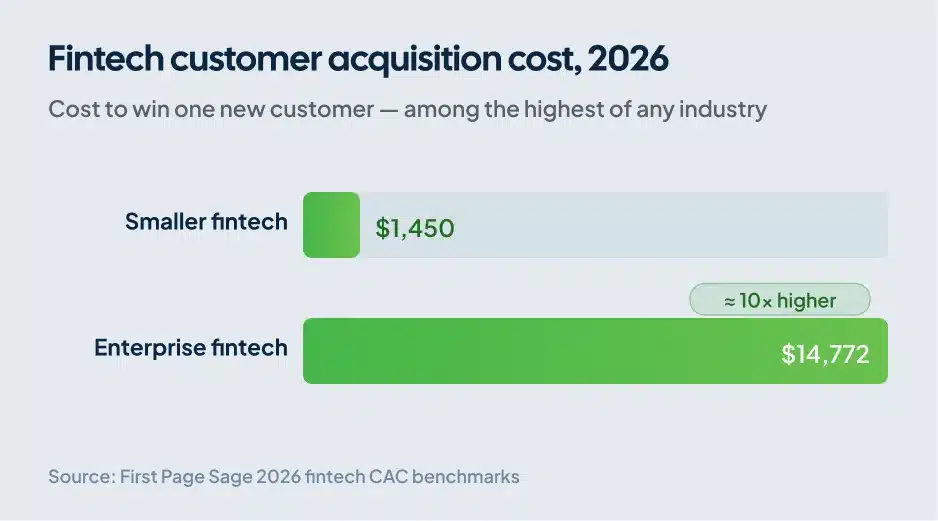
Acquiring a fintech customer costs more than almost any other industry. First Page Sage’s 2026 fintech benchmarks put acquisition near $1,450 for smaller fintech companies and around $14,772 for enterprise fintech.
The reason sits underneath every campaign. You are asking someone to trust you with their money and their data.
That trust is slow to earn and quick to lose. Every claim you make falls under the standard Google calls Your Money or Your Life.
I run ClearBrand, a Webflow agency that handles SEO and AI search for SaaS, fintech, and B2B companies. We took one fintech client from near-zero search traffic to about half of its new customers arriving through organic search. I will share the approach that did it, along with the parts I would tell you to skip.
Fintech marketing, and why it plays by different rules
Fintech marketing is how a financial technology company earns trust, attracts the right users, and turns them into funded customers under strict financial rules. It blends education-first content, search and AI visibility, paid acquisition, and a conversion-focused website.
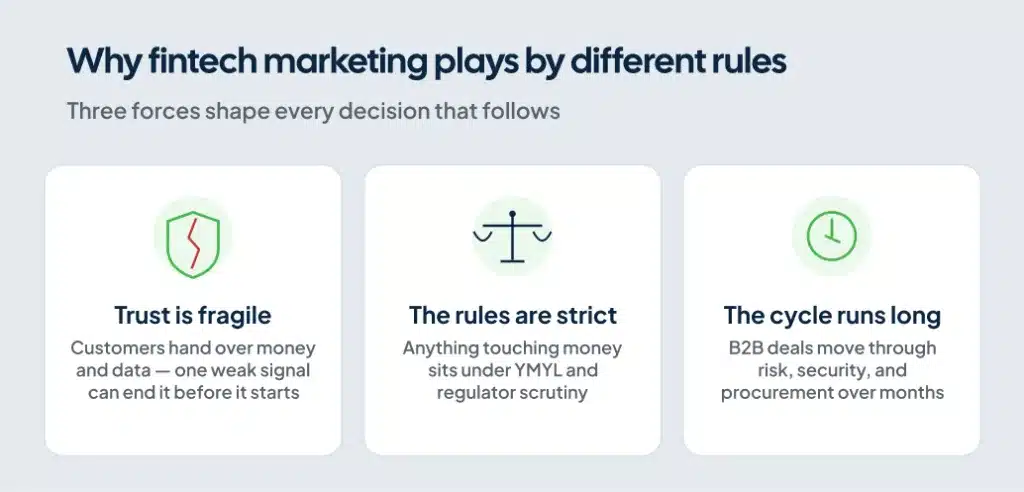
Three things separate it from marketing a normal product.
- Trust is fragile. People hand you their money and their personal data. One vague promise or a slow page can end the relationship before it starts.
- The rules are strict. Anything touching money, lending, or returns sits under YMYL standards. Accuracy and disclosure come before cleverness.
- The buying cycle runs long. In B2B fintech, a deal passes through risk, security, and procurement, often over months.
Hold those three in mind, because they shape every decision that follows.
Decide whether to spend at all before you spend a dollar
Start here, before any channel decision. You pay to grow in money or in time, and there is no version where growth is free.
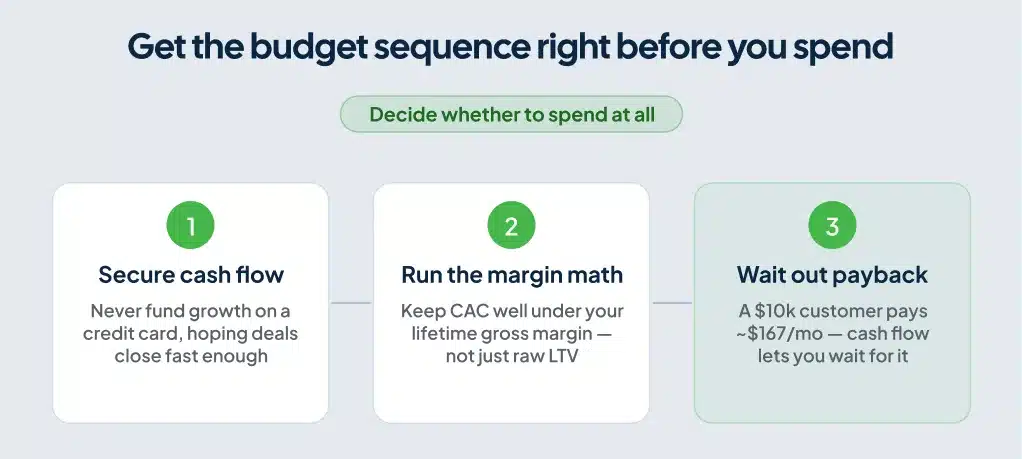
Cash flow comes first
Do not fund marketing on a credit card and hope deals close fast enough to cover it. That plan fails for almost everyone who tries it.
Early on, the work is direct outreach, hustle, and product-market fit. SEO and ads come after.
I tell founders the same thing every time. Never take a risk that can put you out of business. If the marketing falls flat, you should still be standing.
Run the lifetime value and margin math
Once cash flow is steady, look at what a new customer is worth. Spend $5,000 to bring on five customers worth $10,000 each over their lifetime, and you turned $5,000 into $50,000. Good trade.
Then sharpen the number. Cost of goods eats part of every dollar, so lifetime gross margin beats raw lifetime value. Keep your cost to acquire a customer well under that margin.
Watch the payback window
Headline lifetime value hides the timing. A $10,000 customer might pay you around $167 a month. The money is real, and it arrives slowly.
With cash flow in place, you can wait for it. Without cash flow, a slow payback can sink you. That is why cash flow comes first.
Know exactly who you are selling to
Acquisition costs this high punish a fuzzy target. The tighter your audience, the further every dollar goes.
A real ideal customer profile goes past age and income. It includes financial behavior, how often someone transacts, how much risk they tolerate, and how much education they need before they trust you.
Segments behave differently. Some users sign up fast and leave fast. Others take longer to win and stay for years. Map those tiers, then aim your budget at the ones worth keeping.
Build trust before you ask for the sale
In fintech, credibility is part of the product. You earn it out in the open.
- Be transparent. Clear language about fees, security, and how the product works removes the hesitation that kills signups.
- Show proof. Case studies, named testimonials, and third-party reviews carry more weight than adjectives ever will.
- Publish real expertise. Content from a named expert, backed by sources, tells buyers a credible person stands behind the brand.
Put a face on it too. A visible founder or expert author builds more trust than a logo.
Treat compliance as a system, not a last-minute blocker
Marketing money, lending, or returns means living under YMYL standards and several regulators at once.
The SEC watches investment messaging, and the FTC watches advertising claims. The CFPB covers consumer financial products, and state rules add their own requirements on lending and data.
Build the guardrails into the workflow so they speed you up instead of stalling you.
- Keep a library of approved, substantiated claims your team can reuse.
- Make risk language and disclaimers visible, not buried in a footer.
- Route content through legal review with a set turnaround, so approval never becomes the bottleneck.
Misleading projections or hidden terms invite fines and forced takedowns. They also burn trust in seconds.
Lead with content that teaches
Content is your path to the sale, not decoration on top of it. Someone has to understand your product and trust you before they move money. The content that works answers the questions they ask first.
- Explainers that make a financial concept or product feature clear.
- In-depth guides for high-stakes choices like lending, investing, or cash management.
- Comparison and alternative pages that catch buyers late in their research.
Judge content by what happens after the click. Activation, funded accounts, and retention matter more than raw pageviews.
This is the bar I hold our writing to. Each piece should be the best resource on the internet for its topic, then anchor a cluster of related pages around it. If you want the same approach mapped to a B2B audience, our B2B marketing strategies breakdown covers it.
Win search with SEO built for a YMYL category
Fintech SEO targets high-intent financial searches under a higher bar for accuracy (which Google refers to as “Your Money or Your Life” aka YMYL). Ranking takes clean technical performance and visible expertise together.
- Build keywords in tiers across informational, evaluative, and transactional intent.
- Keep the site fast, secure, and stable on mobile.
- Send strong E-E-A-T signals: a named author, cited sources, and reputable links.
- Use language that never overpromises a financial outcome.
Fintech SEO is a wide topic on its own. If search is a priority, our Webflow SEO agency page goes deeper than this section can.
Show up in AI answers, with the right expectations
Search is moving toward AI Overviews and assistants like ChatGPT. To get cited, become a source the models can read and trust. That means clear definitions, consistent terms, sourced claims, and full coverage of a topic.
One sequence has worked well for us. We earned a spot in a relevant listicle to get an early citation, then built out a knowledge base of supporting pages around it. We used that sequence on our own “webflow seo agency” page and saw it rank fairly quickly.
Keep it in proportion. Across our clients, AI search still drives a small share of total search, somewhere around 5 to 10 percent. Google sends most of the clicks and customers. Build for both, and do not let the newer channel pull budget from what works.
If you want the mechanics, start with what AEO is and how it differs across SEO, AEO, and GEO.
Run paid acquisition that optimizes for funded customers
Paid media is a strong growth lever in fintech when you control it tightly.
- Bid on high-intent searches tied to real actions, like opening an account or checking rates.
- Use LinkedIn for B2B targeting by role, company size, and industry.
- Keep ad copy inside FTC and platform rules. Claims need backing. Disclaimers need to be visible.
- Optimize toward funded accounts and approved applications, not raw lead volume.
- Track drop-off through identity checks, credit checks, and funding, then fix the funnel instead of buying more clicks.
That last point usually separates a profitable account from a leaky one. A cheap lead that never funds costs you more than an expensive one that does.
Make your website the conversion engine
Most fintech teams pour money into traffic and ignore the page that has to convert it. A slow or confusing site wastes everything you spent upstream.
A site that converts in fintech does a few things well. It loads fast, says what it does in plain language, and puts security and proof near the decision. It also strips friction out of signup.
We build on Webflow for that. We ran WordPress for years before moving to Webflow-only, and the cleaner build is worth it. It gives us the speed and design we want, and it lets a client’s own team edit safely.
I aim for 75 to 80 on PageSpeed Insights and a load under three seconds. That keeps a site fast enough to rank without giving up the design.
B2C and B2B fintech marketing are not the same job
Selling to consumers and selling to institutions are different jobs. They call for different channels and different messages. This table shows where to put your focus.
| Aspect | B2C fintech | B2B fintech |
| Primary goal | Mass signups, app installs, brand awareness | Pipeline, nurturing long deals, partnerships |
| Key channels | Social, influencers, SEO, content, app store | LinkedIn, content, account-based marketing, events |
| Message | Simplicity, convenience, everyday benefit | ROI, security, compliance, integration |
| Sales cycle | Short, often days | Long, months, several decision-makers |
| Core metrics | Cost per install, CAC, engagement, churn | Cost per lead, qualified leads, pipeline, win rate |
Measure the numbers that predict profit
Fintech marketing answers to finance, so report metrics that map to money. Track CAC, the ratio of lifetime value to CAC, payback period, activation and funded rate, and retention. Watch funnel completion through onboarding, not reach for its own sake.
Use Google Search Console for how people find you, and analytics for what they do next. Last-click attribution undercounts the education and brand work that earns trust early. Weigh those touches before you cut them.
The KleerCard results, in detail
KleerCard is a spend and card platform for churches, nonprofits, and schools.
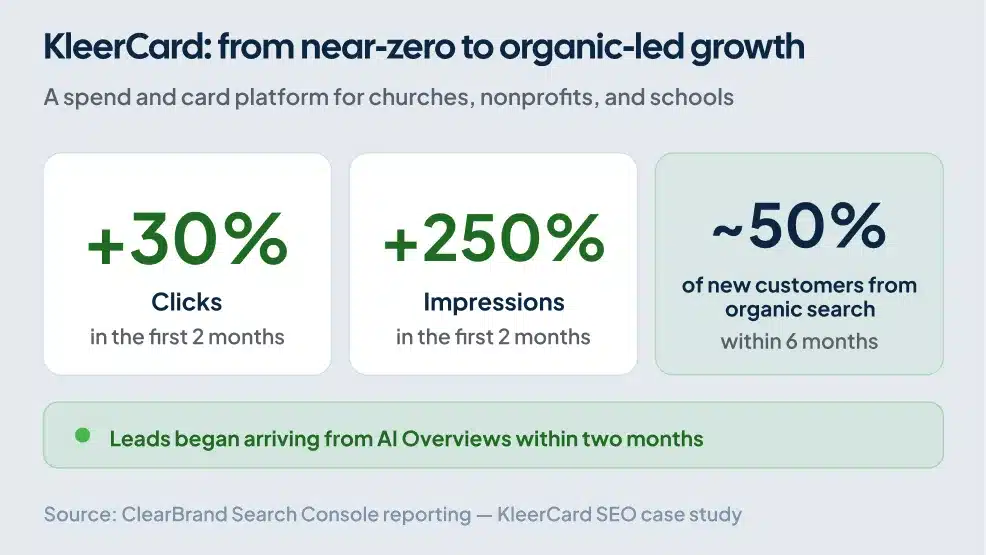
The brand started with close to zero search traffic. We did four things.
- Targeted the exact high-intent searches that decision-makers at their ICP (churches, nonprofits, and schools) were using.
- Found gaps in competitor content and filled them with more useful, more complete pages.
- Wrote each post to be the best resource on its topic, refined with AI-assisted editing.
- Tightened titles, meta descriptions, internal links, and page speed on a clean Webflow blog template.
Here is what moved in the first 2 months, from our own Search Console reporting.
- Clicks up more than 30 percent.
- Impressions up more than 250 percent.
- Leads arriving from AI Overviews within two months.
Culminating in about half of all new customers coming from organic search with 6 months.
The full numbers live in the KleerCard case study.
Hiring help, and knowing when to wait
Honest advice includes the times the answer is not yet.
- If you are early and short on cash flow, grind on outreach and product-market fit first.
- If you run a single local location, fix your Google Business Profile and reviews before broad SEO. Searchers look at the map pack and rarely scroll past it.
- If you sell ecommerce, paid social is often a shorter path to revenue than SEO. Start there, then add SEO when you want to dominate a market.
- If you have cash flow, a real lifetime value, and a payback window you can wait out, a focused content, search, and AI-visibility program compounds.
If that last one sounds like you, that is the work we do for SaaS, fintech, and B2B companies on Webflow. You can see whether we are the right fit in a few minutes.
Frequently asked questions
What is fintech marketing?
Fintech marketing is how a financial technology company earns trust, attracts the right users, and converts them into funded customers under strict financial rules. It combines education-first content, search and AI visibility, paid acquisition, and a conversion-focused website.
How do you market a fintech company?
Start with cash flow and a clear ideal customer profile. Build trust through transparency, proof, and expert content. Layer on SEO and AEO for visibility, paid search and LinkedIn for high-intent demand, and a fast site that converts. Then measure CAC, payback, and funded accounts rather than pageviews.
Why is content marketing important for fintech?
Buyers will not move money until they understand the product and trust the provider. Educational content answers their questions first. It builds the authority that YMYL search rewards, and it feeds the SEO and AI visibility that lower acquisition cost over time.
How is fintech marketing different from regular marketing?
Three things set it apart. Trust is fragile because money and data are on the line. Messaging sits under strict YMYL and regulatory standards, and the buying cycle runs through several decision-makers over months. All of it raises the bar for accuracy and proof.
How do you choose a fintech marketing agency?
Look for proof from real clients, including named results and case studies in regulated categories. Check that they understand compliance, build for both Google and AI search, and can show a website converting, not traffic alone.
How do you measure fintech marketing success?
Tie every metric to money. Track CAC, the ratio of lifetime value to CAC, payback period, activation and funded rate, and retention. Use Search Console and analytics together, and account for the upper-funnel touches that last-click attribution tends to miss.
The takeaway
Fintech marketing rewards the brands that earn trust, publish real expertise, and show up in Google and AI answers. The winners turn that attention into funded customers on a site built to convert. Get the budget sequence right first. Then let the rest compound.
If you are at the point where the numbers work, take a look at our client results and see whether the approach fits your business.