
By Alexander Toth, Founder and CEO of ClearBrand. Last updated June 2026.
Fintech SEO is the practice of optimizing a financial technology company’s website to rank in search engines and AI search. It targets the keywords fintech buyers use, builds the trust signals Google requires for financial content, and earns visibility in AI Overviews, ChatGPT, and Perplexity.
It works as its own discipline because Google holds financial content to a higher standard than almost any other category. The tactics that rank a recipe blog will not rank a lending product.
I have run SEO and content at ClearBrand since 2017, and our fintech work showed me where the usual playbook breaks. KleerCard is a fintech that issues corporate cards and spend management for nonprofits, churches, and schools. We took its site from near-zero search traffic to organic driving about half of its new customers. Clicks rose more than 30%, impressions rose more than 250%, and leads from Google’s AI Overviews started arriving within two months.
This is what earned that, written for a fintech marketer or founder who needs the same results.
What is fintech SEO?
Fintech SEO optimizes a financial technology website to rank in search engines and AI search. It targets the keywords fintech buyers use, builds the trust signals Google requires for financial content, and earns visibility in AI Overviews, ChatGPT, and Perplexity.
The work splits into four parts. You research the keywords buyers use and publish accurate, well-sourced content. You structure the site so search engines and AI crawlers can read it, then earn authority from credible sources.
One principle holds all of it together. Google exists to help a searcher find what they want, and every page on the first results page sits there because Google believes it helps.
Match that goal, and your rankings hold instead of collapsing with the next update. Chase whatever tactic is trending this quarter, and you rewrite everything a year later.
Why fintech SEO is harder than standard SEO
Four forces make fintech a tougher search market than most. Each one changes how you plan content and where you spend effort.
Google treats fintech content as Your Money or Your Life
Google classifies most fintech content as Your Money or Your Life, or YMYL. These are topics that can affect someone’s financial stability, health, or safety, and Google applies its highest quality bar to them. Google states this plainly in its guidance on helpful, reliable, people-first content.
That raises the bar on E-E-A-T, which stands for experience, expertise, authoritativeness, and trust. Google calls trust the most important of the four, and it wants proof before it ranks or cites a financial page.
Thin content that would rank in a low-stakes niche stalls on page three in fintech. Accuracy and credentials carry more weight than how often a keyword appears.
I tell clients this often. A marketer still counting keyword density is a decade behind how Google reads a page today.
Compliance shapes what you can publish
Financial marketing carries legal limits most industries never face. Claims about returns, lending, and risk are regulated, and one careless line can trigger penalties.
Words matter more than usual here. A page that promises “guaranteed returns” or buries an APR disclosure invites trouble, even when the writer meant no harm. Treat every number and claim on a money page as something a regulator could read.
Compliance review also slows publishing. A post can wait days for legal sign-off, which limits how fast you react to a search trend.
Plan content with your compliance team early. Build accuracy and risk disclosures into the brief instead of bolting them on at the end.
Buyers will not convert without trust
People hand fintech products their money and their data. They compare options with care and look for proof that a company is safe.
Search reflects that caution. Many fintech queries ask about security, legitimacy, and how a product works.
Content that answers those questions does two jobs. It ranks, and it moves a careful buyer closer to signing up.
The head terms are crowded and expensive
Broad fintech keywords draw deep-pocketed competitors and high ad costs. Ranking for a term like “investment app” means fighting brands with large link profiles.
Specific, lower-volume terms convert better and cost less to win. A query like “best business card for nonprofits” pulls a reader who is close to a decision.
We point most fintech keyword effort at buyer intent, not vanity volume.
SEO, AEO, and GEO: the three surfaces you compete on
Search has split into three surfaces, and fintech brands now need all three to stay visible. The table below sums up how they differ.
| Discipline | What it targets | Where it shows up | The goal |
| SEO (Search Engine Optimization) | Classic organic rankings | Blue links on the Google results page | Rank on page one |
| AEO (Answer Engine Optimization) | AI answers on the results page | AI Overviews, AI Mode, People Also Ask | Be the cited source |
| GEO (Generative Engine Optimization) | Generative assistant answers off Google | ChatGPT, Gemini, Perplexity | Be referenced and recommended |
The fundamentals carry across all three. Each surface tries to help someone find what they want, so accurate, well-sourced content remains the foundation.
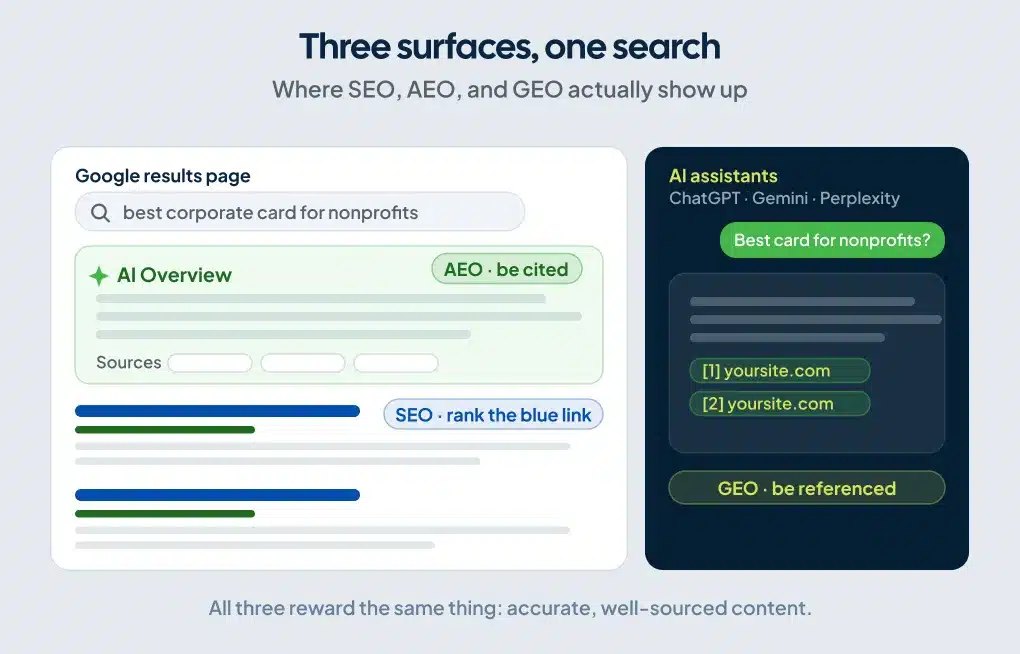
The prize changes. On SEO you win a click; on AEO and GEO you win a citation inside the answer. If the distinction is new to you, Answer Engine Optimization and our guide to SEO, AEO, and GEO break down how they work together.
Keyword research for fintech
Fintech keyword research starts with intent, not volume. You find the searches your future customers run, then match each one to the right page.
Find the fintech query patterns
Finance niches repeat predictable query shapes. Personal credit alone produces “how good is a 600 credit score,” “how good is a 690 credit score,” and dozens of near-identical variants.
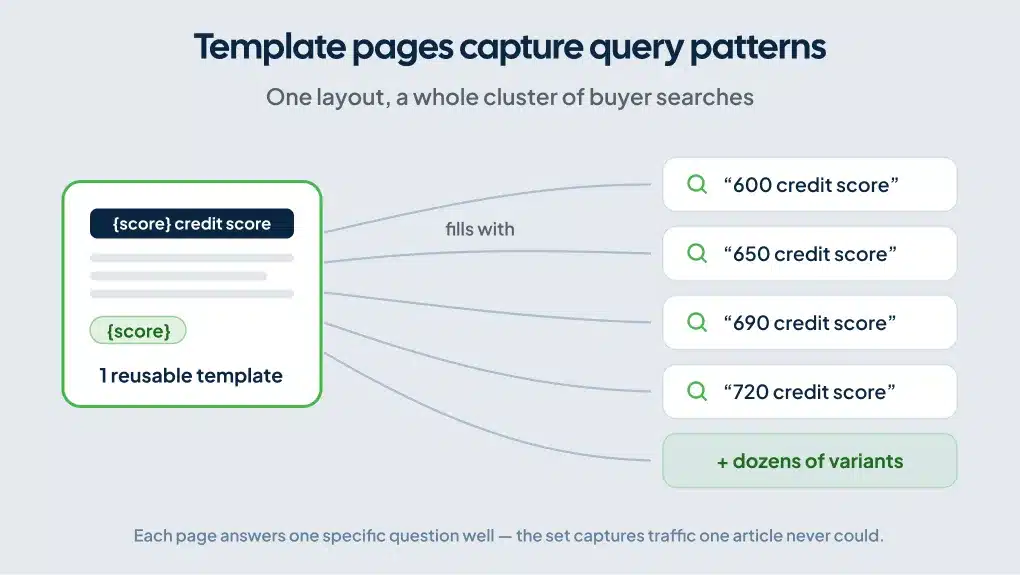
Lending, payments, and investing each have their own patterns. Spot the pattern, and you find a whole cluster instead of one keyword.
These patterns are where template pages earn their keep. One layout covers a long list of finance-specific variants that competitors chase one page at a time.
A credit-monitoring brand can build one template for credit-score ranges, then fill it with the 600, 650, 690, and 720 variations searchers type every day. A lending brand can do the same for loan-amount or APR comparisons. Each page answers one specific question well, and the set captures traffic a single article never could.
Keep every page useful on its own. Shared structure is fine, but thin, duplicated text that adds nothing earns no rankings and can hurt the whole cluster.
Check the results page before you write
Search your target term and study what already ranks. That shows who you compete with and whether you can beat them.
Intent shows up here too. Search “seo tools” and you get product pages, not articles, so a blog post will not rank for that term.
I only target a term when we can build something better than everything on page one. If we cannot, we pick a different term and check again.
Target buyer intent while you build authority
A new domain cannot win the most competitive terms yet. Lower-competition, high-intent terms let you rank fast and build authority first.
I learned this when I started ClearBrand. I became one of the first StoryBrand Certified Guides, and few of them understood SEO.
We targeted StoryBrand terms because the people searching them had high intent and the competition was thin. We ranked quickly, which lifted our authority and let us hold position as competitors arrived.
The same path works in fintech. Win the specific, ready-to-buy queries first, then move up to the harder ones.
Content that earns trust and conversions
Fintech content has two jobs. It has to make complex topics clear, and it has to give a cautious buyer reasons to trust the brand.
Simplify complex financial topics
Fintech products involve dense terminology. A reader who does not understand the concept will not buy the product.
Use guides, FAQs, and glossaries to turn jargon into plain language. A clear explainer builds trust and signals expertise to readers and search engines.
A jargon-buster page works well in fintech. Define the terms your buyers stumble over, and link each one to a deeper article. You give readers a reason to stay and Google a reason to see you as the authority.
Complete coverage matters here. If a reader has to leave your page to finish understanding a topic, your page was not the best answer.
Write for humans, then optimize for Google
I keep these in order on purpose. Write the page a person needs first, then add the structure that helps Google read it.
Content built only for an algorithm reads like it, and readers leave. Google measures that, and a page people enjoy and finish is the one that holds its ranking.
The optimization is real work, and the next section covers it. It comes second because a well-structured page full of weak content still loses.
Cover the full buyer journey
Match content to where the reader stands. Early readers ask “what is a corporate card.” Evaluators compare two products. Decision-stage readers want the best option for their situation.
Each piece targets a different intent and a different cluster. Together they form a path from first question to signup.
Your product and service pages belong on that map. A page built around “corporate card for nonprofits” pulls higher intent than a blog post on the same theme.
Technical SEO and schema for financial sites
Strong content still needs a clean technical base. Search engines and AI crawlers have to read a page before they can rank or cite it.
Structure the page like a book
Give every page one H1, the equivalent of a book title. Use H2s for sections and H3s for subsections, the way chapters and headings nest.
Include one H1 only. Several competing titles confuse Google about what the page covers.
Put your search term in the H1 and a few of the H2s, not all of them. Consistent structure helps readers skim and helps Google read the page.
Get architecture and speed right
Organize the site so related pages link together in clear clusters. Clean structure helps search engines read your topical authority and helps readers find their way.
Speed matters more in fintech, where mobile users abandon slow pages fast. Fix crawl issues, compress images, and keep load times low.
Place images through the page, not stacked at the top. A large image above the answer makes a reader scroll for what they came to find.
Custom images beat stock photos for SEO. A graphic you made or a photo you took adds something Google has not seen on a thousand other sites. It also holds reader attention better than a generic stock image.
Write alt text on every image. It lets visually impaired readers understand the picture, and it gives Google another clear signal about what the page covers.
Add financial schema, with realistic expectations
Schema markup tells search engines and AI systems what a page is about. Schema.org offers types built for finance, including FinancialProduct and its subtypes for cards, accounts, and loans, plus Organization and FAQPage markup. Google’s introduction to structured data explains how it helps Google understand a page.
Set your expectations with the current rules, not old advice. Google now limits FAQ rich results to well-known government and health sites, so a fintech FAQ page will not earn that rich result. The markup still helps machines parse your questions and answers.
For AI search, Google says structured data is not required for AI Overviews or AI Mode. There is no special schema you need to add. It remains worth using as part of sound SEO, because it helps Google understand and label your content. Build it on a consistent question-and-answer structure that matches what readers see.
We build on Webflow because its clean code and CMS make this work easier to control. Faster pages and simpler schema in Webflow follow from that.
Authority and link building in a regulated industry
Backlinks tell Google that credible sources vouch for your content. In a YMYL category, those trust signals carry extra weight.
Think of a link the way you would a reference in a medical book. A book with no sources earns less trust than one that cites studies and named experts.
Earn links from sources that match the stakes. Reputable financial publications, industry research, and recognized institutions signal that your brand is a credible voice.
Start with links you already control. Point your highest-authority pages at newer ones to pass authority along, and link every article to another page on your site.
The most reliable way to earn outside links is to publish something worth citing. One of our StoryBrand tools picked up links from creators we never contacted, because the tool was useful.
Two methods work well beyond that. Reach out to writers whose readers would value your article, and respond to journalists looking for expert sources. Avoid paid link schemes, which put a regulated brand at risk for a short-term gain.
Getting cited in AI Overviews and ChatGPT
Search is splitting between the results page and AI assistants. Google’s AI Overviews answer questions on the results page, while ChatGPT and Perplexity answer them off Google.
For fintech, that raises the bar again. You compete to be the source an AI system trusts enough to cite, not only to rank a blue link.
The fundamentals do not change with the surface. An AI answer has the same goal Google always had, which is to help someone find what they want.
AI systems apply stricter filters to money topics. They cross-reference sources and skip pages that make unsupported financial claims.
To earn fintech AI citations, publish accurate and well-sourced content, show clear author credentials, and keep your facts checkable. Google’s guidance on AI features and on optimizing for generative AI search points to the same fundamentals, plus one detail worth holding onto. Google says there is no separate checklist for AI Overviews. The trust signals that satisfy its YMYL standard are what help AI systems trust you too.
Structure helps an AI lift your answer. Open each section with a direct response to the question, then add the detail underneath. Name the entities plainly, keep your facts checkable, and an AI can quote you with confidence.
Author credibility carries real weight on money topics. A named author with relevant credentials, a real bio, and a track record changes how a page reads. Both Google and AI systems trust it over an anonymous one.
What this looked like for KleerCard
KleerCard issues corporate cards and spend management for nonprofits, churches, and schools. At the start, organic search sent the site almost no traffic.
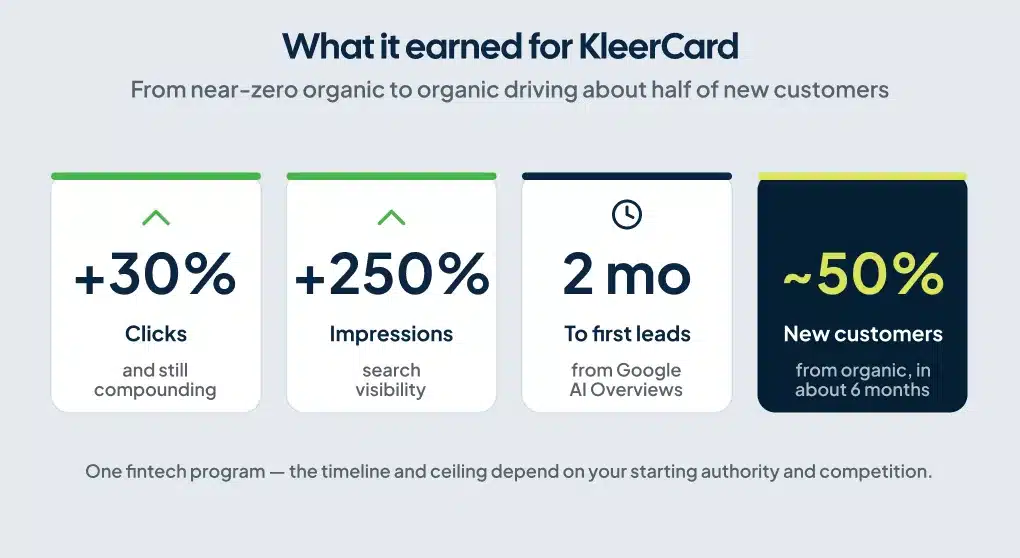
We applied the strategy in this guide. We pointed keyword research at buyer-intent terms and built trust signals into the money pages. We structured the content for both readers and crawlers, then earned authority before chasing the hardest terms.
The numbers moved within months. Clicks rose more than 30% and impressions rose more than 250%. Leads from Google’s AI Overviews started arriving within two months of the work beginning.
Organic kept compounding. Within about six months, organic search drove roughly half of KleerCard’s new customers. You can see the full breakdown in our KleerCard case study.
This is one fintech program, not a claim about every fintech site. The timeline and the ceiling depend on your starting authority and your competition.
How to measure fintech SEO
Track outcomes, not vanity metrics. Traffic that never converts is not a win in fintech.
Set up tracking before you publish. Google Search Console is free and shows clicks, impressions, and position for each page, and AI SEO tools add history and competitive data.
At ClearBrand we track everything we can, because data beats opinion when the two disagree. I have been certain a page was our top performer and been wrong once the numbers came in.
Watch leads and signups from organic first. For KleerCard, we measured new customers from organic, not raw sessions. Then monitor your presence in AI Overviews and AI tools alongside classic rankings.
Give organic credit for the conversions it assists, not only the ones it closes. A reader often finds you in an AI answer, reads two articles, leaves, and signs up later through a branded search. Last-click reports hide that path, so track assisted conversions and branded search lift too.
What fintech SEO costs and how long it takes
Fintech SEO pricing varies with scope, competition, and how much content a site needs. Most credible agencies work on a monthly retainer, not a one-off fee.
Our AI SEO retainer starts at $4,999 per month. Other agencies price higher or lower depending on team and deliverables.
Timeline depends on your starting point. KleerCard saw AI Overview leads within two months and organic driving about half of new customers within six months. Most programs take months to compound, not weeks.
Where to start: fix money pages before blog volume
On a new fintech site, we work on the pages closest to revenue first. The homepage, product pages, and service pages get the keyword research, structure, and trust signals before we write a single blog post.
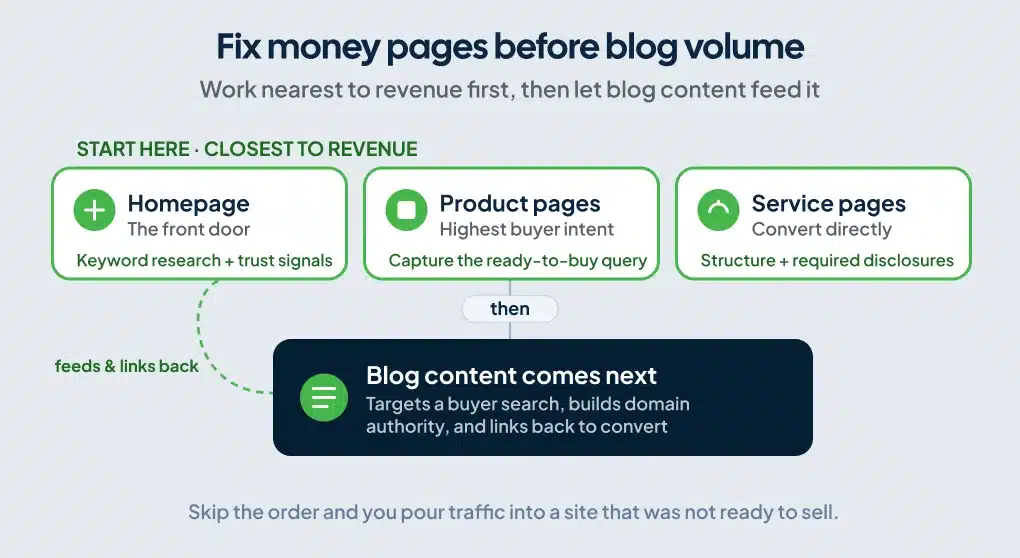
The reason is intent. Someone searching “corporate card for nonprofits” is closer to buying than someone reading a top-of-funnel explainer. Ranking a product page captures that buyer directly.
Blog content comes next and feeds the same engine. Each article targets a search your buyers run, builds authority for the whole domain, and links back to the pages that convert. Skip the order and you pour traffic into a site that was not ready to sell.
Common fintech SEO mistakes
A few patterns hold fintech sites back more than any algorithm change.
Chasing high-volume head terms drains budget on keywords you cannot win and readers who are not ready. Buyer-intent terms convert better and cost less.
Ignoring E-E-A-T leaves financial pages without the credentials and sourcing Google demands. Missing author bios and unsourced claims both cost rankings.
Publishing thin content on complex topics fails readers and Google at once. Treating AI search as a side project leaves citations on the table.
Fintech SEO checklist
Use this to pressure-test a fintech site before and after a content push.
Foundations
- Confirm search intent on the results page before writing any page.
- Point keyword research at buyer-intent terms, not vanity volume.
- Map every target term to one page, with clusters for repeating query patterns.
Trust and E-E-A-T
- Add a named author with credentials, a bio, and a track record.
- Source every statistic and claim, and link to the primary source.
- Build accuracy and required disclosures into the brief, reviewed by compliance.
Content
- Lead each section with the direct answer, then add supporting detail.
- Cover the topic completely, so readers never have to leave to finish learning.
- Write for a person first, then add structure for crawlers.
Technical and schema
- Use one H1 per page, with a logical H2 and H3 hierarchy.
- Compress images, fix crawl issues, and keep mobile load times low.
- Add Organization, FAQPage, and finance schema, with realistic expectations for rich results.
Authority and AI search
- Link high-authority pages to newer ones, and link every article internally.
- Earn outside links by publishing assets worth citing.
- Track AI Overview and assistant citations alongside classic rankings.
Frequently asked questions
What is fintech SEO?
Fintech SEO is the practice of optimizing a financial technology company’s website to rank in search engines and AI search. It targets buyer-intent keywords, builds the trust signals Google requires for financial content, and earns visibility in AI Overviews, ChatGPT, and Perplexity.
Why is SEO harder for fintech companies?
Google classifies most fintech content as Your Money or Your Life, which raises the quality and trust bar. Fintech brands also face compliance limits on what they can claim and crowded, expensive head terms. Together these push the work toward accuracy, credentials, and buyer-intent keywords.
How much does fintech SEO cost?
Fintech SEO usually runs on a monthly retainer that varies with scope and competition. ClearBrand’s AI SEO retainer starts at $4,999 per month. Pricing across the market ranges widely based on team, content volume, and deliverables.
How long does fintech SEO take to work?
Most fintech SEO programs take months to compound. KleerCard began earning leads from AI Overviews within two months and saw organic grow to about half of new customers within six months. Competition and starting authority change the timeline.
What is the difference between fintech SEO and AEO or GEO?
SEO earns rankings in classic search results. AEO targets AI answers like Google’s AI Overviews and People Also Ask. GEO targets responses from generative tools like ChatGPT and Perplexity. Fintech brands now need all three to stay visible.
How do fintech companies get cited in AI Overviews?
Fintech brands earn AI Overview citations by publishing accurate, well-sourced content with clear author credentials. Google says there is no special schema or separate checklist for AI Overviews. The trust signals that meet its YMYL standard are what help AI systems cite you.
Bringing it together
Fintech SEO rewards accuracy, trust, and patience more than clever tactics. Google holds your pages to a higher standard because the stakes are real, and AI search applies the same filter.
Get the foundation right and the results compound. Buyer-intent keywords, content that earns trust, clean technical work, and credible authority all push you toward rankings and AI citations.
If you want a team that has done this in fintech, you can see how we did it for KleerCard. If that is the right fit, book a Growth System Audit. If you would rather run the playbook yourself, the checklist above is a fair place to start.
About the author
Alexander Toth is the Founder and CEO of ClearBrand, a Webflow-focused SEO and web design agency he started in 2017. He has led ClearBrand’s SEO and content work since the beginning, including the fintech program for KleerCard described in this guide.
His work has been featured in a Wall Street Journal bestselling marketing book. He has been interviewed as a marketing expert on podcasts including Marketing Made Simple and Marketing Boost Solutions.
He writes about SEO, AEO, and GEO for B2B and fintech companies, and hosts the ClearBrand Marketing Podcast.