
Ranking on Perplexity does not work like ranking on Google. Perplexity reads a question, searches the live web, and writes one answer with cited sources. Your goal is to become one of those citations.
I’m Alexander Toth, founder of ClearBrand, a Webflow SEO & AI-search agency. We earn citations for clients in Google AI Overviews and ChatGPT, and the same structural work carries over to Perplexity. My work has been featured in a Wall Street Journal bestselling marketing book.
The process below is the one I use for clients. I’ll also be straight about when Perplexity is worth your effort and when it is not.
What ranking on Perplexity means
Ranking on Perplexity means getting cited as a source inside its answers. Perplexity retrieves live web content, summarizes it, and links the sources it trusts. Visibility comes from being cited, not from holding a spot in a list.
You do not climb ten blue links. Perplexity either names you inside the answer or it does not.
That changes the work. Accuracy, structure, and outside authority shape citations more than keyword volume does.
Being cited matters even though Perplexity is smaller than Google. Perplexity reported 780 million queries in May 2025 and growth above 20 percent month over month. A citation there reaches people while they decide.
How Perplexity picks its sources
Perplexity uses retrieval-augmented generation. It pulls real-time web content, ranks it, and summarizes the sources it trusts into one answer.
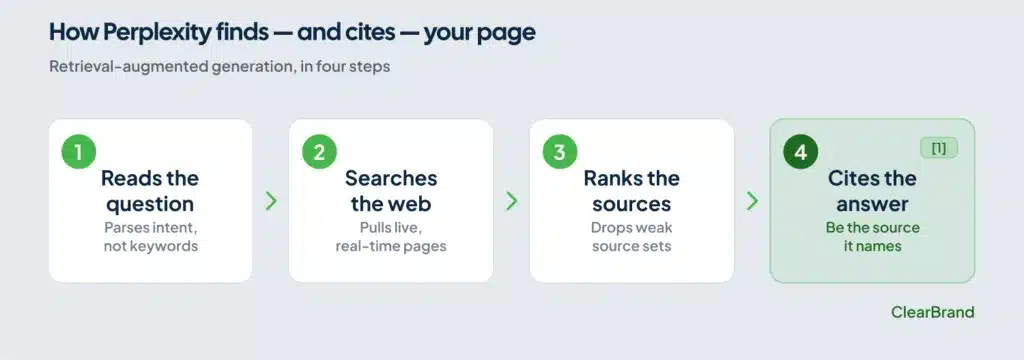
Independent research reported by Search Engine Land mapped how that ranking behaves. A few patterns shape the steps below.
Perplexity runs a three-layer machine-learning reranker for entity queries about people, companies, and topics. If too few sources clear its quality bar, it drops the whole set rather than cite weak ones.
That raises the floor for you. A page about your brand or your category has to clear a higher bar than a generic query. Aim to be the clearest, best-sourced page on the topic.
Early engagement counts. Strong clicks soon after publishing tend to lift long-term visibility.
Topic plays a role too. The research found tech, AI, and science content getting boosted, while sports and entertainment get held back.
Freshness and structure round it out. Pages that get updated often hold their place, and interlinked clusters tend to surface together.
Perplexity pulls live results, so pages that already rank well on Google tend to sit in the pool it draws from. Ranking first on Google does not guarantee a citation, but it rarely hurts.
You cannot reverse-engineer a black box. In my own work, how each engine selects sources shifts constantly, so I build for the inputs I can control.
Perplexity vs Google AI Overviews vs ChatGPT
The three big answer engines source content differently. Profound analyzed 680 million citations from August 2024 to June 2025 and found clear splits.
| Engine | Leading cited source | What it tends to reward |
| Perplexity | Reddit (6.6% of citations) | Community discussion and well-structured pages |
| Google AI Overviews | Reddit (2.2% of citations) | A mix of social and professional content |
| ChatGPT | Wikipedia (7.8% of citations) | Authoritative, encyclopedic pages |
Reddit leads on Perplexity by a wide margin. Inside its top ten sources, Reddit alone holds 46.7 percent of citations.
For you, that means community presence pays off more on Perplexity than on ChatGPT. The work still overlaps, since all three reward clear, credible, well-structured pages.
How to rank on Perplexity, step by step
These steps assume you already publish accurate, useful content. Perplexity cannot rescue a thin page.
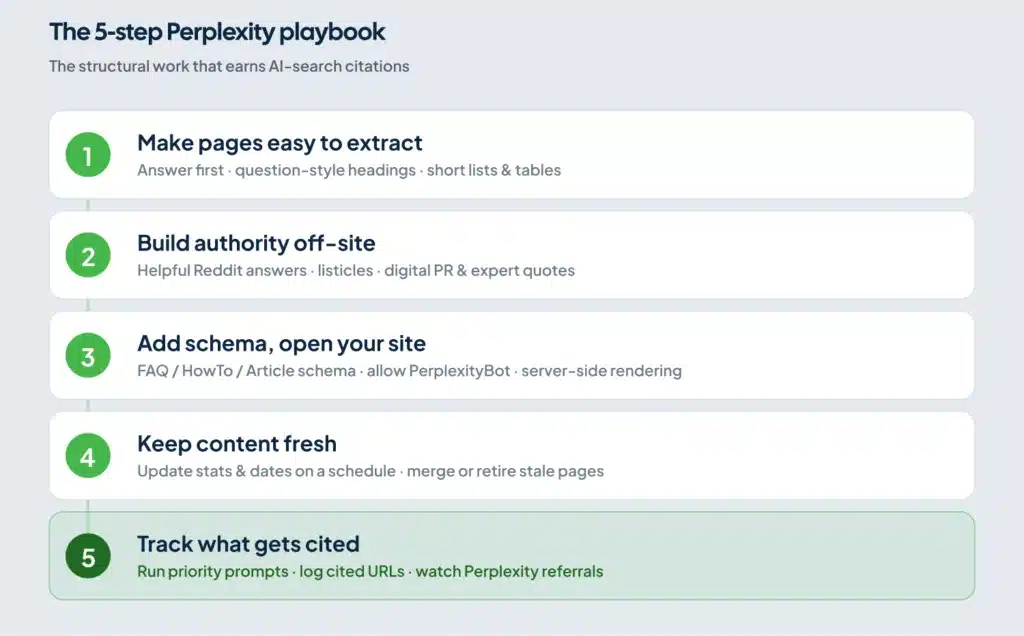
Before you start
A few things need to be in place first:
- A site Perplexity can crawl. Confirm you are not blocking its bots.
- Content that answers a real question, not keyword filler.
- A simple way to check Perplexity answers for your target topics.
Step 1. Make your pages easy to extract
Perplexity pulls clean snippets. Pages that get cited make that pull simple.
- Answer the question in the first few lines, then expand.
- Write headings as questions that match how people phrase prompts.
- Break key points into short lists and tables.
- Keep sentences tight and cut the long wind-up.
If a model has to dig through filler to find your point, it moves on to a page that states the answer plainly.
Step 2. Build authority beyond your own site
Perplexity leans on outside signals more than backlinks alone. Reddit is a clear example.
One analysis of 680 million citations found Reddit is Perplexity’s leading source, far ahead of its share on ChatGPT. Perplexity treats community discussion as honest, experience-based content, and it cites that content often.
You earn that presence by being useful. Answer real questions in subreddits that fit your category, and share specific experience. Promotional posts get filtered out fast, by moderators and by the models.
Pick a few communities where your buyers already gather. A detailed, honest comment in a niche subreddit carries more weight than a dozen shallow posts. The goal is to be the kind of source a real person would quote.
Roundups and best-of lists help too. When someone asks an answer engine for a specific service, listicles get cited more often than not, in my experience.
This is how I earned our own visibility for “webflow seo agency.” I led with a listicle of Webflow agencies, then built a knowledge base of Webflow topics around it. The page ranked fairly quickly, and the cluster gave answer engines more reasons to trust us.
Digital PR and expert quotes on authoritative sites work the same way. Each outside mention raises the odds Perplexity sees you as a credible source.
Step 3. Add schema and open your site to Perplexity
Structured data and clean rendering help Perplexity understand and trust your pages.
- Add FAQ, HowTo, Article, and Organization schema.
- Confirm Perplexity’s crawlers, PerplexityBot and Perplexity-User, can reach your site.
- Use server-side rendering so your main content loads without JavaScript.
Check your robots.txt and any firewall rules first. I have seen sites mistakenly block AI crawlers and wonder why they never get cited. A forward-looking option is an llms.txt file, a plain-text map that helps models read your site. Adoption is early, but it costs little to add.
On Webflow, this is straightforward once you know where to look. You can add JSON-LD in page settings or custom code, and Webflow renders content server-side by default. Our Webflow schema guide walks through the setup.
Step 4. Keep your content fresh
Perplexity favors recent, maintained pages because it retrieves live results.
- Update stats, dates, and references on a schedule.
- Revisit pages on fast-moving topics often.
- Merge or retire stale pages that no longer earn citations.
A page you published two years ago and never touched is a weak candidate for citation, even if it was strong on day one.
Step 5. Track which pages get cited
Perplexity citation tracking is how you learn what works. You cannot improve what you do not watch.
- Run your priority questions as prompts in Perplexity.
- Log which URLs Perplexity cites for each one.
- Watch referral traffic from Perplexity in your analytics.
Do this monthly. Patterns show up fast once you have a record of what gets pulled and what gets skipped.
Common mistakes that keep you out of Perplexity
A few habits hold people back:
- Long, vague pages with no clear answer near the top.
- Blocking AI crawlers or skipping structured data.
- Leaning only on backlinks while ignoring outside mentions.
- Chasing exact prompt wording instead of answering the real question.
- Treating Perplexity as separate from your core SEO. Strong traditional SEO feeds Perplexity citations.
Is ranking on Perplexity worth your time right now?
Be honest with yourself before you pour effort into this. Perplexity is growing fast, but it is still small.
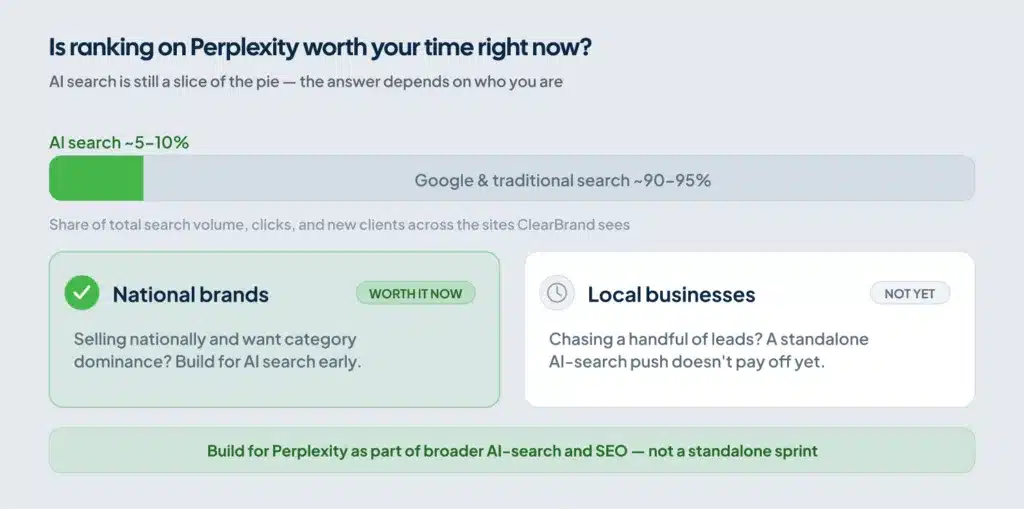
In my own work, AI search is a fraction of Google. It runs roughly 5 to 10 percent of total search volume, clicks, and new clients across the sites I see. People are excited about AI for good reason, and Google still drives most of the customers.
That shapes who should prioritize Perplexity. If you sell nationally and want category dominance, building for AI search early is a smart move. If you are a local business chasing a handful of new leads, a dedicated AI-search push usually does not pay off yet.
The good news is the overlap. The same structural work that earns citations in Google AI Overviews and ChatGPT is what earns them in Perplexity. KleerCard, our fintech client, gets cited in Google AI Overviews and ChatGPT for key terms. You can see the full approach in the KleerCard case study.
Build for Perplexity as part of broader AI-search and SEO work, not as a standalone sprint. The pages that earn Google citations tend to earn Perplexity citations too.
FAQ
What does it mean to rank on Perplexity?
Ranking on Perplexity means getting cited as a source inside its answers. Perplexity does not show a ranked list. It writes one answer and links the sources it trusts, so visibility comes from citations.
How is ranking on Perplexity different from Google SEO?
Google ranks pages in a list. Perplexity cites sources inside a single answer. The factors overlap, since Perplexity often pulls from pages that rank well on Google, but extractable structure and outside authority carry more weight.
Does schema markup help you rank on Perplexity?
Yes. Schema helps Perplexity understand what your content covers. FAQ, HowTo, and Article markup make your pages easier to parse and cite, which raises your odds of being selected.
How long does it take to get cited on Perplexity?
There is no fixed timeline. Pages that already rank on Google can get cited quickly once they are structured for extraction. New pages depend on authority, freshness, and how often Perplexity recrawls your topic.
Can you pay to rank on Perplexity?
No. You cannot buy your way into citations. Placement depends on trust, relevance, and how well your page answers the question.
How do you track your Perplexity rankings?
Run your priority questions as prompts and record which URLs get cited. Repeat on a schedule and watch Perplexity referral traffic in your analytics. Several visibility tools now track AI citations across Perplexity, ChatGPT, and Gemini.
Is ranking on Perplexity worth it for a local business?
Usually not as a standalone effort yet. AI search is still a small slice of total search. A local company chasing a few leads sees better returns from Google and local SEO. National brands seeking category dominance benefit most from early AI-search work.
Where to start
Perplexity rewards content that is accurate, well structured, and trusted by other sources. Earn citations by making pages easy to extract, building outside authority, adding schema, staying fresh, and tracking what gets pulled.
If you want help earning AI-search citations across Perplexity, Google AI Overviews, and ChatGPT, that is the work we do at ClearBrand.