
Three Webflow agency quotes will give you three different numbers. One agency comes back with $4,500 and a six-week timeline. Another quotes $28,000 with strategy, copywriting, and conversion testing included. A third sells a $9,900-per-month subscription with no end date.
None are lying. They are pricing different things.
We have been Webflow-exclusive at ClearBrand for years, working with growing companies since 2017. We have watched owners pick the cheapest quote, launch a site that looks fine, then sit at zero new leads six months later. That pattern shapes how we wrote this guide.
You will find what Webflow agencies charge in 2026, the four pricing models that are most common, and how to read a proposal.
Quick answer: how much does a Webflow agency cost?
Most Webflow agencies charge between $3,000 and $50,000+ for a website build. Boutique retainers run $2,000 to $8,000 per month, with mid-market retainers extending to $15,000+. Subscription agencies typically run $4,700 to $9,900 per month. Hourly rates at established US agencies sit between $100 and $250.
Our Webflow web design and development engagements start at $14,999 and take 8 to 16 weeks from kickoff call to launch.
The right number for your project depends on scope and quality. It also depends on whether you want development only or a full system with design, strategy, copywriting, SEO, and CRM integrations.
Webflow agency pricing at a glance
The table below summarizes typical 2026 pricing across the four common models. The ranges reflect public pricing pages and agency comparison guides published this year.
| Pricing model | Typical range | Best for |
| Flat-rate project | $3,000 to $50,000+ | Defined scope, one-time build or redesign |
| Hourly | $100 to $250 per hour | Small fixes, scoped tweaks, consulting |
| Monthly retainer | $2,000 to $15,000+ per month | Ongoing maintenance, content, optimization |
| Subscription (queue-based) | $4,700 to $9,900 per month | Continuous design and dev work in a queue |
Ranges synthesized from public 2026 pricing data published by Flowout, The Branded Agency, LoudFace, BRIX Templates, and Digi Hotshot. Our own pricing starts at $14,999 for Webflow web design and development and $4,999 per month for AI SEO retainers.
The cheapest quote is usually the most expensive
We see this pattern often enough to lead with it.
Let’s say someone gets three quotes for a new site. The first is $8,000. The second is $22,000. The third is $35,000.
They pick $8,000 to save budget for ads.
Six months later the site is live. Traffic is flat. Conversions are worse than the old site.
The team cannot publish a service page without a developer. Nothing ranks.
The marketing team spends more on ads to get fewer leads. The new pages convert no better than the old ones.
The $8,000 was cheaper on paper. The lost revenue across the next 18 months was not.
Compare that with Dunn & Stone Builders, a custom home builder near Houston. Empty pipeline when they came to us. They were invisible for terms like “custom home builders in Texas.” We rebuilt the site, layered in SEO, and ran ads in parallel.
Seven months later: $1.5M closed, 138 qualified leads, organic clicks up more than 1.6X, search impressions up more than 7X. Full numbers in the Dunn & Stone case study.
You do not need to spend $35,000 on every Webflow build. You do need to ask which quote will produce revenue, not which costs the least.
The four Webflow agency pricing models
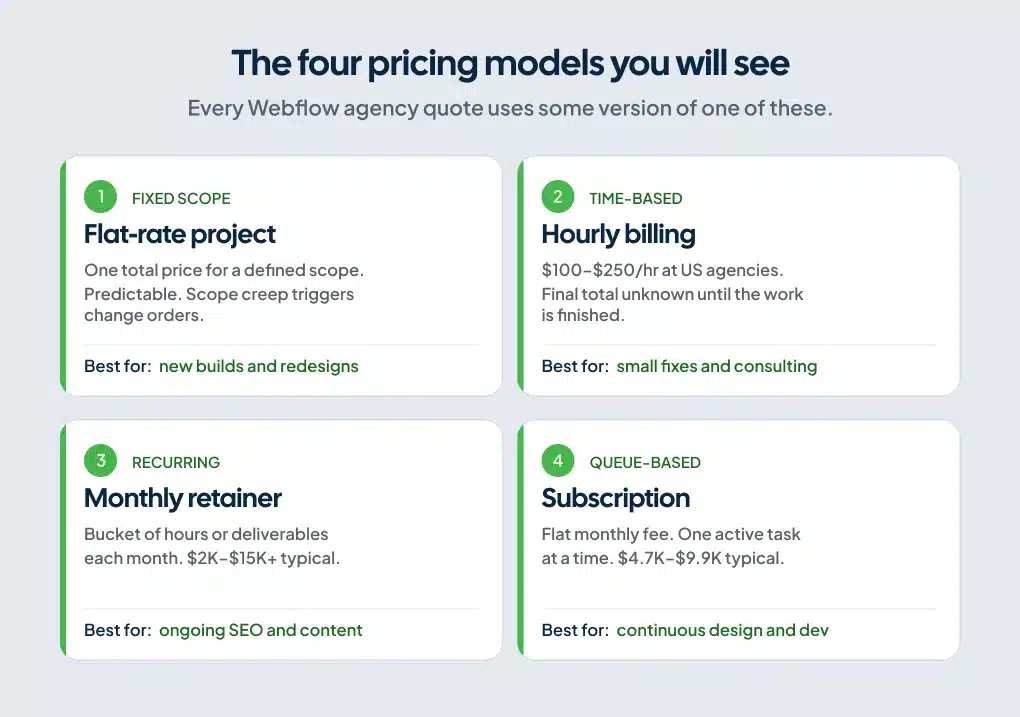
Every agency uses some version of one of these four models. You need to know which one you are looking at before you can compare quotes.
1. Flat-rate project pricing
You pay a fixed total for a defined scope. The agency quotes the project, you sign off, the work gets delivered.
Most companies expect this model when they start shopping. It is predictable and easy to budget for. Scope creep does the most damage here. Anything outside the original quote triggers a change order.
Flat-rate works well for redesigns and new builds with clear requirements. It works poorly when the scope will evolve based on what you learn during the build.
We use flat-rate pricing for website projects. Total price is based on the number of pages being designed, built, and written.
2. Hourly billing
The agency tracks time and bills against it. A US agency with senior developers charges $100 to $250 per hour. BRIX Templates publishes a similar range of $50 to $200, depending on whether you hire a freelancer or an established agency.
Hourly works when scope is unclear or when you need someone to handle small, intermittent tasks. It is risky as a primary model for a full build. The final number is unknown until the work is done.
3. Monthly retainer
You pay a recurring fee for a fixed bucket of hours or deliverables each month. Digi Hotshot publishes their retainer pricing openly: $3,760 for 20 hours per month, $8,000 for 50 hours. Boutique retainers across the industry run $500 to $8,000 per month. Mid-market retainers extend higher, often $10,000 to $15,000+ depending on scope and team size.
Our AI SEO retainer at ClearBrand starts at $4,999 per month. It includes weekly content and landing page builds, technical SEO, schema markup, and answer engine optimization for LLMs like ChatGPT and Perplexity.
Retainers fit ongoing optimization, content publishing, and incremental improvements after a site is live. They work best when you have a roadmap you want executed steadily rather than a single project to deliver.
4. Subscription or queue-based model
You pay a flat monthly fee. The agency processes your requests in a queue, with one active task at a time.
Flowout publishes this model on their pricing page. $5,900 per month for development only. $7,900 for development plus design. $9,900 for development, design, and copywriting.
All are billed monthly, with 10 to 20 percent discounts for quarterly and annual commitments.
“Unlimited” in this model means “as much as we can deliver given our queue,” typically one to three business days per task. You are buying throughput, not capacity in hours.
Ask any subscription agency for their actual queue length and average turnaround over the last 90 days. Vague answers should make you cautious.
What you get at each price tier
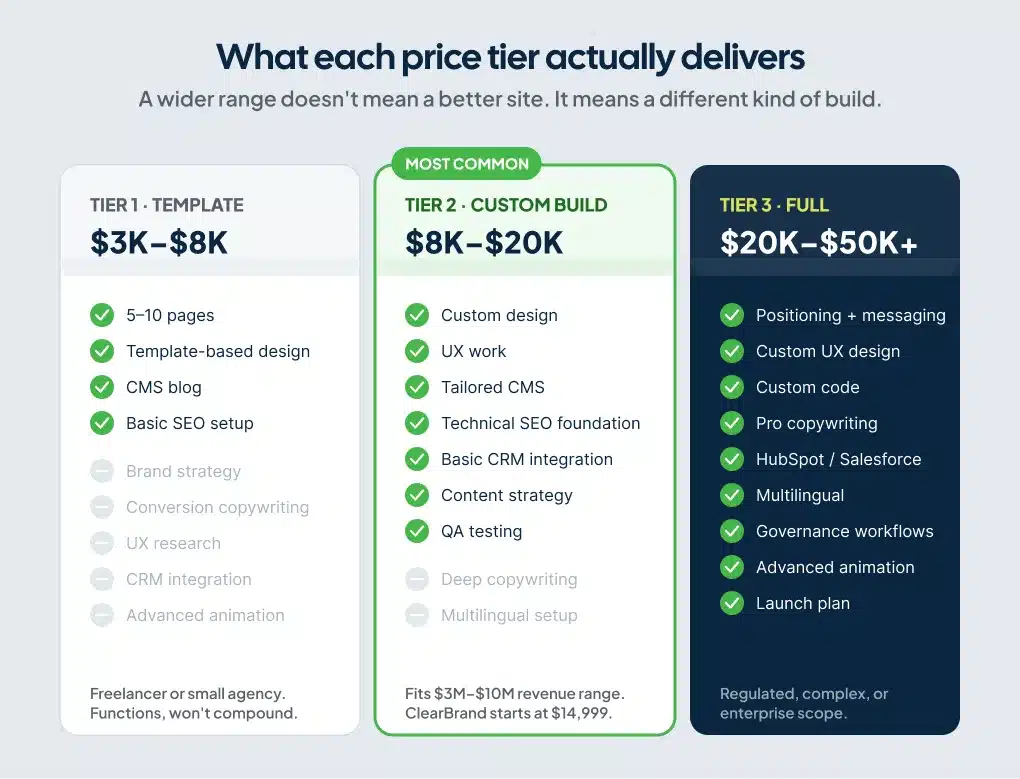
The range from $3,000 to $50,000+ is wide enough to be useless without context. Each tier produces a different kind of site.
$3,000 to $8,000: template-driven builds
You get a freelancer or small agency working from a template or lightweight custom design. Expect a 5 to 10 page site with a CMS-driven blog, basic SEO setup, and limited animations. BRIX Templates puts the typical SaaS marketing site at $3,000 to $8,000. The Branded Agency’s 2026 cost data lands in the same range.
What is usually missing: brand strategy, UX research, conversion copywriting, custom integrations, real analytics. The site will function. It will not compound revenue. If the build does not move conversions, you will spend the savings twice on ads trying to compensate.
$8,000 to $20,000: custom builds with strategy
Most companies in the $3M to $10M revenue range land here for a full website project. You get a custom design, real UX work, and a content management setup tailored to how your team publishes. SEO is baked into the structure.
LoudFace’s tier breakdown calls this the “authority-level” range. Digi Hotshot says one-off builds start around $10,000 and this is their most common client profile. Our Webflow web design and development packages start at $14,999 and sit in this tier.
You get custom homepage and inner page templates, plus CMS for blog and other dynamic collections. You get a technical SEO foundation, basic CRM integration, content strategy and creation, QA testing, and post-launch support.
Still extra at this level: deep copywriting on every page, complex API integrations, advanced animation, multilingual setup.
$20,000 to $50,000+: full engagement
This level covers positioning and messaging work, custom UX design, and advanced Webflow development with custom code and integrations. You also get professional copywriting and a launch plan.
The Branded Agency’s example of a fintech SaaS multilingual redesign totaled around $23,500. Digi Hotshot notes boutique agency builds start at $10,000 to $25,000, with Enterprise-level projects exceeding $100,000.
Companies end up here for one of a few reasons. The product is complex, the industry is regulated, the site needs multilingual support, or the team needs governance and approval workflows built in. Heavy integrations with HubSpot or Salesforce push projects into this tier too.
What drives the number on your quote
Two factors explain most of the variance you will see across quotes for what looks like the same project.
Project complexity matters first. Page count, CMS structure, integrations, custom animations, whether the design exists yet. A 5-page brochure site is different work from a 50-page site with three CMS collections, gated content, and a HubSpot integration.
Agency tier matters second. A senior US agency with a dedicated PM, designer, developer, copywriter, and QA pass quotes 3 to 5 times what a solo freelancer charges. They are selling process, risk reduction, and accountability alongside the hours.
Other factors move the number too. Timeline urgency adds 25 to 40 percent for rush projects. Copywriting scope, design rounds, custom illustration, and motion design all push it higher. Whether post-launch optimization is bundled or treated as a separate retainer matters too.
Most of the surprise costs we see show up in these line items.
What is not included in most Webflow agency quotes
Three categories of cost that quotes regularly leave out.
Webflow charges separately for hosting and team collaboration. The Premium Site Plan is $25 per month billed annually and fits most marketing sites.
Your agency typically pays Webflow’s Workspace fees on top of that. The Site Plan goes on your bill, not theirs. Current numbers live on the Webflow pricing page.
Third-party tools and integrations come next. Memberstack, Finsweet attributes, Lottie, Jetboost, Wized, Make, Zapier. Each is its own line item, typically $20 to $200 per month, and they stack quickly.
Post-launch optimization usually sits outside the build quote. Many agencies deliver a site and stop.
If you want ongoing conversion testing, content publishing, technical SEO work, or new pages without re-engaging a developer, that lives in a retainer relationship. LoudFace pegs post-launch support at $500 to $2,000 per month.
We include 30-day post-launch support in every web design engagement and offer (optional) ongoing AI SEO retainers starting at $4,999 per month for those who want to see real growth.
Read every quote line by line before you sign anything.
How pricing models change agency incentives
Flat-rate projects push the agency to deliver the smallest acceptable version of the scope. The faster they finish, the higher their effective hourly rate. Anything you did not specify will not get built. The benefit of this model is that if you have a good contract, you can push to get what you want without paying more.
Hourly billing pushes the agency to spend more hours, not fewer. You pay for activity, not outcomes. Most agencies deliver well anyway, but the incentive points the wrong direction.
Retainers and subscriptions are another form of hourly billing, but they do better at aligning long-term incentives when they are structured around continuous improvement. The agency wants to keep clients happy because they want the contract to renew next month. Ship slow or sloppy work, you cancel.
Subscriptions can fail in another direction. If the agency oversells capacity, your tasks sit in a queue while higher-revenue clients get prioritized. Ask any “unlimited” agency to share their average turnaround and queue length from the last 90 days before you sign.
No pricing model is perfect. The right one depends on whether you have a defined project, an ongoing publishing operation, or a continuous improvement roadmap.
How to evaluate a Webflow agency proposal
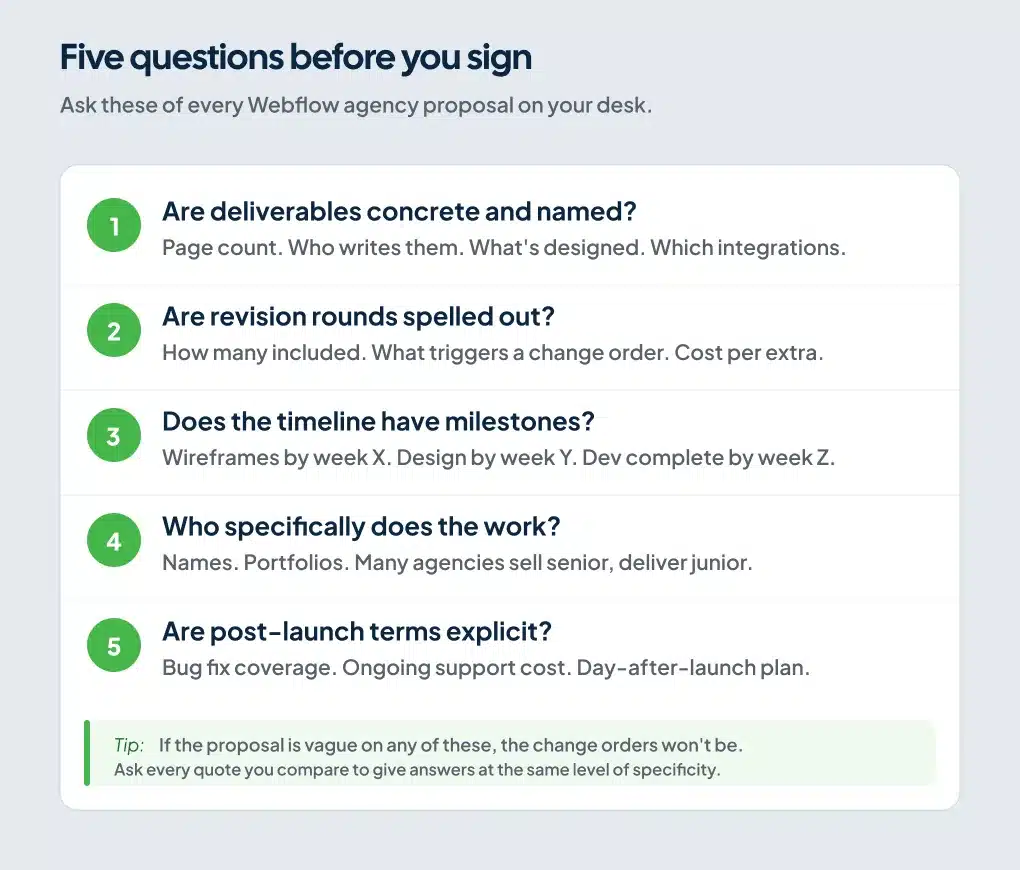
Five questions to ask of every quote before you sign.
Are deliverables concrete and named? How many pages? Who’s writing them? Are they being designed? What integrations are included? Etc.
Are revision rounds and scope changes spelled out? How many rounds are included? What triggers a change order? What does an extra revision cost? If the proposal is vague here, the change orders will not be.
Does the timeline have milestones rather than a single launch date? Wireframes by week X. Design approved by week Y. Development complete by week Z. A single end date with no checkpoints leaves you chasing status updates.
Who specifically does the work? Many agencies sell with senior talent and deliver with juniors. Ask for names. Confirm the designer’s and developer’s portfolios.
Are post-launch terms explicit? What happens the day after launch? How long is bug fix coverage? What does ongoing support cost? Agencies that go quiet about post-launch in the proposal tend to go quiet after launch too.
Our proposals at ClearBrand break out every deliverable and included features on the engagement. They give milestones week by week and include 30-day post-launch support. Ask for that level of specificity from any proposal you are reviewing.
When to hire which type of agency
A short framework for matching agency type to your situation.
You have a defined scope and a fixed budget: hire a flat-rate project agency. Ask for a written scope document, a milestone-based timeline, and explicit change-order pricing.
You need ongoing work and your priorities shift week to week: hire a retainer or subscription agency. Verify turnaround time and ask how many active clients they support per project manager.
You have a roadmap of incremental improvements: hire a retainer agency with hour-based billing. The transparency of an hour ledger keeps both sides honest.
You need a one-off integration, bug fix, or page update: hire by the hour from a freelancer or boutique agency. Cap the hours upfront so the work cannot exceed your budget without explicit approval.
You want a full system that converts, ranks, and compounds: hire a flat-rate build plus an ongoing retainer. The build creates the foundation. The retainer keeps producing.
That structure is what produced Dunn & Stone’s $1.5M in seven months (plus a $25M pipeline by month 12), 138 qualified leads, and 7X search impressions.
What a Webflow agency should produce for your business
A Webflow engagement is worth its price when it produces three outcomes.
- A site that converts better than what you had. Track conversion rate before and after. A redesign that does not move conversions has not earned its budget.
- A system you can maintain and extend. If you have to call the agency every time you add a blog post or update a service page, the build was not finished. Your CMS structure and Editor experience should let your marketing team work without help.
- A foundation that compounds. A new website won’t compound your organic visibility on its own. But it should set you up for SEO that ranks and AI search visibility.
When you evaluate quotes, ask which one will produce the most revenue per dollar spent over the next two years. That comparison matters more than the sticker price.
A short note on bias
We are a Webflow agency writing about Webflow pricing.
ClearBrand was founded in Colorado Springs in 2017. We have been Webflow-exclusive for years.
We work mostly with companies generating $3M to $50M in annual revenue. Past clients include Arena, Dunn & Stone Builders, Koha Pet, Zoë Facility Services, Kleercard, and Integrity Medicine. We publish our pricing. Our case studies name names.
We are not right for every project. The framework above applies whether you hire us or someone else.
Frequently asked questions
How much does it cost to hire a Webflow agency?
Webflow agencies charge between $3,000 and $50,000+ for a website build. Boutique retainers run $2,000 to $8,000 per month. Mid-market retainers can run $10,000 to $15,000+. Subscription agencies charge $4,700 to $9,900 per month.
Our Webflow web design and development engagements start at $14,999. The exact number depends on project complexity, agency tier, and what the engagement includes beyond development.
What is the average hourly rate for a Webflow developer in the US?
US-based Webflow developers at established agencies charge $100 to $250 per hour. Freelancers and offshore developers run lower, often $50 to $100. Hourly rates above $200 typically signal senior US-based talent with a full team behind the engagement.
Is a flat-rate or monthly retainer better for a Webflow project?
Flat-rate fits a defined one-time project: a new build, a redesign, a migration. Monthly retainers fit ongoing work: continuous SEO, content publishing, conversion testing, incremental site improvements after launch. Most companies use both. Flat-rate for the initial build, then a retainer for ongoing growth work.
Why are Webflow agency quotes so different from each other?
Two reasons. Agencies use different pricing models, so the headline numbers do not compare directly. And what is included varies a lot.
One quote might bundle strategy, copywriting, and conversion testing. Another covers only Webflow development. Compare deliverables line by line, not totals.
Are Webflow platform fees included in agency pricing?
Usually not. Webflow charges Site Plans separately, $14 to $39 per month for most marketing sites, billed annually. That cost goes on your bill, not the agency’s.
Some agencies bundle the first year of hosting into their quote. Most do not. Confirm before signing.
How long does a typical Webflow agency build take?
Most marketing site builds run 4 to 12 weeks from kickoff to launch, depending on scope. Our Webflow engagements run 8 to 16 weeks because the build includes more than development. It covers strategy, content creation, CMS migration with SEO protection, custom CRM integrations, and QA testing. Anyone promising a full custom build in under three weeks is either using a template or cutting corners.
Is the cheapest Webflow agency a bad idea?
Often. A cheap site that does not convert and does not rank costs you the build itself. It also costs you the leads it failed to generate and the higher ad spend you need to compensate. The savings on the build rarely cover what comes after.
How to decide what to spend
The right Webflow agency budget produces a measurable return inside 18 months. For companies in the $3M to $50M range, that means investing enough to get a site that converts, scales, and ranks. Not so much that the payback period stretches past the point where it changes the business.
Take the lowest quote you have received. Ask whether the agency that wrote it has produced results, with named clients and verified numbers, that match the outcomes you need. If not, the quote is not cheaper. It is smaller.
If you want a straight conversation about what your project should cost, schedule a call with us. We will walk you through our pricing before you commit to anything. We will tell you whether your project fits what we do best.