
If you run marketing for a B2B company, you’ve had this conversation with your CFO. Traffic is up. Rankings are up.
Then comes the question: how many leads did this bring in? You hand over a slide deck full of charts that don’t say “revenue” anywhere.
Most B2B SEO advice was built for B2C and imported into the B2B world. It tells you to chase volume and publish more. You do that for a year and end up with the chart problem above.
B2B SEO that works is different. It serves the small group of people who can buy what you sell. Most of the time, that group is researching without you in the room.
Gartner found that B2B buyers spend only 17% of their total buying time in direct contact with potential vendors. The other 83% is self-directed.
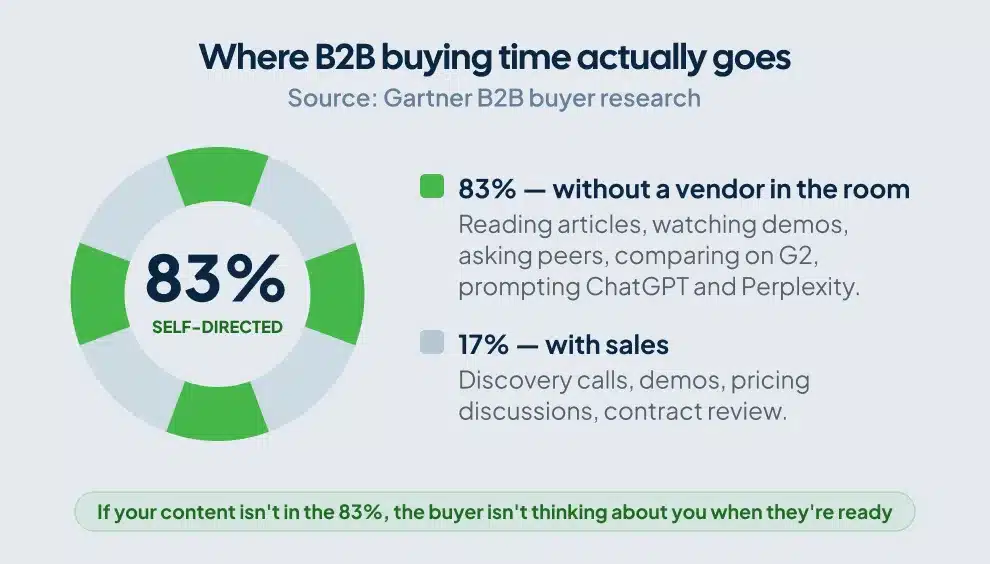
If your site doesn’t show up in the 83%, the buyer probably isn’t thinking about you when they’re ready.
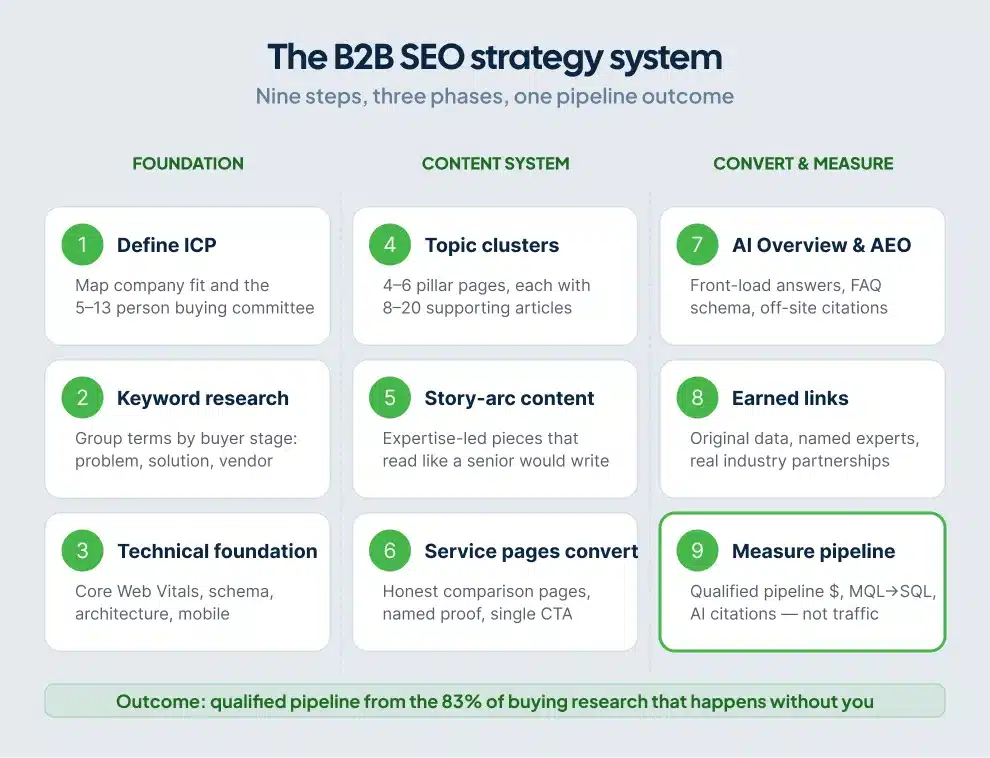
This guide walks through the nine-step approach we use at ClearBrand to get B2B companies ranking and bringing in organic leads. It produced the case studies referenced throughout.
What a B2B SEO Strategy Is
A B2B SEO strategy is a plan for ranking your content on search engines and AI answer engines. The goal is to help decision-makers find you during the 83% of their research that happens without a sales rep.
It targets low-volume, high-intent keywords used by buying committees. It supports long sales cycles. You measure it against pipeline and revenue, not traffic.
That definition shapes the strategy. Everything else is how to execute on it.
B2B vs B2C SEO: Why the Playbook Has to Change
The mechanics of Google’s algorithm are the same for everyone. The buyer is different.
A consumer searches “best running shoes,” scrolls a few options, and buys. A B2B buyer searches “best workforce management software for healthcare.” Then “Kronos vs UKG.” Then “UKG pricing for 500-bed hospital.” Six months pass. Eleven coworkers run their own variants of the same question. Someone decides, and you weren’t in most of those searches.
A few differences are key to every tactical choice you’ll make.
The buying group is large and disagrees with itself. Gartner’s 2024 survey of 632 B2B buyers found that buying groups now run from five to 16 people across up to four functions. 74% of those teams experience unhealthy conflict during the decision process. Your content has to give each stakeholder something they can quote in an internal meeting.
The sales cycle is long. B2B sales cycles average 84 days versus 9 for B2C. Someone reading a blog post today may not buy for another five months. Your strategy has to nurture, not just convert on first visit.
Search volume is lower per keyword and worth more. A keyword that brings ten visits a month can outperform one that brings ten thousand. If those ten visits come from heads of procurement at companies that fit your ICP, they’re gold.
For example, “b2b seo agency” gets about 4,300 monthly searches in the US, per Ahrefs. A B2C term like “running shoes” gets hundreds of thousands. The economics in B2B work differently.
The buyer has often made up their mind before you talk to them. 6sense’s 2025 Buyer Experience Report drew on more than 4,000 B2B buyers. Buying groups place four out of five vendors on their shortlist on day one of the buying journey.
The winning vendor comes from that day-one shortlist 95% of the time. The vendor a buying group contacts first wins the deal about 80% of the time. SEO is how you become the vendor a buyer thinks of on day one.
The 95/5 Rule and Why It Should Change Your Strategy
At any moment, about 5% of your target market is ready to buy. The other 95% have the problem you solve, but aren’t ready yet.
Most B2B companies pour their SEO budget into bottom-of-funnel pages and miss the 95%. By the time those 95% become 5%, they remember someone else.
A working B2B SEO strategy serves both groups. High-intent service pages and comparison content for the 5%. Educational and thought-leadership content for the 95% that helps them trust you and remember you. That way, when they’re ready, your name is the one they think of first.
The principle predates SEO by a century. Brands that show up across the time a buyer is forming preferences win that buyer when the buyer is ready. Skip the 95% and you compete in the 5% the day they search, against companies they already trust.
Step 1: Define Your Ideal Customer Profile and Buying Committee
Don’t open a keyword tool yet.
Your ideal customer profile (ICP) defines the type of company that fits your offer. Industry, company size, revenue range, geography, and the operational pain that makes your offer relevant.
Your buying committee is the set of humans inside that company who weigh in on the decision. For most B2B purchases over $25K, you’re looking at five to thirteen people across marketing, finance, operations, IT, procurement, and an executive sponsor.
For each role, write down:
- The problem they’re trying to solve
- The internal pressure they’re under
- The language they use to describe the problem (not the language you use)
- The question they’d type into Google or ChatGPT when researching
These notes become source material for your keyword strategy, your content briefs, and your messaging. Skip this step and you can spend a year ranking for terms your buyers don’t use.
We saw this play out with Dunn & Stone Builders, a construction firm we work with. Before we touched a keyword tool, we read reviews and talked to the sales team that hears directly from customers. We listened for the language facility managers and operations directors used to describe what they needed.
That language became the foundation of the keyword set. The $25M of pipeline that followed came from showing up for phrases real buyers typed, not the ones our team would have guessed.
Step 2: Do Keyword Research That Maps to Buying Stages
Most B2B keyword research starts in the wrong place. The pattern goes like this: open Ahrefs, type in a broad term, sort by volume, pick whatever’s at the top. A year later, the traffic looks fine, but none of it converts.
Build your keyword set around the three stages buyers move through.
Problem-aware keywords (the 95%). The buyer knows they have a problem, but doesn’t know what the solution is called. Search examples: “how to reduce employee turnover,” “why are our sales cycles getting longer.” These are educational. They earn trust early.
Solution-aware keywords (transitioning). The buyer knows there’s a category of solution and wants to understand it. Search examples: “what is sales enablement software,” “how does account-based marketing work,” “best abm marketing agencies.” Comparison guides and explainers work here.
Vendor-aware keywords (the 5%). The buyer is evaluating specific vendors. Search examples: “Salesloft vs Outreach,” “HubSpot pricing for enterprise,” “alternatives to Marketo.” These convert fastest. They’re also the most competitive.
A complete B2B keyword strategy includes all three. Most strategies skew to one stage and underperform on the others.
For each stage, use your ICP notes to brainstorm seed terms, then expand with a tool that gives volume and difficulty data. Then trim the list. Low volume isn’t a problem in B2B as long as the searcher is qualified.
A keyword like “enterprise data integration platform” might get 200 searches a month. Each of those searches can be worth tens of thousands in contract value.
Then group your keywords into clusters by topic. Each cluster becomes a pillar page plus supporting content, which is Step 3.
Step 3: Get the Technical Foundations Right
Writing well doesn’t matter if Google and AI crawlers can’t parse your site.
A few foundations matter most in B2B:
Core Web Vitals. Slow sites lose buyers and rankings. Pages loading within 2 seconds have a 9% bounce rate. At 5 seconds, that climbs to 38%.
Optimize images, minimize JavaScript, choose a fast platform.
We build every ClearBrand website on Webflow for this reason. Webflow’s hosting handles Core Web Vitals well by default. The CMS structure supports clean topic clusters and pillar pages.
Beyond performance, the on-page SEO controls give us the schema, meta, and URL flexibility every step in this guide depends on. When we rebuilt Dunn & Stone’s site on Webflow as part of their SEO program, the technical foundation contributed to how fast they started ranking.
Mobile responsiveness. B2B research happens on phones more than people expect, including the early problem-aware searches before a decision-maker pulls up the desktop.
Clean architecture and internal linking. Logical URL structure, descriptive page titles, an XML sitemap submitted to Search Console, and every page linking to and from the pages it relates to. This is how Google understands your site is organized around topics.
Structured data. Schema markup so search engines can parse your content into rich results and AI engines can extract it cleanly.
The unsexy hygiene. HTTPS, indexability, no duplicate content, no broken links. None of the above matters if your site can’t be crawled and indexed.
Step 4: Build Topic Clusters, Not Standalone Posts
Google’s algorithm ranks deep topical coverage higher than thin coverage of many topics. Industry analysis shows that 72.9% of pages in Google’s Top 10 are over three years old. Only 5.7% of new pages reach the Top 10 within one year.
Older pages tend to keep compounding their rankings, and topical authority is how you get there. The way to build topical authority is to organize your content around a small number of pillar topics.
Pick four to six pillar topics central to what you sell, not loosely adjacent ones. For a workforce management platform, the pillars might be shift scheduling, time tracking compliance, labor forecasting, employee self-service, and integrations.
For each pillar, build:
- One pillar page covering the topic in depth (the page you’d send someone if they asked you to explain it in one read)
- Eight to twenty supporting articles that go deep on subtopics, problems, or comparisons
- Internal links from each supporting article back to the pillar, and from the pillar out to the supporting articles
This structure tells Google you’ve organized your knowledge of the topic. It tells AI systems the same thing. And it gives buyers a research path inside your site instead of a dead end at the bottom of one blog post.
The companies that grow fastest in B2B SEO aren’t the ones publishing the most content. They run the cleanest cluster structure around the topics that matter for their pipeline.
Step 5: Write Content Using a Story Framework, Not a Template
A lot of B2B SEO falls apart here. Companies hit publish on sixteen blog posts a month, watch traffic tick up, and assume the strategy is working. Then they pull the lead-quality report and almost none of that traffic converted.
The 2024-2026 algorithm shift made this harder. HubSpot published over 18,000 blog pages, including hundreds on topics outside their area of expertise. Google’s updated ranking systems penalize content published outside an organization’s demonstrated expertise.
Reports tracked HubSpot losing up to 80% of organic traffic in a single quarter after the algorithm updates that followed.
The way out of generic content is to write pieces that read like a expert would explain something, not a content team filling a calendar. We do that with a story framework.
At ClearBrand, we write every piece of B2B content using a story structure we call the ClearBrand Story Arc. I developed it over the nine years I’ve been in marketing, across a few hundred client engagements. It’s the same arc you’d find under any billion-dollar movie, modified for websites and marketing.
In the arc, the customer is the hero with a motivation, and something is in their way. You appear as their ally with a clear solution. You build trust with proof, make an offer, and call them to act.
Applied to a blog post, the arc looks like this:
- Current Reality: start with where your readers are, based on the intent of the search term you’re targeting
- Motivation: open with the outcome the reader is after, in their language
- Trust: back it with first-hand evidence (named examples, numbers from your client work, original frameworks)
- Solution: give the answer in full, not a teaser, make your content the most helpful content on the internet for the topic
- Offer + Call to action: close with a specific next step
Notice how this also helps you hit Google’s E-E-A-T signals. Generic B2B content skips steps and fails to rank. Story-structured content walks the reader through the same psychological steps a good salesperson walks them through in a meeting.
A B2B blog of forty cluster-aligned, expertise-rich, story-structured articles will outperform a blog of four hundred generic posts.
KleerCard, a B2B SaaS fintech we work with, has 89 pages and articles at this point. That library generates more than half their pipeline.
Step 6: Make Your Service and Comparison Pages Convert
The 5% who are ready to buy don’t read your blog. They search “your category + pricing” and “you vs competitor” and land on your service pages. If those pages don’t rank and convert, you lose the deals you spent twelve months earning through content.
For service pages:
- One primary keyword per page, in the H1, title tag, URL, and first 100 words
- A specific outcome promise above the fold
- Proof specific to your buyer (named case studies, industry-relevant logos, results with numbers)
- One primary call-to-action, repeated down the page
- An FAQ section addressing the objections your sales team hears most
For comparison pages, be honest about where the competitor is better. Buyers can smell a sales pitch. They trust a comparison that admits the competitor wins on price or implementation speed and explains why your trade-offs are better for their situation. Comparison pages are also the highest-converting B2B content type by a wide margin, so they’re worth the time to do well.
Step 7: Optimize for AI Overviews and Answer Engines
Service pages and blog content getting found is one thing. Getting found in 2026 also means getting cited inside the AI answers that now sit on top of the search results.
The SERP for “b2b seo strategy” returns an AI Overview at the top of the page before any organic results. That happens on most informational queries now.
Ahrefs’ December 2025 study of 300,000 keywords found a 58% CTR reduction for the top organic result when an AI Overview appears. A separate Seer Interactive study tracked informational queries from January 2024 to January 2025. Organic CTR fell from 1.41% to 0.64% on AI Overview queries, a 55% decline. For informational queries, a citation inside the AI Overview now pulls more clicks than the top organic spot under it.
B2B buyers also use AI assistants on their own. Forrester’s 2024 Buyers’ Journey Survey found that 89% of B2B buyers have adopted generative AI in at least one area of their purchasing process. Almost 95% anticipate using it in the next 12 months. Optimizing for these surfaces (sometimes called AEO or GEO) is now part of B2B SEO.
A few things to do:
Answer questions early on the page. When a page targets the question “what is X,” put a 40-to-60-word definition in the first paragraph. AI systems extract these and cite the source. Bury the answer in section four and the AI tools tend to skip you.
Use clear question-and-answer structure. H2s phrased as questions, with answers immediately below. FAQ sections at the bottom of articles, pulled from People Also Ask and your own sales discovery calls.
Add schema markup. FAQPage for question pages, Article for blog posts, HowTo for tutorials, Product for service pages. Schema helps both Google’s classic ranking systems and AI extraction.
Build mentions on the platforms LLMs read. G2, Capterra, Reddit, LinkedIn, industry trade publications, and Wikipedia where appropriate. AI tools pull from these sources when generating recommendations. If your brand isn’t on those platforms, you stay invisible in AI-generated answers regardless of your Google rankings.
Step 8: Build Backlinks the Slow, Honest Way
B2B link building looks different from B2C. You’re not running viral campaigns or buying mentions from coupon sites. You’re earning citations from credible industry sources.
Three things work.
Original research and data. A survey of your customers, a benchmark report drawn from your own platform data, a published case study with real numbers. Journalists, analysts, and competitors link to original data because they can’t get it anywhere else.
Thought leadership from named experts. Articles attributed to a named expert with visible credentials, published on your blog and as guest posts on industry publications. This builds the author’s authority and your site’s at the same time.
Strategic partnerships and citations. Industry associations, integration partners, customer co-marketing, podcast appearances. Real relationships that produce real links.
What doesn’t work in 2026: paid links, link schemes, guest posts on irrelevant sites, comment spam, and most directory listings. Google’s spam systems catch these and they damage rankings.
Step 9: Measure What Connects to Revenue
If your B2B SEO report is mostly “traffic up X%,” you’re measuring an indicator. The outputs that matter are pipeline and revenue.
Metrics worth tracking:
- Qualified pipeline from organic search. Dollar value of opportunities sourced from organic, tagged in your CRM.
- MQL-to-SQL conversion rate from organic vs paid. First Page Sage research shows organic-influenced deals convert at 51% MQL-to-SQL vs 26% for paid, almost 2x better.
- Page-level conversion rate on your highest-traffic pages. Find the pages bringing traffic but failing to convert, and rework them.
- Branded search volume growth. A leading indicator that your 95% content is building memory.
- AI Overview and AI answer citations. Track whether your brand is being cited by ChatGPT, Perplexity, and Google’s AI Mode for the prompts your buyers use.
When you measure the right things, the ROI numbers tend to show up. First Page Sage’s 2026 benchmark data, drawn from campaigns between 2021 and 2025, shows an average ROI of 748% across B2B SEO programs. In B2B SaaS, the average is around 702%, with break-even at around seven months. You see those numbers if you measure correctly and stay patient through the compounding curve.
How Long Does a B2B SEO Strategy Take to Work
Six to twelve months for meaningful traffic. Twelve to eighteen months for meaningful pipeline. Two to three years for the kind of compounding authority that becomes a durable advantage.
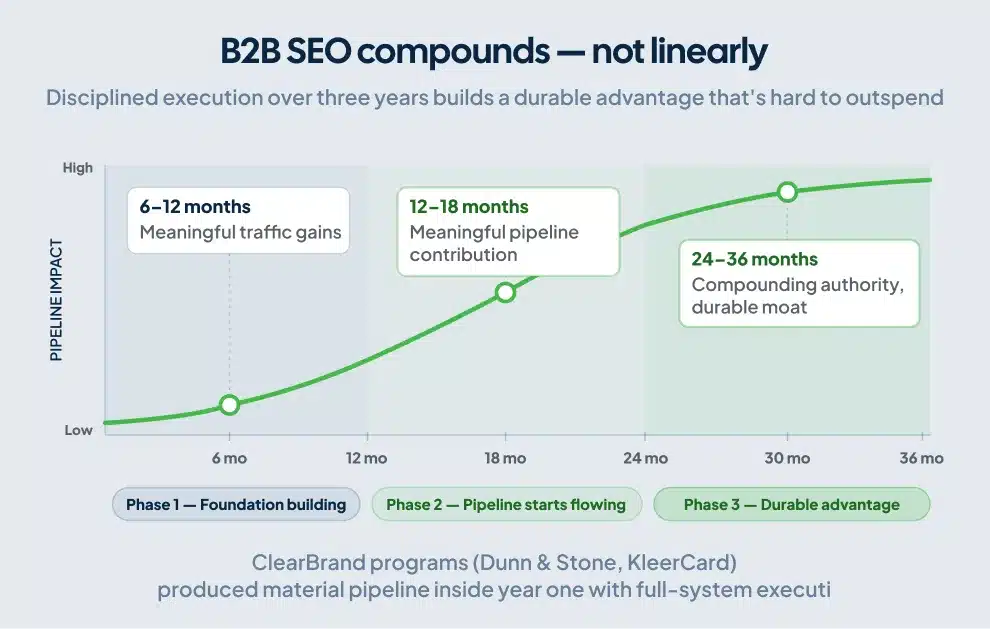
Disciplined execution can move that curve faster. KleerCard went from zero organic search leads to organic-sourced opportunities representing more than half their new customers in nine months. Our SEO work with Dunn & Stone home builders produced $25M of pipeline within their first year. Both programs ran every step in this guide together, in order, without shortcuts.
When you hear of timelines much faster than that, look closer. A faster timeline tends to mean one of two things. A low-competition category, or a definition of “results” that doesn’t include revenue.
What Most B2B SEO Strategies Get Wrong
A few patterns we see come up again and again:
- Treating the blog as a content factory. Publishing volume without depth doesn’t produce rankings or leads.
- Skipping the website that has to convert. You can rank #1 and lose every deal if your service pages are weak. SEO and web design are one system.
- Ignoring the 95%. Bottom-funnel keywords feel safer because they convert faster. If you don’t build memory with the 95%, you’ll fight for scraps in the 5%.
- Measuring traffic instead of pipeline. It’s the easiest report to pull and the least useful one to look at.
- Outsourcing strategy to a partner who doesn’t understand the business. If the keyword list doesn’t match how your buyers search, the year is lost no matter how good the execution looks on paper.
Frequently Asked Questions About B2B SEO Strategy
What is a B2B SEO strategy?
A B2B SEO strategy is a plan for ranking content on Google and AI answer engines. The goal is to help business decision-makers find you during the 83% of their research that happens without sales involvement. It targets low-volume, high-intent keywords used by buying committees, supports long sales cycles, and is measured against pipeline and revenue rather than traffic.
How is B2B SEO different from B2C SEO?
B2B SEO targets smaller audiences, often buying committees of 5 to 16 people. It uses lower-volume but higher-value keywords and supports sales cycles measured in months. It’s judged by pipeline contribution rather than traffic.
B2C SEO targets broad consumer demographics with high-volume keywords and shorter conversion paths. The Google algorithm is the same in both cases; the buyer behavior is different.
How long does B2B SEO take to produce results?
Most programs see meaningful traffic gains at six to twelve months. Meaningful pipeline contribution comes at twelve to eighteen months. Compounding authority that creates durable advantage takes two to three years.
Disciplined execution shortens the curve. Two ClearBrand programs (Dunn & Stone and KleerCard) produced material pipeline within their first year.
What’s the ROI of B2B SEO?
First Page Sage’s 2026 benchmark data, drawn from campaigns between 2021 and 2025, shows an average ROI of 748% across B2B SEO programs. B2B SaaS averages around 702%, with a seven-month break-even window. Results vary based on category competitiveness, content quality, and how well your service pages convert the traffic.
Should B2B companies optimize for AI Overviews and ChatGPT?
Yes. Forrester’s 2024 Buyers’ Journey Survey found that 89% of B2B buyers have adopted generative AI in at least one area of their purchasing process.
Three things matter for AI optimization:
- Structure content for clean extraction
- Build brand presence on the platforms LLMs cite, including G2, Reddit, LinkedIn, and industry publications
- Track AI citations alongside traditional rankings
What’s the most common mistake in B2B SEO?
Targeting keywords by volume instead of by buyer intent. A keyword with 10,000 monthly searches from unqualified consumer traffic is worth less than a keyword with 50 searches from heads of procurement. The qualified searcher matters more than the volume.
Putting It Together
Most B2B SEO advice gives you tactics. You need a system.
The system, summarized:
- Define who you’re selling to and what their committee looks like.
- Build keyword research around how that committee searches at each stage.
- Get the technical foundations and link profile right.
- Organize content into topic clusters with one strong pillar each.
- Write with first-hand expertise using a story structure.
- Make sure your service pages convert the traffic those clusters bring in.
- Optimize structure and schema so AI answer engines can cite you cleanly.
- Measure everything against pipeline.
Execution is where most companies fall short. Six months of focused output produces more than two years of half-built work spread across too many priorities.
If you’d rather have a partner execute the system with you than rebuild the apparatus internally, that’s the work we do at ClearBrand. We build Webflow websites that convert the traffic. We run the monthly SEO and AEO programs that bring the right traffic in the first place. We work with founder-led B2B companies tired of agencies that talk about traffic instead of revenue.
By Alexander Toth, Founder and CEO, ClearBrand