
The way people search for information is changing faster than most businesses realize. Answer Engine Optimization (AEO) is the process of optimizing your content so that AI-powered platforms can recommend your brand and use your website as the cited source when users ask questions.
Instead of typing keywords into Google and clicking through pages of results, your potential customers are now asking AI tools like ChatGPT, Perplexity, and Google’s AI Overviews for direct recommendations.
This guide is for business owners, marketers, and content creators who want to improve their brand’s visibility in AI-powered search results. As AI answer engines become more prevalent, optimizing for AEO is essential to ensure your brand is found and trusted by potential customers.
And here’s the challenge: these AI answer engines don’t show ten blue links. They often give one to five recommendations.
If your brand isn’t that answer, you’re invisible to a growing segment of your audience—even if your traditional SEO is performing well.
The goal of AEO is to become that answer—not just a link in a list, but the brand that gets mentioned, quoted, or recommended when someone asks a relevant question.
This guide breaks down everything you need to know about Answer Engine Optimization (AEO): what it is, how it differs from SEO and GEO, why it matters for your business in 2026, and the practical strategies you can implement today to start winning AI-driven visibility.
What is AEO (Answer Engine Optimization)?
AEO is about optimizing content so that search platforms can directly provide answers to user queries, rather than just listing links. It improves a brand’s visibility in AI-powered answer engines like ChatGPT and Perplexity AI by aligning content with user expectations for quick, concise answers.
Answer engine optimization (AEO) focuses on creating and formatting content so that AI answer engines can easily understand and surface it to answer user questions.
AEO adapts the core principles you already know from SEO—relevance, authority, and technical health—and applies them specifically to generative and conversational AI environments. It’s about making your content easy for AI systems to understand, trust, and cite.
At ClearBrand, we use AEO alongside SEO and generative engine optimization to help Colorado and U.S. businesses turn AI visibility into measurable leads and sales. Because at the end of the day, being “the answer” only matters if it drives real business outcomes.
Here’s what AEO comes down to:
- Great content that becomes the source AI tools reference when answering user queries
- Citations and brand mentions in AI-generated responses, not just rankings
- Your expertise gets surfaced in AI summaries, voice search results, and chat interfaces
- You build trust with both AI crawlers and the humans asking the questions

AEO vs. SEO vs. GEO: What’s the Difference?
All three optimization approaches aim for visibility, but they target different “engines” and user experiences. Understanding the key differences helps you build a strategy that covers the full search landscape.
SEO (Search Engine Optimization) focuses on traditional search engines like Google and Bing. The goal is to earn high search rankings through keyword optimization, quality content, authoritative backlinks, and technical health. Success is measured in organic traffic, impressions, and clicks from search engine results pages.
AEO (Answer Engine Optimization) targets answer engines and AI search surfaces—featured snippets, AI Overviews, voice assistants, and chatbots like ChatGPT and Perplexity. The goal isn’t just to rank; it’s to be selected as the definitive answer. AEO prioritizes content structure, clarity, and authority signals that help AI models identify your content as the best source to cite.
GEO (Generative Engine Optimization) goes a step further, focusing specifically on how large language models synthesize and quote information in their long-form answers. GEO involves crafting content with persuasive, authoritative phrasing that influences how AI tools represent your brand when generating responses.
A holistic engine optimization approach uses all three:
- SEO drives organic search traffic from people browsing search results
- AEO wins zero-click answers where users get information without visiting a site
- GEO shapes how AI narratives describe and recommend your brand
Here’s a practical example: You might rank #1 on Google for “Colorado Springs web design” (SEO win). But when someone asks ChatGPT “What’s the best web design agency in Colorado Springs?”, will your brand be recommended? That’s where AEO and GEO come in.
The businesses winning in 2026 aren’t choosing between these approaches; they’re integrating them into a unified digital marketing strategy.
Why Answer Engine Optimization Matters Now
The shift toward AI-driven answers isn’t a future prediction—it’s already happening. Industry research estimates that over 50% of searches now result in zero-click outcomes, where users get their answer directly on the search results page or through an AI interface (such as Google’s AI Overview).
Gartner-style projections suggest that by 2026, roughly a quarter of search traffic could shift to AI chat and assistant platforms.
This represents a fundamental change in user behavior and how your target audience discovers businesses like yours.
- People ask different questions now. Instead of typing fragmented keywords, users ask complete, conversational queries directly to AI tools: “What’s the best way to get more leads from my website?” rather than “lead generation tips.”
- One answer wins. Traditional search engines show ten results per page. AI platforms often provide one synthesized response with limited citations. If you’re not cited, you don’t exist in that conversation.
- Voice assistants amplify zero-click behavior. When someone asks Siri, Google Assistant, or Alexa a question, they hear one answer—not a list of options. Your brand visibility depends on being that single recommendation.
- Google’s AI Overviews are changing the SERP. Even within traditional Google search, AI-generated summaries now appear above organic results for many queries, reducing clicks to individual websites.
- The upside is significant. Brands that win AEO often see fewer raw clicks but better-qualified visitors. When an AI tool recommends you by name, the people who do visit your site arrive with higher intent and trust.
At ClearBrand, we focus on revenue and lead outcomes—not just traffic numbers. AEO is valuable precisely because it connects your brand with people at the moment they’re looking for solutions, often before they’ve even decided to click anywhere.
Changing Search Behavior & Zero‑Click Results
The way people search has fundamentally evolved. Instead of short keyword phrases, users now ask natural language questions like “what is AEO and how do I use it for a local service business?” or “who’s the best SEO agency in Colorado Springs for small businesses?”
Zero-click searches happen when the answer appears directly in the search results or AI interface, eliminating the need to visit a website. The user gets what they need—a definition, a recommendation, a quick fact—without clicking through.
Consider these scenarios:
- A homeowner asks their smart speaker, “What’s the best roofing company in Colorado Springs?” The assistant names one or two companies. That’s the entire decision set.
- A business owner types into Perplexity AI, “How do I improve my website’s lead generation?” The tool synthesizes an answer and cites two or three sources. Everyone else is invisible.
- Someone searches on Google and sees an AI Overview answering their question before they reach the organic listings.
In this environment, being result #3 through #10 matters far less than being the answer that gets cited. The brands winning AEO are the ones AI tools trust enough to recommend by name.
This doesn’t mean “search is dead” or that no one is clicking anymore. Instead, our focus shifts to things we know are getting clicked, like high-intent, ready-to-do-business searches.
For example, a search like: “Find me the best AEO agency” will result in clicks. This isn’t something the AI Overviews can solve. They can suggest agencies, but that search is from someone looking to do business. If we rank in the AI Overview or ChatGPT answer, we win the business.
AI Answer Engines and Brand Visibility
An “AI answer engine” is any tool that reads web content and generates direct, conversational answers. This includes:
- ChatGPT with browsing capabilities
- Perplexity AI
- Google Gemini
- Microsoft Copilot
- Google AI Overviews within traditional search
These AI-powered answer engines don’t just list sources—they synthesize information and pick a limited set of references to cite or mention. If your website isn’t in that small group, your brand’s presence effectively disappears from the conversation.
What makes this more complex is that answer engines also pull from third party sites: directories, reviews, news articles, industry roundups, and expert publications. This means your off-site authority—your Google Business Profile, your reviews, your mentions in other publications—directly influences whether AI tools trust and recommend you.
ClearBrand’s AEO work addresses both your website and your broader digital visibility footprint. We optimize your on-site content while strengthening the external signals that AI tools use to evaluate brand authority and trustworthiness.
How AEO Works (Behind the Scenes)
Understanding how AI answer engines function helps you optimize more effectively. AEO works by aligning your content with how AI models are trained, how they crawl information, and how they select sources to cite.
Large language models like GPT-4 and Gemini are trained on massive datasets of web content. When they generate answers, they’re essentially predicting the most accurate, authoritative response based on patterns they’ve learned. Freshness, clarity, and authority signals all influence which sources get selected.
Beyond that, these AI platforms are going to search engines (like Google and Bing) to do the research. They’re typing in your search query, seeing what they find, and generating their answer.
So your first goal is actually to rank on Google and Bing. Brands that publish helpful, accessible content position themselves as go-to sources.
After that, you want to see which sources AI is using to generate answers (click the “Sources” button at the bottom of the answer it generates) and be cited in as many of them as you can. The more AI sees your brand mentioned, the more likely it is to recommend you.
AEO is also iterative. You publish optimized content, observe how AI tools respond when queried, refine your structure and messaging based on what works, and then re-measure. It’s a continuous improvement process, not a one-time fix.
Data Sources, Training, and Citations
AI answer engines draw from multiple data sources when generating responses:
- Public web pages: Articles, guides, service pages, and blog posts that are accessible to crawlers
- Structured data: Schema markup, business profiles, and explicitly defined entities
- Licensed content: News publications and authoritative sources with formal data agreements
- User feedback: Engagement signals and quality indicators that influence source rankings
Your AEO strategy should make your brand visible across these data layers. This means maintaining clear NAP (name, address, phone) details, publishing authoritative articles that demonstrate expertise, ensuring consistent product and service information across platforms, and building a strong foundation of reviews and brand mentions.
You can’t control AI training directly, but you can control how often and how clearly your expertise appears online. When you create a comprehensive guide on “what is AEO” that’s well-structured and authoritative, it becomes a frequent citation source for related queries—giving your brand repeated visibility in AI-generated answers.
Natural Language, Structure, and Intent
Answer engines need content written in natural language that mirrors how people actually ask questions. The conversational queries users type or speak—who, what, why, how, where, when—should be reflected in your content structure.
Optimizing for user intent is essential. Intent types include:
- Informational: “What is answer engine optimization?”
- Commercial: “Best AEO agencies in Colorado”
- Transactional: “Schedule a free AEO audit”
- Navigational: “ClearBrand contact page”
- Inspirational: Best Story Brand Website Examples
AEO focuses heavily on informational and commercial intent, where users are seeking answers and evaluating options.
Here’s how to structure content for AI search engines:
- Use clear H2/H3 headings that mirror user questions (e.g., “What Is AEO?” not “Overview”)
- Place a concise 2-3 sentence definition near the top of each section
- Write short paragraphs that are easy to scan and extract
- Include bullet points for lists of features, steps, or options
- Add a dedicated FAQ section to capture long tail queries
For example, this very guide starts with a direct definition of AEO before expanding into deeper detail. That structure helps natural language processing systems quickly identify the core answer and cite it accurately.
Key AEO Strategies You Can Use Today
This section gives you practical steps your business can implement now—even without advanced tools or a dedicated team. These strategies work whether you’re doing AEO in-house or working with an agency like ClearBrand.
The most important thing to understand: AEO is not a replacement for traditional SEO. It’s a focused layer on top of good technical and content fundamentals. If your site has serious technical issues or thin content, fix those first.
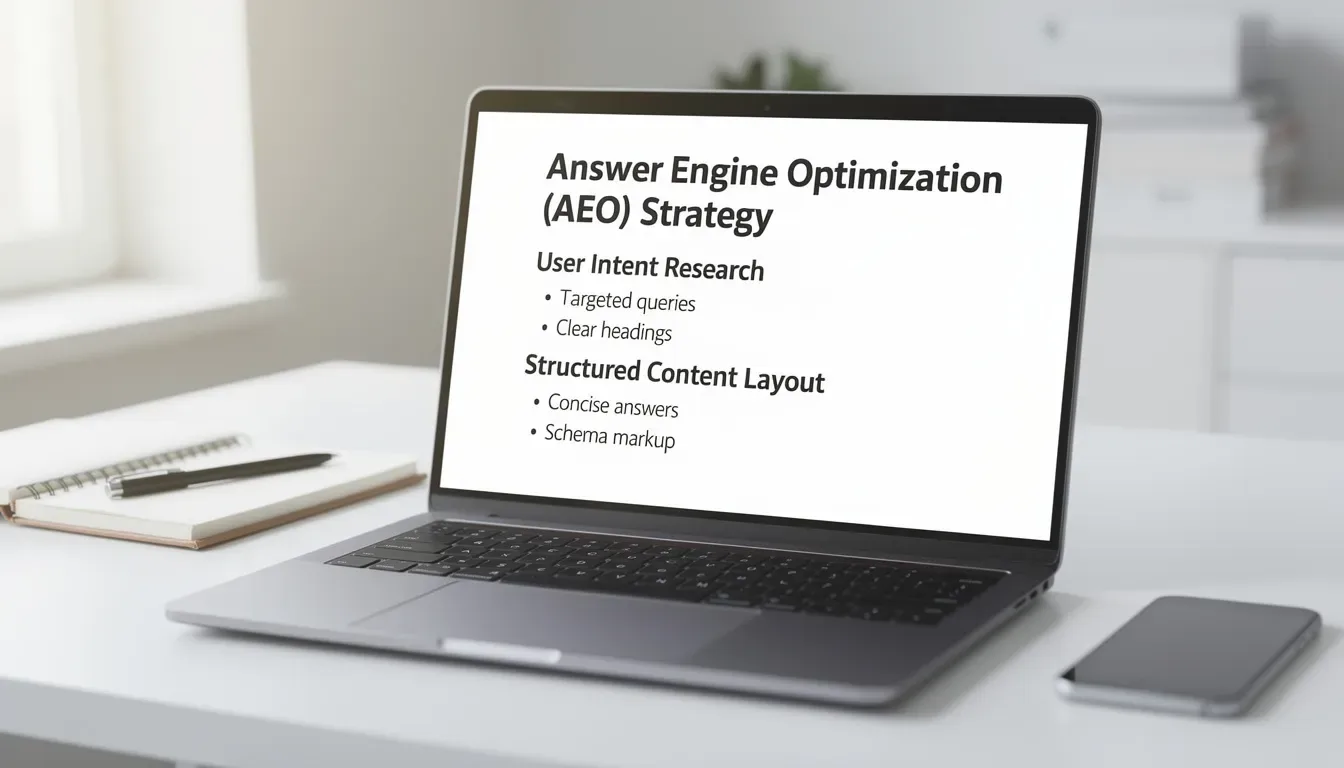
The main strategic pillars of AEO include:
- Research real questions and intent: Understand what your audience is actually asking
- Format content for direct answers: Structure pages so AI can easily extract concise answers
- Implement schema markup: Help AI systems understand your content’s meaning
- Strengthen off-site signals: Build authority through reviews, mentions, and consistent listings.
- Monitor and refine: Track AI visibility and iterate based on results
Start where you already have authority. Focus on your core services and main locations before trying to optimize everything at once.
ClearBrand builds AEO into website redesigns and SEO campaigns so clients don’t have to manage a separate, disconnected project.
Research Real Questions and User Intent
Before you can be the answer, you need to know what questions people are asking. Here’s how to find question-based queries:
- Google Search Console: Filter for queries containing “what,” “how,” “why,” “best,” and question marks
- Keyword research tools: Look for question modifiers and long-form queries in your niche
- People Also Ask: Review the PAA boxes for your target keywords to see related questions
- AI tools themselves: Ask ChatGPT or Perplexity what questions people commonly have about your services
Group the questions you find by topic and intent. For a web design agency, this might include clusters like:
- “What is AEO” / “AEO vs SEO” (educational)
- “How to get more leads from my website” (problem-solving)
- “Best web design agency in Colorado Springs” (commercial/local)
Each high-value question should map to either a dedicated article or a clear section on an existing page. If you’re answering questions directly, with clear structure, you’re positioning yourself to be the source AI tools cite.
Format Content for Direct, AI‑Friendly Answers
The way you format content directly impacts whether AI tools can extract and cite it. Here’s how to structure your pages:
- Answer-first writing: Put a concise 2-3 sentence answer to the main question at the top of the page or section. Don’t bury the answer after paragraphs of background.
- Question-based headings: Use H2/H3 headings that mirror how users ask questions. “What Is AEO?” is better than “Background Information.”
- FAQ sections: Add a dedicated FAQ section with short, direct answers at the end of key pages. This captures question variants and provides direct answers in a format AI tools love.
- Scannable structure: Use bullet points and numbered lists where appropriate. Keep sentences brief and factual. Avoid long, dense paragraphs that are hard to parse.
Think of your content as having two audiences: humans who will read it and AI systems that will scan it for extractable answers. Good AEO formatting serves both.
Use Schema Markup and Structured Data
Schema markup is code you add to your website that helps search engines and AI tools understand what your content means—not just what it says. It defines entities, relationships, questions, and answers in a structured format.
For AEO, prioritize these schema types:
- FAQPage: Marks up question-and-answer content, helping AI identify direct answers
- HowTo: Structures step-by-step guides in a way AI can parse
- Article: Defines author, publication date, and topic for content pieces
- Organization: Establishes your brand entity and key information
- LocalBusiness: Essential for local SEO and appearing in location-based AI answers
- Product/Service: Defines what you offer with specific attributes
Implementation options include SEO plugins (like Yoast or RankMath for WordPress), JSON-LD templates, or developer support for custom implementations. Webflow has all these settings built in, which is one of the reasons we use it to build websites.
ClearBrand includes schema markup setup and audits as part of our SEO and AEO engagements. Proper structured data implementation is foundational—without it, you’re making AI tools work harder to understand your content.
Strengthen Off‑Site Authority and Consistency
AI answer engines don’t just look at your website. They evaluate signals across the web: authoritative backlinks, brand mentions, reviews, directory listings, and social profiles.
Here’s how to strengthen your off-site authority for AEO:
- Google Business Profile: Keep your profile complete, accurate, and regularly updated with posts, photos, and responses to reviews
- Directory consistency: Ensure consistent NAP information across Bing Places, Yelp, Apple Maps, and business directories in your industry
- Reviews: Actively encourage satisfied customers to leave reviews on Google, industry-specific platforms, and third party sites
- Earned mentions: Publish expert content, contribute quotes to industry articles, and pursue inclusion in “best of” lists and roundups
- Referral traffic sources: Build relationships that lead to mentions and links from trusted publications
When AI tools see consistent, positive signals about your brand across multiple authoritative sources, they’re more likely to recommend you. This is especially important for local SEO, where Google Business Profile optimization directly influences whether voice assistants mention your business.
Monitor and Refine Your AEO Performance
AEO measurement is still maturing, but you can start tracking visibility with simple manual checks and existing tools.
Manual AI visibility checks:
- Ask ChatGPT (with browsing enabled), Perplexity, Gemini, and Google AI Overviews questions relevant to your industry
- Note which brands appear, whether you’re cited, and how you’re described
- Track a small set of priority questions monthly
Search Console and Analytics:
- Monitor question-style queries driving impressions or clicks
- Track featured snippets wins for your target questions
- Watch for changes in branded search queries (a sign of growing AI mode visibility)
Refinement process:
- Update and expand content that already earns mentions
- Rework content that has strong SEO performance but never surfaces in AI answers
- Test new formats (FAQs, comparison tables, step-by-step guides) and measure impact
As dedicated AEO and GEO visibility platforms mature, you can add them to your measurement stack. For now, the combination of manual checks, Search Console, and Analytics provides a solid baseline for improving site structure and content strategy based on real AI response data.
Is AEO Worth It for Your Business?
Let’s be clear: AEO is newer than traditional SEO, and best practices are still evolving. It is the “wild west” of search again. But the shift to AI-driven answers is already affecting traffic and discovery. Waiting until it’s “fully figured out” means ceding ground to competitors who start now.
Here’s how to think about whether AEO makes sense for your business:
- Service businesses and B2B companies benefit most. In industries where one or two recommendations drive most leads, being the AI-recommended brand is enormously valuable.
- Strong SEO foundations accelerate AEO results. If your site already has solid technical health, quality content, and decent authority, AEO improvements often appear faster.
- Most AEO work also improves SEO. Clear structure, question-led content, schema markup, and off-site authority building benefit both traditional search rankings and AI visibility.
- High-intent visibility matters more than volume. Even if AI answers reduce raw click volume, the visitors who do arrive tend to be more qualified and ready to convert.
- Investment level matters. Companies spending $5,000-$20,000/month on digital marketing should treat AEO as a core component of their search strategy, not a side experiment.
The question isn’t really whether AEO is worth it—it’s whether you can afford to be absent from the conversations your potential customers are having with AI tools.
Timelines and Expectations
Set realistic expectations for AEO results:
- Initial improvements: Can appear within a few weeks to a few months, depending on your existing authority and how frequently AI tools re-crawl and update their knowledge
- Starting scope: Focus on 5-10 high-value questions at first rather than trying to “optimize everything for AI” simultaneously
- Success metrics: Measure visibility and qualified leads, not just raw organic sessions—AEO success often shows up in branded searches, direct traffic, and conversion rates before it shows in click volume
- Ongoing practice: Treat AEO as something you revisit quarterly as AI tools change their behavior, add new features, and update how they select sources
AEO isn’t a project you complete—it’s a capability you build into your ongoing content strategy and digital visibility work.
How to Get Started with AEO (Step‑by‑Step)
Whether you work with ClearBrand or tackle this in-house, here’s a practical rollout plan any business can follow.
The main phases are:
- Baseline audit of current AI and search visibility
- Goal setting with realistic KPIs and tracking
- Quick wins on priority pages
- Deeper content and schema work
- Monitoring and iteration
ClearBrand handles the technical and strategic heavy lifting for businesses that prefer not to DIY. But these steps work regardless of whether you’re working with an agency or building internal capabilities.
Step 1: Audit Your Current AI and Search Visibility
Start by understanding where you stand today.
- Search your branded and non-branded questions in ChatGPT (with browsing), Perplexity, and Google AI Overviews.
- Ask questions like “What is [your service]?” and “Who’s the best [your category] in [your location]?”
- Note whether your brand appears, how it’s described, and which competitors are cited.
Review Search Console data:
- Filter for question-style queries (what, how, why, best, etc.)
- Identify which questions already drive impressions or clicks
- Note your current featured snippets wins and People Also Ask appearances
Document your baseline:
- Create a simple spreadsheet tracking priority questions, current AI visibility, and current SERP position
- This becomes your benchmark for measuring improvement
This audit can be done with free tools and manual checks in 1-2 days. It gives you the foundation for everything that follows.
Step 2: Define AEO Goals and KPIs
Set concrete, achievable goals rather than vague aspirations.
Example goals:
- Earn at least one AI citation for our main service query within 90 days
- Appear in Google AI Overviews for 3 of our top 5 target questions within 6 months
- Increase branded search queries by 20% over the next quarter
Metrics to track:
- AI citations and mentions (tracked through manual checks)
- Branded search queries (Search Console)
- Qualified leads from organic channels (CRM + Analytics)
- Featured snippet wins (rank tracking tools)
- Conversions supported by organic and direct traffic
Early wins are often qualitative—seeing your brand recommended by an AI tool for the first time. Quantifiable trends build over months as your visibility compounds.
Step 3: Prioritize and Optimize Key Pages
Focus first on pages that matter most to your revenue:
Core service pages:
- Add clear, answer-first definitions of what you offer
- Structure content with question-based headings
- Include relevant schema markup (Service, LocalBusiness, FAQPage)
High-intent educational content:
- Optimize existing guides and blog posts around target questions
- Add FAQ sections capturing long tail query variants
- Ensure headings match how people actually ask questions
Location pages (for local businesses):
- Optimize for “[service] in [location]” queries
- Include complete business information and local schema
- Connect to your Google Business Profile
Create or expand cornerstone content around “what is” and “how to” topics central to your expertise. This comprehensive, well-structured content becomes the foundation of your AEO visibility.
Step 4: Improve Off‑Site Signals and Brand Authority
Your website is only part of the equation. AI tools evaluate your brand across the web.
Immediate actions:
- Update and complete your Google Business Profile
- Standardize NAP information across all directory listings
- Respond to existing reviews and encourage new ones from satisfied customers
Authority building:
- Pursue mentions in local or industry publications
- Contribute expert quotes to articles in your field
- Get included in relevant podcasts, resource lists, and roundups
- Build authoritative backlinks through genuine expertise sharing
These activities take time, but they benefit your SEO, AEO, and overall brand reputation simultaneously. When AI tools see consistent, positive signals about your brand from multiple trusted sources, they’re more likely to cite and recommend you.

Step 5: Monitor, Iterate, and Scale
AEO is an ongoing practice, not a one-time project.
Set a recurring review schedule:
- Monthly or quarterly, test your priority questions in AI tools and search
- Log changes in visibility, citations, and how your brand is described
- Compare against your baseline to measure progress
Double down on what works:
- Identify formats and topics that reliably earn citations
- Create more content following those successful patterns
- Expand schema implementation across additional pages
Scale gradually:
- Start with a handful of high-value questions
- As you see results, expand to a broader library of question-focused content
- Build AEO thinking into every new piece of content you create
AEO grows alongside your SEO and content strategy. The brands that win long-term are those that treat AI visibility as an ongoing capability, not a one-time optimization.
Frequently Asked Questions About AEO
What is AEO?
AEO, or Answer Engine Optimization, is the process of structuring and formatting your content so that AI-powered platforms like ChatGPT, Perplexity, and Google’s AI Overviews can select your brand as the cited source when users ask questions. It focuses on providing direct, concise answers to user queries and uses structured data to help AI understand and surface your content.
How is AEO different from SEO?
While SEO (Search Engine Optimization) aims to improve your rankings in traditional search engines like Google and Bing, AEO (Answer Engine Optimization) is focused on making your content the direct answer that AI-powered platforms provide to users. SEO is about getting clicks from search results, while AEO is about being the cited answer in AI-generated responses, often resulting in zero-click outcomes.
Why is AEO important in 2026?
AEO is crucial in 2026 because AI answer engines are rapidly changing how people search for information. As more users turn to AI tools for direct answers, brands that optimize for AEO will be more visible and trusted. Without AEO, your brand risks being invisible in AI-driven search results, even if your traditional SEO is strong.
What role does structured data play in AEO?
Structured data, such as schema markup, helps AI answer engines understand your content’s meaning and context. By implementing structured data, you increase the chances that your content will be selected and cited in AI-generated answers, improving your brand’s visibility in these new search environments.
Can AEO improve my traditional SEO results?
Yes, many AEO best practices—such as clear content structure, question-based headings, and schema markup—also benefit traditional SEO. Optimizing for AEO can enhance your site’s technical health and authority, leading to better performance in both AI-driven and traditional search results.
How ClearBrand Uses AEO to Grow Leads and Sales
ClearBrand was founded in 2017 in Colorado Springs with a simple focus: helping businesses get more leads and sales through data-driven marketing systems. We’ve integrated web design, SEO, AEO, and GEO into a unified approach because siloed tactics don’t deliver unified results.
Our clients have seen outcomes like 4× revenue growth, 15× organic traffic increases, and 25× ROI—though specific results depend on each client’s situation, market, and starting point.
Here’s how we approach AEO:
- Audience research: Understanding the questions your specific customers ask and the AI platforms they use
- Technical audits: Evaluating site structure, schema implementation, and crawlability for both search engines and AI crawlers
- Question-led content planning: Developing content that directly answers high-value queries with clear structure and authority
- Schema implementation: Setting up and validating structured data that helps AI tools understand your expertise
- Ongoing visibility tracking: Monitoring AI citations, branded searches, and lead quality to measure real business impact
We don’t treat AEO as a separate add-on. It’s built into how we approach every website redesign and SEO campaign, ensuring your online visibility extends to wherever your potential customers are looking—including AI platforms.
Ready to see where your brand stands in AI search?
Schedule a free AEO audit to review your current site, SEO performance, and answer engine visibility. We’ll show you exactly where you’re appearing (or missing) in AI-driven search and what it would take to become the brand that gets recommended.
The shift to AI-powered discovery is already happening. The businesses that adapt now will be the ones customers find—and trust—tomorrow.