

Ranking in ChatGPT means getting cited or recommended when it answers a question in your category. There is no single position to win. ChatGPT writes one answer and pulls from a few sources it can reach and trust. Your visibility comes from how often you show up across many answers.
OpenAI reported more than 900 million weekly active users inFebruary 2026. People now ask it which tools to buy and which companies to hire. A citation inside one of those answers carries weight a blue link never had.
This playbook covers how to earn citations, and where the effort is not worth it for your business yet.
What ranking in ChatGPT means
ChatGPT does not give you ten ranked links. It writes one answer and cites a few sources. Your goal is to be one of them.
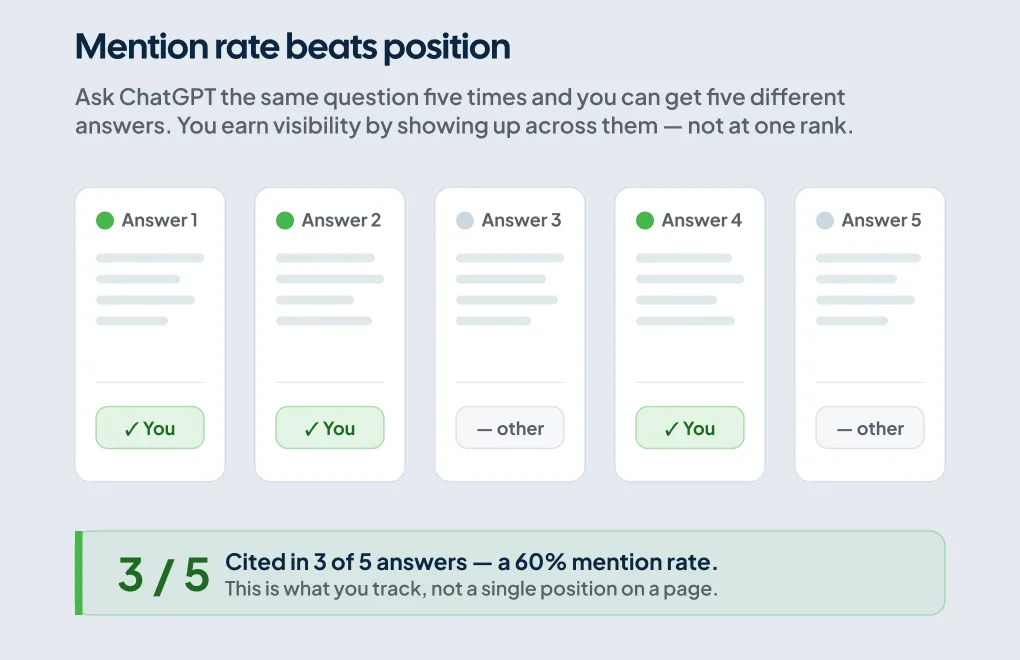
Mention rate matters more than position. Ask ChatGPT the same question five times and you can get five different answers. You win by showing up across the prompts your buyers use.
That changes how you measure yourself. You track how often ChatGPT names you for those questions, not where you land on a page.
How ChatGPT finds and cites your site
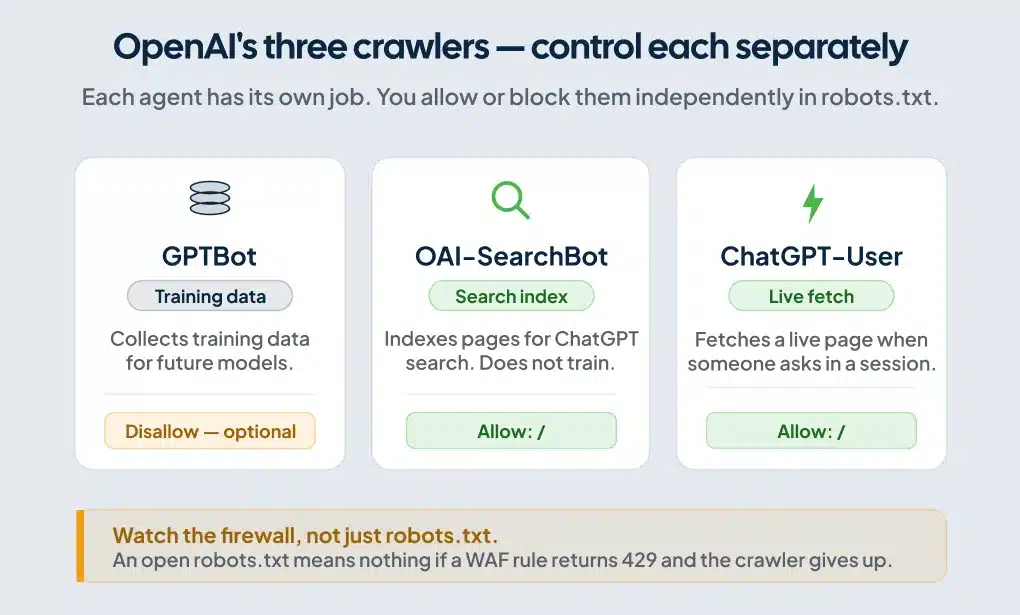
OpenAI uses three crawlers to reach the web, and each has its own job.
-
GPTBot collects training data for future models.
-
OAI-SearchBot indexes pages for ChatGPT search and does not train models.
-
ChatGPT-User fetches a live page when someone asks a question in a session.
You control each one on its own in robots.txt, and OpenAIdocuments how. Blocking GPTBot does not block ChatGPT search. That mix-up costs sites citations they assume they have earned.
You can allow every OpenAI agent in robots.txt and still stay invisible. Many sites block these crawlers at the firewall, where Cloudflare or AWS rules return 429 errors and the crawler gives up.
I ran into this on our own site. We checked crawler access first when we rebuilt our redirect and firewall rules. An open robots.txt means nothing if your firewall turns OpenAI away.
SEO teams flagged that firewall block as a common reason sites earned no ChatGPT citations through 2024 and 2025, even with a clean robots.txt. OurWebflow robots.txt guide walks through the correct setup.
Optimizing for Bing alone is not enough
ChatGPT search does not read Bing’s index and stop there. Its retrieval has moved past that, so optimizing only for Bing leaves citations on the table.
What makes ChatGPT recommend a brand
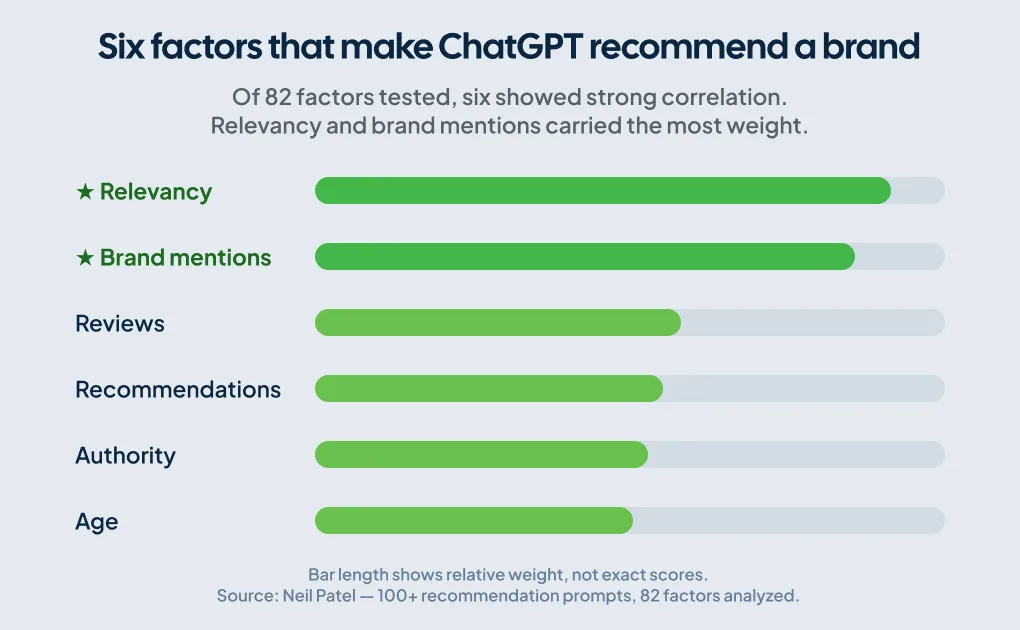
Neil Patel ran more than 100 recommendation prompts through ChatGPT and had an analyst study the patterns. His team tested 82 factors and found six with a strong correlation: brand mentions, reviews, relevancy, age, recommendations, and authority.
Relevancy and brand mentions carried the most weight. The more often trusted sites mention you near the words people search, the more often ChatGPT names you.
Reviews and outside validation feed the same signal. Ratings on sites like G2, Trustpilot, and the BBB tell the model that real people vouch for you.
The model still gets plenty wrong, which gives you room. In that analysis, about 27% of ChatGPT’s answers were off, sometimes naming companies that did not offer the service at all. Clear, verifiable content helps it get you right.
Structure decides whether you get pulled into an answer. Clean headings and short, direct answers make your page easy to lift. This is answer engine optimization at work, and I cover the foundations in ourwhat is AEO guide. Structured data helps too, which I break down in ourWebflow schema markup guide.
Why listicle repetition is beating thought leadership right now
Seer Interactive found that brute-force repetition is beating original thought leadership in ChatGPT. Wil Reynolds, who runs Seer, showed that agencies who rank themselves number one and cross-promote each other across third-party listicles get surfaced more often.
It works because the model reads frequent, consistent mentions as consensus. It also looks like the link schemes of 2005, and that kind of edge tends to age badly.
I would earn the mentions rather than stage them. Get cited where your buyers already look. Publish original data, and let the frequency build on something real. That approach survives the cleanups that catch shortcuts.
How to rank in ChatGPT, step by step
These are the steps I follow with clients, in order.
Step 1: Set a baseline with diagnostic prompts
Open ChatGPT and run the questions your buyers ask. Try “What is [your brand]?”, “Best [your category] for [use case]?”, and “Compare [you] versus [a competitor]?”
You will land in one of three spots. ChatGPT names you well, names you with errors, or leaves you out. Each result points to a different fix, from widening your coverage to correcting your entity data to building visibility from zero.
Step 2: Make sure ChatGPT can reach your site
Confirm OAI-SearchBot and ChatGPT-User are allowed in robots.txt. Decide on its own whether to allow GPTBot for training. A common setup looks like this:
User-agent: OAI-SearchBot Allow: /
User-agent: ChatGPT-User Allow: /
User-agent: GPTBot Disallow: /
That allows ChatGPT search and live fetches while keeping your content out of model training. Then check your firewall, not only robots.txt. Look for WAF rules or rate limits that hand OpenAI’s agents a 429, because that keeps many sites from being cited.
Step 3: Structure pages so the model can lift your answers
Write your H1 as the question people ask. Answer it in 40 to 60 words before you expand into detail.
Use question-style H2s, short paragraphs, and schema markup. That formatting lets the model parse your page and quote it without guessing.
Step 4: Earn off-site mentions and reviews
Get featured on the industry blogs, directories, and review platforms your buyers trust. Each mention near your category keywords strengthens the two factors that matter most.
Pursue real reviews on third-party sites, and use digital PR to grow your presence beyond your own pages.
Step 5: Build a knowledge base around your category
One page rarely earns steady citations. A cluster of related, useful pages does.
I learned this on our own site. We ranked ClearBrand for a competitive service term by publishing a strong listicle first. Then we built out a library of related Webflow and SEO topics behind it.
The cluster compounds, because it gives the model many places to find and trust us.
Step 6: Measure and re-check
You cannot track a single ChatGPT position, so track your mention rate. Re-run your prompt set on a schedule and log how often you appear.
Pair those manual checks with AI-visibility tools when you need to watch many prompts at once. I cover the ones worth using in ourAI SEO tools guide.
Common mistakes that keep you out of ChatGPT
-
Blocking the crawlers at your firewall while allowing them in robots.txt.
-
Optimizing only for Google and assuming ChatGPT will follow.
-
Publishing thin pages that name a topic without answering the question.
-
Staging fake authority through self-ranking listicles that will not hold.
-
Chasing AI visibility while your fundamentals stay broken, like slow pages and unclear content.
On speed, I want client pages loading in under three seconds, with a PageSpeed score of at least 75 to 80. AI visibility built on a slow, confusing site does not last.
Is ranking in ChatGPT worth it for you?
AI search is real and growing, but it makes up a fraction of total search. In our client work, AI drives roughly 5 to 10% of what Google brings in on clicks and customers. It earns a place in your plan, not the center of it.
ChatGPT visibility pays off when buyers in your category already ask AI for recommendations and you sell beyond one location. For a single-location local business, I would start with your Google Business Profile and reviews. The map pack still decides most local searches, and people rarely scroll past it.
The strongest setup treats ChatGPT visibility as an extension of solid SEO, not a swap for it. For a gut check on whether that fits you, ourright-fit guide lays out the questions I ask.
What this looks like in practice
We helped KleerCard, a fintech company, get discovered in Google’s AI Overviews and AI search for the terms their buyers use.
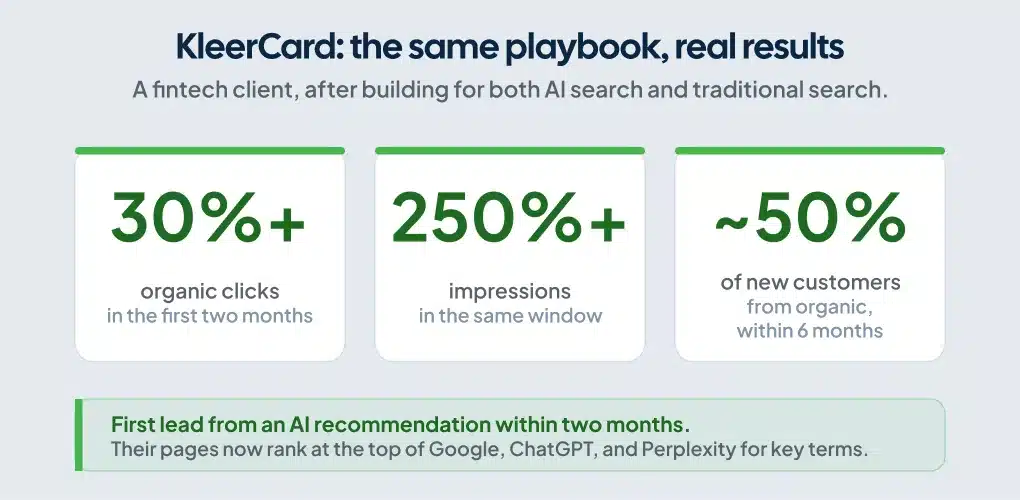
Within the first two months, organic clicks rose more than 30% and impressions rose more than 250%. They earned their first lead from an AI recommendation in that same window. Within about six months, organic search brought in close to half of their new customers.
Their pages now sit at the top of Google, ChatGPT, and Perplexity for key terms.
The build followed the same steps above. We made the site reachable, structured the pages for extraction, earned outside authority, and grew a cluster around the category.
You can read the fullKleerCard case study, with more in ourcase studies.
Frequently asked questions
How fast can you rank in ChatGPT?
Faster than Google in some cases, because ChatGPT search retrieves live pages instead of waiting for a training run. Your timeline depends on how reachable your site is, how cleanly it answers questions, and how many trusted sources mention you.
How do I rank number one in ChatGPT?
There is no number one in ChatGPT. It writes one answer and cites a few sources. Aim to be cited often across the prompts your buyers use, rather than holding a fixed position.
How is ranking in ChatGPT different from SEO?
The foundations overlap, but the target shifts. SEO earns a position on a results page, while ChatGPT visibility earns a citation inside a generated answer. That rewards extractable content and outside authority more than a single keyword rank.
How do you track ChatGPT rankings?
Track your mention rate, not a position. Run your target prompts on a schedule and record how often ChatGPT names you. Use AI-visibility tools when you want to monitor many prompts at scale.
Can you pay to rank in ChatGPT?
Not for the cited recommendations themselves. Those come from earned signals like mentions, reviews, and authority. OpenAI has begun testing ads in ChatGPT, and those paid placements stay separate from earned citations.
How do I do SEO for ChatGPT?
Make your site reachable to OpenAI’s crawlers, structure pages to answer questions directly, and earn mentions and reviews on trusted third-party sites. Then build a content cluster around your category and track how often ChatGPT cites you.
The takeaway
Ranking in ChatGPT rests on what you can control: a site it can reach and content it can trust. Get the access and authority right, and the citations build over time.
Treat it as a growing extension of good SEO, sized to where your buyers already search. That points your budget at real returns instead of a trend.
If you want a Webflow site built to get cited across AI search and traditional search, that is the work we do at ClearBrand. Book a call or grab afree resource to start on your own.
About the author
Alexander Toth is the Founder and CEO of ClearBrand, a Webflow web design, SEO, and AI search agency in Colorado Springs. He has been featured in a Wall Street Journal bestselling marketing book and works directly with the SaaS, fintech, and B2B clients referenced here.