
By Alexander, CEO of ClearBrand. Nine years working in SEO. Sharing what we see working for our clients.
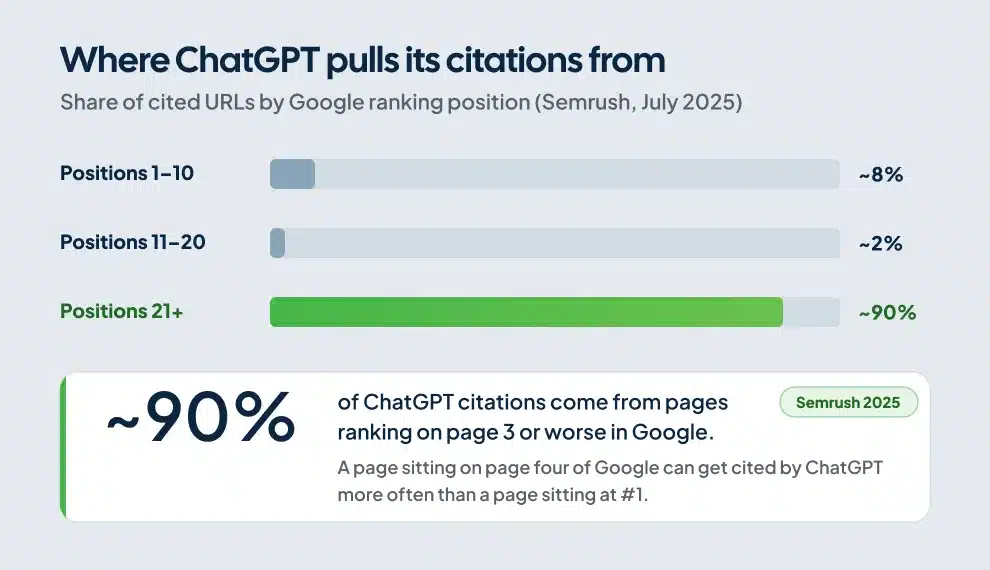
Almost 90% of ChatGPT citations come from pages ranking position 21 or worse in Google.
Semrush published that finding in July 2025 after studying AI search traffic across 500+ digital marketing topics. A page sitting on page four of Google can get cited by ChatGPT more often than a page sitting at #1.
The pattern is not identical across every LLM. The same Semrush study found some models favor pages in positions 1-5, and traditional rankings still help AI visibility. The bigger point holds: AI search pulls from a far wider pool than the first SERP. Ranking well on Google is no longer a prerequisite for being cited.
We see this play out at ClearBrand. Across our SaaS, fintech, and B2B clients, LLM referrers grow from 0% of new leads to 5% to 10%. That gain shows up in the first year of combined SEO and LLM SEO work.
Getting to those numbers starts with a working definition of LLM SEO that holds up across ChatGPT, Gemini, Perplexity, Claude, and Google’s AI Overviews.
What is LLM SEO?
LLM SEO is the practice of optimizing your content so large language models can find, understand, and cite it in their generated answers. It builds on traditional SEO foundations (crawlability, structure, authority). It adds a layer focused on how AI systems retrieve and surface information.
Traditional SEO targets a ranking position on a search results page. LLM SEO targets inclusion inside the answer itself.
A user asking ChatGPT “what is the best Webflow SEO checklist” does not see ten blue links. They see one paragraph, sometimes with citations, sometimes without. Your job is to be in that paragraph.
You will see this discipline called several things: LLMO (large language model optimization), GEO (generative engine optimization), AEO (answer engine optimization), AI SEO, or LEO. The acronyms compete for territory, but the underlying work is the same.
Why LLM SEO matters in 2026
ChatGPT processes around 2.5 billion prompts per day as of mid-2025, with about 330 million from US users. Weekly active users crossed 800 million by October 2025 and hit 900 million by February 2026.
Google still handles roughly 14 to 16 billion daily searches by most credible estimates. This is not a one-for-one substitution. The trajectory still matters.
The change shows up in business data. Vercel reports that ChatGPT refers about 10% of new signups, up from 1% six months prior. Tally said AI search became their biggest acquisition channel and helped them grow from $2M to $3M ARR in four months.
We see the same pattern in our own client data. ClearBrand client KleerCard, a fintech startup, now outranks several billion-dollar companies for target keywords in both Google and AI answers. The reason is not budget. We publish well-structured content at moderate-to-high volume consistently.
Traditional search is losing clicks fast. Ahrefs’ December 2025 study of 300,000 keywords found that AI Overviews now correlate with a 58% drop in CTR for the top organic result. That number was 34.5% in the April 2025 version of the same study. Ranking #1 in Google means losing more than half your clicks when an AI Overview is present.
To recover that lost visibility, you need to be inside the AI Overview, not under it. That changes what your content has to look like.
LLM SEO vs traditional SEO: what changes and what does not
SEO fundamentals still matter. Pages that cannot be crawled, indexed, and parsed will not be cited by any AI system. But several signals work differently when you optimize for AI citations instead of search rankings. Here is how the two disciplines compare side by side:
| Area | Traditional SEO | LLM SEO |
| Goal | Rank in search results | Get cited in generated answers |
| Primary signal | Backlinks and on-page relevance | Concept clarity, semantic depth, brand mentions |
| Query type | Short keyword phrases | Full natural-language questions |
| User outcome | Click to your page | Read the answer in the chat or SERP |
| Rendering | JS rendering supported | Most AI crawlers do not execute JavaScript |
| Measurement | Rank tracking, organic clicks | Citation tracking, share of voice in AI |
| Time-to-impact | Weeks to months | Days for retrieval, months for training |
LLMs are not deciding which page deserves rank #1. They are deciding which content best answers this specific question for this specific user. Clarity and extractability matter more than keyword stuffing or authority signals.
Before getting into how to write for that, it helps to understand the two ways models actually encounter your content in the first place.
How LLMs find your content
There are two pathways. Most LLM SEO articles cover the second one and ignore the first.
Training data. Foundation models are trained on huge web crawls (Common Crawl, web archives, licensed data). When your brand appears across the open web on Reddit, GitHub, forums, and articles, the model is more likely to know you. That recognition carries through even when the model is not searching the live web.
Model retraining happens on multi-month cycles. Changes compound slowly.
Live retrieval. When a user asks a question, modern AI systems often run a real-time search to pull current sources. ChatGPT and Copilot lean on Bing, Google’s Gemini and AI Overviews use Google’s index, Claude might be using Brave Search (difficult to confirm), and Perplexity uses its own crawl plus partners.
The process is called retrieval-augmented generation (RAG). The system runs a search, pulls a handful of pages, extracts what it needs, writes the answer.
Effective LLM SEO targets both. When you only optimize for retrieval, you miss the answers where AI does not search. When you only chase mentions, you miss the live citations that drive measurable referral traffic today.
What LLMs reward (and what they ignore)
Three findings from independent research worth knowing.
Lower-ranking pages get cited often, especially in ChatGPT. Semrush’s July 2025 analysis found ChatGPT cites pages ranking position 21 or worse about 90% of the time. Perplexity and Google’s AI Overviews favor higher-ranking pages, so traditional ranking is not irrelevant.
ChatGPT and several other models pull from a much wider pool than the first SERP. Ahrefs corroborated the pattern in August 2025: only 12% of URLs cited by ChatGPT, Perplexity, and Copilot rank in Google’s top 10.
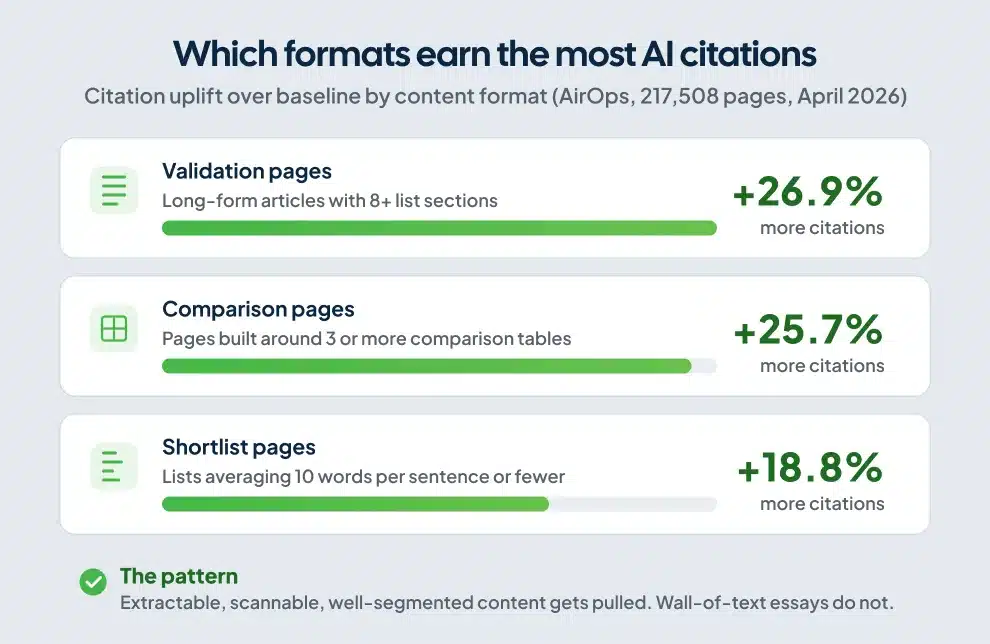
Structure beats length. AirOps analyzed 217,508 retrieved pages across 7,500 commercial prompts in April 2026 and found three formats reliably outperform:
- Comparison pages with 3 tables earn 25.7% more citations
- Validation pages with 8 list sections earn up to 26.9% more citations
- Shortlist pages averaging 10 words per sentence or fewer earn 18.8% more citations
Across all three, the pattern points the same direction. Extractable, scannable, well-segmented content gets pulled. Wall-of-text essays do not.
Schema is overrated for AI citations. Ahrefs tracked 1,885 pages adding JSON-LD schema between August 2025 and March 2026 and found no meaningful uplift in citations. FAQ schema has been deprioritized by Google itself since 2023. Schema still helps with traditional SEO and entity clarity, but treating it as the unlock for AI citations is misallocated effort.
What to optimize: clarity, structure, extractability, original information density. Not authority, not link count, not schema theatrics.
That research lines up with what we see working for clients. Applying it is its own discipline, with a few principles we hold to before any specific tactic.
How we do LLM SEO at ClearBrand
Our internal motto is “ClearBrand delivers.” For LLM SEO that means a small set of principles we apply to every client engagement. We take correct actions with consistency. We treat AI as an accelerant, not a magic wand, and write what readers want to read in formats LLMs can extract.
The work also asks us to keep learning as the field shifts and to stay focused on revenue rather than vanity citation counts. No single tactic carries the result. The result comes from doing all of it together, repeatedly, for long enough to compound.
The nine tactics below are how we put those principles to work.
1. Lead with extractable answers
Write the answer first, then add context. The first 2-3 sentences of any major section should fully answer the question in the heading. AI systems pull these snippets directly. When your answer is buried under preamble or hedged across paragraphs, the model will pull from a cleaner source.
For an H2 like “How long does Webflow SEO take,” skip the generic lead-in. The next sentence should be: “Most Webflow sites see meaningful organic traffic gains within 90 to 180 days, depending on domain authority and competitive density.”
2. Own a concept, do not just cover a topic
LLMs surface the clearest, most definitive explanation of a concept. When your article is the 47th “ultimate guide” and adds nothing new, the model has no reason to pick you.
Pick concepts where you can be the source. Original frameworks, original data from your own work, edge cases competitors do not cover, contrarian takes backed by evidence. Ask whether a competitor could replicate this article tomorrow. When the answer is yes, dig deeper.
3. Publish high-quality content, consistently
LLMs reward freshness and depth across a topic cluster. You have to get good content out there, not get stuck in “analysis paralysis.” One excellent post per quarter loses to one good post per week.
Content can’t be AI slop. It has to be high quality and hit EEAT signals. But it also needs to get published. We’ve identified the line where an article is “good enough” and have found that you need to be above the line, but going well above it doesn’t help. Once you’re above it, post the article.
For our SaaS client engagements, we publish a minimum of 3 articles/pages per week.
In our experience, this consistency drives the biggest difference in getting traffic and leads. KleerCard outranks much larger competitors because they ship high-quality content week after week, not because they have more authority.
4. Build for both retrieval and training
For retrieval (short-term wins), publish clean, indexable pages that match how people ask AI questions. Long-tail, full-sentence queries. Comparison and listicle formats. Pages that load fast and serve static HTML.
For training (long-term moat), seed your brand across the channels models learn from: Reddit, Hacker News, GitHub, LinkedIn, Stack Overflow, podcast transcripts, niche communities. Organic mentions in these places train the model to associate your name with your concept. That work is why digital PR has become useful again.
5. Optimize for Bing as much as Google
ChatGPT’s web search uses Bing’s index. Copilot uses Bing. Meta AI uses Bing.
When you are not in Bing Webmaster Tools and have not confirmed indexability there, you are leaving a chunk of AI visibility on the table.
6. Use structured formats AI systems can lift
Based on the AirOps citation patterns, the formats that work hardest:
- Comparison tables with 3 rows of features
- Numbered step lists for how-to content
- Definition blocks at the top of explainer pages
- FAQs at the bottom mirroring the exact phrasing of real user questions
- Short, declarative sentences in summary sections
Treat tables and lists as extraction targets, not aesthetic choices.
7. Match the way people ask AI questions
Search queries are clipped: “webflow seo cost.” AI queries are conversational: “how much does it cost to hire a Webflow SEO agency for a SaaS site.”
Your content needs to include the full conversational phrasing somewhere. Use it as an H3 question or inside the body. People Also Ask data in Google is a good starting point.
8. Use server-side rendering, not client-side JS
Most AI crawlers fetch HTML but do not execute JavaScript. When your content is rendered client-side, the crawler sees an empty shell. Webflow sites avoid this problem because Webflow serves static HTML by default, which is part of why Webflow is good for SEO. For React or Next.js sites that rely on client-side rendering, switch to SSR, SSG, or ISR for content pages.
9. Set a refresh cadence
LLMs prioritize recent, accurate content. Stale pages lose their place in retrieval over time even when they were once cited heavily. Build a 30/90/180 day review cycle. Update statistics, refresh examples, fix broken links, revise outdated claims.
How to measure LLM SEO
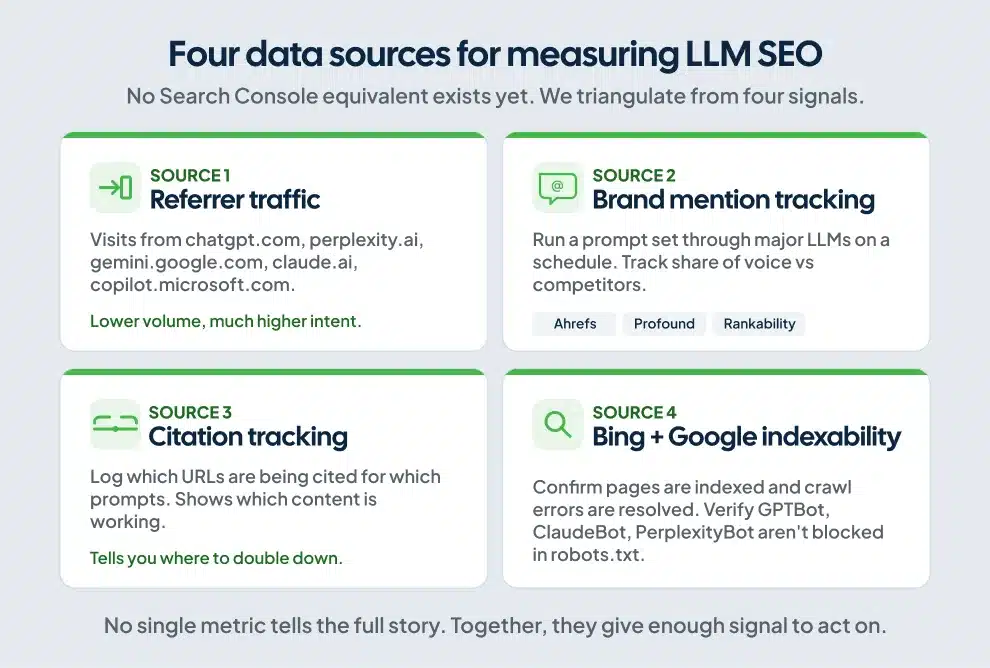
No Google Search Console equivalent exists for AI search yet. The patchwork works. We pull from four sources.
Referrer traffic. Track visits in your analytics from chatgpt.com, chat.openai.com, perplexity.ai, gemini.google.com, claude.ai, and copilot.microsoft.com. These are direct measures of users arriving from AI answers. Lower absolute volume than search clicks, much higher intent.
Brand mention monitoring in AI. Run a prompt set through ChatGPT, Gemini, Perplexity, and Claude on a schedule, tracking when your brand appears. Tools like Ahrefs Brand Radar, Profound, AthenaHQ, and Semrush AIO automate this. Track share of voice against named competitors for the queries that matter to your business.
Citation tracking. Some AI tools show inline citations. Log which of your URLs are getting cited for which prompts. That data tells you which content is doing the work.
We use Rankability for brand mention monitoring and citation tracking.
Bing and Google indexability. Use Bing Webmaster Tools and Google Search Console to confirm pages are indexed and crawl errors are resolved. Make sure robots.txt is not blocking AI crawlers (GPTBot, PerplexityBot, ClaudeBot) unless that is a deliberate choice. For Webflow sites, here’s how to manage your Webflow sitemap for better indexing.
No single metric tells the full story. Together, these four give you enough signal to know what content is working and where to invest more.
Common mistakes to avoid
- Treating LLM SEO as separate from SEO. It is not. When your traditional SEO foundation is broken, your LLM SEO will not work either. Many of the common SEO mistakes tank LLM visibility too.
- Publishing inconsistently. Two great posts a month loses to four good posts a week. Topical density compounds. Plan for at least six months of steady publishing before evaluating results.
- Over-investing in schema for AI citations. Schema helps with traditional SEO and entity clarity. It does not move the needle on AI citations.
- Blocking AI crawlers reflexively. Some sites block GPTBot to “protect content.” That also blocks you from being cited.
- Using AI as a magic wand. Generating 50 AI-only posts a month does not work. Citation rates do not move. Human-authored, human-edited, AI-accelerated content does.
- Chasing every new tactic. People are freaking out about every new AI thing. Don’t be that person. Here’s an example: llms.txt has limited adoption. Add it when easy. Do not reorganize your whole strategy around it.
Frequently asked questions
What is LLM in SEO?
LLM stands for large language model, the type of AI system behind ChatGPT, Gemini, Claude, and Perplexity. In an SEO context, LLM refers to optimizing content so these systems will understand, trust, and cite it in their generated answers. The goal shifts from ranking high in search results to being included in AI-generated responses.
What is the difference between traditional SEO and LLM SEO?
Traditional SEO optimizes for ranking on search engine results pages. LLM SEO optimizes for being cited inside AI-generated answers. The foundational work overlaps heavily: crawlable pages, clear structure, quality content.
Three things change. Measurement shifts from ranks to citations. Format priorities shift from keyword-targeted pages to extractable snippets and tables. And the place you build authority shifts from primarily backlinks to community mentions and brand presence.
For a deeper breakdown of how modern SEO works, see our full guide.
Is LLM SEO the same as GEO and AEO?
Yes, in practice. GEO (generative engine optimization), AEO (answer engine optimization), and LLM SEO all describe optimizing for AI-generated answers. The acronyms emerged from different communities and emphasize slightly different angles.
The tactics are nearly identical. LLMO (large language model optimization) is sometimes used as a broader umbrella covering both search-connected and non-search AI contexts. We break down the differences in our SEO vs AEO vs GEO comparison.
How long does LLM SEO take to show results?
Early retrieval wins show in 30-60 days. Meaningful pipeline contribution from AI referrers takes 6-12 months.
Retrieval-side changes (publishing extractable content, fixing indexability, adding structured formats) can show up in citations within days to a few weeks. Training-side changes (brand mentions, community presence, authority building) compound over months and tie to model retraining cycles. In our engagements, clients that hit the 6-12 month mark with steady publishing see AI referrers contributing 5-10% of new leads.
Will SEO be replaced by LLM SEO?
No. They are converging, not replacing. Traditional search still drives most organic traffic for most sites. AI search is growing fast but represents a meaningful minority of total search activity today. The teams winning are doing both.
Do AI Overviews count as LLM SEO?
Yes. Google’s AI Overviews are generated by Google’s LLMs (the Gemini family). Optimizing for AI Overview inclusion uses the same tactics as optimizing for ChatGPT or Perplexity citations: extractable answers, clear structure, authoritative source signals.
AI Overview inclusion correlates strongly with already ranking in the top 10 traditional results. That is the opposite of ChatGPT’s pattern.
Can a small site really get cited over a big one?
Yes, and we have seen this firsthand with KleerCard. The fintech startup now outranks several billion-dollar companies for target keywords in both Google and AI answers. The Semrush data showing 90% of ChatGPT citations come from pages ranking 21+ explains why this is possible. Domain authority matters less than clarity, structure, and consistency.
What to do next
The brands winning at LLM SEO right now are not the ones with the biggest budgets. They have figured out that AI search rewards different content than traditional search does.
They publish original work week after week, structure it for extraction, and show up in the communities models learn from. Their measurement runs on citations as much as clicks.
Most competitors are still treating LLM SEO as a future problem. The Semrush 90% finding gets the headlines, but the broader point is simpler. AI search is not won by domain authority alone, and the reward goes to the clearest, most useful answer to a specific question.
Smaller sites can win it. Newer sites can win it. The fundamentals are in your control.
If you want help auditing your site for AI visibility, or building a content strategy that earns citations, we do that work at ClearBrand.